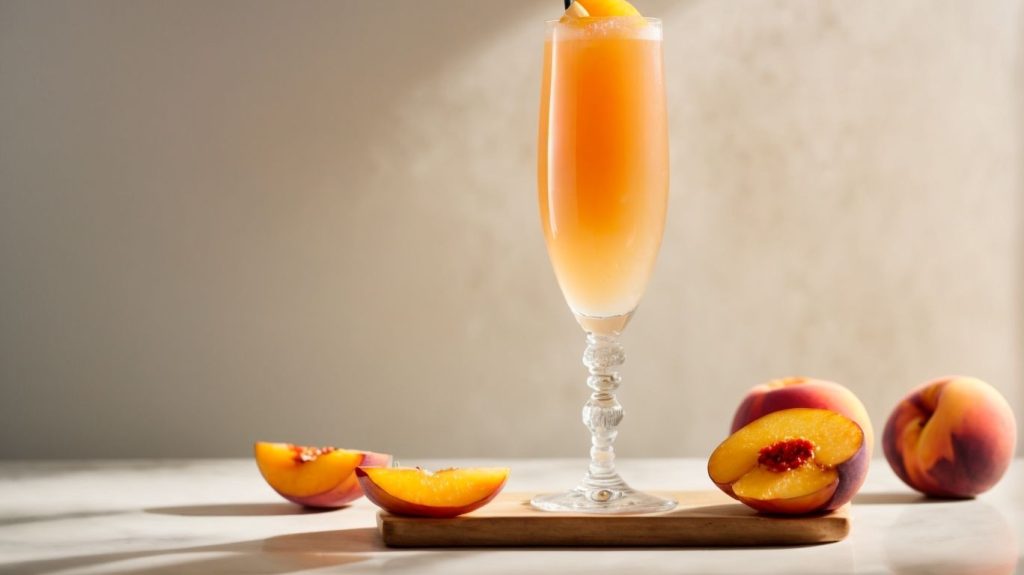

Grilled Peaches and Cream Mimosa

Ingredients
- 4 Medium Peaches
- 1 cup Heavy Cream
- 2 Tbsp Honey
- 2 Tsp Ground Cinnamon
- 750 ml Champagne

Instructions
- Grill the Peaches: Preheat your grill to medium-high heat. Cut the peaches in half, remove the pits, and lightly brush with olive oil. Grill cut-side down for 3-4 minutes until char marks appear, then flip and grill for an additional 2-3 minutes until tender. Let cool slightly.
- Blend: Slice the grilled peaches and place them in a blender. Add a splash of heavy cream (about 1/4 cup), the honey, and a squeeze of fresh lemon juice (optional, about 1 tablespoon) to the blender. Blend until smooth and creamy.4 Medium Peaches, 1 cup Heavy Cream, 2 Tbsp Honey
- Assemble the Mimosas: Fill serving glasses halfway with the grilled peach mixture. Slowly pour chilled champagne over the peach puree until the glass is filled, gently stirring to combine.750 ml Champagne, 2 Tsp Ground Cinnamon
- Garnish: Garnish each glass with a sprig of mint or a slice of grilled peach for a touch of elegance.
Notes
Nutrition
The classic mimosa is a brunch institution — sparkling wine, citrus juice, done. It works because it works. But if you have a grill running and a flat of peak-season peaches on the counter, you are leaving serious flavor on the table. Grilling stone fruit at 450–500°F triggers two simultaneous reactions — Maillard browning on the cut face and accelerated sugar caramelization as the fruit’s 10–12 Brix sucrose load concentrates under direct radiant heat — and the result is a depth of flavor no raw peach purée can touch. Float that smoke-kissed purée under a pour of chilled champagne, lace it with honey and cold heavy cream, and you have a cocktail that earns its place at any serious brunch table.
This is not a “fancy garnish on a basic drink” situation. The grilling step is load-bearing. It restructures the peach’s pectin matrix, softens the fruit to blade-ready tenderness in under six minutes, and deposits a thin layer of volatile aromatic compounds that would not exist otherwise. The cream and honey are not decoration — they are fat-soluble aromatic carriers and acid buffers, respectively. Every ingredient is doing chemistry. Here is what is actually happening in the glass.
Why does grilling a peach make a better mimosa? The science
Grilling a peach half at medium-high heat generates volatile aromatic compounds that are chemically impossible to produce in raw fruit. When a peach half hits a clean, oiled grate at roughly 450°F surface temperature, the cut face loses free surface moisture within the first ninety seconds and the sugars begin dry-caramelizing above 320°F. Simultaneously, the amino acids in the fruit’s flesh undergo Maillard condensation with those reducing sugars, generating a family of furanones, maltol, and low-molecular-weight aldehydes — the same compound classes responsible for caramel and toasted-bread aromas. Peaches are especially responsive to this treatment because their high fructose-to-glucose ratio means fructose (which caramelizes at a lower threshold than glucose) begins browning almost immediately on contact with the hot iron. The result is a measurable increase in gamma-decalactone and benzaldehyde concentration relative to raw fruit — the “peachy” and faintly almond-like top notes that make this purée distinctive.
The heavy cream in the blender is doing more than adding richness. Cream at roughly 36% milkfat acts as a fat-soluble volatile carrier. The lactone and ester aromatics from the grilled peach partition preferentially into the fat phase, slowing their evaporation rate and extending the aromatic residence time in the glass — a phenomenon governed by each compound’s octanol-water partition coefficient (log Kow). Higher log Kow aromatics, like gamma-decalactone, migrate toward fat rather than the aqueous or CO₂-vapor phase, meaning the cream is literally holding the most complex flavor compounds in place while you drink. The honey (primarily fructose and glucose, with trace organic acids at pH ~3.9) buffers the lemon juice’s tartaric and citric acid load, landing the purée at a working pH around 3.4–3.6 — acidic enough to stay bright and fruit-forward without turning harsh against champagne’s own acidity.
Champagne introduces roughly 5–7 g/L of dissolved CO₂ at serving temperature (ideally 38–42°F). When you pour the chilled wine over the denser peach-cream purée, convective currents carry bubbles upward through the fruit layer, nucleating on the suspended solids and carrying volatile aromatics — including cinnamon’s primary compound, cinnamaldehyde, and the lighter peach esters — toward the headspace. This is why the pour order is not arbitrary: purée first, champagne second, so the CO₂ does the work of integrating the two layers visually and aromatically over the first thirty seconds in the glass. Pouring in reverse flattens the effervescence prematurely and mutes the aromatic bloom.
What equipment and ingredients do I need?
A high-powered blender (Vitamix-class, 1380W+) produces a smoother purée than a standard countertop unit because it can fully disrupt the pectin-reinforced cell walls. If you are working with a lower-wattage blender, strain the purée through a fine-mesh sieve after blending — this removes fibrous skin fragments that will otherwise create a gritty mouthfeel and cause early bubble nucleation that flattens your champagne faster than intended.
Champagne selection matters here. A brut or extra-brut (0–12 g/L residual sugar) is the correct call — the purée brings its own sweetness at roughly 8–10 Brix after grilling and honey addition, and a demi-sec would push the final cocktail past 18–20 Brix total, which reads as cloying. A non-vintage Champagne or a quality domestic sparkling wine (Gruet, Schramsberg, Iron Horse) in the $18–30 range is entirely appropriate; save the prestige cuvée for sipping unadorned. Chill the bottle to 38°F before service — CO₂ solubility increases at lower temperatures, and a properly cold bottle retains carbonation through the entire pour sequence.
Peach selection: use freestone peaches at peak ripeness (Brix 11–13, slight give at the shoulders under thumb pressure). Clingstone peaches are harder to halve cleanly and will fight you at the pit. Avoid refrigerator-cold fruit — pulling peaches straight from cold storage suppresses the volatile release during grilling. Room-temperature peaches (65–70°F) entering a hot grate brown faster and more evenly. If peaches are out of season, nectarines substitute directly at a 1:1 ratio with virtually identical chemistry.
Grilled Peaches and Cream Mimosa
Ingredients
- 4 Medium Peaches
- 1 cup Heavy Cream
- 2 Tbsp Honey
- 2 Tsp Ground Cinnamon
- 750 ml Champagne
Instructions
- Grill the Peaches: Preheat your grill to medium-high heat. Cut the peaches in half, remove the pits, and lightly brush with olive oil. Grill cut-side down for 3-4 minutes until char marks appear, then flip and grill for an additional 2-3 minutes until tender. Let cool slightly.
- Blend: Slice the grilled peaches and place them in a blender. Add a splash of heavy cream (about 1/4 cup), the honey, and a squeeze of fresh lemon juice (optional, about 1 tablespoon) to the blender. Blend until smooth and creamy.4 Medium Peaches, 1 cup Heavy Cream, 2 Tbsp Honey
- Assemble the Mimosas: Fill serving glasses halfway with the grilled peach mixture. Slowly pour chilled champagne over the peach puree until the glass is filled, gently stirring to combine.750 ml Champagne, 2 Tsp Ground Cinnamon
- Garnish: Garnish each glass with a sprig of mint or a slice of grilled peach for a touch of elegance.
Notes
Nutrition
How do I nail it every time? Tips for a flawless pour
- Oil the grate, not just the peach. Brushing oil on the cut face helps, but a poorly cleaned or dry grate will tear the caramelized crust on contact. Use a folded paper towel dipped in neutral oil to wipe the grate immediately before the peaches go on.
- Do not rush the grill marks. The peaches need 4–5 minutes undisturbed on the cut face. Lifting them early pulls the crust away and you lose the Maillard layer that carries most of the complex flavor. They release cleanly when the crust has fully set.
- Chill the purée before assembling. A warm purée will shock the champagne and trigger rapid CO₂ release. After blending, refrigerate the purée for at least 20–30 minutes (or a brief 10-minute freezer rest) before service. Target purée temperature: 40–45°F.
- Add the cream in stages during blending. Starting with only 1/4 cup prevents over-emulsification that can make the purée too thick for the champagne to penetrate on the pour. Adjust consistency after the first blend pass.
- Pour champagne slowly down the inside of a tilted glass. The same technique used for beer pours applies here — minimizing turbulence on entry preserves dissolved CO₂ and keeps the layers visually defined long enough to photograph and serve.
- Batch the purée, not the cocktail. The purée holds refrigerated for up to 24 hours. Do not pre-mix with champagne — carbonation loss is essentially irreversible once the bottle is open and combined.
What variations can I make to this grilled peach mimosa?
Smoked peach version. For a more assertive smoke character, add a single wood chunk (applewood or cherry) to the coals and close the grill lid during the peach grilling step. The closed-lid environment increases phenol adsorption — specifically guaiacol and syringol — onto the fruit’s surface moisture. Even 3–4 minutes of indirect smoke contact at 400°F is enough to push those volatile phenols into detectable range without overwhelming the fruit. The result pairs especially well with a rosé sparkling wine, whose red-fruit esters complement rather than compete with the smoke layer.
Spiced brown butter whip instead of heavy cream. Brown butter (beurre noisette) at the point where the milk solids hit 320°F generates 2-acetylpyrazine and diacetyl — nutty, buttery volatile compounds that reinforce the Maillard notes from the grilled peach. Cool the brown butter to room temperature, then whisk vigorously with equal-weight heavy cream to emulsify before using in place of straight cream. This adds structural complexity to the fat phase and produces a noticeably deeper mid-palate.
Non-alcoholic version. Swap the 750 ml champagne for a quality non-alcoholic sparkling wine or a 50/50 blend of chilled sparkling water and white grape juice (filtered, not from concentrate). The CO₂ mechanics are identical; carbonation level will be slightly higher in sparkling water, so pour even more slowly. The honey and lemon juice remain essential — without the ethanol to carry lipophilic aromatics, the acid-sweet balance does the structural work alone.
Frozen mimosa slushie. Blend the peach purée with one tray of ice (approximately 10–12 standard cubes) and reduce the cream to 2 tablespoons to prevent the fat from muting the carbonation entirely. Spoon the slushie into glasses and pour champagne over the top as a float. The slushed purée acts as a built-in chilling agent and extends drinking time in high-heat outdoor environments — the ice melt dilution is roughly calibrated to compensate for the champagne’s added volume, keeping overall ABV in the 4–6% range as the drink progresses.
Frequently asked questions
Can I use canned or frozen peaches instead of fresh? You can, but the chemistry changes significantly. Canned peaches have already undergone thermal processing that breaks down pectin and drives off most of the volatile esters — there is very little left for the grill to work with. If using frozen, thaw completely, pat dry, and grill on a very hot, clean grate. You will get some Maillard activity on the surface moisture, but the depth of flavor will be noticeably flatter than peak-season fresh fruit. Adjust honey upward by 1–2 teaspoons to compensate for the lower residual sugar.
Why does my champagne go flat almost immediately after pouring? Three likely culprits: purée is too warm (above 50°F) causing thermal shock CO₂ release; there is residual soap film on the glasses (detergent surfactants are aggressive nucleation sites — rinse champagne flutes with hot water only, no soap, then air dry); or the purée is too thick, creating so many suspended-solid nucleation points that CO₂ escapes in a rush rather than a slow, persistent bead. Strain the purée and chill it properly before service.
How far ahead can I prep this cocktail for a party? The grilled peach purée can be made up to 24 hours in advance and stored in an airtight container in the refrigerator. Blend it, strain it if needed, and keep it cold. Do not add the champagne until the moment of service — CO₂ loss in a pre-mixed batch is roughly 30–40% within the first hour at refrigerator temperature. Grilling the peaches the day before is actually beneficial: overnight cold rest allows the volatile aromatics to redistribute evenly through the purée, softening any harsh high-heat off-notes from the grill.