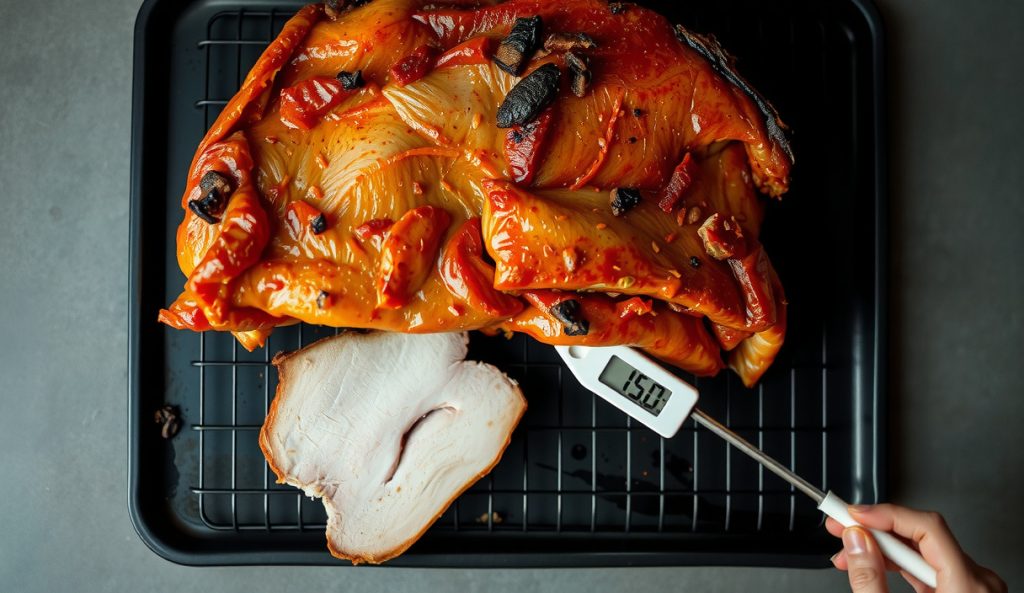
Cold-smoked cured bacon is traditionally a raw product that requires pan cooking at the point of service. This variation adds a hot-smoke finishing stage that brings the belly slab to a safe internal temperature inside the smoker, producing a fully cooked, ready-to-eat product. The practical payoff is a bacon you can slice thin and eat without a pan, shave directly over eggs, or layer into a cold sandwich with zero further preparation. The tradeoff is a textural shift that is worth understanding before committing to this method.
What changes when you add the hot-smoke finish?
After the cold-smoke session concludes — with the smoker maintained below 30°C (86°F) throughout — raise the smoker temperature to 200–225°F and continue until the belly reaches an internal temperature of 150°F at its thickest point. At 150°F, myosin and actin proteins have fully denatured and set, and a significant portion of the intramuscular fat has rendered out of the tissue into the surrounding structure.
This partial fat render is irreversible: the finished slab will be firmer, less jiggly, and will not produce the same volume of rendered fat in a pan that raw-cured bacon does. Collagen in the skin and connective tissue begins converting to gelatin above approximately 160°F, so the 150°F finish temperature preserves some structural integrity in the rind while still meeting food safety targets.
Label this product clearly in your refrigerator or vacuum bags. Because the bacon is now a fully cooked product, its refrigerated shelf life differs from a raw-cured slab — treat it as you would a cooked deli meat rather than raw cured bacon. The two-stage cold-smoke/hot-cook model is collapsed into a single smoker session, which is a meaningful change to both the workflow and the product’s identity.
What stays the same as the base recipe?
The Prague Powder No. 1 cure chemistry, the pellicle formation requirement, the initial cold-smoke duration and wood choice, and the cure duration all remain unchanged from the base method. The nitrite-based color development and flavor foundation established during the cure and cold-smoke stages carry fully into the hot-smoked finish, so the smoke character and cured flavor profile are preserved.
When is the hot-smoke finish the better choice?
This variation is the better choice when a ready-to-eat product is the priority — camping, travel, or any situation where a pan and rendered fat are impractical. It is also well-suited for thin-shaved applications over fried eggs, in composed salads, or as a charcuterie component, where the texture of a partially rendered, fully set slab is actually preferable to a pliable raw rasher.
Use the full cure method, pellicle guidance, and cold-smoke protocol from the original Cold-Smoked Cured Bacon — Home-Cured, then apply this finishing stage directly after the cold-smoke session without removing the slab from the smoker.