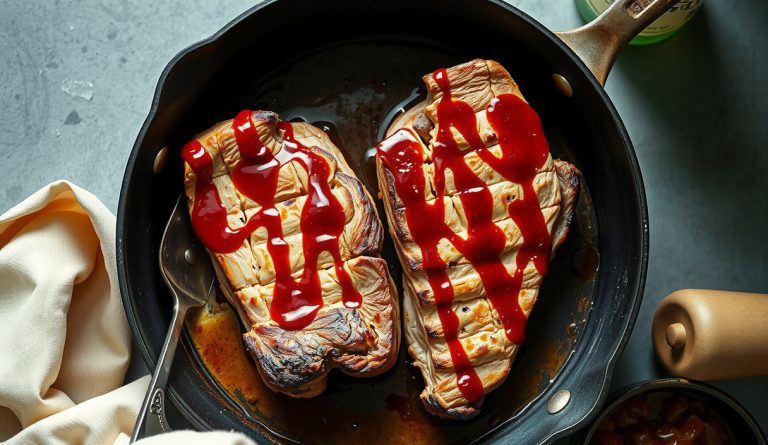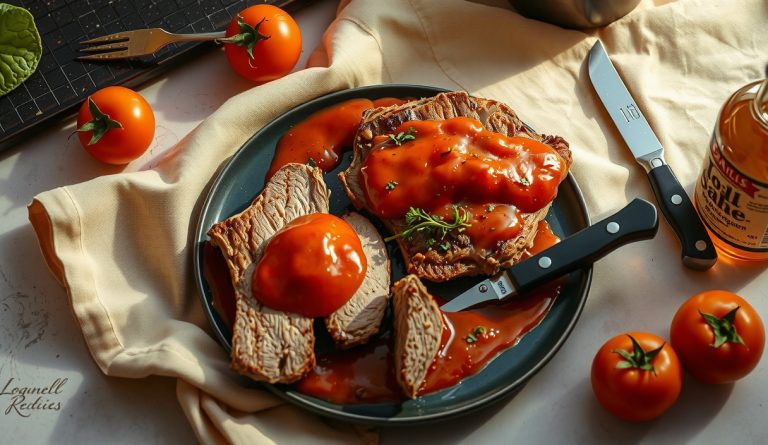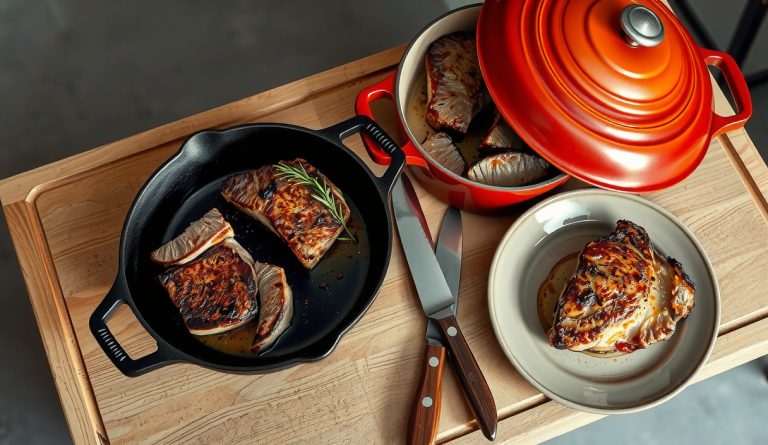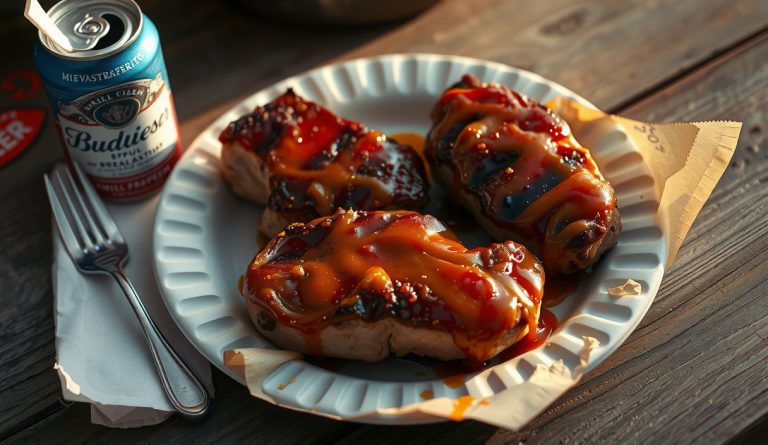
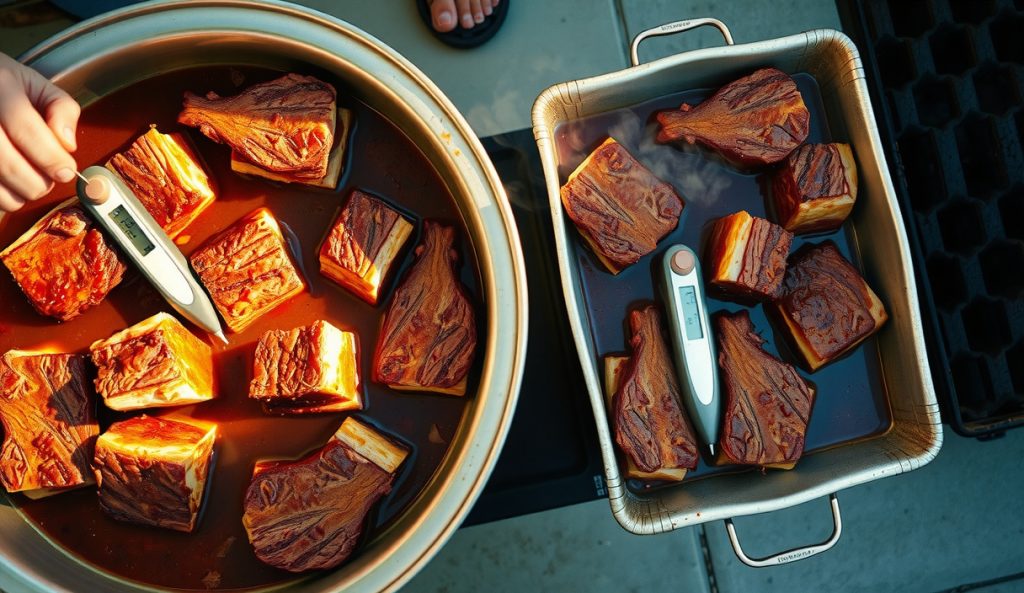
Pork steaks are a natural choice for large gatherings — they are inexpensive per pound, they braise in their own liquid without requiring individual attention, and they hold well once done. Scaling from 4 steaks to 12 or 16 is straightforward, but thermal mass introduces a timing variable that catches cooks off guard the first time they run a full pan.
What changes when you scale pork steaks for a crowd?
Stack the pork steaks in full-size steam-table pans — deep hotel pans work best because the extra vertical clearance improves steam circulation — with braising liquid scaled proportionally. The recipe scales linearly: double the steaks, double the beer and sauce. The pan geometry keeps the liquid-to-meat ratio consistent regardless of batch size.
Add 20 to 25 minutes to the covered braise time when cooking more than 8 steaks in a single pan. A larger thermal mass — more meat, more liquid, more metal — absorbs more heat energy before the braising liquid reaches a rolling simmer. Heat transfer from the grill or oven reaches the pan edges faster than the center, so the center steaks in a densely packed layer will lag the perimeter steaks by a meaningful margin. The fix is time, not higher temperature: raising the heat to compensate risks drying the outer steaks before the inner ones finish.
Always verify doneness with an instant-read thermometer placed in the center steaks of each pan. Target 195°F in those center steaks specifically — if the center reads 195°F, the perimeter steaks will be at or above that threshold and fully collagen-converted. Do not pull the pan based on edge-steak readings alone.
What stays the same no matter how many steaks you cook?
The 195°F collagen-conversion target, the two-zone fire or oven temperature, the glaze phase sequence, and the rub formula all remain identical at any batch size. Scaling changes volume and timing only — the underlying chemistry of collagen breakdown does not shift with the number of steaks in the pan.
When is the large-batch approach the better choice?
Use this approach for backyard parties of 12 or more, church cookouts, catering setups, or any event where the canonical 4-steak batch would require multiple sequential cooks. Steam-table pans travel well and hold temperature in a cooler or warming cabinet for up to 45 minutes after pulling — useful when timing service around guests arriving at different intervals.
Use the full rub, braising liquid formula, and fire management instructions from the original St. Louis Pork Steaks.