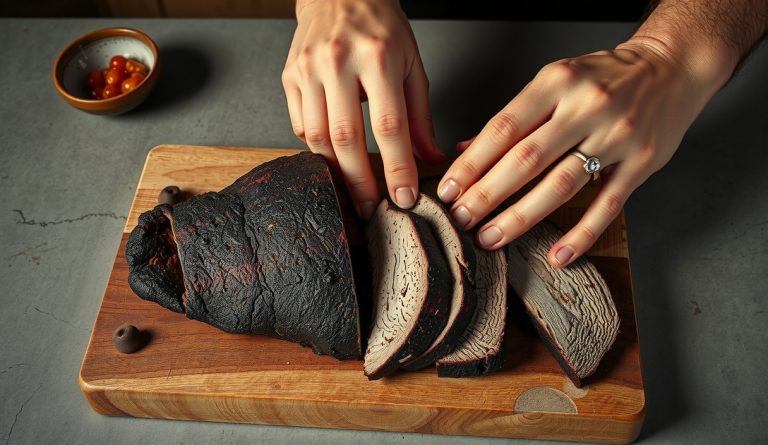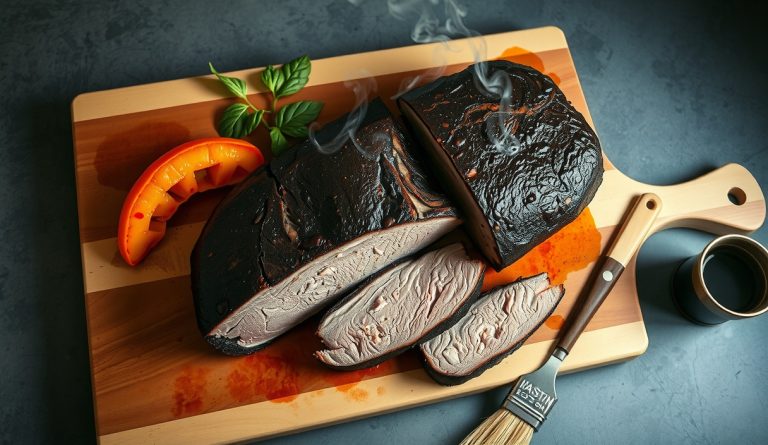
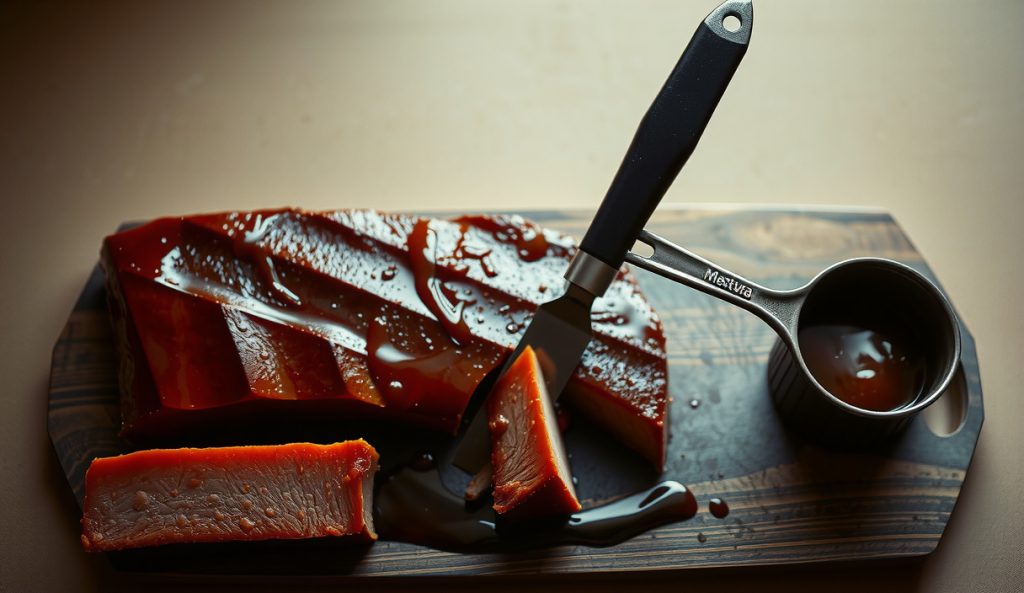
Kansas City barbecue is defined as much by its glaze as by its smoke. The style prizes a dark, sticky, almost candy-like bark that clings to the protein and reflects light like lacquer. Applied to a seitan brisket slab, this approach produces a surface character that reads unmistakably as KC-style — caramelized, sweet-acidic, and deeply colored — while the interior pink from betacyanin remains untouched beneath the crust.
What changes in the Kansas City glaze variation?
In the final 20 minutes of the smoke, the seitan brisket surface is brushed with a tomato-molasses-apple cider vinegar glaze that has been reduced to roughly half its original volume. Reduction is not optional — it is mechanically essential. A thin, watery glaze introduces surface moisture that suppresses the Maillard and caramelization reactions responsible for bark formation, effectively steaming the exterior rather than firming it.
Reducing the glaze concentrates soluble solids — primarily sucrose, fructose, and organic acids — raising viscosity so the glaze adheres rather than runs. Sucrose begins caramelizing at approximately 160°C (320°F). At smoker temperatures of 225–250°F, the glaze relies on the brief surface-temperature spike near the heat source and the convective flow of hot smoke to push the outermost layer past that threshold across the 20-minute window. Apply in two light coats rather than one heavy application to build successive layers of color and structure.
The betacyanin pigment responsible for the interior pink is partially masked at the surface by the deep mahogany of the reduced glaze, but a clean cross-section slice will reveal the intact pink interior beneath — confirming the protein structure is unaltered by the glazing step.
What stays the same as the base seitan brisket recipe?
The full seitan preparation, lamination technique, rub application, and primary smoke duration remain unchanged from the canonical recipe. The Kansas City glaze is an additive final step — it does not alter the protein structure, total cook time, or slicing approach. All timing, temperature, and wood-selection guidance from the base recipe applies in full.
When is the Kansas City glaze variation the better choice?
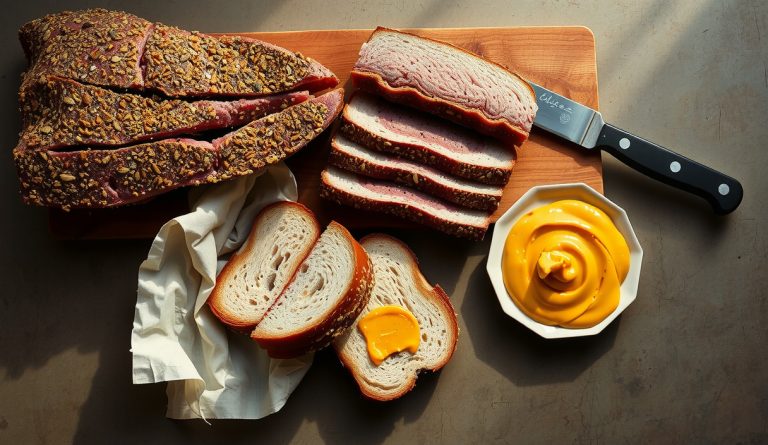
Choose this variation when serving guests who expect the visual grammar of classic KC barbecue, or when presenting the seitan brisket slab at a table where the lacquered surface carries as much persuasive weight as the flavor. The sticky glaze is also a strong choice for sandwiches and sliders — it clings to bread and layers well with pickles and white onion in the traditional KC format.
- Ideal for guests expecting classic Kansas City visual cues — dark, lacquered bark
- Well-suited to sandwiches and sliders where glaze adhesion improves layering with pickles and white onion
- Effective for presentation settings where surface appearance drives first impressions
Use the full method, equipment, and rub measurements from the original Vegan Smoked ‘Brisket’ — Seitan-Based with Myoglobin-Mimicking Bark.