Vegan Smoked ‘Brisket’ — Hand-Laminated Seitan

Equipment
- 1 Stand mixer with dough hook (or large bowl and strong hands)
- 1 Large steamer insert or bamboo steamer basket Must fit a slab at least 8 x 5 inches
- 1 Smoker (offset, kettle, or pellet grill) Capable of holding a stable 250°F for 5 hours
- 4 oz Oak or hickory wood chunks or pellets Add a smoke tube if using a pellet grill for denser phenol coverage
- 2 sheets Unlined pink butcher paper Do not substitute foil — it steams the bark soft
- 1 Instant-read thermometer
- 1 Sharp slicing knife, 12-inch or longer
Ingredients
Seitan Dough
- 2 cups vital wheat gluten 75–80% protein content; Bob’s Red Mill or Anthony’s recommended
- 3 tbsp nutritional yeast
- 1 tsp smoked paprika
- 1 tsp garlic powder
- 1 tsp onion powder
- ½ tsp fine black pepper
- ½ tsp fine sea salt
Wet Myoglobin-Analogue Mix
- ¾ cup fresh-pressed or cold-pressed beet juice Not canned; heat-treated beet juice loses betacyanin color stability
- 3 tbsp soy sauce or tamari
- 2 tbsp white (shiro) miso paste White miso has the highest free-sugar load and the most aggressive Maillard contribution
- 1 tbsp tomato paste
- 1 tbsp apple cider vinegar
- 1 tsp liquid smoke Optional — adds interior smoke complexity even before the smoker
Bark Rub
- 2 tbsp coarsely ground black pepper
- 1 tbsp flaky sea salt or kosher salt
- 1 tsp smoked paprika
- 1 tsp garlic powder
- ½ tsp coriander, ground
- ½ tsp cayenne pepper Optional; omit for a milder bark
Smoke Phase
- 1 tbsp refined coconut oil, melted Creates a thin lipid boundary layer that captures smoke phenols; refined for neutral flavor

Instructions
Day 1 — Build and Steam
- In a large bowl, whisk together the vital wheat gluten, nutritional yeast, smoked paprika, garlic powder, onion powder, black pepper, and fine sea salt until completely uniform. Make a well in the center.3 tbsp nutritional yeast, 1 tsp smoked paprika, 1 tsp garlic powder, 1 tsp onion powder, 1/2 tsp fine black pepper, 1/2 tsp fine sea salt
- In a separate bowl, whisk together the beet juice, soy sauce, white miso paste, tomato paste, apple cider vinegar, and liquid smoke (if using) until the miso is fully dissolved. Pour the wet mixture into the dry ingredients all at once.3/4 cup fresh-pressed or cold-pressed beet juice, 3 tbsp soy sauce or tamari, 2 tbsp white (shiro) miso paste, 1 tbsp tomato paste, 1 tbsp apple cider vinegar, 1 tsp liquid smoke
- Mix immediately with a fork or dough hook until the dough comes together into a shaggy mass — about 60 seconds. Then knead by hand or on the stand mixer at medium speed for 3–4 minutes until the dough is cohesive and slightly elastic. Do not over-knead at this stage — you want the gluten network initiated but not fully developed, so the subsequent lamination folds can direct its orientation.
- Lamination — the critical step: Turn the dough out onto a clean, unfloured work surface. Stretch it into a rough rectangle approximately 10 x 7 inches. Fold the far third over the center third, then fold the near third over that (like a letter fold). Rotate 90 degrees and repeat. Do this fold-and-rotate cycle 8 to 10 times in the same primary direction, stretching the dough firmly before each fold. You are physically aligning the glutenin and gliadin chains into parallel arrays — this is your fiber direction. Mark the final orientation with a light score or a small notch on one end so you remember it for slicing later. Shape the laminated slab into a rough oval or rectangular block about 8 x 5 x 2 inches thick.
- Wrap the slab loosely in foil or parchment, leaving a small vent gap. Place in your steamer over vigorously boiling water. Steam for 50–60 minutes, flipping once at the 30-minute mark. The slab will firm considerably, develop a slightly tacky exterior, and deepen in color from the betacyanin. Remove and unwrap carefully — it will be hot.
- Allow the steamed slab to cool to room temperature on a wire rack for 30 minutes, then refrigerate uncovered for at least 12 hours and up to 24 hours. The gluten network continues to cross-link during this cold rest, and surface moisture equalizes — both are essential for bark formation in the smoker.
Day 2 — Rub and Smoke
- Remove the chilled slab from the refrigerator 30 minutes before smoking to temper slightly. Combine all bark rub ingredients — coarse black pepper, flaky sea salt, smoked paprika, garlic powder, coriander, and cayenne — in a small bowl.2 tbsp coarsely ground black pepper, 1 tbsp flaky sea salt or kosher salt, 1 tsp smoked paprika, 1 tsp garlic powder, 1/2 tsp coriander, ground, 1/2 tsp cayenne pepper
- Brush the entire exterior surface of the slab with the melted refined coconut oil in a thin, even coat. This lipid layer is your smoke-phenol capture vehicle — keep it thin. Immediately press the bark rub firmly into all surfaces. The rub should adhere well to the oiled surface. Do not skip the oil step; rub applied directly to the dry seitan surface will partially fall off and will not form an integrated bark.1 tbsp refined coconut oil, melted
- Set up your smoker for indirect heat at a stable 250°F. Add 2–3 oak or hickory chunks to the coals or your smoke tube. Place the slab fat-side up (the side you will slice from last) on the grate. Insert the thermometer probe into the thickest part of the center if using one.
- Smoke uncovered for 2.5 to 3 hours, adding wood once more at the 90-minute mark to maintain consistent smoke density. Resist opening the lid more than necessary. During the first 90–120 minutes, surface evaporation will suppress bark color development — this is the stall analog. Once the surface dehydrates past that threshold, color will darken rapidly. Begin monitoring surface color closely after the 2-hour mark.
- Wrap phase (Texas crutch): When the surface reaches a deep amber-to-mahogany color and resists light finger pressure, wrap the slab tightly in two overlapping sheets of butcher paper. Return to the smoker and continue cooking for 1 to 1.5 additional hours. Internal temperature target: 165–170°F. This is a texture target, not a food-safety number — at 165°F the interior is set, slice-able, and moist without being gummy.
- Rest: Remove from the smoker. Keep wrapped in butcher paper, then wrap in a kitchen towel and rest on the counter for 20–30 minutes. This allows interior moisture to redistribute throughout the gluten matrix. Do not skip this step.
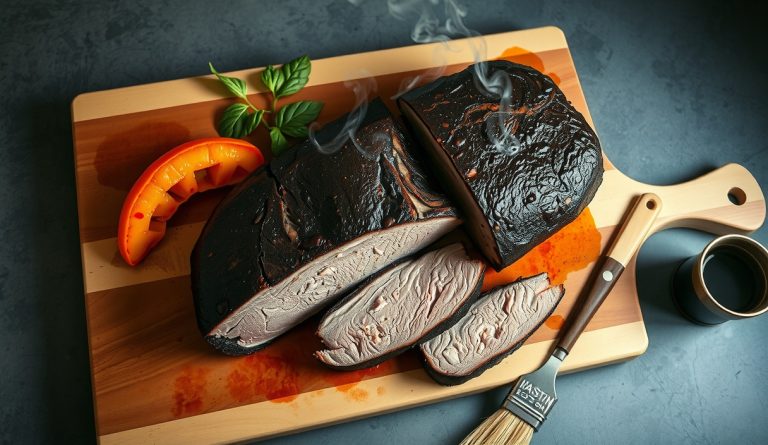
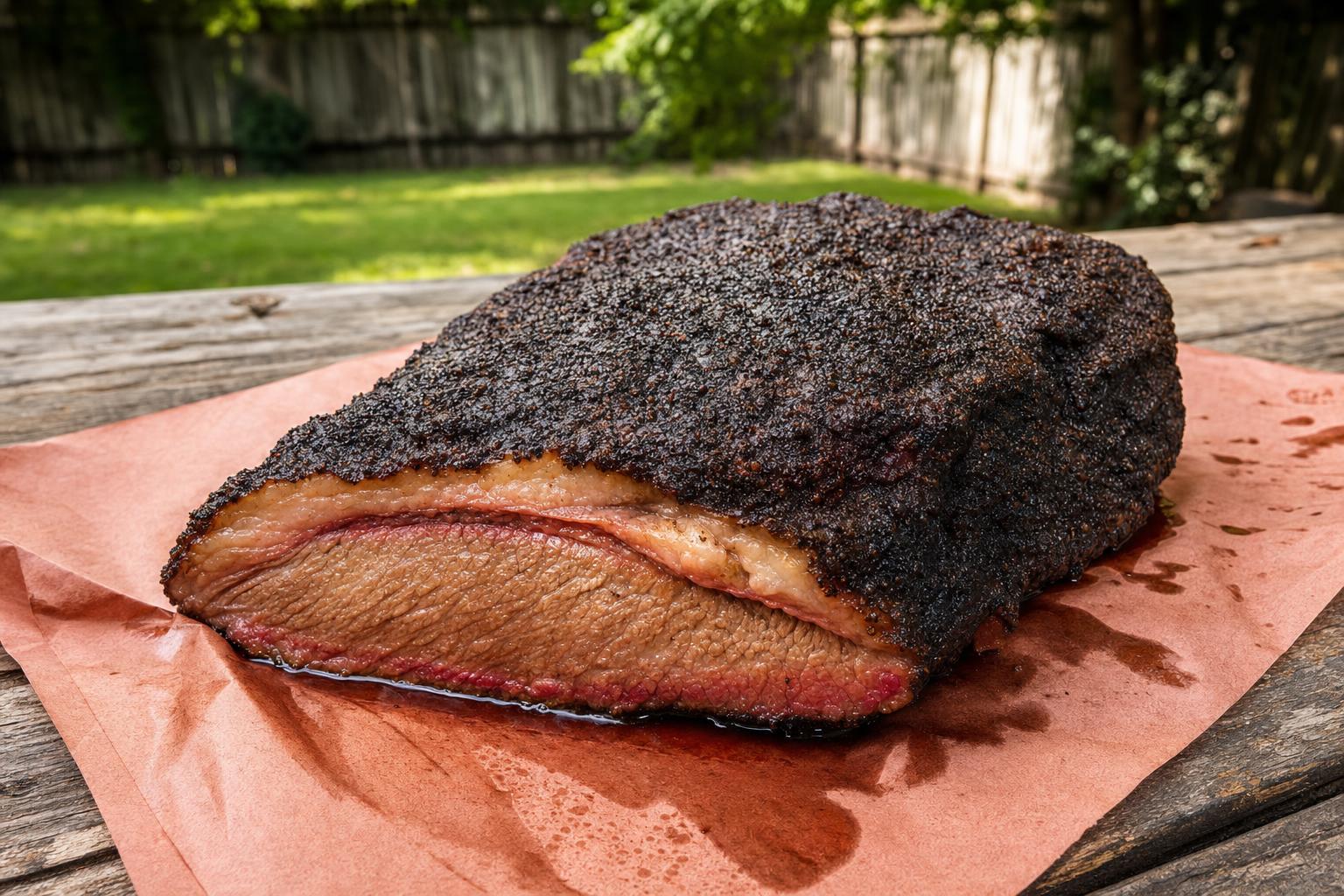
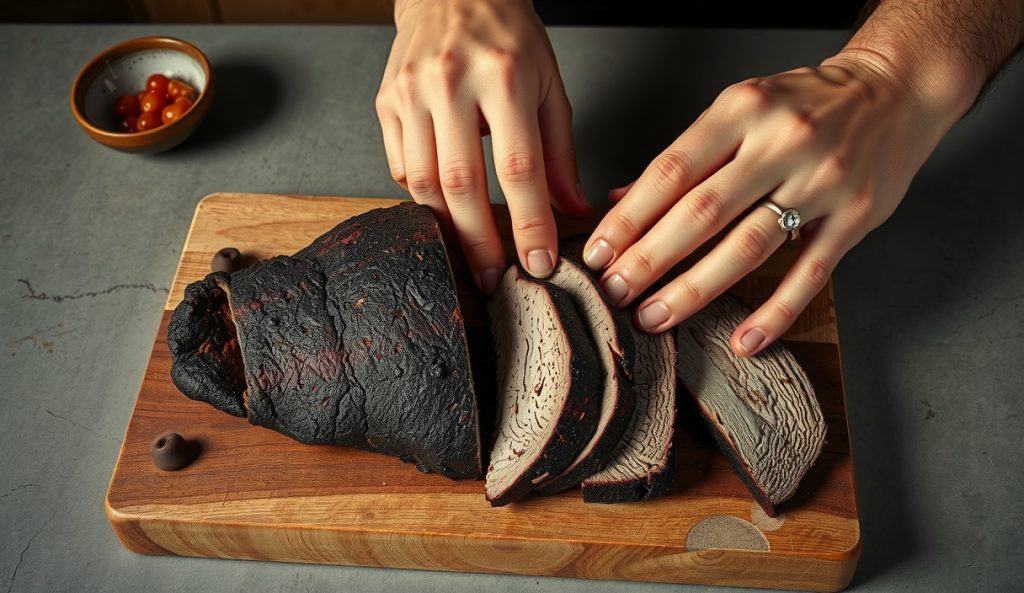
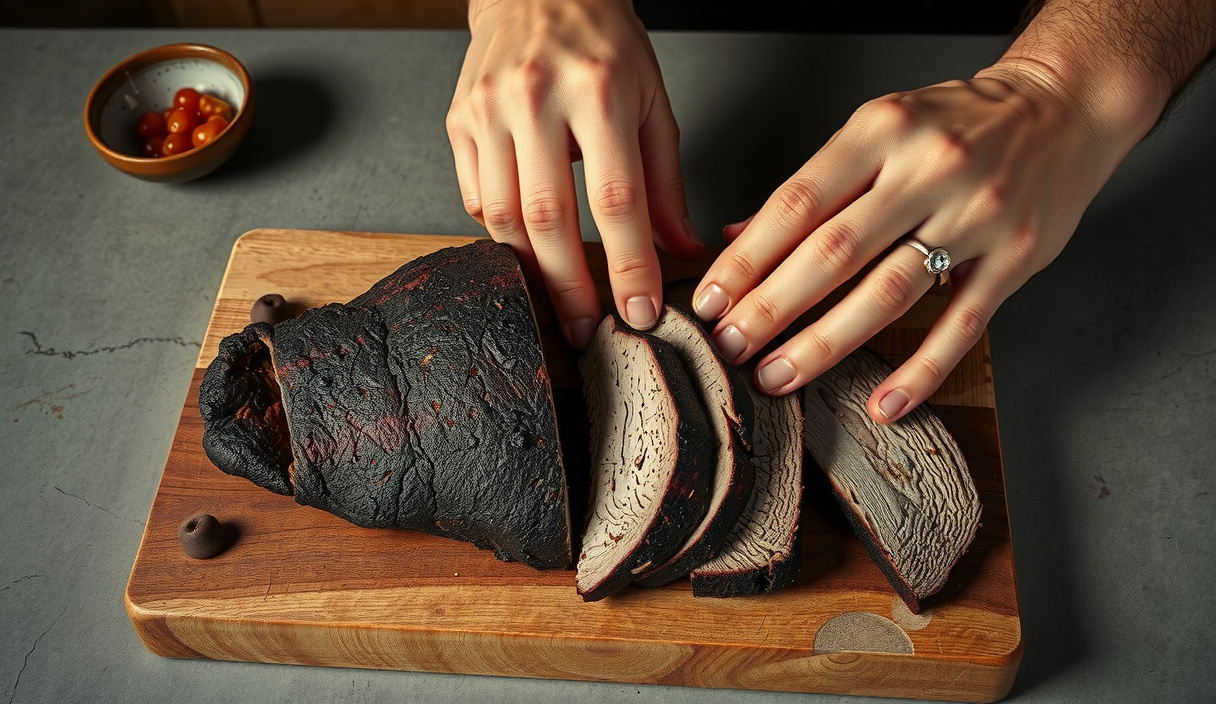
- Slice: Unwrap and identify the lamination grain direction from your earlier notch mark. Using a sharp 12-inch slicing knife, slice perpendicular to the fiber direction — against the grain — in slices approximately 1/4 to 3/8 inch thick. The cross section should show a pink-to-rose interior (betacyanin intact) surrounded by a deep mahogany bark. Serve immediately.
Notes
Nutrition
The first time I pulled a seitan brisket off the offset smoker at 11 p.m., bark mahogany and tight, I made the mistake of slicing it immediately. The fiber structure held. The smoke ring was real. My neighbor — a card-carrying central Texas brisket devotee — stared for a long moment before picking up a slice. He did not say anything for a while. That silence was the whole point. This recipe is not a consolation prize. It is a precision-engineered slab of gluten protein, laminated by hand to direct fiber orientation, doped with beet juice and white miso to produce a myoglobin-color analogue that holds its pinkish interior through the smoke, and cooked on a real fire at 250°F until the Maillard cascade runs deep. It takes two days. It is worth every minute.
The technique borrows directly from high-moisture extrusion science — the same thermomechanical principle that gives commercial plant-based cuts their fibrous bite — and translates it into something you can execute in a home kitchen with your hands and a sheet pan. Lamination folds create directional protein alignment. The smoke does the rest.
Why does vegan smoked brisket work? The science
Seitan’s structural backbone is the gluten network: a viscoelastic matrix of glutenin and gliadin proteins held together by intermolecular disulfide bonds and noncovalent hydrophobic interactions. When vital wheat gluten hydrates and is worked under mechanical shear, these chains align — a directional polymer orientation that creates anisotropic, fibrous bite analogous to myofibrillar muscle tissue. Commercial high-moisture extrusion (HME) achieves this by forcing the protein melt through a temperature-controlled cooling die under elongational flow at 140–180°F, generating the cross-sectional velocity gradients that physically pull chains into parallel arrays. In this recipe we replicate that alignment manually: by stretching, folding, and re-laminating the dough in consistent parallel strokes, we impose a preferred fiber direction before the protein is heat-set. The result is a slab you can tear along the grain, exactly like a flat muscle. Shear — whether from industrial screws or from your hands — is the control variable.
Color is the second engineering problem. Beef brisket’s signature pinkish interior and deep bark owe everything to myoglobin: the iron-containing heme protein that binds oxygen in muscle tissue. At internal temperatures around 140–150°F, myoglobin partially denatures and converts to metmyoglobin, deepening toward gray-brown, while the bark’s crust runs through the full Maillard cascade — amino-carbonyl browning onset above approximately 280°F surface temperature — building hundreds of volatile organic compounds and deep melanoidin pigments. Seitan carries none of that. Our myoglobin analogue is a two-component system: beet juice supplies betacyanin, a pH-sensitive red chromophore that survives cooking temperatures in the low-smoke range and maintains a pink interior hue; white miso provides free amino acids and reducing sugars that aggressively accelerate Maillard browning at the surface when the exterior dehydrates during the smoke. The bark chemistry is real Maillard, not food coloring. The interior pink is a deliberate betacyanin optical signal — as honest a structural decision as any pitmaster makes when they pick the wood.
Smoke penetration on seitan works differently than on beef. Animal fat renders and migrates outward, carrying smoke-soluble phenols (guaiacol, syringol) into the matrix. Seitan has no fat to render. To compensate, we wrap the surface in a thin slick of refined coconut oil before the final smoke phase, creating a temporary lipid-continuous boundary layer that captures smoke phenols and embeds them into the exterior gluten matrix as the protein sets. The moisture evaporating from the dough during the first two hours of smoke also suppresses surface temperature at approximately 212°F — the same evaporative stall physics that governs the beef brisket stall — protecting the interior from overcooking while the exterior dries down to bark conditions. Once the surface dehydrates past that evaporative threshold, Maillard browning accelerates hard. Monitor surface color, not time.
What equipment and ingredients do I need?
Vital wheat gluten: Not all bags are equal. Seek protein content of 75–80% or higher on the label. Lower-protein batches hydrate sluggishly and produce a denser, rubberier result. Bob’s Red Mill and Anthony’s are reliable baselines.
White (shiro) miso: White miso has the lowest salt content and the highest free sugar load of the miso spectrum, making it the most aggressive Maillard participant at surface temperatures. Red miso works but pushes flavor toward fermented-sour. Use white miso for bark depth without distraction.
Beet juice: Fresh-pressed or cold-pressed bottled (not canned, which is frequently heat-treated and pH-shifted). Betacyanin stability declines sharply above pH 6 and above 185°F for extended periods. The low-and-slow smoke at 250°F keeps interior temps well below that threshold for most of the cook, preserving the pink interior signal. If the seitan goes gray inside, the cook ran too hot or too long.
Smoker: Any smoker capable of holding 250°F for 4–5 hours works — offset, kettle with the snake method, pellet grill, or a covered charcoal grill with indirect setup. Oak or hickory is recommended for this build; mesquite reads too sharp against the gluten’s mild base. If you use a pellet grill, add a smoke tube for additional phenol density.
Butcher paper: Unlined pink or white butcher paper for the wrap phase, identical to the Texas crutch technique. Foil will steam the bark soft. Butcher paper breathes, letting bark harden while braising the interior with its own moisture.
- Stand mixer with dough hook, or strong hands and 15 minutes of patience
- Instant-read thermometer (optional but useful for interior temp monitoring)
- Smoker capable of stable 250°F
- Oak or hickory wood chunks or pellets
- Pink butcher paper
- Sharp slicing knife (brisket knife or carving knife, 12-inch or longer)
Vegan Smoked ‘Brisket’ — Hand-Laminated Seitan
Equipment
- 1 Stand mixer with dough hook (or large bowl and strong hands)
- 1 Large steamer insert or bamboo steamer basket Must fit a slab at least 8 x 5 inches
- 1 Smoker (offset, kettle, or pellet grill) Capable of holding a stable 250°F for 5 hours
- 4 oz Oak or hickory wood chunks or pellets Add a smoke tube if using a pellet grill for denser phenol coverage
- 2 sheets Unlined pink butcher paper Do not substitute foil — it steams the bark soft
- 1 Instant-read thermometer
- 1 Sharp slicing knife, 12-inch or longer
Ingredients
Seitan Dough
- 2 cups vital wheat gluten 75–80% protein content; Bob’s Red Mill or Anthony’s recommended
- 3 tbsp nutritional yeast
- 1 tsp smoked paprika
- 1 tsp garlic powder
- 1 tsp onion powder
- ½ tsp fine black pepper
- ½ tsp fine sea salt
Wet Myoglobin-Analogue Mix
- ¾ cup fresh-pressed or cold-pressed beet juice Not canned; heat-treated beet juice loses betacyanin color stability
- 3 tbsp soy sauce or tamari
- 2 tbsp white (shiro) miso paste White miso has the highest free-sugar load and the most aggressive Maillard contribution
- 1 tbsp tomato paste
- 1 tbsp apple cider vinegar
- 1 tsp liquid smoke Optional — adds interior smoke complexity even before the smoker
Bark Rub
- 2 tbsp coarsely ground black pepper
- 1 tbsp flaky sea salt or kosher salt
- 1 tsp smoked paprika
- 1 tsp garlic powder
- ½ tsp coriander, ground
- ½ tsp cayenne pepper Optional; omit for a milder bark
Smoke Phase
- 1 tbsp refined coconut oil, melted Creates a thin lipid boundary layer that captures smoke phenols; refined for neutral flavor
Instructions
Day 1 — Build and Steam
- In a large bowl, whisk together the vital wheat gluten, nutritional yeast, smoked paprika, garlic powder, onion powder, black pepper, and fine sea salt until completely uniform. Make a well in the center.3 tbsp nutritional yeast, 1 tsp smoked paprika, 1 tsp garlic powder, 1 tsp onion powder, 1/2 tsp fine black pepper, 1/2 tsp fine sea salt
- In a separate bowl, whisk together the beet juice, soy sauce, white miso paste, tomato paste, apple cider vinegar, and liquid smoke (if using) until the miso is fully dissolved. Pour the wet mixture into the dry ingredients all at once.3/4 cup fresh-pressed or cold-pressed beet juice, 3 tbsp soy sauce or tamari, 2 tbsp white (shiro) miso paste, 1 tbsp tomato paste, 1 tbsp apple cider vinegar, 1 tsp liquid smoke
- Mix immediately with a fork or dough hook until the dough comes together into a shaggy mass — about 60 seconds. Then knead by hand or on the stand mixer at medium speed for 3–4 minutes until the dough is cohesive and slightly elastic. Do not over-knead at this stage — you want the gluten network initiated but not fully developed, so the subsequent lamination folds can direct its orientation.
- Lamination — the critical step: Turn the dough out onto a clean, unfloured work surface. Stretch it into a rough rectangle approximately 10 x 7 inches. Fold the far third over the center third, then fold the near third over that (like a letter fold). Rotate 90 degrees and repeat. Do this fold-and-rotate cycle 8 to 10 times in the same primary direction, stretching the dough firmly before each fold. You are physically aligning the glutenin and gliadin chains into parallel arrays — this is your fiber direction. Mark the final orientation with a light score or a small notch on one end so you remember it for slicing later. Shape the laminated slab into a rough oval or rectangular block about 8 x 5 x 2 inches thick.
- Wrap the slab loosely in foil or parchment, leaving a small vent gap. Place in your steamer over vigorously boiling water. Steam for 50–60 minutes, flipping once at the 30-minute mark. The slab will firm considerably, develop a slightly tacky exterior, and deepen in color from the betacyanin. Remove and unwrap carefully — it will be hot.
- Allow the steamed slab to cool to room temperature on a wire rack for 30 minutes, then refrigerate uncovered for at least 12 hours and up to 24 hours. The gluten network continues to cross-link during this cold rest, and surface moisture equalizes — both are essential for bark formation in the smoker.
Day 2 — Rub and Smoke
- Remove the chilled slab from the refrigerator 30 minutes before smoking to temper slightly. Combine all bark rub ingredients — coarse black pepper, flaky sea salt, smoked paprika, garlic powder, coriander, and cayenne — in a small bowl.2 tbsp coarsely ground black pepper, 1 tbsp flaky sea salt or kosher salt, 1 tsp smoked paprika, 1 tsp garlic powder, 1/2 tsp coriander, ground, 1/2 tsp cayenne pepper
- Brush the entire exterior surface of the slab with the melted refined coconut oil in a thin, even coat. This lipid layer is your smoke-phenol capture vehicle — keep it thin. Immediately press the bark rub firmly into all surfaces. The rub should adhere well to the oiled surface. Do not skip the oil step; rub applied directly to the dry seitan surface will partially fall off and will not form an integrated bark.1 tbsp refined coconut oil, melted
- Set up your smoker for indirect heat at a stable 250°F. Add 2–3 oak or hickory chunks to the coals or your smoke tube. Place the slab fat-side up (the side you will slice from last) on the grate. Insert the thermometer probe into the thickest part of the center if using one.
- Smoke uncovered for 2.5 to 3 hours, adding wood once more at the 90-minute mark to maintain consistent smoke density. Resist opening the lid more than necessary. During the first 90–120 minutes, surface evaporation will suppress bark color development — this is the stall analog. Once the surface dehydrates past that threshold, color will darken rapidly. Begin monitoring surface color closely after the 2-hour mark.
- Wrap phase (Texas crutch): When the surface reaches a deep amber-to-mahogany color and resists light finger pressure, wrap the slab tightly in two overlapping sheets of butcher paper. Return to the smoker and continue cooking for 1 to 1.5 additional hours. Internal temperature target: 165–170°F. This is a texture target, not a food-safety number — at 165°F the interior is set, slice-able, and moist without being gummy.
- Rest: Remove from the smoker. Keep wrapped in butcher paper, then wrap in a kitchen towel and rest on the counter for 20–30 minutes. This allows interior moisture to redistribute throughout the gluten matrix. Do not skip this step.
- Slice: Unwrap and identify the lamination grain direction from your earlier notch mark. Using a sharp 12-inch slicing knife, slice perpendicular to the fiber direction — against the grain — in slices approximately 1/4 to 3/8 inch thick. The cross section should show a pink-to-rose interior (betacyanin intact) surrounded by a deep mahogany bark. Serve immediately.
Notes
Nutrition
How do I nail the vegan smoked brisket every time?
- Do not skip the overnight rest. After steaming, the gluten network continues cross-linking as it cools. A dough smoked fresh off the steam will be gummy and structurally soft. Twelve hours in the fridge lets the protein matrix fully set and the betacyanin distribute evenly, and it allows surface moisture to equalize for better bark formation.
- Laminate with intention. Each fold should be a deliberate stretch-and-fold in the same direction. Random folding creates random fiber orientation — that is what gives commercial seitan its uniform, homogeneous texture. Consistent direction is what gives you pull-apart grain. Think of it as shaping a croissant laminate, not kneading bread.
- Watch surface color, not the clock. The target is a deep mahogany bark — similar to the color of dark chocolate. If your smoker runs cool, give the seitan brisket another 30–45 minutes uncovered. If the bark is blackening, the smoker is running hot or the coconut oil layer was too thick. Pull and wrap early.
- Wrap when the bark is set. Wrap too early and you will steam the crust soft. Wrap too late and the exterior over-dries into jerky. The correct moment is when the surface resists light finger pressure and the color is uniformly deep amber-to-mahogany, typically around the 3-hour mark at 250°F.
- Rest before slicing. The interior moisture redistributes during a 20–30 minute rest wrapped in butcher paper and a towel. Slicing immediately causes the surface moisture to rush out, making the interior grainy. The rest is not optional.
- Slice against the lamination grain. Look at the surface of the slab and identify the fiber direction from your lamination folds. Slice perpendicular to those fibers. This is the same principle as slicing beef against the grain — it dramatically shortens the apparent fiber length under the tooth, producing a tender bite rather than a chewy one.
What variations can I try?
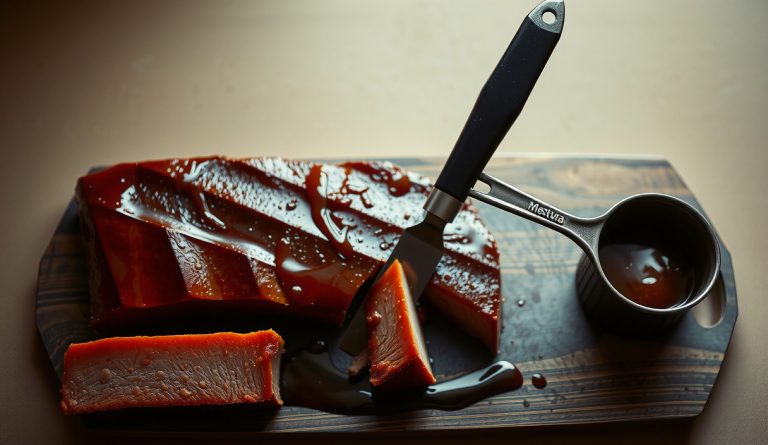
Kansas City glaze: In the final 20 minutes of the smoke, brush the surface of the seitan brisket with a reduced tomato-molasses-apple cider vinegar glaze. The high sugar content accelerates surface caramelization and builds a lacquered, sticky bark more characteristic of Kansas City style. Reduce the glaze to roughly half its original volume before application — thin glazes steam the surface and prevent bark from firming. The betacyanin color will partially be masked by the dark glaze, but the interior pink remains intact.
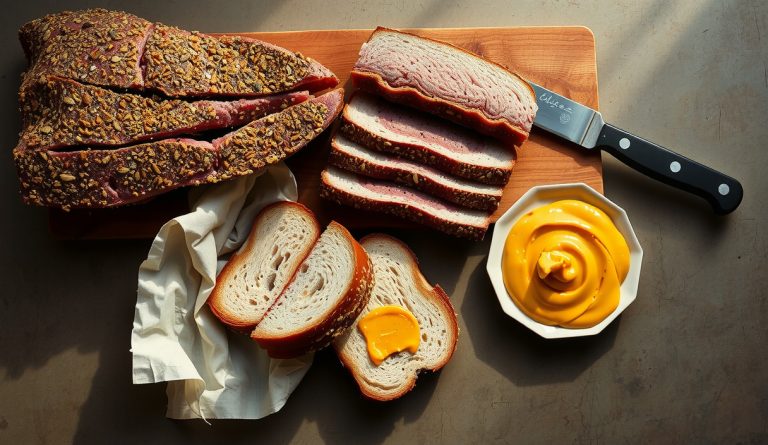
Pastrami build: Press the exterior of the raw dough slab heavily with a coriander-black pepper-brown sugar rub identical to classic pastrami seasoning. Smoke as directed but reduce the cook time to 3 hours (the thinner coating and lack of fat means it firms faster). Slice paper-thin on a mandoline or deli slicer and serve cold on rye with mustard. The lamination grain creates an excellent deli-cut chew.
Scaling up: This recipe produces a slab roughly equivalent to a 2-pound flat. To scale to a full packer-style brisket shape, double the recipe and laminate two slabs separately before pressing them together with a thin layer of miso paste as adhesive. Tie with butcher’s twine at 2-inch intervals. The dual-slab build also creates a more dramatic point-and-flat visual cross section when sliced.
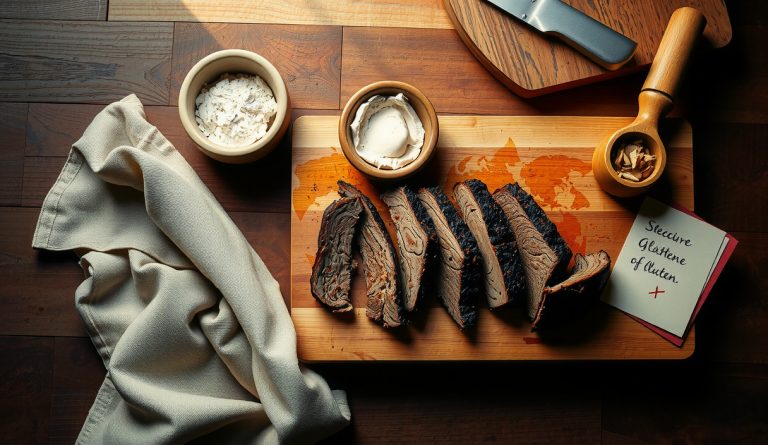
Gluten-free impossibility note: This recipe is not adaptable to gluten-free constraints. The entire structural premise depends on gluten’s unique viscoelastic disulfide network. Replacing vital wheat gluten with any combination of rice flour, chickpea flour, or tapioca starch will not produce a fibrous, sliceable result — it will produce a dense, crumbly protein mass. For a genuinely gluten-free smoked plant protein, a mycelium-based or high-moisture-extruded soy or pea product is the correct substrate.
Frequently asked questions
Why does seitan brisket turn gray inside instead of pink? Betacyanin — the red chromophore in beet juice — is sensitive to both heat and pH. If the interior temperature exceeds approximately 185°F for an extended period, or if the dough’s pH drifts above 6.5 (which can happen with heavily alkaline water or excess baking soda in any modification), the betacyanin degrades to a colorless compound called betalamic acid and the interior goes gray. Keep the smoker at a true 250°F and pull the slab when the internal temp reads 165–170°F. No higher internal temperature is needed — unlike meat, there is no food safety rationale for high internal temps in seitan, only texture control.
Can I skip the steaming step and go straight to the smoker? No — not with the results this recipe targets. The steam phase is the primary heat-set event: it denatures the gluten proteins and locks the fiber orientation established during lamination before the smoke begins. Without steaming first, the protein matrix is still hydrated and extensible when the slab hits the smoker. The result is a slab that contracts, distorts, and loses fiber direction as the cross-links form under dry heat rather than moist. Steam first; smoke second. The two-stage process is non-negotiable for structural fidelity.
What is the shelf life and how do I reheat the smoked seitan brisket? The smoked slab keeps refrigerated for up to 5 days tightly wrapped in butcher paper or cling film, or frozen for up to 3 months. Reheat whole slabs wrapped in foil in a 300°F oven for 20–25 minutes — this re-softens the interior without steaming the bark completely soft. For individual slices, a dry cast iron skillet over medium heat for 90 seconds per side re-crisps the bark edges and warms through without moisture loss. Avoid the microwave, which introduces steam and makes the exterior rubbery.