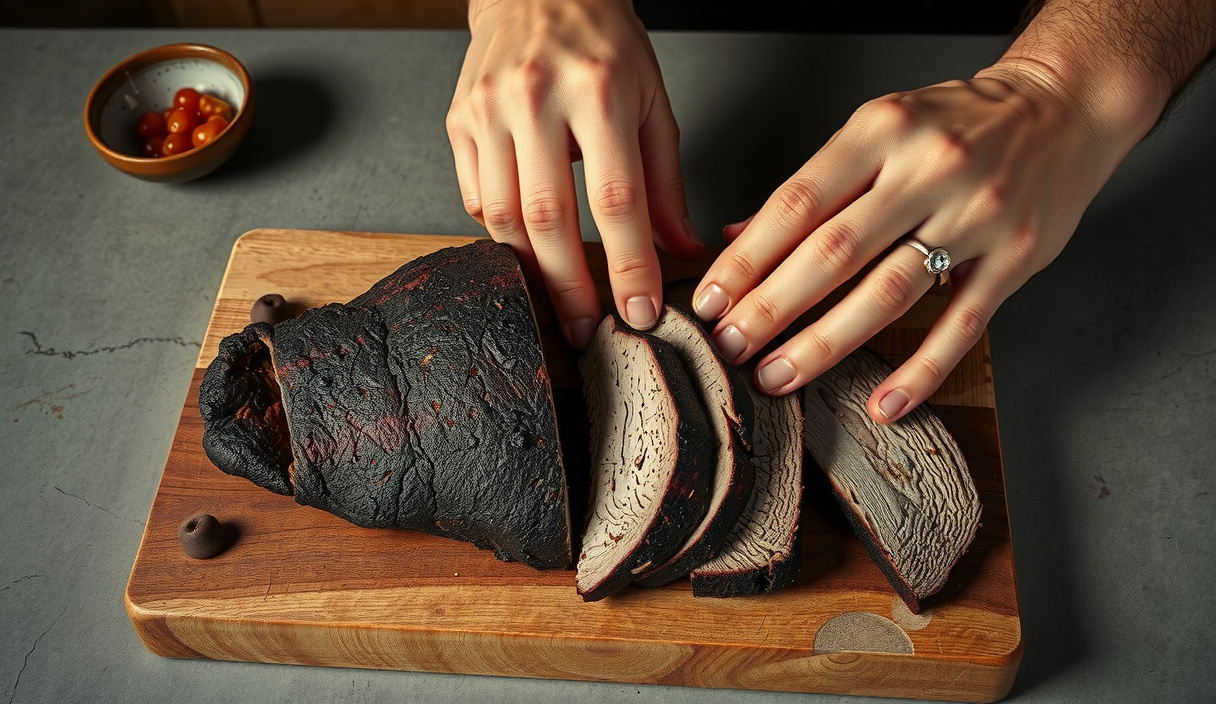
Vegan Smoked 'Brisket' — Hand-Laminated Seitan

A slab of vital wheat gluten laminated by hand to create directional fiber alignment, charged with beet juice and white miso for a myoglobin-color analogue, and smoked low-and-slow at 250°F over oak until the bark runs deep mahogany. Two-day process, pitmaster-level results, zero animal products.
Equipment
- 1 Stand mixer with dough hook (or large bowl and strong hands)
- 1 Large steamer insert or bamboo steamer basket Must fit a slab at least 8 x 5 inches
- 1 Smoker (offset, kettle, or pellet grill) Capable of holding a stable 250°F for 5 hours
- 4 oz Oak or hickory wood chunks or pellets Add a smoke tube if using a pellet grill for denser phenol coverage
- 2 sheets Unlined pink butcher paper Do not substitute foil — it steams the bark soft
- 1 Instant-read thermometer
- 1 Sharp slicing knife, 12-inch or longer
Ingredients
Seitan Dough
- 2 cups vital wheat gluten 75–80% protein content; Bob's Red Mill or Anthony's recommended
- 3 tbsp nutritional yeast
- 1 tsp smoked paprika
- 1 tsp garlic powder
- 1 tsp onion powder
- ½ tsp fine black pepper
- ½ tsp fine sea salt
Wet Myoglobin-Analogue Mix
- ¾ cup fresh-pressed or cold-pressed beet juice Not canned; heat-treated beet juice loses betacyanin color stability
- 3 tbsp soy sauce or tamari
- 2 tbsp white (shiro) miso paste White miso has the highest free-sugar load and the most aggressive Maillard contribution
- 1 tbsp tomato paste
- 1 tbsp apple cider vinegar
- 1 tsp liquid smoke Optional — adds interior smoke complexity even before the smoker
Bark Rub
- 2 tbsp coarsely ground black pepper
- 1 tbsp flaky sea salt or kosher salt
- 1 tsp smoked paprika
- 1 tsp garlic powder
- ½ tsp coriander, ground
- ½ tsp cayenne pepper Optional; omit for a milder bark
Smoke Phase
- 1 tbsp refined coconut oil, melted Creates a thin lipid boundary layer that captures smoke phenols; refined for neutral flavor

Instructions
Day 1 — Build and Steam
- In a large bowl, whisk together the vital wheat gluten, nutritional yeast, smoked paprika, garlic powder, onion powder, black pepper, and fine sea salt until completely uniform. Make a well in the center.3 tbsp nutritional yeast, 1 tsp smoked paprika, 1 tsp garlic powder, 1 tsp onion powder, 1/2 tsp fine black pepper, 1/2 tsp fine sea salt
- In a separate bowl, whisk together the beet juice, soy sauce, white miso paste, tomato paste, apple cider vinegar, and liquid smoke (if using) until the miso is fully dissolved. Pour the wet mixture into the dry ingredients all at once.3/4 cup fresh-pressed or cold-pressed beet juice, 3 tbsp soy sauce or tamari, 2 tbsp white (shiro) miso paste, 1 tbsp tomato paste, 1 tbsp apple cider vinegar, 1 tsp liquid smoke
- Mix immediately with a fork or dough hook until the dough comes together into a shaggy mass — about 60 seconds. Then knead by hand or on the stand mixer at medium speed for 3–4 minutes until the dough is cohesive and slightly elastic. Do not over-knead at this stage — you want the gluten network initiated but not fully developed, so the subsequent lamination folds can direct its orientation.
- Lamination — the critical step: Turn the dough out onto a clean, unfloured work surface. Stretch it into a rough rectangle approximately 10 x 7 inches. Fold the far third over the center third, then fold the near third over that (like a letter fold). Rotate 90 degrees and repeat. Do this fold-and-rotate cycle 8 to 10 times in the same primary direction, stretching the dough firmly before each fold. You are physically aligning the glutenin and gliadin chains into parallel arrays — this is your fiber direction. Mark the final orientation with a light score or a small notch on one end so you remember it for slicing later. Shape the laminated slab into a rough oval or rectangular block about 8 x 5 x 2 inches thick.
- Wrap the slab loosely in foil or parchment, leaving a small vent gap. Place in your steamer over vigorously boiling water. Steam for 50–60 minutes, flipping once at the 30-minute mark. The slab will firm considerably, develop a slightly tacky exterior, and deepen in color from the betacyanin. Remove and unwrap carefully — it will be hot.
- Allow the steamed slab to cool to room temperature on a wire rack for 30 minutes, then refrigerate uncovered for at least 12 hours and up to 24 hours. The gluten network continues to cross-link during this cold rest, and surface moisture equalizes — both are essential for bark formation in the smoker.
Day 2 — Rub and Smoke
- Remove the chilled slab from the refrigerator 30 minutes before smoking to temper slightly. Combine all bark rub ingredients — coarse black pepper, flaky sea salt, smoked paprika, garlic powder, coriander, and cayenne — in a small bowl.2 tbsp coarsely ground black pepper, 1 tbsp flaky sea salt or kosher salt, 1 tsp smoked paprika, 1 tsp garlic powder, 1/2 tsp coriander, ground, 1/2 tsp cayenne pepper
- Brush the entire exterior surface of the slab with the melted refined coconut oil in a thin, even coat. This lipid layer is your smoke-phenol capture vehicle — keep it thin. Immediately press the bark rub firmly into all surfaces. The rub should adhere well to the oiled surface. Do not skip the oil step; rub applied directly to the dry seitan surface will partially fall off and will not form an integrated bark.1 tbsp refined coconut oil, melted
- Set up your smoker for indirect heat at a stable 250°F. Add 2–3 oak or hickory chunks to the coals or your smoke tube. Place the slab fat-side up (the side you will slice from last) on the grate. Insert the thermometer probe into the thickest part of the center if using one.
- Smoke uncovered for 2.5 to 3 hours, adding wood once more at the 90-minute mark to maintain consistent smoke density. Resist opening the lid more than necessary. During the first 90–120 minutes, surface evaporation will suppress bark color development — this is the stall analog. Once the surface dehydrates past that threshold, color will darken rapidly. Begin monitoring surface color closely after the 2-hour mark.
- Wrap phase (Texas crutch): When the surface reaches a deep amber-to-mahogany color and resists light finger pressure, wrap the slab tightly in two overlapping sheets of butcher paper. Return to the smoker and continue cooking for 1 to 1.5 additional hours. Internal temperature target: 165–170°F. This is a texture target, not a food-safety number — at 165°F the interior is set, slice-able, and moist without being gummy.
- Rest: Remove from the smoker. Keep wrapped in butcher paper, then wrap in a kitchen towel and rest on the counter for 20–30 minutes. This allows interior moisture to redistribute throughout the gluten matrix. Do not skip this step.
- Slice: Unwrap and identify the lamination grain direction from your earlier notch mark. Using a sharp 12-inch slicing knife, slice perpendicular to the fiber direction — against the grain — in slices approximately 1/4 to 3/8 inch thick. The cross section should show a pink-to-rose interior (betacyanin intact) surrounded by a deep mahogany bark. Serve immediately.
Notes
Why the stall happens here: During the first 90–120 minutes at 250°F, the surface of the seitan slab is still moisture-saturated from the steam cook and the overnight rest. As the smoker delivers energy, that surface water absorbs the latent heat of vaporization and evaporates rather than allowing surface temperature to rise. This holds the exterior near 212°F — exactly the same mechanism that stalls beef brisket at 160–170°F internal temp during muscle collagen hydrolysis. The seitan stall is evaporative, not collagen-driven, but the physics of energy absorption are identical. Bark formation cannot begin in earnest until the surface is substantially dehydrated. This is why monitoring surface color, not elapsed time, is the correct control variable.
Betacyanin color stability: Beet juice betacyanin is a pH-sensitive, heat-labile chromophore. At pH 4–6 and temperatures below 185°F, it is stable and maintains its red-pink hue. Above pH 6.5 or sustained temperatures exceeding 185–190°F, it hydrolyzes to yellow-beige betalamic acid and the interior goes gray. The 250°F smoker produces interior temperatures well below this threshold during the main cook — the seitan interior typically reaches only 140–165°F. Keeping the smoker temperature at or below 265°F and wrapping in butcher paper during the final phase prevents runaway internal temp spikes that would destroy the betacyanin signal.
Maillard at the bark surface: The bark's deep brown-mahogany color is genuine Maillard chemistry, not caramelization or burning. The white miso contributes free amino acids (glutamic acid, lysine) and simple reducing sugars (glucose from koji enzymatic breakdown of starch). These react with the bark rub's amino groups under the dry-heat conditions of the exposed smoke phase — Maillard onset occurs at surface temperatures above approximately 280–300°F, which the exterior easily reaches once the evaporative stall breaks. The hundreds of volatile organic compounds generated — pyrazines, furans, thiophenes — are the same compound classes that define roasted meat bark flavor. The smoke phenols (guaiacol from oak, syringol) layer over these Maillard volatiles, building complexity that reads unmistakably as smoked barbecue.
Fiber direction and lamination science: The hand-lamination step replicates, in crude form, the elongational flow alignment produced by twin-screw high-moisture extrusion at 140–180°F. In extrusion, the velocity gradient between the die wall and the molten protein center physically stretches and aligns polypeptide chains in the flow direction as disulfide bonds form during cooling. In hand lamination, repeated directional stretch-and-fold mechanically aligns the glutenin macropolymer chains before the steam phase heat-sets them. Eight to ten consistent folds in the same primary axis is the minimum for measurable anisotropy. Fewer folds produce random fiber orientation and a uniform, commercial-style texture; more folds increase alignment and produce more pronounced tear-along-the-grain behavior.
Nutrition
Calories: 310kcalCarbohydrates: 14gProtein: 42gFat: 8gSaturated Fat: 3gSodium: 820mgFiber: 2gSugar: 4g
Tried this recipe?Let us know how it was!