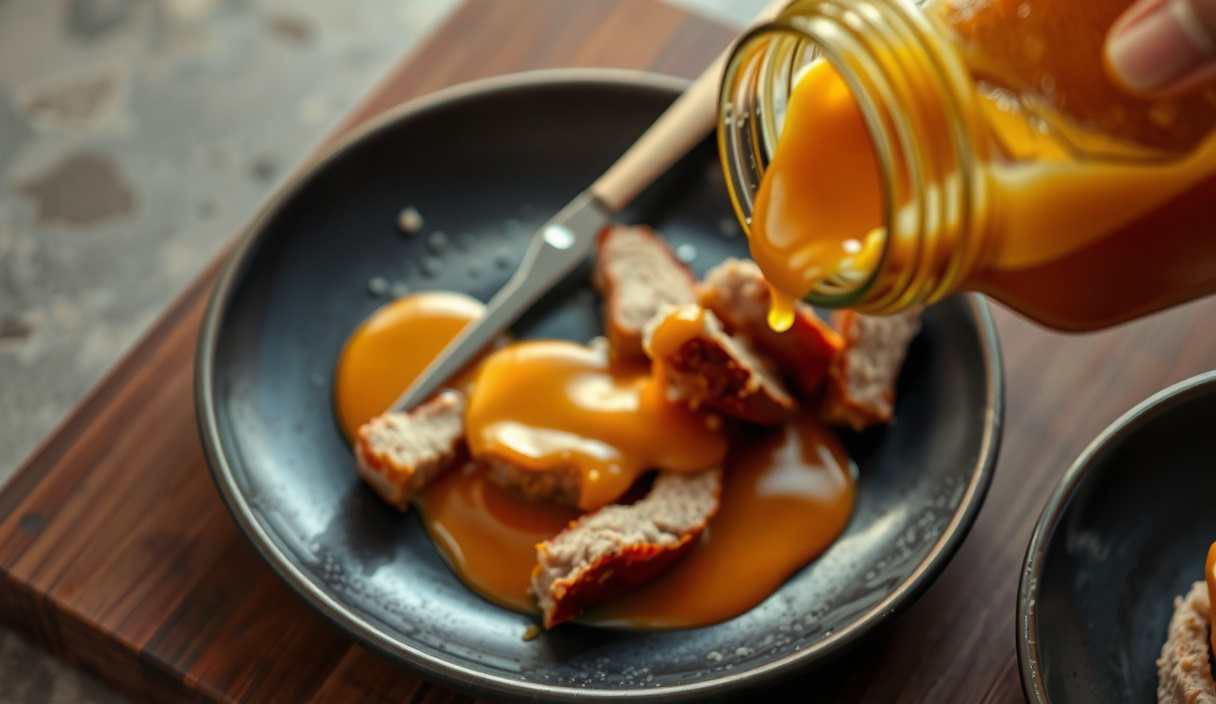
Carolina Mustard BBQ Sauce (South Carolina Gold)

A glossy, tangy South Carolina gold-style BBQ sauce built on yellow mustard's natural emulsifying power. Apple cider vinegar drives the pH below 4.0, brown sugar rounds the acidity, Worcestershire adds layered umami, and cayenne delivers a slow, building heat. Ready in under 20 minutes and shelf-stable refrigerated for up to 4 weeks.
Equipment
- 1 Heavy-bottomed saucepan (2-quart) Stainless-steel or enameled cast iron preferred to prevent scorching from sugar concentration.
- 1 Silicone spatula or wooden spoon For continuous stirring during the final reduction phase.
- 1 Instant-read thermometer Optional but useful; target 200–205°F during active reduction.
- 1 Glass jar with lid (16 oz) For storage; glass is non-reactive with the low-pH sauce.
Ingredients
Sauce Base
- 1 tablespoon unsalted butter Used to bloom the dry spices; provides fat for dissolving fat-soluble capsaicinoids.
- 1 cup prepared yellow mustard Standard American yellow mustard (e.g., French's). Do not substitute Dijon — the emulsion profile and flavor register differ substantially.
- 0.5 cup apple cider vinegar Raw, unfiltered preferred for ester complexity. Distilled white vinegar produces a sharper, cleaner result.
- 0.25 cup light brown sugar, packed Dark brown sugar is acceptable for a deeper molasses note; watch for increased bitterness at high reduction.
- 2 tablespoons Worcestershire sauce Lee & Perrins is the benchmark. Scale to taste if using a generic brand with lower anchovy/tamarind concentration.
- 1 tablespoon honey Adds floral complexity and helps round the acidic edge. Can be omitted for a sharper sauce.
- 1 tablespoon ketchup A small tomato note anchors the sauce without pushing it toward a ketchup-based Southern style.
Spice Blend
- 0.5 teaspoon cayenne pepper For a hotter sauce, increase to 1 teaspoon; for mild, reduce to 1/4 teaspoon.
- 0.5 teaspoon dry mustard powder Amplifies the glucosinolate heat of the prepared mustard base with additional allyl isothiocyanate precursors.
- 0.5 teaspoon garlic powder
- 0.25 teaspoon onion powder
- 0.25 teaspoon freshly ground black pepper
- 0.25 teaspoon kosher salt Added at the end of cooking to avoid ionic disruption of the mustard emulsion during the reduction phase.

Instructions
Build the Sauce
- Melt the butter in a heavy-bottomed 2-quart saucepan over medium heat. Once it foams and subsides, add the cayenne, dry mustard powder, garlic powder, onion powder, and black pepper. Stir constantly and cook for 60 seconds, until the spices are fragrant and the butter is lightly golden. This fat-bloom step dissolves fat-soluble capsaicinoids and sulfurous volatile compounds for even heat distribution throughout the final sauce.0.5 teaspoon dry mustard powder, 0.5 teaspoon garlic powder, 0.25 teaspoon onion powder, 0.25 teaspoon freshly ground black pepper, 0.25 teaspoon kosher salt
- Add the yellow mustard, apple cider vinegar, brown sugar, Worcestershire sauce, honey, and ketchup to the saucepan. Whisk vigorously to fully incorporate the spice-fat bloom into the liquid base. The sauce will look slightly grainy at this stage — that is normal and will resolve as it heats.1 cup prepared yellow mustard, 0.5 cup apple cider vinegar, 0.25 cup light brown sugar, packed, 2 tablespoons Worcestershire sauce, 1 tablespoon honey, 1 tablespoon ketchup
- Increase heat to medium-high and bring the sauce to a low boil, whisking occasionally. Once bubbling, reduce heat to medium and maintain a vigorous simmer. Cook uncovered for 12 to 15 minutes, stirring every 2 to 3 minutes, until the sauce has reduced by roughly one-quarter and coats the back of a spoon with visible resistance. Target sauce temperature: 200–205°F. Watch closely in the final 3 minutes — sugar concentration increases rapidly and scorching risk spikes.
- Remove the saucepan from heat. Stir in the kosher salt. Allow the sauce to rest, uncovered, for 5 minutes before tasting. Flavors will sharpen and concentrate as the sauce cools. Adjust salt and, if desired, a few extra drops of apple cider vinegar for brightness. The sauce is ready to use immediately or transfer to a sealed glass jar for refrigerated storage.0.5 cup apple cider vinegar
Notes
Mustard as emulsifier — the glucosinolate mechanism: Yellow mustard seed contains sinigrin and sinalbin, glucosinolates that hydrolyze into allyl isothiocyanate and p-hydroxybenzyl isothiocyanate when the seed is milled with water. These amphiphilic molecules reduce oil-water interfacial tension and, combined with mucilaginous seed-coat polysaccharides, stabilize the prepared mustard as a naturally occurring oil-in-water emulsion. This means the mustard base carries its own emulsifying infrastructure into the sauce — no egg yolk or synthetic lecithin required. The mucilage proteins carry a slight negative surface charge at this sauce's pH range (approximately pH 3.5 to 4.2), maintaining electrostatic repulsion between dispersed droplets and long-term emulsion stability.
Why salt goes in last: Sodium ions increase the ionic strength of the aqueous phase, which shortens the Debye screening length and reduces electrostatic repulsion between charged mustard-protein droplets. Aggressive early salting can cause visible oil separation — a classic emulsion-breaking cross-coupling failure. Adding salt off-heat, after the sauce has reduced and the emulsion has set, avoids this instability.
Dual heat architecture — mustard vs. cayenne: Mustard's allyl isothiocyanate activates TRPA1 ion channels in the trigeminal system, producing a fast-onset, nasal-clearing heat that peaks and fades within 30 to 60 seconds. Cayenne's capsaicin activates TRPV1 channels, producing a slower-building, longer-lasting heat. Using both creates a temporal heat profile: mustard brightness first, cayenne persistence behind it. This layering is why well-made Carolina gold sauce feels complex rather than simply hot.
Brown sugar and Maillard kinetics in glazing: When this sauce is applied as a glaze in the final 15 to 20 minutes of a pork cook, the reducing sugars from the brown sugar's partial invert fraction and the amino acids present in the sauce react above approximately 285°F on the meat surface, generating complex Maillard browning products and melanoidin pigments. This is why a mustard-glazed shoulder or rack develops a distinct golden-amber bark — the sauce is actively participating in surface browning chemistry, not just coating the meat.
Nutrition
Calories: 38kcalCarbohydrates: 6.5gProtein: 0.8gFat: 1.2gSaturated Fat: 0.6gCholesterol: 2mgSodium: 210mgFiber: 0.4gSugar: 5.2g
Tried this recipe?Let us know how it was!