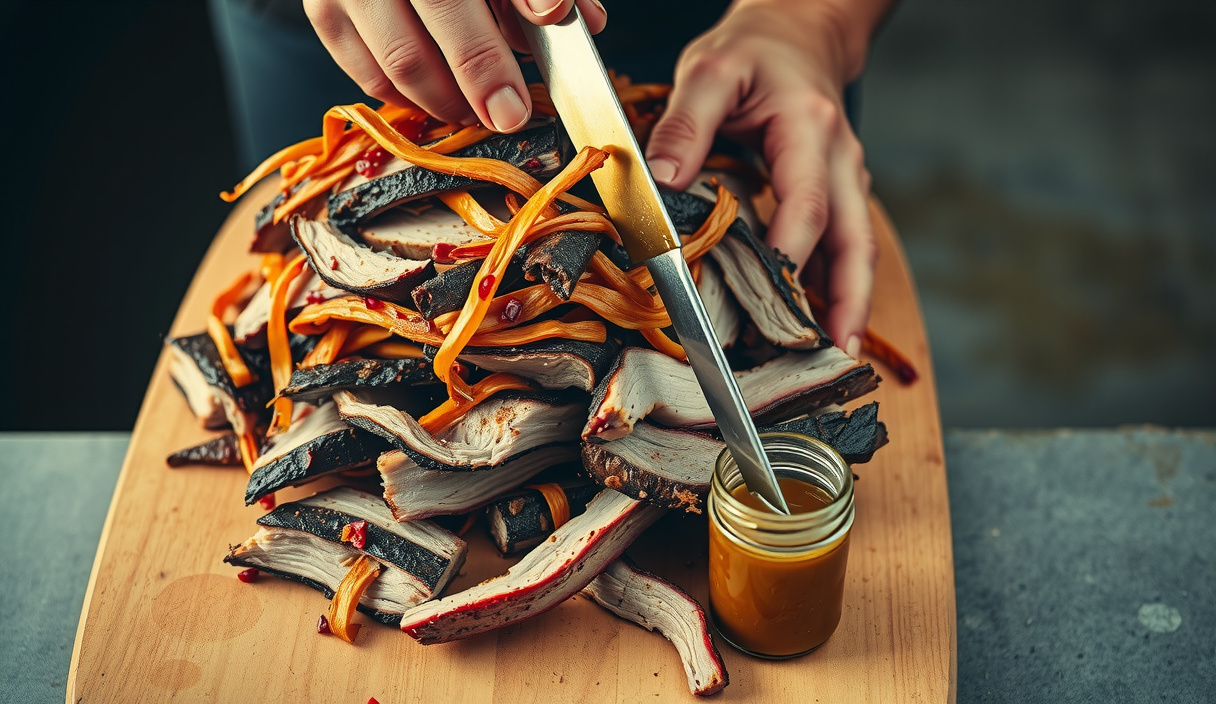
Carolina Pulled Pork with Eastern NC Vinegar Mop

A bone-in pork shoulder smoked low-and-slow at 225°F for 12 to 14 hours over oak and hickory, pulled at 203°F internal, and finished with a classic Eastern North Carolina apple cider vinegar mop. No tomato, no sugar — just acid, heat, smoke, and collagen doing exactly what physics intended.
Equipment
- 1 Offset smoker, kettle grill, or pellet grill Must hold a stable 225°F chamber temperature for 12+ hours. Verify grate temperature with a secondary probe.
- 1 Dual-channel leave-in wireless thermometer One probe for the meat (away from bone), one probe at grate level. Non-negotiable for a 12-hour cook.
- 1 Mop brush or spray bottle A 16-oz standard basting brush or a food-grade spray bottle both work. The spray bottle applies a thinner, more even coat.
- 2 sheets Butcher paper For optional wrapping at the stall and mandatory resting. Do not use foil — it traps steam and softens bark.
- 1 Dry cooler or insulated bag For the post-cook rest. Line with a clean towel, place wrapped shoulder inside, close lid. Holds temperature for 2+ hours.
- 1 Large cutting board Minimum 18x24 inches. You will be pulling 8-10 pounds of meat and need the real estate.
Ingredients
Pork
- 1 bone-in pork shoulder (Boston butt), 8-10 lbs Do not use enhanced or pre-brined pork. Bone-in only — the bone is a collagen reservoir and a doneness indicator.
Dry Rub
- 3 tablespoons kosher salt Diamond Crystal preferred. If using Morton's, reduce to 2 tablespoons — it is roughly twice as dense by volume.
- 2 tablespoons coarsely ground black pepper 16-mesh or coarser grind. Fine pepper creates a muddy bark crust.
- 1 tablespoon smoked paprika
- 1 teaspoon cayenne pepper
Eastern NC Vinegar Mop
- 2 cups unfiltered apple cider vinegar Raw, unfiltered with 5% acidity. Bragg or a local producer. Do not substitute distilled white vinegar.
- 1 cup water
- 2 tablespoons crushed red pepper flakes Standard grocery-store heat level. Scale up to 3 tablespoons for serious heat.
- 1 tablespoon kosher salt
- 1 teaspoon coarsely ground black pepper
For the Smoker
- 4 lbs oak wood chunks or splits Post oak or white oak preferred. Use as your primary fuel flavor base.
- 2 lbs hickory wood chunks Accent wood only. More than a 1:2 hickory-to-oak ratio turns acrid on a long cook.

Instructions
Day Before: Dry Brine
- Combine the kosher salt, black pepper, smoked paprika, and cayenne in a small bowl. Mix until evenly distributed.2 tablespoons coarsely ground black pepper, 1 tablespoon smoked paprika, 1 teaspoon cayenne pepper
- Pat the pork shoulder completely dry with paper towels. Apply the dry rub aggressively on all surfaces, including the fat cap and the bone-exposed end. Work the rub into any crevices. You want complete coverage — no bare patches.
- Place the shoulder uncovered on a wire rack set over a sheet pan in the refrigerator for 12-24 hours. The salt will draw surface moisture out initially, then pull it back in, seasoning deep into the first centimeter of meat. Do not skip this step.
Day Of: Prep and Fire
- Remove the shoulder from the refrigerator 1 hour before cooking. The cold interior of a large butt extends the stall dramatically — a tempered start shaves 30-45 minutes off the low-temperature climb.
- Build your fire and stabilize the smoker at 225°F at grate level. This may take 45-60 minutes depending on your setup. Use a charcoal chimney for a clean base fire, then add your wood. On an offset, place oak splits in the firebox to establish your coal bed before adding a single hickory chunk. On a kettle, set up a two-zone fire with coals banked to one side and 2-3 wood chunks nestled into the coals.1 tablespoon kosher salt, 1 teaspoon coarsely ground black pepper
- Combine all vinegar mop ingredients in a non-reactive container — glass or stainless. Stir to dissolve the salt. Do not heat the mop. It goes on cold, which creates a brief surface-temperature drop that accelerates bark re-drying after application. Set aside at room temperature.2 cups unfiltered apple cider vinegar, 1 cup water, 2 tablespoons crushed red pepper flakes, 4 lbs oak wood chunks or splits, 2 lbs hickory wood chunks
The Cook
- Place the shoulder fat-cap up on the grate, away from direct heat on an offset, or over the cool zone on a kettle. Insert your meat probe into the deepest part of the largest muscle mass — aim for the geometric center, avoiding the bone. The probe tip should not touch bone; bone reads 15-20°F hotter than meat.
- Close the lid and do not open it for the first 4 hours. Maintain chamber temperature at 225°F by adjusting intake vents and adding wood as needed. The smoke ring — the pink layer just under the bark — develops in this window. Opening the lid interrupts it.
- At hour 5, open the lid and assess the bark. It should be dark mahogany to almost black on raised edges, dry and tacky to the touch. If the surface is still moist or pale, close the lid and check again at hour 6. Do not apply mop to a wet or underdeveloped bark.
- Once bark is set and dry, apply the first coat of vinegar mop using your brush or spray bottle. Work quickly and close the lid. Apply mop every 45-60 minutes from this point forward. Each application should be light — you are refreshing the surface moisture and acid, not drowning the bark. If the bark softens noticeably after mopping, extend your intervals to 90 minutes and leave the lid cracked for 5 minutes post-application to re-dry the surface.2 cups unfiltered apple cider vinegar, 1 cup water, 2 tablespoons crushed red pepper flakes, 4 lbs oak wood chunks or splits, 2 lbs hickory wood chunks
- Expect the internal temperature to stall between 155°F and 168°F. This is evaporative cooling physics — the stall can last 2-4 hours. Do not raise the chamber temperature to push through it. If you are on a hard deadline after hour 10 and the internal has not cleared 190°F, wrap the shoulder tightly in two layers of butcher paper and return to the smoker. This eliminates the evaporation mechanism and drives the internal up within 60-90 minutes.
- When the internal reaches 195°F, flip the shoulder fat-cap down. This firms the meat-side bark during the final push and insulates the top of the shoulder from direct radiant heat. Continue cooking to an internal temperature of 203°F.
- At 203°F, perform the probe-slide test: insert your probe vertically into the thickest muscle mass. It should slide in with the resistance of softened butter — no fibrous drag. If you feel resistance, add 30 minutes and recheck. The bone should wiggle freely when you push it laterally.
Rest and Pull
- Remove the shoulder from the smoker and wrap it in two layers of butcher paper. Place it in a dry cooler lined with a clean towel. Close the cooler and rest for 45-60 minutes minimum. The internal temperature will continue to climb 3-5°F during this time, then slowly decline. The gelatin re-absorbs into the muscle fibers during this phase. Do not skip or shorten the rest.
- Unwrap the shoulder over a large cutting board — capture any accumulated juices in the paper and reserve them. Pull the bone free with your hand; it should release with no resistance. Discard the bone or add it to stock.
- Pull the pork by hand, working along the grain of the muscle fibers and removing any large fat deposits or unrendered collagen. Tear into long strands rather than chopping — chopped pulled pork is a different product with different texture mechanics. Season the pulled meat with reserved resting juices and an additional 2-3 tablespoons of vinegar mop, tossed to distribute evenly. Taste and adjust with more mop and salt as needed.2 cups unfiltered apple cider vinegar, 1 cup water, 2 tablespoons crushed red pepper flakes, 4 lbs oak wood chunks or splits, 2 lbs hickory wood chunks
Notes
Why 225°F and not 250°F? The difference between 225°F and 250°F ambient is not just 25 degrees — it fundamentally changes the rate of moisture loss relative to collagen conversion. At 225°F, the internal climbs slowly enough that collagen hydrolysis (which requires sustained exposure above roughly 160°F internal to proceed meaningfully) can run to near completion before actin denaturation drives catastrophic water expulsion past 165°F internal. At 250°F, the temperature gradient from surface to core is steeper, meaning the outer muscle fibers spend more time in the 165-185°F danger zone — above actin denaturation, below optimal gelatin integration — before the core reaches 203°F. The result is drier exterior layers despite an identical final internal temperature.
The stall — evaporative cooling in detail: At 155-168°F internal, the surface moisture of the shoulder evaporates at a rate that absorbs incoming radiant and convective energy as fast as the 225°F chamber delivers it. This is the same latent heat of vaporization physics that keeps a wet-bulb thermometer cooler than a dry-bulb in the same air. The energy budget is roughly 540 calories per gram of water evaporated — a significant thermal sink on a 10-pound pork shoulder with substantial surface area. The stall ends naturally when surface moisture is sufficiently depleted that evaporative cooling can no longer match energy input, and the internal resumes its climb.
Vinegar mop and the partition coefficient: Apple cider vinegar (pH approximately 3.0-3.5) shifts the thermodynamic partition of wood smoke volatile compounds. Lipophilic smoke compounds — guaiacol, syringol, and cresols — dissolve preferentially into the rendered intramuscular fat during the cook. In a low-pH surface environment, the vapor-condensed phase partition coefficient for these compounds increases, meaning more of the bound smoke VOCs release into the vapor phase and reach the olfactory epithelium during eating. This is why properly mopped Eastern NC pork tastes smokier than an unmopped shoulder cooked in the same smoker for the same duration — the acid is doing flavor physics, not just adding tartness.
Collagen conversion kinetics: Collagen hydrolysis into soluble gelatin follows first-order kinetics — the rate constant increases exponentially with temperature. At 160°F internal, meaningful conversion begins. At 180°F, the rate accelerates sharply. The target of 203°F represents a temperature-time combination where the collagen load of a pork shoulder — approximately 6-8% of muscle mass in heavily worked muscles — has converted sufficiently to saturate the local aqueous phase with dissolved gelatin. This gelatin coats individual muscle fibers, providing the characteristic lubricated, moist mouthfeel of properly cooked pulled pork even after the muscle proteins themselves have lost significant bound water above 165°F internal.
Nutrition
Calories: 410kcalCarbohydrates: 1gProtein: 42gFat: 26gSaturated Fat: 9gCholesterol: 145mgSodium: 680mg
Tried this recipe?Let us know how it was!