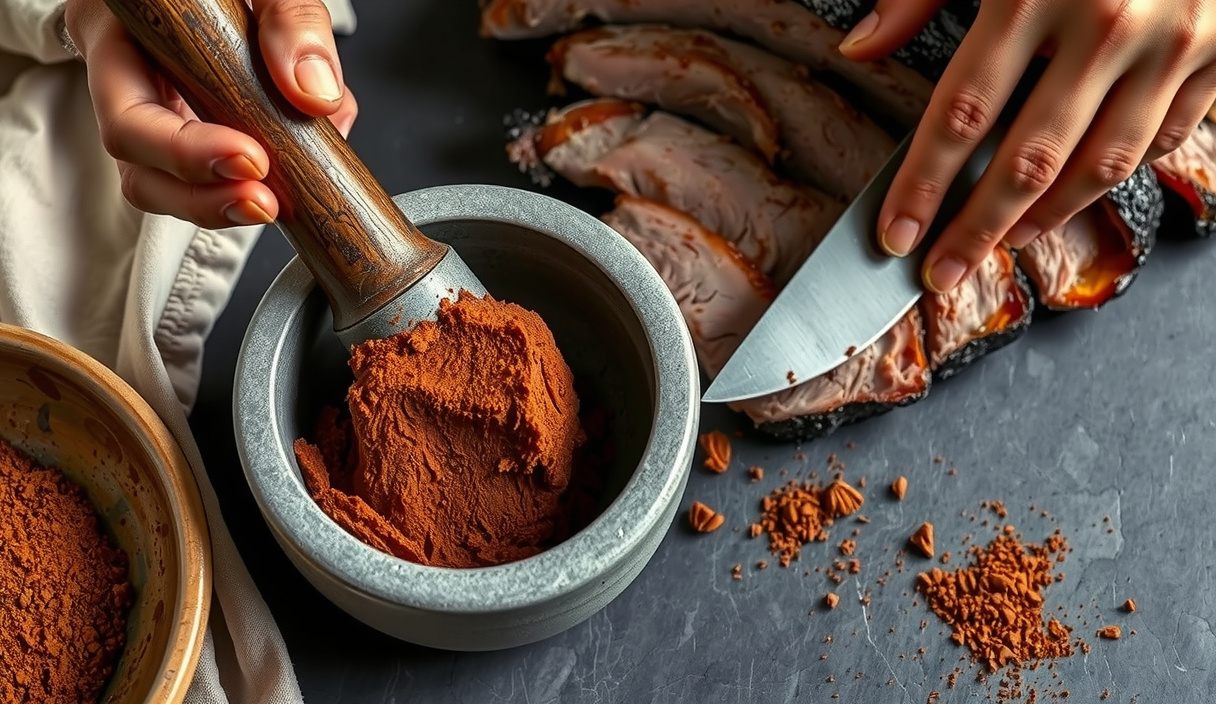
Coffee-Cocoa Brisket Rub
A precision-engineered dry rub built around fine-ground espresso and Dutch-process cocoa. The formula is calibrated to drive alkylpyrazine and furanone production that fuses with wood smoke phenols, creating a bark with roasted depth, caramel sweetness, and a finish that outlasts every one-dimensional pepper rub in the rotation. Enough for one full packer brisket (12–16 lb).
Equipment
- 1 Kitchen scale Required — volume measurements produce unreliable salt percentages in this formula
- 1 Mixing bowl Medium, wide enough to whisk without spilling
- 1 Whisk or fork For thorough incorporation of fine and coarse particles
- 1 Airtight jar or container For storage; keeps for up to 6 weeks before volatile aromatics diminish
- 1 Offset smoker or kettle grill Post oak or 60/40 post oak–pecan recommended; target 250–265°F
- 1 Instant-read thermometer For monitoring internal temp through the stall; wrap at 165–170°F
Ingredients
Dry Rub
- 70 g fine-ground espresso 25% of blend by weight; freshly ground dark roast preferred, no flavored varieties
- 42 g Dutch-process cocoa powder 15% of blend; must be alkalized (pH 6.8–7.5); do not substitute natural cocoa
- 78 g Diamond Crystal kosher salt 28% of blend; reduce by 25% if using Morton kosher salt
- 42 g dark brown sugar 15% of blend; packed; provides free fructose-glucose for early-stage Maillard browning
- 28 g coarse-ground black pepper 10% of blend; 16-mesh grind preferred for bark texture
- 20 g smoked paprika 7% of blend; adds carotenoid pigment and methyl pyrazine aromatics
- 14 g ancho chile powder 5% of blend; dried poblano at 1,000–2,000 SHU; do not substitute cayenne

Instructions
Mix the Rub
- Weigh each ingredient separately on a kitchen scale. Do not measure by volume — density mismatches between fine espresso and flake salt will throw the salt percentage off by up to 30% if you use tablespoons.42 g Dutch-process cocoa powder, 78 g Diamond Crystal kosher salt, 42 g dark brown sugar, 28 g coarse-ground black pepper, 20 g smoked paprika, 14 g ancho chile powder
- Combine all ingredients in a medium mixing bowl. Whisk thoroughly for 90 seconds, lifting from the bottom, until the brown sugar has broken up into uniform fine particles and the blend shows no streaks of lighter or darker color. The finished rub should be a uniform dark brown-black with visible coarse pepper flakes.42 g Dutch-process cocoa powder, 78 g Diamond Crystal kosher salt, 42 g dark brown sugar, 28 g coarse-ground black pepper, 20 g smoked paprika, 14 g ancho chile powder
- Transfer to an airtight jar. The rub is ready to use immediately and will keep for up to 6 weeks at room temperature, away from heat and direct light. After 6 weeks the espresso fraction loses most of its volatile pyrazine contribution; the browning function persists but the aromatic depth diminishes.
Apply to Brisket
- Pat the brisket surface completely dry with paper towels. Moisture on the surface will prevent the first layer of rub from adhering and will delay bark formation. If the brisket came from a wet-aged cryovac, dry it uncovered in the refrigerator for 4–8 hours first.
- First pass: Apply a light, even coating of rub to all surfaces — fat cap, flat, and point. This layer gives the second pass something to adhere to. Apply 100–120g of rub total across a 12–16 lb brisket.42 g Dutch-process cocoa powder, 78 g Diamond Crystal kosher salt, 42 g dark brown sugar, 28 g coarse-ground black pepper, 20 g smoked paprika, 14 g ancho chile powder
- Second pass: Apply a more generous coat, pressing firmly with the flat of your hand rather than rubbing. Rubbing strips the first layer. Focus extra coverage on the flat where surface area is greatest and bark tends to set thinner.42 g Dutch-process cocoa powder, 78 g Diamond Crystal kosher salt, 42 g dark brown sugar, 28 g coarse-ground black pepper, 20 g smoked paprika, 14 g ancho chile powder
- Rest the rubbed brisket uncovered at room temperature for 60 minutes before placing in the smoker. During this rest, salt draws surface moisture osmotically, dropping surface water activity from approximately 0.98 toward the 0.70–0.80 range. This is the critical step that primes the surface for Maillard bark formation. Skipping this step means the first hour of smoke is spent steaming rather than browning.78 g Diamond Crystal kosher salt
Smoke
- Place the brisket fat-cap-up in a smoker running at 250–265°F with post oak or a post oak–pecan blend. Do not exceed 275°F — above this threshold the brown sugar fraction pyrolyzes past melanoidin development into acrid char before the bark can fully set.
- Do not spritz for the first 4 hours. Any added moisture resets surface water activity and suppresses the Maillard reaction just as the pyrazine-phenol crust is building. The bark will look alarmingly dark by hour 3 — this is the cocoa and espresso browning ahead of the meat proteins. This is correct.
- Monitor internal temperature. The stall will occur at 160–170°F internal as evaporative cooling matches heat input. Do not wrap until the stall has broken or you reach 165–170°F. Wrap in unwaxed butcher paper (or foil for a softer bark) and continue cooking to 200–205°F internal. Rest wrapped for a minimum of 60 minutes — 90 minutes preferred — before slicing against the grain.
Notes
Why Dutch-process cocoa and not natural: pH governs Maillard condensation velocity. Dutch-process cocoa at pH 6.8–7.5 sits closer to the alkaline optimum for amino-carbonyl browning; natural cocoa at pH 5.2–5.5 suppresses the nucleophilic concentration of free amino groups, producing a lighter, more acidic bark with significantly less roasted depth. The difference is visible and palatable.
The pyrazine-phenol synergy mechanism: Ground espresso and Dutch-process cocoa contribute alkylpyrazines (notably 2-ethyl-3,5-dimethylpyrazine) through Strecker degradation of free amino acids during the extended cook. Wood smoke contributes guaiacol and syringol phenols from lignin pyrolysis. These two aromatic classes co-elute in the vapor phase above the brisket surface and are perceived in combination — the roasted-nutty character of pyrazines amplifies and extends the woodsy-smoky character of phenols in a way that neither source produces alone. This is the mechanistic basis for why coffee-and-smoke pairings are perceived as greater than the sum of their parts.
The stall explained: At 160–170°F internal, the rate of evaporative cooling at the brisket surface matches the heat input rate from the smoker. Energy that would otherwise raise the internal temperature is absorbed as latent heat of vaporization. The stall can persist for 2–4 hours depending on humidity, fat cap thickness, and smoker airflow. Wrapping in butcher paper reduces evaporative surface area and breaks the stall while preserving some bark texture. Foil breaks it faster but softens the bark completely. Do not raise smoker temperature to push through the stall — this risks scorching the sugar fraction before the interior reaches target temperature.
Allulose substitution for the no-sugar variant: Allulose (D-allulose) is a C-3 epimer of D-fructose that enters the Maillard cascade at approximately 230°F surface temperature — lower than sucrose or even brown sugar. If substituting allulose 1:1 by weight for brown sugar, reduce smoker temperature to 245°F and begin monitoring bark color at the 2.5-hour mark rather than 3 hours. Allulose browning is more aggressive, not less — this substitution is not a safety measure against scorching, it is the opposite.
Nutrition
Calories: 18kcalCarbohydrates: 4gProtein: 0.5gFat: 0.3gSaturated Fat: 0.1gSodium: 680mgFiber: 0.6gSugar: 2.5g
Tried this recipe?Let us know how it was!