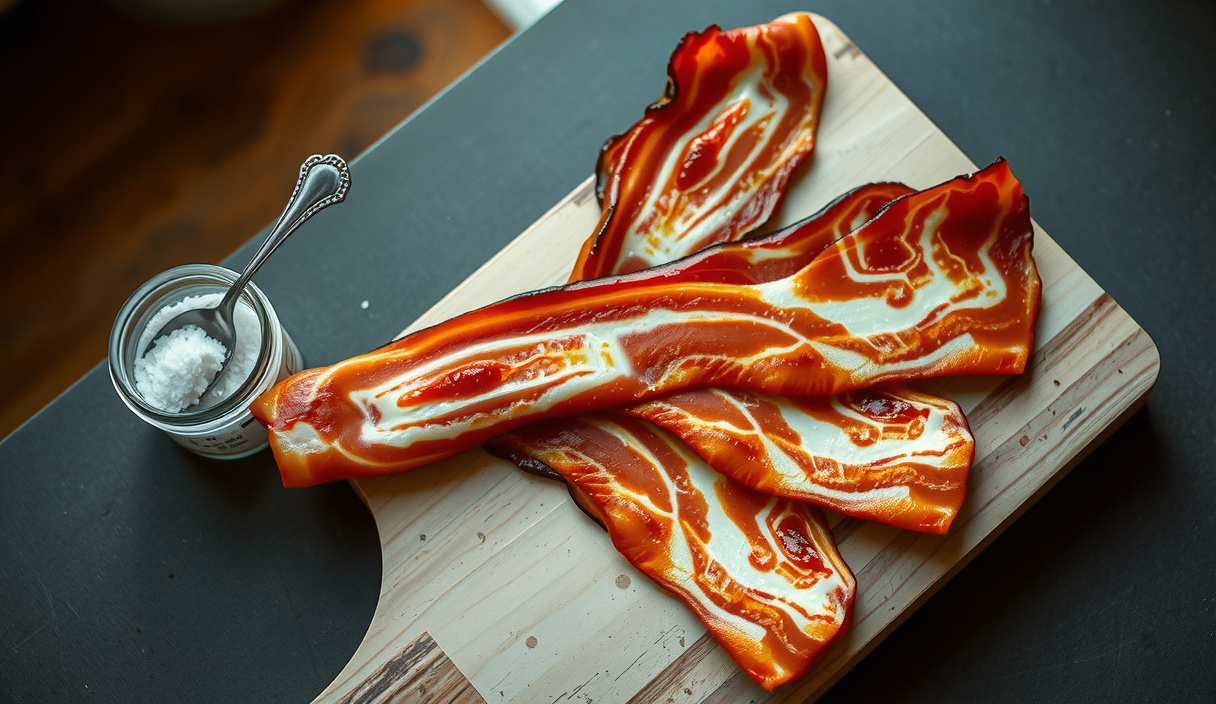
Cold-Smoked Cured Bacon — Home-Cured

A precision-cured pork belly using equilibrium curing chemistry — pink cure salt #1, sea salt, and brown sugar applied by exact weight percentage — followed by a 7-day refrigerator cure and an 8-hour cold smoke session at 80°F. The result is a deeply aromatic, properly cured slab bacon that you slice to order and hot-cook at service. This is the full process, explained at the mechanism level.
Equipment
- 1 Digital kitchen scale (0.1g resolution) Required for precise cure measurement — do not use volume measures for pink salt
- 1 Large zip-lock bag or vacuum sealer For 7-day refrigerator cure; vacuum seal is preferred for even cure distribution
- 1 Wire rack set over a sheet pan For pellicle formation — allows airflow on all sides of the belly
- 1 Cold smoke generator (maze-style) or offset smoker Must hold chamber temperature at or below 85°F throughout the 8-hour smoke session
- 1 Ambient probe thermometer Clip inside the smoking chamber to monitor chamber temperature continuously
- 1 Instant-read thermometer For verifying doneness of cooked slices at service (145°F internal minimum)
- 1 Sharp slicing knife or deli slicer Slice the belly very cold — near-frozen — for clean, even slices
Ingredients
The Cure (calculated by belly weight)
- 2 kg fresh pork belly, skin-on or skinless Even thickness 1.5–2.5 inches; flat center-cut preferred; weigh your specific piece and recalculate cure amounts accordingly
- 5 g Prague Powder #1 (pink cure salt #1) Exactly 0.25% of belly weight — for a 2 kg belly this is 5.0 g; recalculate precisely for your slab weight
- 50 g fine sea salt Exactly 2.5% of belly weight — for a 2 kg belly this is 50 g
- 30 g brown sugar, packed Exactly 1.5% of belly weight — for a 2 kg belly this is 30 g; dark brown sugar adds deeper molasses notes
Cold Smoke
- 2 cups hardwood smoking dust or fine chips (hickory, applewood, or cherrywood) Fine dust for maze generators; chips for offset setups — avoid any resinous softwood
Optional Finishing Crust (before smoking)
- 2 tbsp coarsely cracked black pepper Press into surface after pellicle forms and just before smoking; omit for classic plain bacon

Instructions
Day 1 — Calculate and Apply the Cure
- Weigh your pork belly on a digital scale and record the exact weight in grams. Calculate your cure amounts precisely: Prague Powder #1 at 0.25% (multiply belly weight in grams by 0.0025), sea salt at 2.5% (multiply by 0.025), and brown sugar at 1.5% (multiply by 0.015). Write these numbers down. Do not estimate.5 g Prague Powder #1 (pink cure salt #1), 50 g fine sea salt, 30 g brown sugar, packed
- Combine the measured Prague Powder #1, sea salt, and brown sugar in a small bowl and mix thoroughly until the pink salt is evenly distributed through the blend. The pink color should be uniform — no concentrated pink streaks.5 g Prague Powder #1 (pink cure salt #1), 50 g fine sea salt, 30 g brown sugar, packed
- Place the pork belly in a large zip-lock bag or on a clean sheet pan. Apply the entire cure blend to all surfaces of the belly — top, bottom, and sides — massaging it in evenly. Every surface must be coated. Place the belly in the zip-lock bag, press out as much air as possible, and seal. If you have a vacuum sealer, use it.5 g Prague Powder #1 (pink cure salt #1), 50 g fine sea salt, 30 g brown sugar, packed
- Refrigerate at 38–40°F (3–4°C). Flip the bag once daily. The belly will begin releasing liquid (purge) within 24 hours as osmotic pressure drives water outward. This is normal and expected — do not drain it.
Days 1–7 — The Cure
- Cure for a minimum of 7 days for a belly up to 2 inches thick. Add 1 day of cure time for every additional half-inch of thickness beyond 2 inches. Flip the bag each day. The belly will firm up noticeably as water is displaced by sodium and as the protein structure tightens. By day 7, the interior should feel uniformly firm with no soft, undercured spots at the center.
Day 7 — Rinse and Form the Pellicle
- Remove the belly from the bag. Rinse it thoroughly under cold running water to remove all surface cure residue. Pat completely dry with paper towels. Taste a thin slice from an edge to check salt level — it should be pleasantly salty but not aggressively so. If it is too salty, soak in cold water for 30 minutes and re-taste.
- Set the belly fat-side up on a wire rack over a sheet pan. Refrigerate uncovered for 12 to 24 hours. Do not cover it. The surface must dry completely and develop a tacky, slightly shiny film — the pellicle. This protein film is the adhesion surface for smoke compounds. Without a proper pellicle, smoke will not bind to the belly. The surface should feel slightly sticky to a clean fingertip when it is ready.
Day 8 — Cold Smoke (8 hours at 80°F)
- Set up your cold smoke generator or offset smoker. Verify the ambient temperature inside the smoking chamber is at or below 85°F before loading the belly. Clip an ambient probe thermometer inside the chamber, separate from any meat probe. If ambient outdoor temperature is above 60°F, use ice in a secondary pan inside the chamber or smoke only during the coolest part of the day.2 cups hardwood smoking dust or fine chips (hickory, applewood, or cherrywood)
- If using an optional pepper crust, press the cracked black pepper firmly into all surfaces of the belly now, before it enters the smoker.2 tbsp coarsely cracked black pepper
- Load the belly into the smoker fat-side up on the rack. Ignite the smoke generator and begin the 8-hour cold smoke session. Monitor chamber temperature continuously — if the chamber rises above 85°F, open a vent or pause the smoke generator. The belly is raw; food safety depends on keeping the smoking environment cold. The internal temperature of the belly should not rise above 60°F during the smoke session. If you are concerned, use a meat probe to monitor it.2 cups hardwood smoking dust or fine chips (hickory, applewood, or cherrywood)
- After 8 hours, the belly surface should be deep mahogany to reddish-brown with a dry, set exterior. Remove from the smoker. At this point the bacon is cured, smoked, and raw. It is not ready to eat — it must be cooked at service. Wrap tightly in butcher paper or plastic wrap and refrigerate.
Slicing and Cooking at Service
- For cleanest slices, refrigerate the smoked belly until very cold — just above 32°F — or place in the freezer for 30 minutes until firm but not hard. Slice to your preferred thickness (3–4mm for standard breakfast bacon, 6–8mm for thick-cut) using a sharp knife or deli slicer.
- To cook, place slices in a cold or lightly warm dry skillet or cast-iron pan. Start over medium-low heat to allow fat to render before the lean dries out. Increase heat to medium once fat has begun to render. Cook until the bacon reaches your preferred texture — the lean should reach a minimum internal temperature of 145°F. Rest briefly on a paper towel. Serve immediately.
Notes
Why 0.25% Prague Powder #1? Sodium nitrite is the primary antimicrobial agent preventing Clostridium botulinum germination in this anaerobic, reduced-water-activity environment. Prague Powder #1 is 6.25% sodium nitrite by weight. At 0.25% application rate, you are delivering approximately 156 ppm of nitrite to the meat — within the USDA's established safe range of 120–200 ppm for cured whole-muscle products. Do not increase this dose. Do not decrease it. Do not substitute. Nitrite is also responsible for the characteristic pink cure color (nitrosomyoglobin formation) and contributes to the cured flavor through nitrogen-carbon chemistry during Maillard browning at service temperatures.
Why cold smoke instead of hot smoke first? Cold smoking deposits guaiacol, syringol, and phenolic aromatic compounds onto the surface of a still-raw protein. These compounds condense and bind to the tacky pellicle below the onset of protein denaturation (~103°F for myosin). If you hot-smoked first, surface proteins would denature and the pellicle chemistry would change, altering both smoke adhesion and final flavor integration. The two-stage process — cold smoke the raw belly, hot-cook at service — allows the smoke aromatics to fully bind, then interact with fat rendering and Maillard browning during the final cook for maximum sensory complexity.
The pellicle is a protein film, not a skin. When you leave the rinsed belly uncovered in the refrigerator, moisture evaporates from the surface while dissolved proteins from the curing purge migrate outward and dry down. This creates a semi-rigid, tacky layer of concentrated protein that acts as a physical adhesion substrate for wood-smoke phenols. The equilibrium between surface evaporation and protein concentration is why the belly needs 12–24 hours, not 2. Rushing the pellicle by using a fan on high setting can cause the surface to dry too quickly and crack rather than form a uniform film — moderate air circulation is fine, aggressive drying is not.
Stacking cure days is cumulative, not additive. A belly that sat in cure for 6 days cannot be fixed by adding more cure on day 7. The equilibrium diffusion process is time- and temperature-dependent. If you are unsure whether your belly is fully cured, press the center firmly — a fully cured belly feels uniformly firm and slightly springy, with no soft undercured pocket at the thickest point. If you feel softness at the center, it needs more time.
Nutrition
Calories: 210kcalCarbohydrates: 0.5gProtein: 7gFat: 20gSaturated Fat: 7gCholesterol: 35mgSodium: 520mgSugar: 0.5g
Tried this recipe?Let us know how it was!