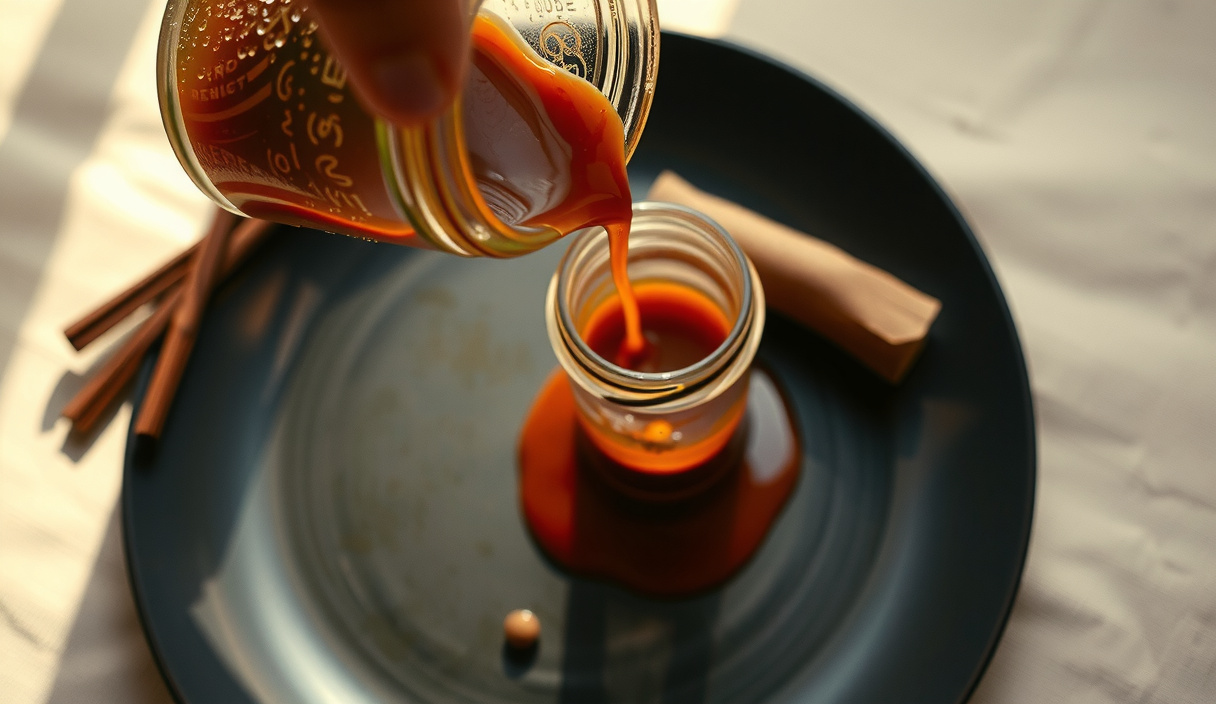
Gluten-Free BBQ Sauce — Tamari Base

A genuinely gluten-free BBQ sauce built on certified tamari, tomato paste, blackstrap molasses, apple cider vinegar, and smoked paprika. No Worcestershire, no malt, no hidden wheat — just deep, layered, pitmaster-grade flavor reduced to a nappe-consistency sauce that works on brisket, ribs, chicken, or anything that touches fire.
Equipment
- 1 Heavy-bottomed saucepan (3-quart minimum) 3-ply stainless or enameled cast iron preferred — prevents scorching at high sugar concentrations
- 1 Silicone spatula Flexible enough to reach pan edges and prevent caramelized sugar buildup
- 1 Fine-mesh strainer Optional — for ultra-smooth texture; strain out any solids before jarring
- 1 Instant-read thermometer or refractometer Refractometer reads 38–42 Brix at the correct endpoint; thermometer confirms sauce is below 220°F during active reduction
- 1 Mason jar (pint, wide-mouth) For storage; sterilize if canning
Ingredients
Aromatic base
- 2 tablespoons extra-virgin olive oil
- 1 teaspoon garlic powder certified GF; single-ingredient, no anti-caking fillers
- 1 teaspoon onion powder certified GF
- 2 teaspoons smoked paprika certified GF; Spanish pimenton de la vera preferred for depth
- ½ teaspoon dry mustard powder certified GF
- ¼ teaspoon cayenne pepper adjust to heat preference
Wet base
- 6 ounces tomato paste one standard small can; look for BPA-free, no-added-sugar varieties
- ½ cup certified gluten-free tamari San-J or Kikkoman GF certified; verify the GF certification mark on label — not merely 'wheat-free'
- ½ cup apple cider vinegar raw unfiltered preferred; naturally GF
- ¼ cup blackstrap molasses unsulfured; Brer Rabbit or Plantation brand; provides melanoidin depth and viscosity
- ¼ cup packed dark brown sugar balances blackstrap bitterness; naturally GF
- 1 cup water filtered; starting hydration for reduction
Finishing
- 1 tablespoon fresh lemon juice added off-heat; brightens without adding harsh acidity
- 1 teaspoon kosher salt Diamond Crystal; add after full reduction and taste — tamari contributes substantial sodium
- ½ teaspoon freshly cracked black pepper

Instructions
Build the aromatic base
- Heat the olive oil in your heavy-bottomed saucepan over medium heat until it shimmers — approximately 300°F at the surface. Add the garlic powder, onion powder, smoked paprika, dry mustard, and cayenne all at once.Stir constantly with the silicone spatula for 45 to 60 seconds. You are blooming the fat-soluble aroma compounds into the lipid phase: the guaiacol volatiles from the smoked paprika, the allyl sulfides from the garlic and onion, and the capsaicin from the cayenne all partition dramatically better into oil than into water. Do not walk away — spice powders scorch fast in direct-contact oil.1 teaspoon garlic powder, 1 teaspoon onion powder, 2 teaspoons smoked paprika, 1/2 teaspoon dry mustard powder, 1/4 teaspoon cayenne pepper
- Add the tomato paste directly to the bloomed spice oil. Stir and cook for 2 to 3 minutes, pressing the paste against the pan, until it deepens from bright red to a brick-red color and begins to stick slightly to the bottom. This step drives additional Maillard browning in the tomato's sugar-amino acid matrix and reduces its raw, acidic edge before the vinegar goes in.6 ounces tomato paste
Build and dissolve the wet base
- Pour in the tamari, apple cider vinegar, blackstrap molasses, brown sugar, and water in one pour. Stir vigorously to deglaze any fond from the bottom of the pan — those stuck bits are concentrated Maillard solids and are full of flavor.Raise heat to medium-high and bring the mixture to a full boil, stirring until the brown sugar is completely dissolved. You will see a single, unified, deep mahogany liquid with no visible sugar granules.1/2 cup certified gluten-free tamari, 1/2 cup apple cider vinegar, 1/4 cup blackstrap molasses, 1/4 cup packed dark brown sugar, 1 cup water
Reduce to nappe consistency
- Once the sauce reaches a full boil, immediately drop the heat to a steady simmer — medium-low, with occasional large lazy bubbles breaking the surface. A hard rolling boil will volatilize the smoked paprika aromatics and the acetic acid edge of the ACV faster than flavor can develop. This is the critical heat-management step.Simmer uncovered, stirring every 3 to 5 minutes and scraping the edges of the pan, for 20 to 25 minutes. The sauce is ready when it coats the back of the spatula cleanly and holds a distinct line when you draw a finger through it. Volume will reduce by approximately 30 to 35 percent from the starting amount.
Finish and season
- Remove the pan from heat. Stir in the fresh lemon juice. The lemon goes in off-heat to preserve its bright, volatile citrus esters — heat destroys them rapidly.Taste the sauce now, before adding salt. The tamari has contributed significant sodium through the reduction. Add the kosher salt and freshly cracked black pepper gradually, tasting after each addition. The finished sauce should be deeply savory, smoke-forward, tangy, and balanced — not salty-forward.1 tablespoon fresh lemon juice, 1 teaspoon kosher salt, 1/2 teaspoon freshly cracked black pepper
- For a smooth, glossy finished texture, pass the sauce through a fine-mesh strainer, pressing the solids through with the back of a spoon. For a slightly more rustic texture with visible spice freckles, skip the strainer — both are correct.Transfer to a sterilized mason jar while still hot. Let cool uncovered for 10 minutes, then seal and refrigerate. The sauce will thicken further as it chills — this is normal starch retrogradation behavior from the tomato paste pectin and concentrated sugars. It will loosen again when warmed.
Notes
Why tamari, not soy sauce or Worcestershire? Standard soy sauce (shoyu) is brewed with roughly equal parts wheat and soybeans — a direct gluten exposure. Worcestershire sauce is traditionally fermented with malt vinegar, a barley derivative, placing it firmly off-limits for celiac disease. Tamari was historically the liquid pressed from miso, made primarily from soybeans with minimal or no wheat. Certified GF tamari is third-party tested to below 20 ppm gluten — the FDA threshold for gluten-free labeling — making it the only structurally sound drop-in that preserves the fermented-umami depth both ingredients contribute.
Maillard kinetics and acid suppression: Apple cider vinegar at pH 3.0–3.5 suppresses Maillard browning during the reduction phase by protonating the amino groups needed for Schiff base formation. This is deliberately exploited here — it keeps the sauce from scorching before it reaches the correct Brix level, while the molasses and brown sugar supply pre-formed melanoidins and reducing sugars that contribute color and flavor without requiring high-temperature browning conditions. The tomato paste's brief high-heat bloom (step 1b) is where the controlled Maillard development actually occurs.
Fat partition and smoke perception: The methoxyphenol volatiles in smoked paprika — guaiacol, 4-methylguaiacol, and eugenol — have log P values between 1.1 and 2.7, meaning they strongly prefer the lipid phase over the aqueous phase. The olive oil in this recipe acts as a controlled-release reservoir: volatiles partition into the oil at rest and burst retronasally when the sauce is sheared during eating. This mechanism is why the smoke character of this sauce persists through multiple bites rather than front-loading on first contact.
Reduction endpoint physics: A correctly reduced batch will register 38–42 Brix on a refractometer. Below 35 Brix, the sauce lacks the pseudoplastic cling needed to adhere to meat during basting. Above 45 Brix, sugar crystallization risk increases on cooling and the sauce may seize in the jar. The nappe test is the practical field equivalent: the sauce coats a spoon, holds a clean line when you drag through it, and does not drip off in a thin stream.
Cross-contact note for celiac severity: Beyond the tamari label, confirm that your smoked paprika, garlic powder, onion powder, and brown sugar are manufactured on dedicated GF lines or tested to GF thresholds. Spice blends and grocery-store brown sugar occasionally share equipment with wheat-containing products. Single-origin certified-GF spices eliminate this vector entirely.
Nutrition
Calories: 35kcalCarbohydrates: 6.5gProtein: 0.8gFat: 1.1gSaturated Fat: 0.2gSodium: 310mgFiber: 0.4gSugar: 5.2g
Tried this recipe?Let us know how it was!