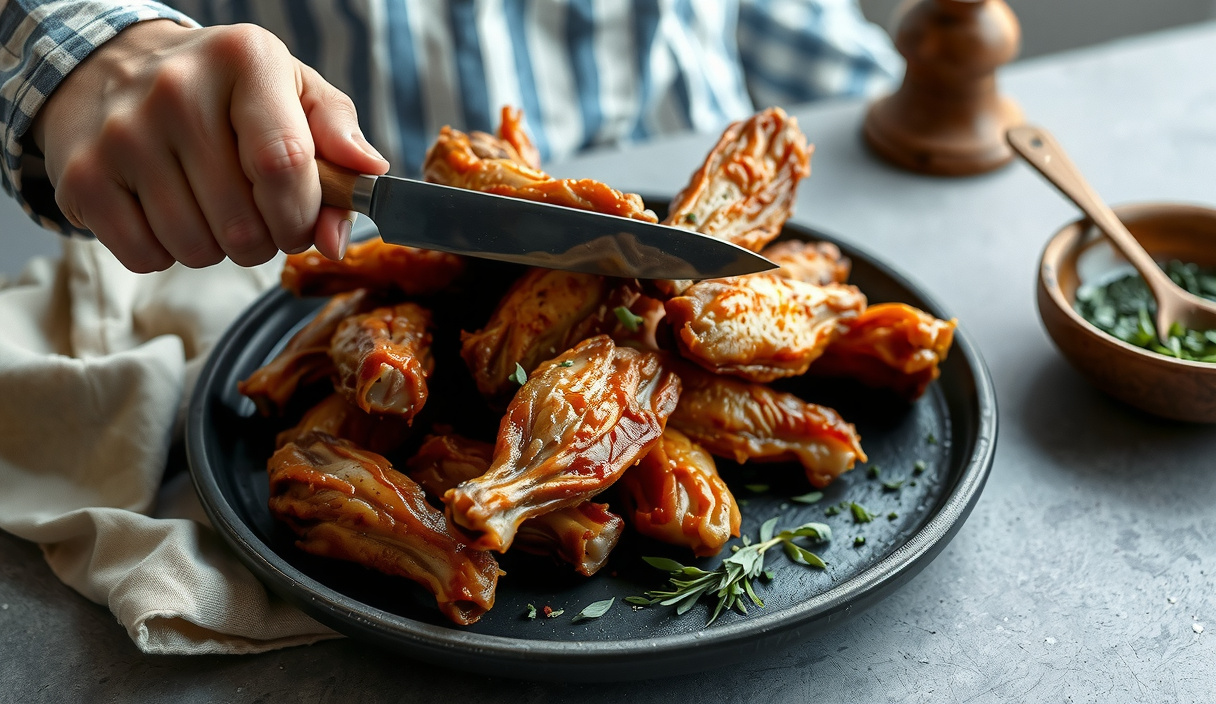
Gluten-Free Smoked Wings — Shatter-Crisp Coating

A two-stage smoke-and-finish program produces gluten-free chicken wings with a tapioca-cornstarch crust that shatters audibly on the bite. Smoke builds flavor in the fat layer; a 425°F blast or quick fry locks the starch lattice into a glass-like shell. No gluten, no compromises.
Equipment
- 1 Smoker or kettle grill (indirect heat, 250°F capable) Pellet grill, offset, or kettle with snake method. Wood: cherry or apple chunks.
- 1 Instant-read thermometer Thermapen or equivalent. Required for the 160°F pull point.
- 1 Wire rack set inside a rimmed sheet pan For the oven-finish option. Elevates wings so rendered fat drips away and hot air circulates on all sides.
- 1 Large zip-lock bag or wide mixing bowl For tossing the dredge onto the wings.
- 1 Cast-iron skillet or Dutch oven (fry-finish option) Holds a minimum of 2 inches of oil at 375°F. A 5-quart Dutch oven is ideal for heat stability.
- 1 Clip-on or probe thermometer For monitoring oil temperature if using the fry-finish method.
Ingredients
Wings
- 3 lbs chicken party wings (flats and drumettes, split) Pat dry thoroughly with paper towels. Place on a wire rack uncovered in the refrigerator for 8–24 hours before cooking. This is not optional — surface drying is the mechanism for crust adhesion.
- 1 tsp kosher salt Applied to the wings before the dredge. Brines the surface proteins and pre-seasons the meat.
- 1 tsp black pepper, freshly ground
Gluten-Free Dredge
- 3 tbsp tapioca starch Not tapioca flour. Provides the elastic, pliable base film that adheres to the skin. Gelatinizes at 140–149°F during the smoke stage, anchoring the dredge.
- 3 tbsp cornstarch Use certified gluten-free cornstarch (Bob's Red Mill or Anthony's). Forms the rigid, glass-like lattice in the high-heat finish stage. Gelatinizes at 157–167°F.
- 1 tsp certified gluten-free baking powder Clabber Girl or Rumford are certified GF. Raises surface pH to approximately 8.0–8.5, accelerating Maillard browning in the finish stage.
- 1 tsp garlic powder
- 1 tsp smoked paprika Adds a secondary smoke compound layer and contributes carotenoid pigments that deepen color.
- 0.5 tsp onion powder
- 0.5 tsp cayenne pepper Optional. Adds trigeminal TRPV1 heat. Omit for a mild profile.
- 0.5 tsp kosher salt In the dredge, separate from the pre-season salt.
Smoke Stage
- 2 oz cherry or apple wood chunks One fist-sized chunk at a time. Avoid over-smoking wings — their high surface-area-to-mass ratio makes them absorb smoke compounds faster than large cuts.
Finish Stage (choose one method)
- 2 tbsp neutral oil (avocado, refined coconut, or grapeseed) Oven-finish option: brush or mist lightly over wings before the 425°F blast. Accelerates Maillard by providing a thin conductive lipid layer.
- 1 quart neutral frying oil (avocado or refined peanut) Fry-finish option only. Fill the Dutch oven or skillet to 2 inches. Target 375°F. High smoke-point oils prevent off-flavor development at frying temperatures.

Instructions
Dry-Brine and Prep (Day Before)
- Pat the wings completely dry with paper towels — every surface, every crevice. Set them on a wire rack placed over a sheet pan. Season lightly with 1 tsp kosher salt and 1 tsp black pepper. Refrigerate uncovered for 8 to 24 hours. The goal is a surface that looks matte and feels tacky to the touch, not wet. This step directly controls crust adhesion: a wet surface creates a paste-dredge that steams rather than crisps.1 tsp kosher salt, 1 tsp black pepper, freshly ground
Build the Dredge
- Combine 3 tbsp tapioca starch, 3 tbsp cornstarch, 1 tsp certified GF baking powder, 1 tsp garlic powder, 1 tsp smoked paprika, 0.5 tsp onion powder, 0.5 tsp cayenne (if using), and 0.5 tsp kosher salt in a wide bowl or zip-lock bag. Whisk or shake until homogeneous. There should be no visible clumps — baking powder lumps will create localized alkaline hot-spots and uneven color.3 tbsp tapioca starch, 3 tbsp cornstarch, 1 tsp certified gluten-free baking powder, 1 tsp garlic powder, 1 tsp smoked paprika, 0.5 tsp onion powder, 0.5 tsp cayenne pepper, 0.5 tsp kosher salt
- Remove the wings from the refrigerator. Working in batches of 8 to 10 pieces, add them to the dredge bag or bowl and toss aggressively until every surface is coated. Shake off any large excess — you want a thin, even film, not a thick crust. Return the coated wings to the wire rack and let them rest for exactly 10 minutes before loading the smoker. During this rest, surface moisture migrates into the starch layer, partially gelatinizing it and gluing it to the skin.3 tbsp tapioca starch, 3 tbsp cornstarch, 1 tsp certified gluten-free baking powder, 1 tsp garlic powder, 1 tsp smoked paprika, 0.5 tsp onion powder, 0.5 tsp cayenne pepper, 0.5 tsp kosher salt
Smoke Stage (250°F to 160°F Internal)
- Set up your smoker or kettle grill for indirect heat and stabilize the temperature at 250°F. Add one chunk of cherry or apple wood. Place the coated wings directly on the grate, skin side up, leaving at least 1 inch between pieces. Do not crowd them — airflow is smoke-delivery infrastructure.2 oz cherry or apple wood chunks
- Smoke the wings uncovered at 250°F until an instant-read thermometer inserted into the thickest part of a drumette (not touching bone) reads 160°F internal. This will take 60 to 90 minutes depending on wing size, smoker efficiency, and ambient temperature. Add a second wood chunk at the 30-minute mark if smoke has subsided. Do not open the smoker unnecessarily — each lid-lift drops the chamber temperature and extends the smoke time unpredictably.2 oz cherry or apple wood chunks
- At 160°F, remove the wings and transfer them immediately to the wire rack set over a sheet pan. The dredge will appear set but pale — that is correct. The Maillard browning happens in the finish stage, not the smoker. Move quickly to the next step; resting time here should be under 5 minutes to retain maximum surface heat for the finish.
Finish Stage — Option A: Oven at 425°F
- While the wings are in the final 15 minutes of the smoke stage, preheat your oven to 425°F convection (or 450°F conventional if convection is unavailable). Lightly brush or spray the smoked wings with 2 tbsp neutral oil. This thin lipid layer conducts heat into the starch matrix and provides the fat-phase needed to fry the crust from the outside while rendered subcutaneous fat fries it from the inside.2 tbsp neutral oil (avocado, refined coconut, or grapeseed)
- Slide the wire rack with wings into the oven. Roast for 15 to 20 minutes, flipping the wings once at the 10-minute mark, until the crust is deeply golden and the surface cracks when you gently flex a wing. Internal temperature should reach 165–170°F. Remove immediately — at 175°F+ the actin network collapses fully and the meat turns dry.2 tbsp neutral oil (avocado, refined coconut, or grapeseed)
Finish Stage — Option B: Fry at 375°F
- Pour 1 quart neutral frying oil into a 5-quart Dutch oven or a deep cast-iron skillet. Heat over medium-high to 375°F on a clip-on thermometer. Maintain this temperature throughout — temperature drop during frying is the primary cause of soggy fried coatings because it shifts starch granule behavior from rapid dehydration to slow stewing.1 quart neutral frying oil (avocado or refined peanut)
- Working in batches of 6 to 8 wings, lower them into the oil using tongs or a spider strainer. Fry for 3 to 4 minutes, turning once, until deeply golden and the crust visibly crackles. Allow the oil to return to 375°F between batches (2 to 3 minutes). Drain on a wire rack, not paper towels — paper towels trap steam against the crust and collapse the lattice you just built.1 quart neutral frying oil (avocado or refined peanut)
Serve
- Serve immediately — the shatter-crisp window is widest in the first 8 minutes off the heat. If tossing in sauce, use a butter-emulsified hot sauce (Buffalo style) applied just before plating: the fat phase coats the starch lattice rather than hydrating it. Water-based sauces should be served on the side for dipping to preserve the crust's integrity. A sprinkle of flaky salt over the wings immediately after finishing reinforces the savory top note.
Notes
Why the two-starch dredge works: Tapioca starch (amylopectin-dominant, gelatinizes at 140–149°F) forms the elastic base film during the low-and-slow smoke stage, physically adhering the dredge to the skin proteins. Cornstarch (higher amylose, gelatinizes at 157–167°F) activates in the high-heat finish stage, crosslinking into a rigid, glass-like lattice that produces the audible shatter. Using either starch alone fails: tapioca alone produces a gummy, chewy crust; cornstarch alone produces a brittle crust that cracks and separates from the skin.
Why baking powder drives browning: Baking powder contains sodium bicarbonate, which raises the surface pH of the dredge to approximately 8.0–8.5. At alkaline pH, free amino groups on the skin proteins become more nucleophilic, dramatically accelerating the Maillard reaction — specifically the rate of Schiff base formation and Amadori rearrangement. The practical result is a darker, more complex crust at lower temperatures and shorter finish times compared to a neutral-pH dredge. Use certified gluten-free baking powder (Clabber Girl, Rumford) — standard baking powder sometimes uses wheat starch as the carrier.
The 160°F pull point: Poultry actin denatures aggressively between 165–167°F. Pulling wings at 160°F internal in the smoker and finishing at high heat means the carryover and the 15–20 minutes in the 425°F oven deliver a final internal temperature of 165–170°F — the USDA safe minimum for poultry — without overshooting into the zone (175°F+) where the actomyosin complex violently contracts and expels bound moisture, producing dry, cottony wing meat. This is thermodynamic precision, not guesswork. Use a probe.
Celiac cross-contact note: This recipe uses no gluten-containing ingredients, but celiac-safe execution requires verified equipment cleaning and certified GF labeling on both the cornstarch and baking powder. Some cornstarch facilities process wheat on shared equipment. Bob's Red Mill and Anthony's cornstarch are routinely certified GF. When in doubt, contact the manufacturer directly.
Nutrition
Calories: 410kcalCarbohydrates: 10gProtein: 32gFat: 27gSaturated Fat: 7gCholesterol: 145mgSodium: 540mg
Tried this recipe?Let us know how it was!