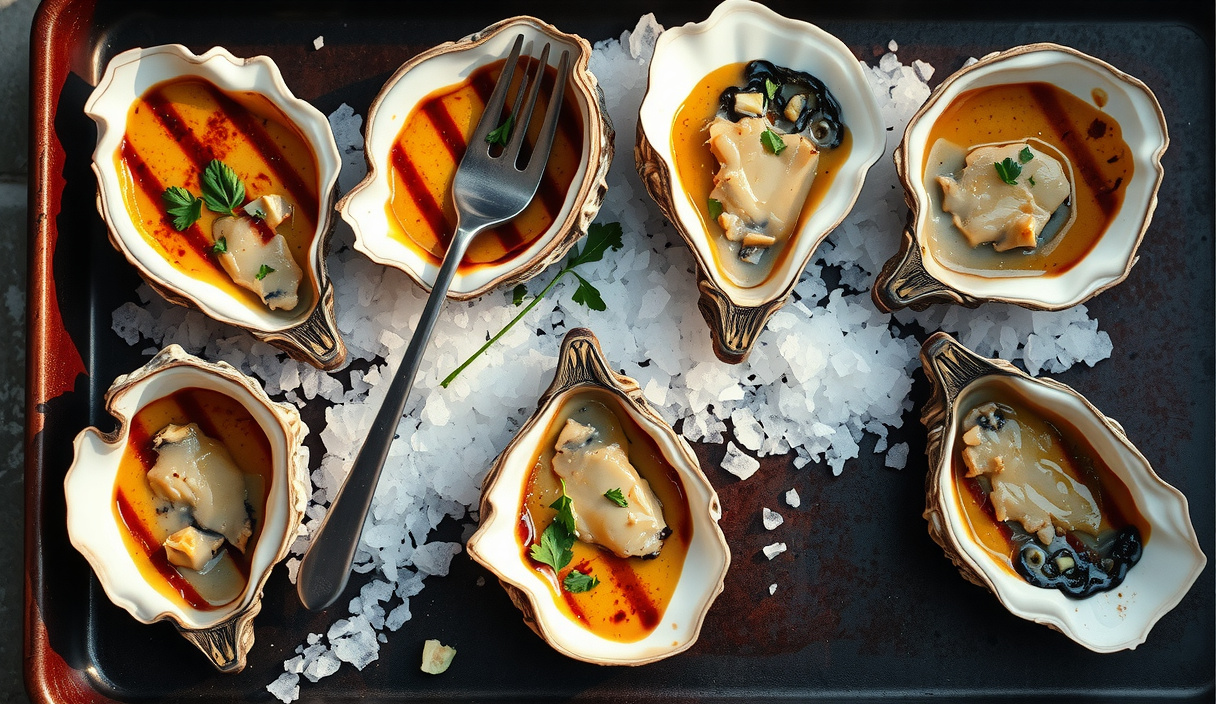
Grilled Oysters with Garlic-Parsley Butter

Live oysters grilled on the half shell at 500°F until the adductor releases and the lid pops open — then finished with a compound garlic-parsley butter that Maillard-browns against the glycogen-rich meat in under 90 seconds. The result is simultaneously briny, caramelized, and deeply savory: one of the fastest high-impact seafood preparations in the pitmaster's arsenal.
Equipment
- 1 Charcoal or gas grill Must reach and hold 500°F (260°C) at the grate surface. Verify with an infrared thermometer.
- 1 Infrared thermometer Essential for confirming grate temperature before committing oysters.
- 1 Sheet pan with coarse rock salt or crumpled aluminum foil Acts as a cradle to hold finished oysters level during serving and catches butter runoff.
- 1 Oyster knife For prying any oysters that do not fully open on their own.
- 1 Long-handled tongs Heat-rated for direct grill work. Use to transfer oysters and nudge open shells.
- 1 Small spoon or pastry brush For depositing compound butter into each open shell quickly.
- 1 Kitchen timer Non-negotiable. The window is 90 seconds.
Ingredients
Oysters
- 24 live oysters, deep-cupped variety (Gulf Select, Pacific, or Kumamoto) Shells must be tightly closed or snap shut when tapped. Scrub shells under cold running water before grilling.
Garlic-Parsley Compound Butter
- 8 tablespoons unsalted European-style butter (82–84% fat), softened to room temperature Higher fat content increases aroma-retention capacity. Standard American butter works but delivers slightly less richness.
- 4 cloves garlic, minced very fine Mince immediately before mixing to maximize allicin generation from the enzymatic conversion. Do not use pre-minced jarred garlic.
- 3 tablespoons fresh flat-leaf parsley, finely chopped Adds chlorophyll-green brightness and a grassy VOC layer that contrasts the butter richness.
- 1 tablespoon fresh lemon juice Shifts system to pH 4–5, amplifying perceived brininess and retronasal volatile release. Add just before serving, not into the base compound, to prevent emulsion weeping during hold.
- 1 teaspoon kosher salt
- 0.5 teaspoon freshly cracked black pepper
- 0.25 teaspoon crushed red pepper flakes Optional. Capsaicin activates TRPV1 channels and creates a mild chemesthetic heat that highlights the brine.
For Serving
- 2 cups coarse rock salt or crumpled aluminum foil Spread on a sheet pan to cradle and stabilize finished oysters during plating.
- 1 lemon, cut into wedges For additional acid at the table.
- 1 small bunch fresh parsley, for garnish Optional.

Instructions
Make the Compound Butter
- In a small bowl, combine the softened butter, minced garlic, chopped parsley, kosher salt, black pepper, and red pepper flakes if using. Mix vigorously with a fork until fully homogeneous — no streaks of plain butter remaining. Do not add lemon juice yet. Acid added now can cause the emulsion to weep during hold. Transfer to a small ramekin, cover, and hold at cool room temperature for up to 1 hour, or refrigerate for up to 5 days and bring back to spreadable consistency before service.4 cloves garlic, minced very fine, 3 tablespoons fresh flat-leaf parsley, finely chopped, 1 teaspoon kosher salt, 0.5 teaspoon freshly cracked black pepper, 0.25 teaspoon crushed red pepper flakes
Prep the Grill and Staging Area
- Light a full chimney of lump charcoal. When the coals are fully ashed over and glowing orange (about 15–20 minutes), dump into the grill and spread into an even single layer. Open all vents fully. Allow to heat for 10 minutes with the grill grate in place and the lid off. Verify surface temperature with an infrared thermometer: target 480–520°F (249–271°C). For gas grills, preheat on high with the lid closed for 10 minutes and verify the same target.
- While the grill heats, spread coarse rock salt or tightly crumpled aluminum foil across a sheet pan to a depth of about 1 inch. This is your serving and holding platform. Set it on a heatproof surface near the grill. Set out the ramekin of compound butter and your spoon or brush within arm's reach of the grill.2 cups coarse rock salt or crumpled aluminum foil
- Scrub oyster shells under cold running water with a stiff brush to remove grit and debris. Inspect each one: any oyster with a gaping shell that does not snap closed when tapped is dead — discard it. Sort oysters so the deep, cupped side is visually identifiable. This orientation goes down on the grate.
Grill the Oysters
- Place oysters directly on the hot grate, deep cup down, flat lid up. Work in batches of 6 to 12 depending on your grill surface area. Do not crowd — each oyster needs direct radiant heat from the coals below. Start your timer the moment the last oyster hits the grate.
- At approximately 50–60 seconds, watch for the flat lid to crack open. This signals that the adductor muscle has denatured sufficiently and the internal steam pressure has lifted the shell. Use tongs to nudge any lid that is slow to open — apply gentle lateral pressure at the hinge side. Do not force; if the shell resists, give it another 10–15 seconds.
- The moment a shell is fully open, use your spoon to deposit approximately 1 teaspoon of compound butter directly onto the meat. The residual heat of the shell and the steam will melt the butter within 5–10 seconds, and it will immediately begin to bubble and brown against the glycogen-rich oyster surface. At 75–80 seconds, the butter should be actively bubbling. At 90 seconds total from when the oysters hit the grate, pull all oysters with tongs and transfer them immediately to the salt or foil bed on your sheet pan. The meat edges should be just curled; the liquor should be opaque and milky-gold, not evaporated. Do not exceed 90 seconds.4 cloves garlic, minced very fine, 3 tablespoons fresh flat-leaf parsley, finely chopped, 1 teaspoon kosher salt, 0.5 teaspoon freshly cracked black pepper, 0.25 teaspoon crushed red pepper flakes
Finish and Serve
- Squeeze fresh lemon juice over the oysters immediately before serving — not before, as acid weeping into the warm butter will cause the sauce to break and pool in the shell. Add a few small parsley leaves for garnish if desired. Serve directly on the salt-lined sheet pan, with lemon wedges alongside. Eat immediately — grilled oysters hold for approximately 3 minutes before the interior cools past the optimal serving temperature of 55–60°C and the texture begins to tighten.1 tablespoon fresh lemon juice, 1 lemon, cut into wedges, 1 small bunch fresh parsley, for garnish
Notes
Why the shell opens on its own: The oyster adductor muscle — the single protein column holding the shell halves together — begins rapid myosin denaturation around 50°C (122°F). As internal steam pressure builds and the adductor loses structural integrity through the 55–65°C range, the elastic tension in the shell ligament overwhelms the weakening muscle, and the lid springs open. This is the same protein-denaturation physics that causes a bivalve to open in any wet-heat application, accelerated here by the extreme radiant energy of a 500°F grate.
The Maillard window at the oyster surface: Oyster glycogen is a branched glucose polymer that begins hydrolyzing into free reducing sugars as cell membranes rupture under heat. At the butter-meat interface, where surface temperature can exceed 150°C locally, these glucose units condense with free amino acids (primarily cysteine and lysine from the garlic) via Schiff base formation and Amadori rearrangement, then cascade through Strecker degradation into pyrazines, furanones, and thiophenes. This is why the aroma of a grilled oyster includes notes of toasted bread and roasted meat that are entirely absent in the raw bivalve.
The 74°C danger threshold: Actin, the most thermally stable myofibrillar protein, denatures and collapses between 74–78°C (165–172°F), causing violent transverse contraction of the muscle fiber network and mass expulsion of bound water. An oyster that crosses this threshold internally becomes rubbery, shrunken, and dry. The 90-second protocol at 500°F is calibrated to hold the interior at approximately 60–65°C while driving the surface past Maillard onset — a deliberate exploitation of the steep thermal gradient between the hot grate and the cool, liquid-filled interior of the shell.
Fat as an aroma-retention system: European butter at 82–84% fat provides a substantially larger lipid phase than standard American butter. Lipophilic volatile compounds generated during Maillard browning (including 2-acetyl-1-pyrroline, the key popcorn-aroma compound, and numerous thiazoles) partition strongly into this fat phase, suppressing their immediate headspace release and extending the aromatic narrative on the palate. This is the same thermodynamic partitioning principle that makes a rich cream sauce carry flavor longer than a thin broth.
Nutrition
Calories: 210kcalCarbohydrates: 7gProtein: 10gFat: 16gSaturated Fat: 9gCholesterol: 85mgSodium: 480mgSugar: 1g
Tried this recipe?Let us know how it was!