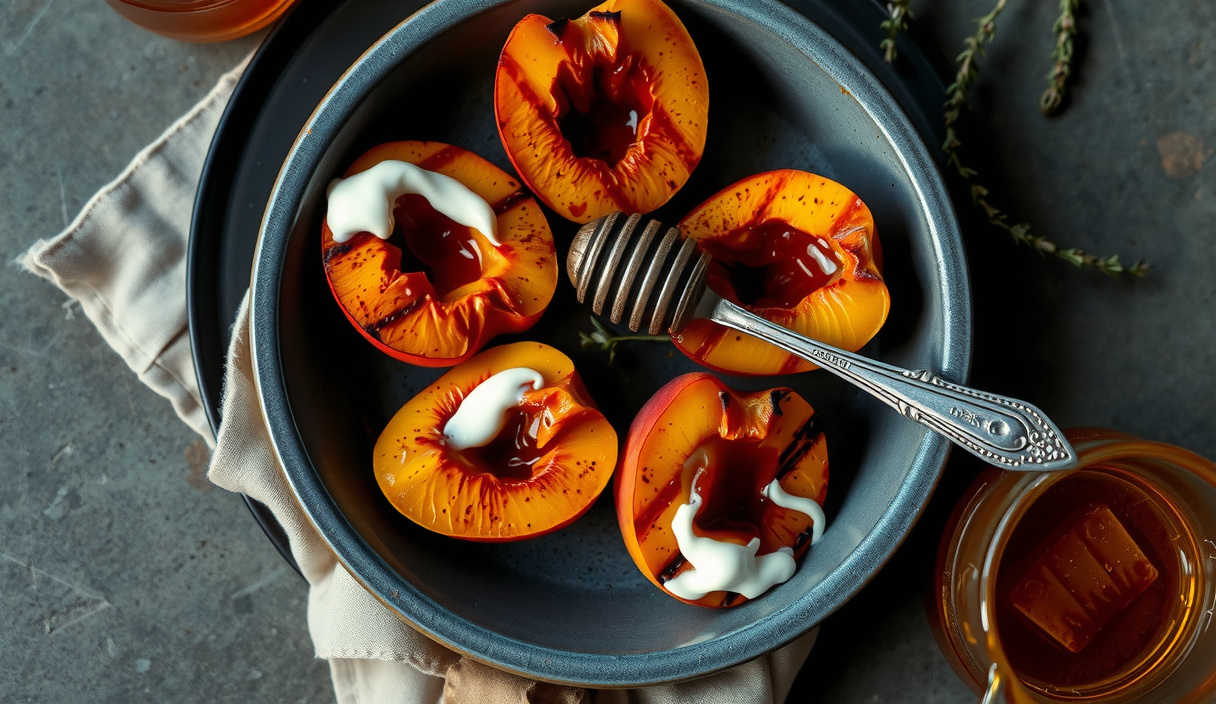
Grilled Peaches with Honey-Yogurt and Fresh Thyme

Halved freestone peaches go cut-side down on a screaming-hot grill for three precise minutes, long enough for the free fructose and glucose in ripe stone fruit to clear the evaporative cooling phase and ignite a full Maillard browning cascade — caramel, brown butter, and roasted-stone aromas in under four minutes. Finished with cold full-fat Greek yogurt, raw honey, fresh thyme, and a pinch of flaky sea salt. Four ingredients. One technique. No oven.
Equipment
- 1 Gas or charcoal grill Must reach 450–500°F (232–260°C) at the grate surface. Preheat with lid closed for at least 10 minutes.
- 1 Laser thermometer Optional but strongly recommended — confirms grate surface temperature rather than relying on ambient dial readings.
- 1 Thin wide spatula Slides fully under the flat caramelized face for clean removal without tearing the flesh.
- 1 Pastry brush For applying neutral oil to the cut face of each peach half before grilling.
- 1 Sharp chef's knife For halving and pitting the peaches cleanly along the crease.
Ingredients
Grilled Peaches
- 4 ripe freestone peaches Fully ripe — they should yield slightly when pressed at the shoulder. Freestone varieties release from the pit cleanly. Do not use underripe fruit.
- 1 tablespoon neutral oil Grapeseed or avocado oil. Applied to the cut face, not the grate, to prevent sticking and promote even heat conduction.
- 1 pinch flaky sea salt Maldon or similar. Applied at plating, not during cooking. Heightens sweetness perception and amplifies the caramel char aroma.
Honey-Yogurt
- 1 cup full-fat Greek yogurt Minimum 5% milkfat. The fat phase carries the volatile aroma compounds from the honey and thyme. Low-fat versions will taste watery against the caramelized fruit.
- 3 tablespoons raw honey Varietal raw honey preferred — tupelo, orange blossom, or wildflower. Raw honey retains volatile terpene and phenolic compounds destroyed by commercial heat-filtration.
- 1 teaspoon fresh thyme leaves Stripped from stems just before serving to preserve linalool and thymol concentration. Do not substitute dried thyme — oxidation during drying destroys the key volatile compounds.

Instructions
Preheat and Prep
- Preheat your grill to high with the lid closed for 10 minutes. Confirm the grate surface temperature reaches 450–500°F (232–260°C) using a laser thermometer or by holding your hand 3 inches above the grate — you should only be able to hold it there for 1 second. A cool grate stews the peaches instead of searing them.
- Halve the peaches along their natural crease and twist to separate. Remove the pit with a spoon or your thumb. Pat the cut faces dry with a paper towel — removing surface moisture speeds the evaporative phase and gets you to Maillard browning faster. Brush the cut face of each half lightly with neutral oil.1 tablespoon neutral oil
- While the grill heats, stir together the Greek yogurt and 2 tablespoons of the honey in a small bowl until smooth. Keep it in the refrigerator until plating — cold yogurt against warm caramelized peach is a deliberate temperature contrast, not an oversight.1 cup full-fat Greek yogurt, 3 tablespoons raw honey
Grill the Peaches
- Place the peach halves cut-side down on the hot grate. Do not move them once placed — uninterrupted contact is required for the Maillard crust to form. Set a timer for 3 minutes.
- After 3 minutes, slide a thin wide spatula fully under the flat face and lift gently. The cut surface should show deep amber to caramel-brown grill marks and a slightly glossy, caramelized texture. If the peaches resist, give them another 30 seconds — they are still releasing from the grate. Do not grill past 4 minutes total or the pectin structure collapses and the halves turn to mush.
- Transfer the grilled peach halves to a plate or sheet pan, cut-side up. They can rest for 1 to 2 minutes before plating — the interior will continue to warm through gently.
Plate and Finish
- Spoon a generous dollop of the cold honey-yogurt into the cavity of each grilled peach half, letting it spread slightly over the caramelized face. Cold yogurt goes on first — it creates the landing surface for the honey drizzle and slows heat transfer from the warm fruit to the cream layer.1 cup full-fat Greek yogurt, 3 tablespoons raw honey
- Drizzle the remaining tablespoon of raw honey directly over the yogurt. Strip the fresh thyme leaves from their stems and scatter over the top. Finish with a very small pinch of flaky sea salt placed on the yogurt layer, not the peach.3 tablespoons raw honey, 1 teaspoon fresh thyme leaves, 1 pinch flaky sea salt
- Serve immediately. The temperature contrast between the warm caramelized peach and the cold acidic yogurt is at its maximum right now — it diminishes as the yogurt comes to room temperature.
Notes
Why the cut face browns so fast: Ripe peach flesh contains free reducing sugars — primarily fructose and glucose — at 6 to 10% by fresh weight, alongside free amino acids released during ripening. Once the thin surface-water film evaporates (the first 30–45 seconds on a 450°F grate), the boundary-layer temperature spikes and the Maillard amino-carbonyl condensation cascade ignites above ~280°F (138°C). The reaction accelerates exponentially as the surface climbs past 300°F, generating furyl compounds, pyrazines, and ketones — the same volatile classes responsible for caramel, roasted grain, and brown-butter aroma. Total elapsed time to a fully developed crust: under 3 minutes.
Why not to go past 4 minutes: Peach flesh contains pectin — polygalacturonic acid chains cross-linked by calcium ions — that begins thermal beta-elimination above ~185°F (85°C). Three minutes of direct heat caramelizes the surface while leaving the interior relatively cool and firm. Extending past 4 minutes raises the interior temperature above the pectin collapse threshold, destroying the textural gradient that makes the dish work. The halves will hold their shape on the plate only if the cook is stopped on time.
Why the yogurt must be cold: The temperature differential between warm caramelized fruit and cold (39–42°F) yogurt is a deliberate sensory engineering choice. The contrast amplifies perceived sweetness, heightens the perception of the grill char, and extends the aromatic finish by slowing volatile compound evaporation from the warm surface. Full-fat yogurt at pH 4.0–4.5 also suppresses the vapor pressure of the delicate lactone and aldehyde aroma compounds in the peach slightly, lengthening the finish on the palate.
Why raw honey matters: Processed commercial honey is heat-filtered to prevent crystallization. That process degrades linalool, geraniol, and the phenolic compounds responsible for varietal honey character. Raw honey retains those volatile compounds intact. They contribute directly to the aromatic layering of the finished dish in a way that processed honey simply cannot replicate.
Thyme mechanism: Fresh thyme delivers linalool and thymol — terpene compounds that activate TRPM8 cold receptors at a low threshold, producing a mild cooling aftereffect that counterpoints the warm grill char. This receptor-level contrast between heat and cool is part of what makes the dish feel more complex than four ingredients should deliver. Dried thyme has oxidized away most of its linalool during drying and provides none of this effect.
Nutrition
Calories: 165kcalCarbohydrates: 28gProtein: 6gFat: 4gSaturated Fat: 2gCholesterol: 10mgSodium: 55mgFiber: 2gSugar: 25g
Tried this recipe?Let us know how it was!