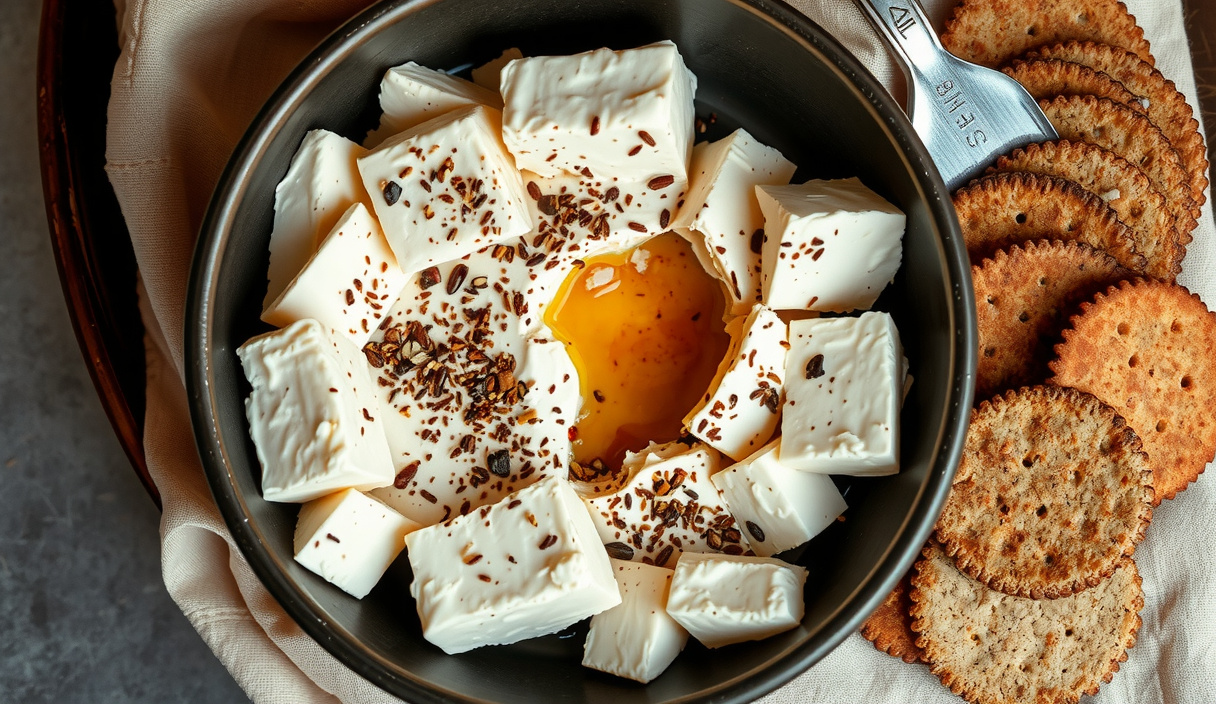
High-Protein Smoked Cottage Cheese with Everything Bagel Seasoning

Full-fat cottage cheese cold-smoked at 90°F for 60 minutes absorbs wood phenols directly into its casein curd matrix, producing a deeply savory, smoke-threaded spread with 28 grams of protein per cup. Everything bagel seasoning applied before smoking creates a brine surface that accelerates phenolic uptake — zero heat, zero fuss, maximum payoff.
Equipment
- 1 Smoker or grill with cold-smoke capability Pellet grill with smoke tube, offset with smoldering wood, or dedicated cold-smoke generator — must hold 85–95°F ambient without exceeding 105°F at the cheese surface
- 1 Shallow 9-inch cast iron skillet or quarter-sheet pan Maximizes smoke contact surface area; keep cheese depth under 1.5 inches
- 1 Instant-read or leave-in probe thermometer Insert into the center of the cheese mass — monitor protein matrix temp, not ambient air
- 1 Fine-mesh strainer For draining excess whey before seasoning
- 1 handful Applewood, cherrywood, or alder chips or pellets Avoid hickory and mesquite — too aggressive at cold-smoke temperatures
Ingredients
- 2 cups full-fat 4% cottage cheese Small-curd preferred for maximum surface area; pulled straight from refrigerator at 38–40°F
- 1.5 tablespoons everything bagel seasoning See ingredient notes for ratio; taste commercial blends before applying — they vary in salt load
- 1 tablespoon extra virgin olive oil Optional — drizzled over the surface before seasoning to help the seasoning adhere and add additional lipophilic surface area for smoke absorption
- 0.25 teaspoon flaky sea salt Optional finishing salt — add after smoking if the seasoning blend is low in salt
For Serving (Optional)
- 1 tablespoon fresh dill Chopped; brightens the phenolic depth
- 1 teaspoon hot honey Drizzled immediately before serving for sweet-heat contrast
- crackers, cucumber rounds, or crostini For dipping and spreading

Instructions
Prepare
- Set up your smoker or cold-smoke apparatus and bring it to a stable 85–95°F ambient temperature. Load applewood, cherrywood, or alder and get a clean, thin smoke established before the cheese goes in. Cold smoke requires patient setup — do not rush to place the cheese until your temperature and smoke output are stable and the initial acrid burst from fresh chips has cleared.
- Drain excess whey from the full-fat 4% cottage cheese: pour it into a fine-mesh strainer set over a bowl and let it rest for 10 minutes. This removes standing liquid so the seasoning makes direct contact with curd surfaces and smoke absorption concentrates in the curd matrix rather than the watery continuous phase.2 cups full-fat 4% cottage cheese
- Transfer the drained cottage cheese to your shallow cast iron skillet or quarter-sheet pan, spreading it into an even layer no deeper than 1.5 inches. If using, drizzle the extra virgin olive oil over the surface in a thin, even coat — this adds lipophilic surface area for phenol absorption and helps the seasoning adhere.2 cups full-fat 4% cottage cheese, 1 tablespoon extra virgin olive oil
- Distribute the everything bagel seasoning evenly over the entire surface of the cottage cheese. Press it lightly into the top layer of curds — you want the salt crystals in contact with the curd surface so they begin drawing a thin brine film via osmosis before the cheese enters the smoker. This brine layer accelerates water-soluble smoke compound absorption in the first 20 minutes of exposure.1.5 tablespoons everything bagel seasoning
- Insert your probe thermometer tip into the center of the cheese mass. Target cheese surface and interior temperature of 38–50°F when you begin smoking. The colder the starting temperature, the wider your safety margin before you approach protein-denaturing territory above 130°F.
Cold Smoke
- Place the pan in the smoker. Close the lid or cover. Maintain ambient chamber temperature at 85–95°F throughout the process — do not exceed 105°F ambient or 65°F at the cheese surface. On warm days or with an energetic cold-smoke generator, mist the exterior sides of the pan with cold water every 20 minutes to suppress surface heating.
- Smoke for 60 minutes without opening the lid or stirring the cheese. The surface seasoning cap and top curd layer form a phenolic-rich zone that diffuses inward through the curd network. Disturbing this layer resets the concentration gradient. If your smoke output looks thin after 30 minutes, add a small fresh handful of wood chips — but do not produce heavy, billowing smoke, which risks creosote deposition on the cold, wet curd surface.
Rest and Serve
- Remove the pan from the smoker. Let the smoked cottage cheese rest uncovered at room temperature for 10 minutes. This allows the lighter volatile phenols and carbonyl compounds on the surface to partially off-gas, while the remaining bound phenolics equilibrate through the curd interior. Eating immediately produces an acrid top note; resting integrates the smoke into a cohesive, rounded flavor.
- Taste and adjust: add the optional flaky sea salt if the everything bagel blend ran light on salt. Finish with fresh dill and/or a drizzle of hot honey if using.0.25 teaspoon flaky sea salt, 1 tablespoon fresh dill, 1 teaspoon hot honey
- Serve directly from the pan or transfer to a serving bowl. Accompany with crackers, cucumber rounds, or crostini. Leftovers keep in an airtight container refrigerated for up to 5 days — the smoke flavor deepens and integrates noticeably over the first 24 hours of rest.crackers, cucumber rounds, or crostini
Notes
Why cold smoke, not hot smoke? The casein curd network of cottage cheese begins to express whey and tighten at approximately 110–120°F, and whey proteins (beta-lactoglobulin, alpha-lactalbumin) denature meaningfully above 140°F. Cold smoking at 90°F keeps the entire protein matrix in its native gel state — the curd stays creamy, the whey stays bound, and the porous internal structure remains fully open for smoke compound diffusion. Hot smoke above 140°F would cook the cheese into a firm, expressive curd with dramatically reduced surface area and a texture closer to scrambled egg than spreadable dip.
Why full-fat 4% specifically? Smoke phenol absorption operates through two simultaneous mechanisms. Water-soluble phenolic acids and carbonyl aldehydes dissolve into the aqueous whey phase trapped inside each curd. Lipophilic phenols — guaiacol, syringol, and their methoxy derivatives, responsible for the characteristic "smoked wood" aroma — partition preferentially into the fat globules dispersed throughout the curd matrix. In low-fat or fat-free cottage cheese, this lipophilic reservoir is absent or drastically reduced. The thermodynamic partition coefficient for guaiacol between water and lipid runs approximately 10:1 in favor of the lipid phase. Without it, you get a one-dimensional, slightly acidic result with minimal smoke character.
The brine-film mechanism: Applying salt-containing everything bagel seasoning directly to the cold, moist curd surface initiates osmotic water migration within seconds. A thin continuous brine film forms across the seasoned surface. This film acts as a secondary polar absorption medium during the first 20 minutes of smoke exposure — essentially a liquid trap for water-soluble smoke compounds before the curd interior equilibrates. This is why seasoning before smoking produces measurably more integrated smoke flavor than seasoning after.
Wood selection matters more at cold temperatures: At full combustion temperatures above 400°F, most wood species produce qualitatively similar smoke phenol profiles because the pyrolysis chemistry converges. At cold-smoke temperatures (85–95°F), the wood is smoldering at low oxygen availability, and species-specific lignin composition drives the output more distinctly. Fruitwoods (apple, cherry) produce higher guaiacol-to-syringol ratios and lower tar fractions — meaning clean, sweet, floral smoke. High-resin hardwoods (hickory, mesquite) generate more polycyclic aromatic hydrocarbons at low combustion temperatures because incomplete pyrolysis leaves heavy molecular-weight compounds in the smoke stream. These deposit unevenly on cold, wet protein surfaces and produce bitter, medicinal aftertastes rather than clean phenolic depth.
Nutrition
Calories: 148kcalCarbohydrates: 5gProtein: 14gFat: 8gSaturated Fat: 3.5gCholesterol: 22mgSodium: 520mgFiber: 0.5gSugar: 3g
Tried this recipe?Let us know how it was!