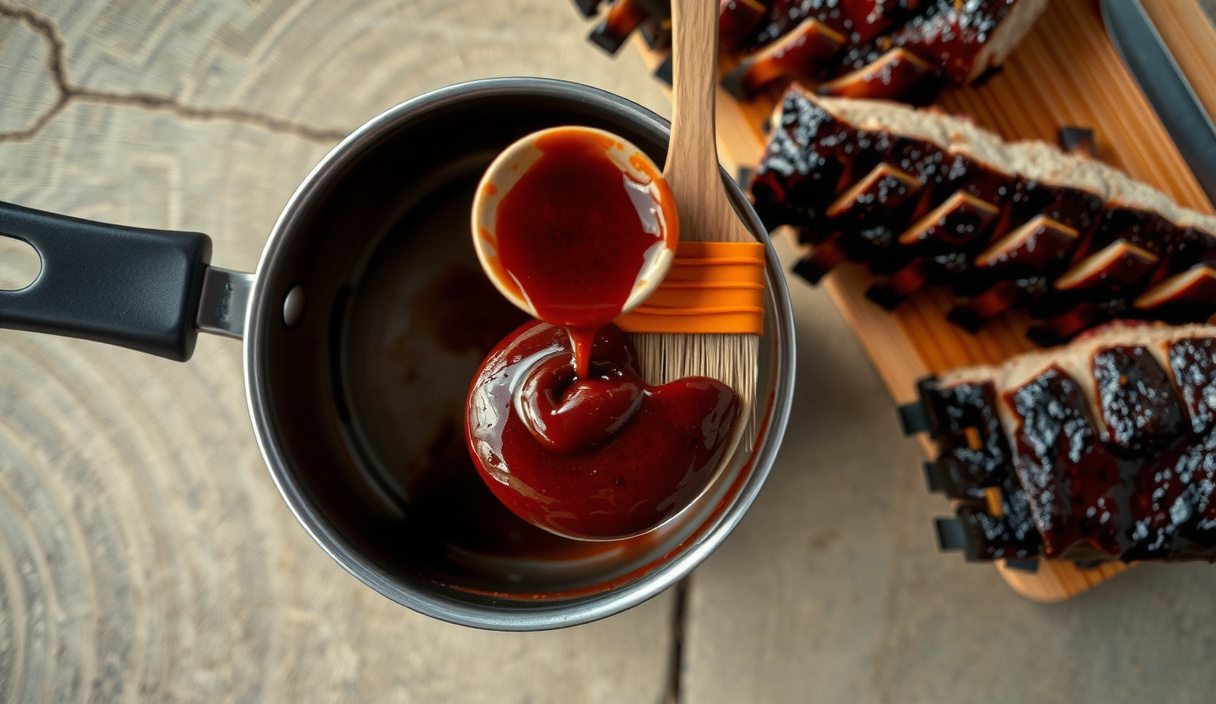
Kansas City BBQ Sauce — Molasses-Tomato

A classically structured Kansas City barbecue sauce built on the convergence of tomato-pectin gelation and sugar concentration science. Molasses, dark brown sugar, tomato paste, apple cider vinegar, Worcestershire, and a calibrated spice blend reduce over 30 minutes to approximately 50 degrees Brix — the precise soluble-solids threshold where the sauce develops a thick, glossy, shear-thinning body that coats protein without running off the grate. Deep mahogany color, sweet-forward with layered caramel and smoke, balanced by bright acetic acid and warm chili spice.
Equipment
- 1 Heavy-bottomed 3-quart saucepan Enameled cast iron or tri-ply stainless preferred; thin pans create scorching hot spots at high sugar concentrations
- 1 Silicone spatula For continuous bottom-scraping during the final 10 minutes of reduction
- 1 Digital refractometer (Brix scale) Optional but highly recommended; target 48–52 Brix at endpoint — costs under $20 and eliminates guesswork
- 2 Half-pint mason jars with lids Sterilize in boiling water before use; fill while sauce is still hot for best shelf life
- 1 set Measuring cups and spoons
Ingredients
Sauce Base
- 1 6-oz can tomato paste Standard domestic double-concentrated paste; avoid Italian-style if you want a less aggressively savory base
- 1 cup ketchup Standard full-sugar ketchup adds additional tomato solids, pectin, and initial Brix base
- ½ cup water Used to loosen the paste for even incorporation before reduction begins
Sweeteners
- ⅓ cup unsulfured blackstrap molasses Blackstrap carries the highest reducing-sugar load and most complex bitterness of any molasses grade; sulfured molasses introduces an off-note
- ⅓ cup dark brown sugar, packed Contributes reducing sugars and residual molasses melanoidins for additional Maillard depth
Acid and Umami
- 3 tablespoons apple cider vinegar (5% acidity) Split: 2 tbsp added at the start to activate pectin and drive pH to 3.2–3.6; 1 tbsp added off heat to preserve the bright aromatic top note
- 2 tablespoons Worcestershire sauce Contributes concentrated fermented amino acids and glutamate; contains anchovies — flag for fish-allergy guests
- 1 tablespoon yellow mustard Adds mild emulsification, subtle heat, and additional acidity
Spice Blend
- 1 ½ teaspoons smoked paprika Load-bearing ingredient — contributes Maillard-reactive carotenoid precursors that deepen color and smoke character during reduction; do not substitute sweet paprika
- 1 teaspoon chili powder Ancho-based preferred; contributes mild capsaicin warmth and complex earthiness
- ½ teaspoon garlic powder
- ½ teaspoon onion powder
- ¼ teaspoon freshly ground black pepper
- ¼ teaspoon ground cayenne pepper Optional — adds direct TRPV1 heat; omit for a purely sweet-and-smoky profile
- ½ teaspoon kosher salt Add conservatively at the start; the reduction concentrates all flavors — taste and correct only at the end

Instructions
Build the Base
- Combine the tomato paste, ketchup, and water in a heavy-bottomed 3-quart saucepan. Whisk until smooth and uniformly incorporated — no streaks of paste remaining.1 cup ketchup, 1/2 cup water
- Add the blackstrap molasses, dark brown sugar, 2 tablespoons of the apple cider vinegar (reserve 1 tablespoon for the finish), Worcestershire sauce, and yellow mustard. Whisk again to fully dissolve the sugar and integrate the molasses.1/3 cup unsulfured blackstrap molasses, 1/3 cup dark brown sugar, packed, 3 tablespoons apple cider vinegar (5% acidity), 2 tablespoons Worcestershire sauce, 1 tablespoon yellow mustard
- Add all the spices — smoked paprika, chili powder, garlic powder, onion powder, black pepper, cayenne (if using), and a conservative pinch of kosher salt. Stir to distribute evenly through the sauce base.1 1/2 teaspoons smoked paprika, 1 teaspoon chili powder, 1/2 teaspoon garlic powder, 1/2 teaspoon onion powder, 1/4 teaspoon freshly ground black pepper, 1/4 teaspoon ground cayenne pepper, 1/2 teaspoon kosher salt
Reduce to Target Brix
- Set the saucepan over medium heat. Bring the sauce to a steady, active simmer — large slow bubbles breaking across the surface, not a rapid rolling boil. Stir every 2–3 minutes during the first 10 minutes as the bulk water drives off.
- After 10–12 minutes the sauce will begin to thicken noticeably and the bubbles will grow larger and pop more slowly. At this point, drop the heat to medium-low. Begin stirring continuously with a silicone spatula, dragging it across the bottom of the pan to prevent the sugar-tomato matrix from scorching.
- Continue reducing for an additional 18–20 minutes, stirring continuously during the final 10 minutes. Total active cook time: approximately 30 minutes. The sauce is ready when it passes the spoon-coat test — drag a clean finger across the back of a sauce-coated spoon; the line should hold clean with no watery bleed. If you have a refractometer, target 48–52 Brix. The sauce will read slightly thin while hot; it thickens substantially as it cools.
Finish and Jar
- Remove the saucepan from heat. Stir in the reserved 1 tablespoon of apple cider vinegar. This late addition preserves the volatile acetic acid top note that would otherwise cook off entirely during reduction — it is what gives the finished sauce its signature bright, fruity tang over the deep caramel base.3 tablespoons apple cider vinegar (5% acidity)
- Taste the sauce. Adjust salt carefully — the concentration has amplified every flavor. Add kosher salt in 1/8-teaspoon increments, tasting between each addition. Adjust acid with a few drops more ACV if you prefer a sharper profile.1/2 teaspoon kosher salt
- Transfer the hot sauce into pre-sterilized half-pint mason jars, leaving 1/4-inch headspace. Seal immediately. Allow to cool completely at room temperature — approximately 15 minutes — before refrigerating. The sauce will reach its final target body only after cooling fully. Refrigerate for up to 3–4 weeks, or water-bath can for up to 12 months.
Notes
Why the sauce thickens as it cools: During reduction the sauce approaches 50 Brix — a dissolved-solids concentration where the native high-methoxyl pectin from tomato paste transitions from a pseudoplastic viscosity contributor into a weak-gel network. As temperature drops from 212°F toward room temperature (~70°F), the reduced mobility of water molecules allows pectin chains to form additional hydrogen-bond junction zones, dramatically increasing apparent viscosity. A sauce that looks thin at the end of the cook will typically reach its correct body at room temperature. Never judge final consistency while the sauce is still above 140°F.
The Maillard cascade in a molasses-tomato base: Maillard browning initiates when reducing sugars (fructose, glucose — abundant in molasses and brown sugar) encounter free amino groups from the Worcestershire amino acid load and the tomato's own peptide fraction. The reaction proceeds through Schiff base formation and Amadori rearrangement, generating hundreds of volatile aromatic compounds (pyrazines, furans, thiazoles) that produce the characteristic caramel-roast complexity of a properly reduced KC sauce. Onset requires surface temperatures above approximately 280°F (138°C), which the sauce achieves locally at the pan base even at medium-low heat settings — this is why the color deepens continuously throughout the reduction and why stirring is mandatory.
Pectin activation and pH control: High-methoxyl pectin (HM pectin, the form dominant in tomato) requires a pH of 2.8–3.5 to form its characteristic gel network. The 2 tablespoons of apple cider vinegar added at the start drives the sauce pH into the 3.2–3.6 range. At this pH the pectin's carboxyl groups are sufficiently protonated to allow hydrogen bonding between polymer chains, creating the continuous network responsible for the sauce's thick, shear-thinning body. Below pH 2.8 the pectin degrades; above pH 4.0 the HM gelling mechanism fails entirely and the sauce remains thin regardless of concentration level.
Brix and water activity: At 50 Brix, the sauce contains approximately 50 grams of dissolved solids per 100 grams of solution. This elevated dissolved-solids concentration significantly depresses water activity (a_w) relative to a thin sauce, reducing the thermodynamic availability of free water for microbial growth. Combined with the acetic acid from ACV (which crosses bacterial cell membranes in its undissociated form at low pH and disrupts internal pH homeostasis), the sauce creates a moderately hostile environment for common spoilage organisms — which explains its 3–4 week refrigerated shelf life without added preservatives.
Nutrition
Calories: 45kcalCarbohydrates: 11gProtein: 0.5gFat: 0.1gSodium: 190mgFiber: 0.3gSugar: 9g
Tried this recipe?Let us know how it was!