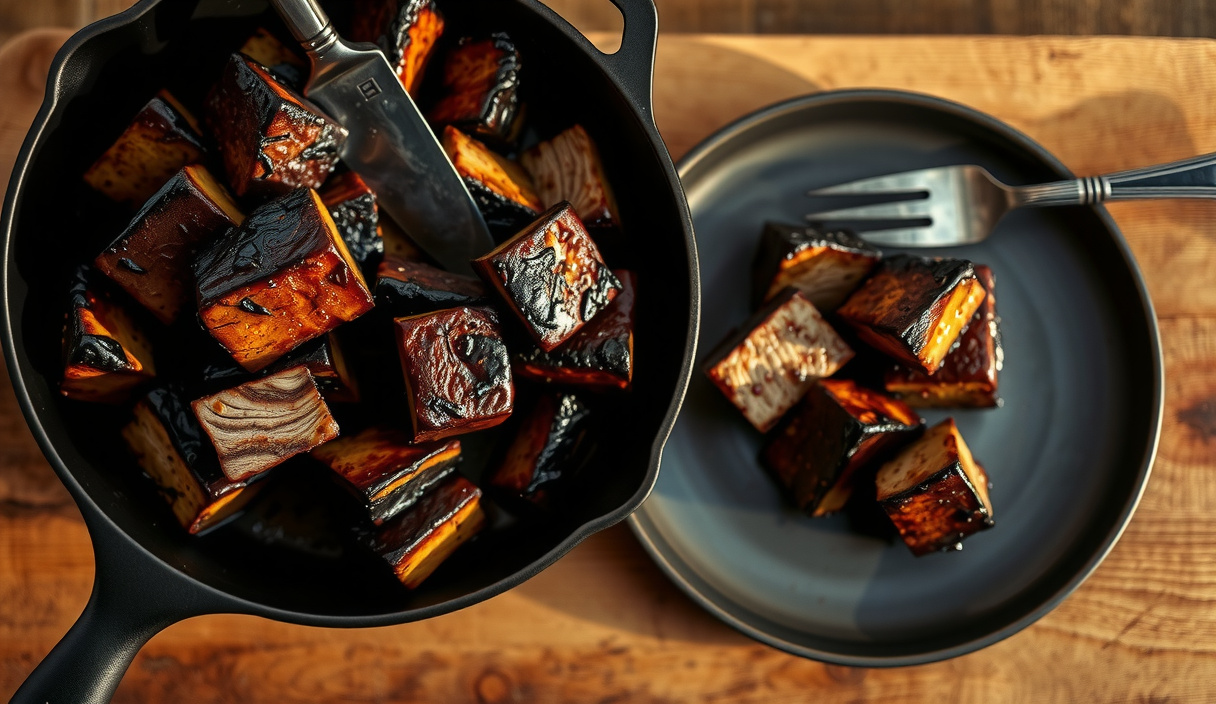
Kansas City Burnt Ends
Brisket point smoked low-and-slow to full collagen hydrolysis, cubed, braised in KC-style sauce and rendered tallow, then returned to a 275°F smoker for a lacquered double-bark finish. Rich, sticky, smoke-forward, and deeply savory — the definitive Kansas City BBQ experience.
Equipment
- 1 Offset smoker, kettle, drum, or pellet smoker Must hold 250°F for 10-12 hours and 275°F for the finish phase
- 1 Instant-read thermometer A leave-in probe thermometer for the initial cook is strongly recommended
- 2 large sheets Uncoated butcher paper Not foil — butcher paper is vapor-permeable and preserves bark integrity through the stall
- 2 Disposable aluminum half-pan One for the braise phase, one as backup; cubes must sit in a single layer
- 1 Large cutting board
- 1 Sharp boning or chef's knife For separating the point from the flat and cubing
- 1 Cooler or insulated Cambro container For the mandatory post-cook rest
- 1 Chimney starter For lighting wood or charcoal
Ingredients
Brisket
- 1 whole packer brisket, USDA Prime or high-Choice 14-18 lb; you will use the point only (~5-7 lb trimmed) — cook the full packer and separate after the flat is done
- 2 tbsp kosher salt Diamond Crystal; if using Morton, reduce to 1.5 tbsp
- 2 tbsp coarse black pepper 16-mesh or coarsely cracked; not fine-ground
- 1 tbsp garlic powder
- 1 tbsp smoked paprika
- 1 tsp cayenne pepper Optional; adjust to heat preference
KC-Style Glaze Sauce
- 1.5 cups ketchup
- 0.5 cup apple cider vinegar
- 0.5 cup dark brown sugar Packed; provides reducing sugars and molasses bitter-complexity for Maillard depth
- 0.25 cup unsulfured molasses
- 2 tbsp Worcestershire sauce Verify gluten-free if needed
- 1 tbsp yellow mustard
- 1 tbsp onion powder
- 1 tsp garlic powder
- 1 tsp smoked paprika
- 0.5 tsp ground black pepper
- 0.5 tsp kosher salt
- 0.25 tsp cayenne pepper
Braise Liquid
- 4 tbsp rendered beef tallow or brisket drippings Collect from the initial cook drip pan; substitute with unsalted butter if not available
- 0.25 cup beef stock or bone broth Low sodium; used to thin the sauce for the braise phase if needed
Wood Fuel
- 4-6 chunks post oak wood chunks Or substitute: 2 chunks cherry + 2 chunks post oak for a slightly sweeter bark

Instructions
Make the KC Sauce
- Combine all KC-Style Glaze Sauce ingredients in a medium saucepan over medium heat. Whisk to dissolve the brown sugar and molasses. Bring to a gentle simmer and cook for 15-20 minutes, stirring occasionally, until the sauce has thickened slightly and the raw vinegar edge has mellowed. Taste and adjust salt. Remove from heat and set aside. Make-ahead note: Sauce keeps refrigerated for up to 2 weeks.1.5 cups ketchup, 0.5 cup apple cider vinegar, 0.5 cup dark brown sugar, 0.25 cup unsulfured molasses, 2 tbsp Worcestershire sauce, 1 tbsp yellow mustard, 1 tbsp onion powder, 1 tsp garlic powder, 1 tsp smoked paprika, 0.5 tsp ground black pepper, 0.5 tsp kosher salt, 0.25 tsp cayenne pepper
Season the Brisket
- Mix salt, black pepper, garlic powder, smoked paprika, and cayenne in a small bowl. Trim the fat cap of the whole packer brisket to approximately 1/4 inch — do not trim to zero. Apply the rub generously across all surfaces, pressing it firmly into the meat. For maximum bark development, season 12-24 hours ahead and refrigerate uncovered on a wire rack. This dry-brining step draws surface moisture out and then back in, hydrating the rub into the protein matrix.2 tbsp kosher salt, 2 tbsp coarse black pepper, 1 tbsp garlic powder, 1 tbsp smoked paprika, 1 tsp cayenne pepper
Initial Smoke (250°F, ~10-12 hours)
- Fire your smoker to a stable 250°F. Add 2-3 chunks of post oak. Place the brisket fat-side up on the grate. Insert a leave-in probe into the thickest part of the flat, away from fat seams. Add the remaining wood chunks in the first 3-4 hours of the cook — smoke deposition is most effective when the surface is moist.
- Smoke the brisket undisturbed until the flat reaches an internal temperature of 165°F — this typically takes 5-7 hours. You will hit the stall in this range: the internal temperature will plateau for 1-3 hours as surface evaporation absorbs heat energy as fast as the smoker delivers it. Do not panic. Do not raise the pit temperature. The stall is driving bark formation.
- Wrap the brisket tightly in 2 sheets of uncoated butcher paper at 165°F internal. Return to the smoker. Continue cooking until the flat reaches 195-200°F internal and a probe inserted into the flat meets no resistance — it should slide in like warm butter. This is the sign that collagen hydrolysis is complete in the flat. Total cook time is typically 10-12 hours depending on brisket size and pit consistency.
- At this point, remove the whole brisket from the smoker and rest it, still wrapped, inside a cooler lined with towels for a minimum of 60 minutes. The flat is done. The point needs more time — but it will hold perfectly in the cooler rest while you prepare the cube phase.
Separate, Cube, and Set Up the Braise
- After the rest, unwrap the brisket on a large cutting board over a rimmed sheet pan — you want to catch all accumulated juices and drippings for the braise. Locate the fat seam running diagonally between the flat and the point. Using a boning knife or sharp chef's knife, separate the point from the flat along that seam. Set the flat aside to slice and serve separately.
- Cut the brisket point into 1.5-inch cubes. Irregular cuts are fine — the goal is uniform size for even cooking, not geometric perfection. Discard any hard fat pockets that did not render during the initial cook. Place the cubes in a single layer in one or two disposable aluminum half-pans. Do not pile or stack.
- Add the rendered beef tallow or drippings to the pan. Pour approximately 2/3 of the KC sauce over the cubes and toss gently to coat all sides. If the sauce is very thick, thin with 1/4 cup of beef stock to achieve a pourable consistency — you want the cubes coated, not submerged.4 tbsp rendered beef tallow or brisket drippings, 0.25 cup beef stock or bone broth
Braise Phase (275°F, ~60 minutes covered)
- Bring the smoker up to 275°F. Cover the half-pan tightly with aluminum foil. Place the covered pan on the smoker grate. Cook covered for 45-60 minutes. The sauce will bubble and reduce; the cubes will re-absorb moisture and the interior gelatin structure will tighten into a rich, sticky matrix. Do not rush this phase — covered braising is what transforms the interior from sliced-brisket texture to true burnt-end richness.
Uncover and Return to Smoke (275°F, ~60-90 minutes)
- Remove the foil cover. Pour the remaining 1/3 of the KC sauce over the cubes — this fresh application provides new reducing sugars for the final Maillard sprint. Toss gently if possible without breaking the cubes apart. Return the uncovered pan to the 275°F smoker. Do not add a water pan — you need dry convective airflow for bark re-formation.1.5 cups ketchup, 0.5 cup apple cider vinegar, 0.5 cup dark brown sugar, 0.25 cup unsulfured molasses, 2 tbsp Worcestershire sauce, 1 tbsp yellow mustard, 1 tbsp onion powder, 1 tsp garlic powder, 1 tsp smoked paprika, 0.5 tsp ground black pepper, 0.5 tsp kosher salt, 0.25 tsp cayenne pepper
- Cook uncovered for 60-90 minutes, checking every 20 minutes. The burnt ends are done when the glaze has shifted from wet and reflective to matte-tacky, and the surface of each cube shows a tight, dark, lacquered bark on all exposed faces. An instant-read probe into the center of a cube should read 195-205°F. The cubes should hold their shape when lifted with tongs but yield to slight pressure.
Rest and Serve
- Remove the pan from the smoker. Let the burnt ends rest uncovered for 10 minutes — this allows the glaze to set from tacky to firm and allows steam from the interior to escape without condensing back onto the bark. Serve directly from the pan or pile onto a butcher paper-lined tray. Serve with additional KC sauce on the side if desired. Burnt ends are best eaten immediately but hold well covered in a 150°F oven for up to 2 hours.
Notes
Why the stall happens — and why you do not fight it: At 155-165°F internal, evaporative cooling at the brisket surface absorbs energy at approximately the same rate the smoker delivers it, creating a thermal plateau that can last 1-3 hours. This is not a malfunction. During the stall, bark formation is actively occurring — the dry surface is accumulating polymerized Maillard melanoidins and smoke phenols. Wrapping in butcher paper at 165°F creates a vapor-permeable boundary layer that reduces evaporative flux by roughly 40%, allowing the internal thermal gradient to advance while preserving the bark. Foil eliminates evaporation entirely, which speeds internal cooking but creates a steam environment that softens the bark — acceptable for brisket flat, problematic for a point that needs maximum bark for the cube-and-return phase.
Collagen hydrolysis kinetics: The brisket point is dense in Type I collagen cross-linking the perimysium (connective tissue sheath around muscle fiber bundles). At temperatures above 160°F internal, the peptide bonds in collagen begin to cleave at a rate governed by first-order kinetics — meaning the conversion rate is proportional to the remaining collagen concentration. Extended time at 160-180°F internal is required for full conversion to soluble gelatin. This is why probe-tenderness matters more than a specific temperature number: the probe is measuring resistance to shear, which correlates directly with collagen conversion. A brisket point that probes clean at 195°F has achieved near-complete collagen hydrolysis; one that feels tight at 203°F has not. Trust the probe, not the thermometer.
The double-bark mechanism: During the initial smoke, Maillard browning produces a first bark composed of melanoidins (brown pigment polymers), smoke phenols, and dehydrated protein aggregates. When the point is cubed and returned to heat with sauce, the sucrose in the KC sauce hydrolyzes in the acidic sauce environment (pH ~3.8-4.2) into glucose and fructose — both highly reactive reducing monosaccharides. These free sugars coat the existing bark, providing a new layer of Maillard substrate. At 275°F surface temperature, the second Maillard cascade runs aggressively, building a second layer of darker, stickier melanoidins over the first. The result is a bark with measurably greater thickness, lower water activity, and higher aromatic complexity than a single-cook product. This two-phase Maillard architecture is the defining structural feature of authentic KC burnt ends — not the sauce, not the smoke level, but the second bark.
Fat as aromatic carrier: Rendered tallow in the braise pan is not merely a cooking medium. Beef tallow is a high-saturated-fat lipid system that dissolves and concentrates lipophilic aromatic compounds — specifically the guaiacol, syringol, and phenol derivatives deposited during smoke exposure. As the braise liquid reduces, these phenolic compounds partition heavily into the lipid phase, re-concentrating the smoke signal back onto each cube surface. This is the physical mechanism behind the observation that brisket point burnt ends taste smokier than the point sliced straight from the initial cook, even though no additional smoke exposure has occurred.
Nutrition
Calories: 610kcalCarbohydrates: 28gProtein: 48gFat: 34gSaturated Fat: 13gCholesterol: 165mgSodium: 980mgFiber: 1gSugar: 24g
Tried this recipe?Let us know how it was!