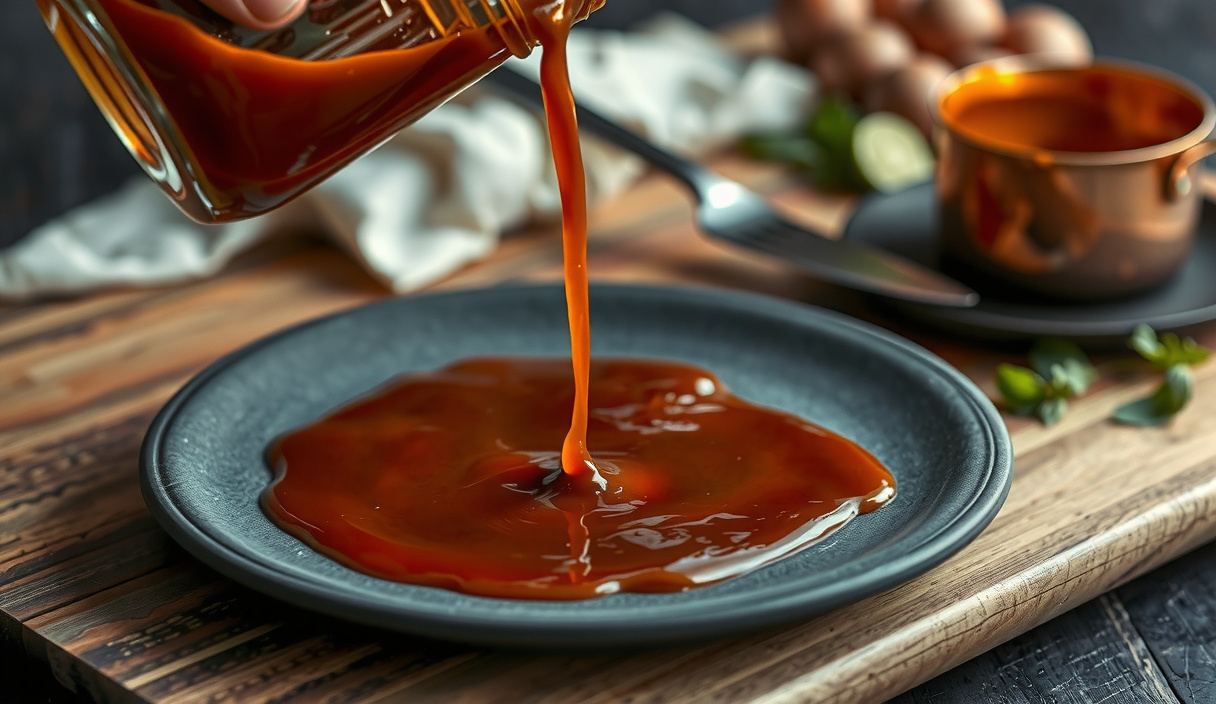
Keto BBQ Sauce — Allulose Base

A deeply caramelized keto BBQ sauce built on an allulose base for authentic Maillard browning, thickened to commercial consistency with xanthan gum at 0.3% w/w, and balanced with tomato paste and apple cider vinegar. Delivers 2g net carbs per 2-tablespoon serving with the glossy, clingy texture that makes brisket bark sing.
Equipment
- 1 Heavy-bottomed 2-quart saucepan Thick base prevents allulose scorching from hotspots
- 1 Instant-read thermometer Essential for holding the 200–205°F reduction window
- 1 Whisk For dispersing xanthan gum into cold liquid without clumping
- 1 Kitchen scale For weighing xanthan gum to the 0.3% w/w target — volume measures are imprecise at this level
- 1 Glass jar with lid (1 pint) For storage; refrigerate immediately after cooling
Ingredients
Sauce Base
- 1 cup tomato paste Double-concentrated preferred; provides Maillard precursors and natural pectin body
- ½ cup apple cider vinegar Drops pH to ~3.8; use raw unfiltered for malic acid complexity
- ½ cup water Adjust to preferred finished consistency
- ⅓ cup granular allulose ~67g; browns at ~230°F via Maillard cascade — do not substitute erythritol
- 1 tablespoon Worcestershire sauce Provides nucleotide-driven umami depth; verify keto-compliant brand with no added sugars
Spice Blend
- 2 teaspoons smoked paprika Spanish pimentón de la Vera preferred for complex smoke character
- 1 teaspoon garlic powder
- 1 teaspoon onion powder
- 1 teaspoon ground black pepper Freshly ground preferred
- ½ teaspoon dry mustard powder Adds low-level TRPA1 warmth and emulsifying mucilage
- ½ teaspoon cayenne pepper Adjust to heat preference; activates TRPV1 thermoreceptors
- 1 teaspoon fine kosher salt Or to taste; adds ionic strength that blunts perceived acidity
Thickener
- 1.2 g xanthan gum Approximately 0.3% w/w of finished sauce (~400g total); measure by weight — this is approximately 1/3 teaspoon but weigh it if possible

Instructions
Disperse Xanthan (Cold Phase)
- Combine the apple cider vinegar and water in the cold saucepan. Sprinkle the xanthan gum over the surface and whisk vigorously for 60 to 90 seconds until fully dispersed with no dry clumps visible. The mixture will thicken slightly and appear slightly gelled — this is correct. Do not skip this step or add the xanthan to a hot pan. Xanthan hydrates uniformly below 60°F and clumps irreversibly when added to hot liquid.1/2 cup water, 1.2 g xanthan gum
Build the Base
- Whisk the tomato paste, allulose, and Worcestershire sauce into the xanthan-liquid mixture until smooth and fully incorporated. The allulose should dissolve completely at this stage — granular allulose dissolves more slowly than sucrose; allow 60 seconds of active whisking.1/3 cup granular allulose, 1 tablespoon Worcestershire sauce
- Add all the spice blend ingredients — smoked paprika, garlic powder, onion powder, black pepper, dry mustard powder, cayenne, and kosher salt — and whisk to fully incorporate. The mixture will be thick and brick-red at this point.2 teaspoons smoked paprika, 1 teaspoon garlic powder, 1 teaspoon onion powder, 1 teaspoon ground black pepper, 1/2 teaspoon dry mustard powder, 1/2 teaspoon cayenne pepper, 1 teaspoon fine kosher salt
Reduction Phase
- Place the saucepan over medium heat. Bring to a gentle simmer, stirring frequently. Clip or hold your instant-read thermometer to confirm the sauce reaches and holds between 200°F and 205°F (93°C to 96°C). Do not allow a rolling boil — the high evaporation rate will concentrate the allulose rapidly and push the sauce toward scorching.
- Reduce uncovered for 20 to 25 minutes, stirring every 3 to 4 minutes and scraping the bottom of the pan with a silicone spatula to prevent sticking. The sauce will appear thin and bright red for the first 10 to 12 minutes. Watch for the color shift: as the allulose concentration increases with water loss, the sauce will rapidly deepen to a dark mahogany red — this is the Maillard cascade activating at concentrated temperatures. The sauce is ready when it coats the back of a spoon thickly and a line drawn through the coating holds cleanly.
- Pull the pan from heat immediately once the desired consistency is reached. The sauce will continue to thicken as the xanthan network tightens during cooling — pull it 10% thinner than your target finished consistency. It should pour slowly from a spoon when hot, and set to a clingy, glossy consistency when cooled to 75°F.
Finishing and Storage
- Taste the sauce while still warm (approximately 140°F). Adjust acid with an additional splash of apple cider vinegar if flat; adjust salt if harsh. Allow to cool to room temperature for 10 minutes before transferring to a sealed glass jar. Refrigerate immediately. The sauce will reach its final target viscosity at refrigeration temperature (38°F to 42°F). Use within 3 weeks.1/2 cup apple cider vinegar, 1 teaspoon fine kosher salt
Notes
Why 0.3% xanthan gum? Xanthan gum at 0.2% w/w produces a sauce that is well-thickened but slightly thinner than commercial BBQ sauces at rest. At 0.5% w/w, the viscosity is high enough to physically trap volatile aroma compounds — the oral shear stress increases to a level where tastants cannot diffuse freely to gustatory receptors, producing a sauce that tastes muted despite aggressive seasoning. The 0.3% w/w target is the minimum concentration that achieves commercial-style cling and coating while keeping retronasal aroma delivery fully intact. Xanthan is a pseudoplastic fluid: its viscosity collapses dramatically under the shear of brushing or squeezing, allowing clean application, then recovers immediately upon rest to hold position on hot protein surfaces.
Why does allulose brown at lower temperatures than sucrose? Allulose is a reducing monosaccharide — it carries a free aldehyde group that reacts directly with free amino acids (present in the tomato paste and Worcestershire sauce) to initiate the Amadori rearrangement, the first committed step of the Maillard cascade. Sucrose, a disaccharide, must hydrolyze into glucose and fructose before participating in this reaction, which requires higher temperatures. Allulose bypasses this requirement, intercepting the Maillard activation barrier at approximately 230°F (110°C) and generating melanoidin pigments and volatile aromatic compounds — alkyl pyrazines, furfural, 2-acetylpyrroline — that create authentic caramelized depth. This is why the reduction temperature ceiling of 205°F matters: allulose's head-start advantage means the sauce will progress through color phases faster than an identical sucrose-based sauce, and the window between optimal caramelized flavor and acrid pyrolysis is compressed.
Net carb calculation: Per 2-tablespoon serving — tomato paste contributes approximately 3g total carbohydrate, of which approximately 1g is fiber, yielding 2g net carbs. Allulose is excluded from net carb counting under FDA guidance as it is not metabolized via glycolytic pathways and does not raise blood glucose or insulin in clinical studies. Xanthan gum contributes trace carbohydrates that round to zero at this concentration. Worcestershire sauce contributes less than 0.5g per serving at this dilution.
Nutrition
Calories: 22kcalCarbohydrates: 5gProtein: 1gSodium: 148mgFiber: 1gSugar: 1g
Tried this recipe?Let us know how it was!