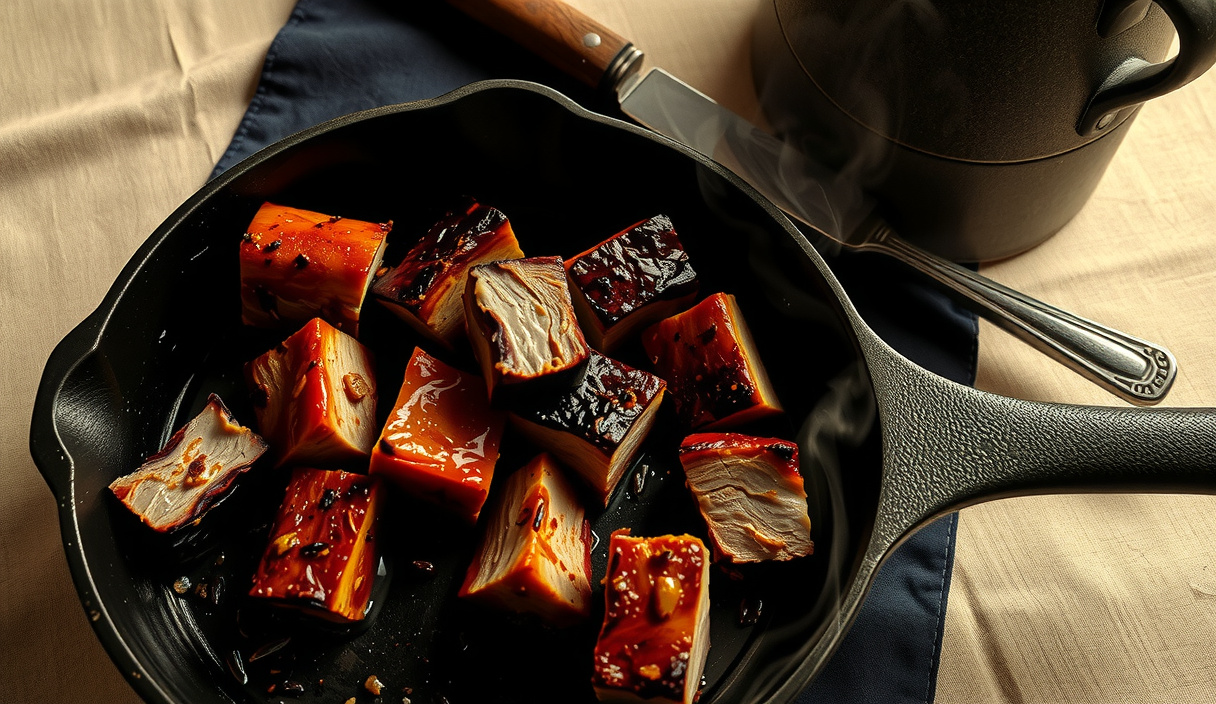
Keto Pork Belly Burnt Ends with Allulose Glaze

Smoke-lacquered pork belly cubes built on the Maillard-active chemistry of allulose — the only keto sweetener that genuinely caramelizes. Three grams of net carbs per serving, real glaze depth, and collagen-rich interiors rendered low-and-slow at 250°F. Where Flavor Meets the Flame.
Equipment
- 1 Offset smoker or pellet grill Capable of holding a steady 225–250°F with indirect heat
- 2 Cherry or apple wood chunks One of each; generates moderate, sweet-forward smoke
- 1 Instant-read or leave-in probe thermometer Essential for monitoring stall and finish temperature
- 1 Disposable aluminum foil pan (half-size) For the foil-braise phase with butter and glaze liquid
- 1 Sharp boning or chef knife For cubing the belly into uniform 1.5-inch pieces
- 1 Pastry brush or silicone basting brush For applying glaze in thin, even coats
- 1 Small saucepan For warming and dissolving the allulose glaze
Ingredients
Pork Belly and Dry Rub
- 3 lbs skin-off pork belly Heritage breed preferred; heavy intramuscular marbling
- 3 tablespoons granulated allulose For the dry rub; do not substitute erythritol
- 1 tablespoon kosher salt Diamond Crystal preferred; adjust to taste
- 2 teaspoons black pepper Freshly cracked
- 2 teaspoons smoked paprika Spanish pimenton adds deeper color and sweetness
- 1 teaspoon garlic powder
- 1 teaspoon onion powder
- 1 teaspoon cayenne pepper Adjust to heat preference
- 1 teaspoon mustard powder Dry mustard; provides Maillard precursor amino acids
Allulose Glaze
- ½ cup granulated allulose Primary Maillard-reactive sweetener; do not substitute
- 4 tablespoons unsalted butter Cut into tablespoon pats for even melting
- 2 tablespoons apple cider vinegar Drops glaze pH to 4.5–5.5, accelerating Maillard condensation
- 2 tablespoons soy sauce or coconut aminos Coconut aminos for strict keto; adds umami and Maillard precursors
- 1 teaspoon smoked paprika Reinforces color and smoke note in the glaze
- ½ teaspoon garlic powder
- ⅛ teaspoon xanthan gum Approximately 0.1% w/w; shear-thinning adhesion without gumminess
- 1 tablespoon your favorite keto-certified hot sauce Optional; verify no added sugars or maltodextrin
Braising Liquid
- 4 tablespoons unsalted butter Adds fat-phase lubrication during the covered braise
- ¼ cup beef broth or bone broth Low-sodium; provides collagen-rich liquid environment during braise

Instructions
Prepare and Season the Pork Belly
- Preheat your smoker to 250°F with one cherry wood chunk and one apple wood chunk positioned at the firebox. Allow the smoker to reach temperature and produce a clean, thin blue smoke before placing any meat.
- Pat the pork belly completely dry on all surfaces using paper towels. Moisture on the surface delays the initial bark formation by keeping surface temperature anchored near 212°F via evaporative cooling.
- In a small bowl, combine the dry rub: 3 tablespoons allulose, kosher salt, black pepper, smoked paprika, garlic powder, onion powder, cayenne, and mustard powder. Whisk thoroughly to distribute evenly.3 tablespoons granulated allulose, 1 tablespoon kosher salt, 2 teaspoons black pepper, 2 teaspoons smoked paprika, 1 teaspoon garlic powder, 1 teaspoon onion powder, 1 teaspoon cayenne pepper, 1 teaspoon mustard powder
- Apply the dry rub generously to all six faces of the pork belly slab. Press the rub firmly into the surface to maximize contact between the allulose-amino rub and the meat proteins. Allow to rest uncovered at room temperature for 15 minutes before placing on the smoker.3 tablespoons granulated allulose, 1 tablespoon kosher salt, 2 teaspoons black pepper, 2 teaspoons smoked paprika, 1 teaspoon garlic powder, 1 teaspoon onion powder, 1 teaspoon cayenne pepper, 1 teaspoon mustard powder
Initial Smoke Phase
- Place the seasoned pork belly on the smoker grate, fat-side up, over indirect heat. Insert a leave-in probe thermometer into the thickest part of the belly, avoiding fat pockets. Close the lid and smoke at 250°F undisturbed.
- Smoke until the pork belly reaches an internal temperature of 195–205°F, approximately 4 to 5 hours depending on slab thickness. The internal temperature will stall between 160°F and 170°F for 60 to 90 minutes as surface evaporation absorbs thermal energy — this is the collagen-hydrolysis phase. Do not increase smoker temperature during the stall. The fat matrix will keep the interior moist throughout this window.
Cube and Braise
- Remove the pork belly from the smoker and allow it to rest on a cutting board for 10 minutes. This allows the gelatin-rich interior to redistribute before cutting.
- Cut the belly into uniform 1.5-inch cubes. Consistent sizing is critical for even glaze adhesion and uniform finish temperature during the final phase.
- Transfer the cubes to a half-size disposable foil pan. Add 4 tablespoons unsalted butter (cut into pats) and 1/4 cup beef or bone broth to the pan. Toss the cubes gently to coat in the braising liquid.4 tablespoons unsalted butter, 1/4 cup beef broth or bone broth
- Cover the foil pan tightly with aluminum foil and return to the smoker at 250°F. Braise covered for 60 to 75 minutes until the cubes are fully yielding and a probe inserts with no resistance. The collagen-to-gelatin conversion completes during this phase, producing the signature melt-in-the-mouth interior.4 tablespoons unsalted butter, 1/4 cup beef broth or bone broth
Build the Allulose Glaze
- While the cubes braise, prepare the allulose glaze. In a small saucepan over medium-low heat, melt 4 tablespoons unsalted butter. Add 1/2 cup granulated allulose and stir constantly until fully dissolved, approximately 2 minutes. Do not allow the mixture to exceed 250°F at this stage — allulose browning onset occurs around 250–280°F and you want to build the glaze without initiating Maillard reactions in the pan.4 tablespoons unsalted butter, 1/2 cup granulated allulose
- Remove from heat. Add apple cider vinegar, soy sauce or coconut aminos, smoked paprika, garlic powder, and hot sauce (if using). Whisk to combine. The glaze will be thin and fluid — this is correct for a two-coat application.2 tablespoons apple cider vinegar, 2 tablespoons soy sauce or coconut aminos, 1 teaspoon smoked paprika, 1/2 teaspoon garlic powder, 1 tablespoon your favorite keto-certified hot sauce
- Sprinkle xanthan gum over the glaze and whisk vigorously for 30 seconds until fully hydrated with no visible clumps. The glaze will thicken slightly from its initial thin state and become shear-thinning — it will flow easily under brush pressure but cling to the cubes when the brushing shear is removed. Allow glaze to cool to approximately 120°F before applying.1/8 teaspoon xanthan gum
Glaze and Final Set
- Reduce smoker temperature to 225°F. Remove the foil pan from the smoker, uncover, and drain excess braising liquid. Return the cubes to the smoker grate in a single layer with space between each cube to allow smoke and heat to reach all faces.
- Apply the first coat of allulose glaze to all exposed faces of the cubes using a pastry or silicone brush. Use light, even strokes — you are depositing a thin, uniform film, not painting on a thick layer. Close the smoker lid.1/2 cup granulated allulose, 4 tablespoons unsalted butter, 2 tablespoons apple cider vinegar, 2 tablespoons soy sauce or coconut aminos, 1 teaspoon smoked paprika, 1/2 teaspoon garlic powder, 1/8 teaspoon xanthan gum, 1 tablespoon your favorite keto-certified hot sauce
- After 10 to 12 minutes, check the glaze surface. It should appear set and tacky with visible color development. Apply the second coat of glaze, again using light strokes across all faces. Monitor closely — at 225°F, allulose caramelization proceeds quickly and the window between lacquered and bitter is approximately 5 to 8 minutes after the second coat is fully set. The finished surface should be deep mahogany, shiny, and dry to a light touch rather than wet or pooled.1/2 cup granulated allulose, 4 tablespoons unsalted butter, 2 tablespoons apple cider vinegar, 2 tablespoons soy sauce or coconut aminos, 1 teaspoon smoked paprika, 1/2 teaspoon garlic powder, 1/8 teaspoon xanthan gum, 1 tablespoon your favorite keto-certified hot sauce
- Remove the glazed burnt ends from the smoker and rest uncovered on a wire rack for 5 minutes before serving. The rest allows the gelatin interior to firm slightly and the glaze surface to transition from tacky to a true, dry lacquer.
Notes
Why allulose browns and erythritol does not: Allulose is a reducing monosaccharide — its open-chain form presents a free aldehyde carbonyl that reacts directly with free amino groups on the meat surface proteins via Schiff base formation, initiating the Maillard cascade. Erythritol is a four-carbon polyol with no carbonyl group in its stable form; it cannot initiate the Maillard reaction and will not produce browning regardless of temperature. This is the fundamental structural chemistry that makes allulose uniquely valuable in keto BBQ formulation.
The stall explained: Between approximately 160°F and 170°F internal, surface evaporation absorbs thermal energy from the smoker at the same rate it is delivered, anchoring the internal temperature. During this window, collagen hydrolysis into soluble gelatin is actively proceeding via first-order kinetics. The stall is productive — pushing through it with patience rather than increased temperature produces a dramatically more yielding interior than wrapping or spiking the temperature, which drives rapid water expulsion and can overshoot the actin denaturation threshold at 74°F internal, permanently collapsing water-holding capacity.
Allulose glaze temperature ceiling: Allulose initiates Maillard browning at approximately 250–280°F surface temperature — roughly 150°F lower than the activation energy required for sucrose caramelization. The final glaze phase is set at 225°F smoker temperature precisely to keep the cubes surface below the bitter melanoidin accumulation zone. If your smoker runs hot, use an oven thermometer to verify actual chamber temperature and adjust accordingly.
Xanthan gum at 0.1% w/w: The glaze uses xanthan gum as a pseudoplastic (shear-thinning) stabilizer. Under the mechanical shear of brushing, xanthan's polymer chains align in the direction of force and viscosity drops, allowing even application. At rest on the cube surface, the chains re-entangle and viscosity recovers, holding the glaze in place rather than pooling at the base. Exceeding 0.2% w/w total xanthan content will produce perceptible gumminess and will physically trap aromatic volatiles, muting the smoke and caramelized-fat notes on the palate.
Net carb calculation: Allulose is not metabolized for energy in humans and is excluded from net carb calculations per FDA guidance. The 3g net carbs per 4oz serving reflects the total digestible carbohydrate load from the spice rub, soy sauce or coconut aminos, and vinegar. If using standard soy sauce rather than coconut aminos, verify your brand's carbohydrate content — most are 1g per tablespoon and negligible at recipe scale.
Nutrition
Calories: 520kcalCarbohydrates: 3gProtein: 18gFat: 48gSaturated Fat: 18gCholesterol: 95mgSodium: 620mg
Tried this recipe?Let us know how it was!