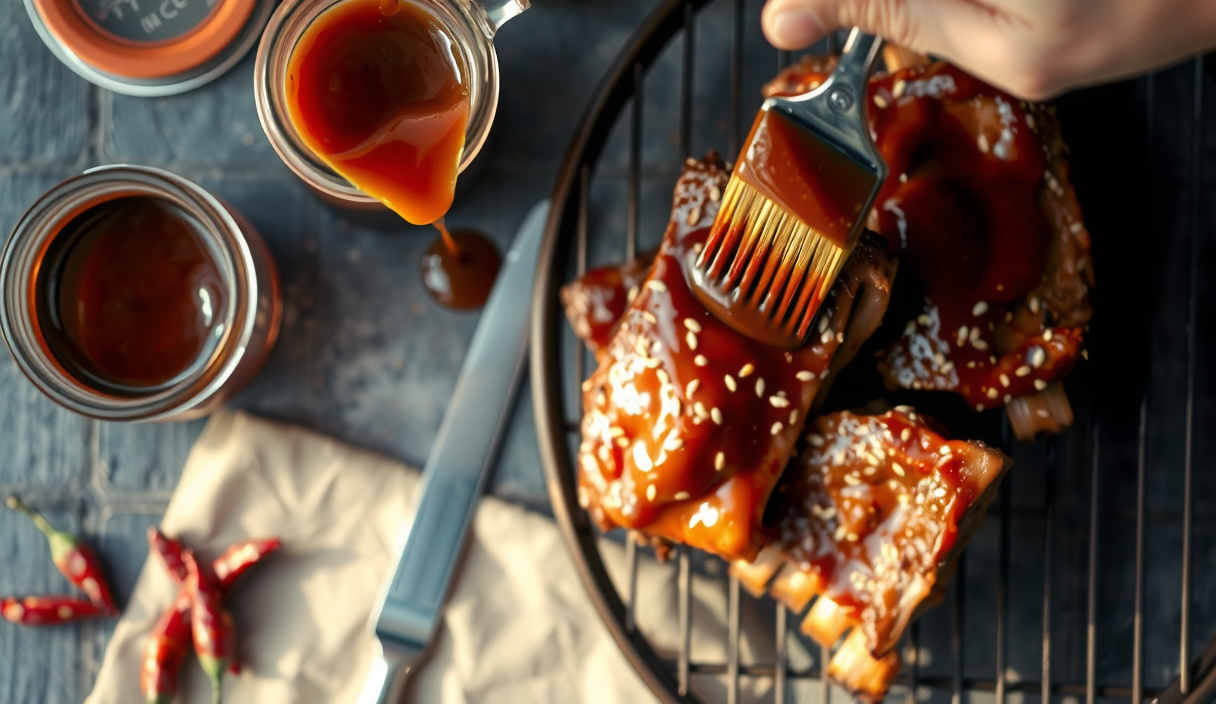
Korean Gochujang BBQ Sauce

A ferment-driven Korean BBQ sauce built on the glutamate-rich depth of gochujang, Maillard-ready brown sugars, and sesame oil aroma chemistry. Ready in 15 minutes of active cooking, this sauce layers centuries of fermentation science with the heat chemistry of the live fire. It grips ribs, pork belly, chicken thighs, and grilled salmon with equal authority.
Equipment
- 1 Small stainless steel or enameled saucepan 2–3 quart capacity; avoid reactive metals
- 1 Whisk For emulsifying the fat phase into the aqueous base
- 1 Instant-read thermometer For monitoring sauce temperature; target 90–95°C during reduction
- 1 Airtight glass jar 12–16 oz capacity for storage; glass preferred over plastic to limit oxidation of sesame oil
Ingredients
Sauce Base
- 3 tablespoons gochujang (fermented Korean chili paste) Medium heat variety; look for meju powder and rice flour in the first three ingredients
- 3 tablespoons brown sugar, packed Dark brown sugar preferred for higher molasses fraction and more reducing-sugar Maillard activity
- 3 tablespoons soy sauce Full-sodium, brewed soy sauce — not low-sodium
- 2 tablespoons rice vinegar Unseasoned; provides pH 2.9–3.1 brightness without harsh acetate notes
- 2 tablespoons water Adjusts viscosity during initial cook; the sauce reduces to final consistency
- 1 tablespoon honey Adds fructose and glucose for additional Maillard activity; mild floral aromatic note
Aromatics
- 4 cloves garlic, finely minced or pressed Allicin precursors convert to thiosulfinates during cooking; mince fine for uniform dispersion
- 1 tablespoon fresh ginger, grated on a microplane Gingerol and shogaol contribute mild TRPV1 activation distinct from capsaicin
- 1 teaspoon toasted sesame oil Added off-heat only; do not cook — high-volatility pyrazine aromatics dissipate above 70°C
Finish
- 1 teaspoon toasted sesame seeds Optional garnish; adds textural contrast and visual cue for sesame identity
- 2 stalks scallions, thinly sliced (green parts only) Optional garnish; raw allium sharpness provides brightness contrast against the fermented base

Instructions
Build the Base
- Combine the gochujang, brown sugar, soy sauce, rice vinegar, and water in a small stainless steel or enameled saucepan. Whisk together until the gochujang paste is fully dissolved into a uniform, brick-red liquid with no lumps. The brown sugar should be fully incorporated — the texture should look like a smooth, moderately thick liquid at this stage.3 tablespoons brown sugar, packed, 3 tablespoons soy sauce, 2 tablespoons rice vinegar, 2 tablespoons water
- Add the honey, minced garlic, and grated ginger to the pan. Whisk again to combine. The honey will initially resist mixing — give it 20–30 seconds of brisk whisking to fully integrate into the aqueous base.1 tablespoon honey, 4 cloves garlic, finely minced or pressed, 1 tablespoon fresh ginger, grated on a microplane
Cook the Sauce
- Place the saucepan over medium heat. Bring the mixture to a gentle simmer — you are targeting lazy surface bubbles breaking at roughly 90–95°C (194–203°F). Do not allow the sauce to reach a hard rolling boil. A hard boil drives off volatile aromatic compounds from the gochujang and drives the sauce toward scorching on the bottom.
- Reduce heat to medium-low and cook, stirring frequently with a silicone spatula or whisk, for 10–12 minutes. The sauce is ready when it coats the back of a spoon and a line drawn through it holds for 2–3 seconds before filling back in. It will appear slightly thinner than the final consistency — it continues to thicken as it cools. If the sauce reduces too aggressively, add water 1 teaspoon at a time to maintain a pourable consistency.
Finish and Store
- Remove the pan from heat. Allow it to rest for 60–90 seconds so the surface temperature drops below 70°C (158°F). Then stir in the toasted sesame oil. Adding it now — and only now — preserves the high-volatility pyrazine and furfurylthiol aromatic compounds that define the sauce's roasted sesame finish. Stirring into still-hot sauce above 70°C will flash off these aromatics within seconds.1 teaspoon toasted sesame oil
- Taste and adjust: if the sauce is too thick, whisk in water 1 teaspoon at a time. If it needs more salt, add soy sauce a few drops at a time rather than adding raw salt — this preserves the glutamate amplification. If it needs more acid brightness, add rice vinegar in 1/2-teaspoon increments.3 tablespoons soy sauce, 2 tablespoons rice vinegar
- Transfer to a clean, airtight glass jar. Garnish individual servings with toasted sesame seeds and scallion greens if desired. The sauce holds refrigerated for up to 3 weeks. Bring to room temperature or warm gently before use — the sesame oil phase thickens significantly under refrigeration and the sauce will appear artificially thick when cold.1 teaspoon toasted sesame seeds, 2 stalks scallions, thinly sliced (green parts only)
Notes
Why gochujang is not just a hot sauce: During its 30-day minimum (up to 36-month premium) fermentation, proteolytic enzymes from Bacillus subtilis and lactic acid bacteria hydrolyze the meju soybean proteins into free amino acids — primarily L-glutamic acid at concentrations of 400–900 mg per 100g. When combined with the 5'-ribonucleotides (IMP, GMP) in the added soy sauce, the result is synergistic T1R1/T1R3 receptor activation: umami perception amplified far beyond what either ingredient achieves alone. This is the same nucleotide-glutamate synergy underlying aged Parmigiano-Reggiano and is why this sauce tastes disproportionately complex for 15 minutes of work.
The Maillard window on the grill: Brown sugar's molasses fraction carries reducing sugars (glucose, fructose) that become Maillard-active at grill surface temperatures above 140°C. When you brush this sauce onto meat in the final 20–30 minutes of cooking, the moisture evaporates rapidly, the local water activity at the surface drops below 0.70, and the reducing sugars condense with available amino groups — driving the formation of pyrazines (roasty, nutty), furanones (caramel), and diacetyl (buttery). The resulting mahogany lacquer is the visual signature of completed Maillard intermediates, not just caramelization.
Sesame oil aroma physics: The key aromatic compounds in toasted sesame oil — 2-furfurylthiol, sesamol derivatives, alkylpyrazines — are highly lipophilic. Their vapor-condensed phase partition coefficients (Kaw) strongly favor retention in the fat phase, meaning they are slowly and sustainably released as the oil warms in the mouth rather than volatilizing all at once. This is why adding sesame oil off-heat produces a sauce with a dramatically longer retronasal aromatic finish than adding it during cooking. One tablespoon, correctly timed, does the work of three tablespoons added wrong.
Storage chemistry note: The finished sauce has a water activity (aw) of approximately 0.82–0.88, below the threshold for most spoilage yeast growth but above the threshold for complete bacteriostasis. Refrigerate below 38°F (3°C) and consume within 3 weeks. Store in glass, not plastic — the sesame oil's polyunsaturated linoleic acid fraction oxidizes faster in porous or oxygen-permeable containers, generating rancid off-notes that compromise the sauce's clean fermented character.
Nutrition
Calories: 42kcalCarbohydrates: 7.8gProtein: 1.1gFat: 1.2gSaturated Fat: 0.2gSodium: 390mgFiber: 0.3gSugar: 6.1g
Tried this recipe?Let us know how it was!