Korean Gochujang BBQ Sauce

Equipment
- 1 Small stainless steel or enameled saucepan 2–3 quart capacity; avoid reactive metals
- 1 Whisk For emulsifying the fat phase into the aqueous base
- 1 Instant-read thermometer For monitoring sauce temperature; target 90–95°C during reduction
- 1 Airtight glass jar 12–16 oz capacity for storage; glass preferred over plastic to limit oxidation of sesame oil
Ingredients
Sauce Base
- 3 tablespoons gochujang (fermented Korean chili paste) Medium heat variety; look for meju powder and rice flour in the first three ingredients
- 3 tablespoons brown sugar, packed Dark brown sugar preferred for higher molasses fraction and more reducing-sugar Maillard activity
- 3 tablespoons soy sauce Full-sodium, brewed soy sauce — not low-sodium
- 2 tablespoons rice vinegar Unseasoned; provides pH 2.9–3.1 brightness without harsh acetate notes
- 2 tablespoons water Adjusts viscosity during initial cook; the sauce reduces to final consistency
- 1 tablespoon honey Adds fructose and glucose for additional Maillard activity; mild floral aromatic note
Aromatics
- 4 cloves garlic, finely minced or pressed Allicin precursors convert to thiosulfinates during cooking; mince fine for uniform dispersion
- 1 tablespoon fresh ginger, grated on a microplane Gingerol and shogaol contribute mild TRPV1 activation distinct from capsaicin
- 1 teaspoon toasted sesame oil Added off-heat only; do not cook — high-volatility pyrazine aromatics dissipate above 70°C
Finish
- 1 teaspoon toasted sesame seeds Optional garnish; adds textural contrast and visual cue for sesame identity
- 2 stalks scallions, thinly sliced (green parts only) Optional garnish; raw allium sharpness provides brightness contrast against the fermented base

Instructions
Build the Base
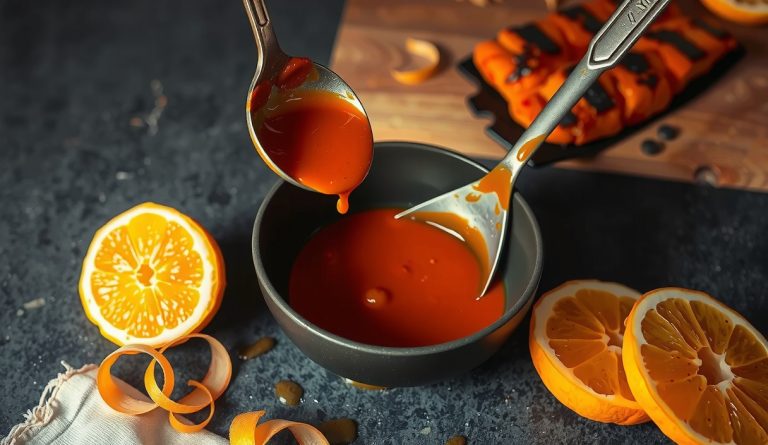
- Combine the gochujang, brown sugar, soy sauce, rice vinegar, and water in a small stainless steel or enameled saucepan. Whisk together until the gochujang paste is fully dissolved into a uniform, brick-red liquid with no lumps. The brown sugar should be fully incorporated — the texture should look like a smooth, moderately thick liquid at this stage.3 tablespoons brown sugar, packed, 3 tablespoons soy sauce, 2 tablespoons rice vinegar, 2 tablespoons water
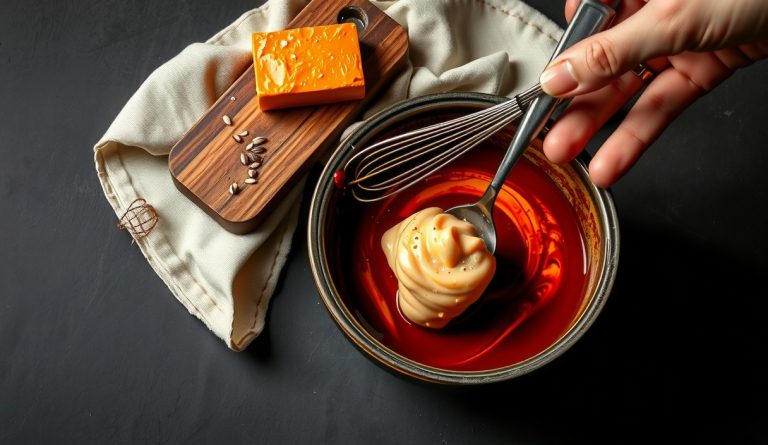
- Add the honey, minced garlic, and grated ginger to the pan. Whisk again to combine. The honey will initially resist mixing — give it 20–30 seconds of brisk whisking to fully integrate into the aqueous base.1 tablespoon honey, 4 cloves garlic, finely minced or pressed, 1 tablespoon fresh ginger, grated on a microplane
Cook the Sauce
- Place the saucepan over medium heat. Bring the mixture to a gentle simmer — you are targeting lazy surface bubbles breaking at roughly 90–95°C (194–203°F). Do not allow the sauce to reach a hard rolling boil. A hard boil drives off volatile aromatic compounds from the gochujang and drives the sauce toward scorching on the bottom.
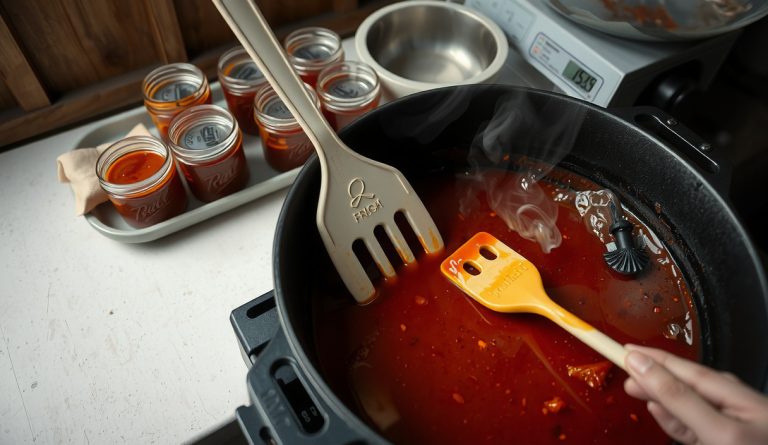
- Reduce heat to medium-low and cook, stirring frequently with a silicone spatula or whisk, for 10–12 minutes. The sauce is ready when it coats the back of a spoon and a line drawn through it holds for 2–3 seconds before filling back in. It will appear slightly thinner than the final consistency — it continues to thicken as it cools. If the sauce reduces too aggressively, add water 1 teaspoon at a time to maintain a pourable consistency.
Finish and Store
- Remove the pan from heat. Allow it to rest for 60–90 seconds so the surface temperature drops below 70°C (158°F). Then stir in the toasted sesame oil. Adding it now — and only now — preserves the high-volatility pyrazine and furfurylthiol aromatic compounds that define the sauce’s roasted sesame finish. Stirring into still-hot sauce above 70°C will flash off these aromatics within seconds.1 teaspoon toasted sesame oil
- Taste and adjust: if the sauce is too thick, whisk in water 1 teaspoon at a time. If it needs more salt, add soy sauce a few drops at a time rather than adding raw salt — this preserves the glutamate amplification. If it needs more acid brightness, add rice vinegar in 1/2-teaspoon increments.3 tablespoons soy sauce, 2 tablespoons rice vinegar
- Transfer to a clean, airtight glass jar. Garnish individual servings with toasted sesame seeds and scallion greens if desired. The sauce holds refrigerated for up to 3 weeks. Bring to room temperature or warm gently before use — the sesame oil phase thickens significantly under refrigeration and the sauce will appear artificially thick when cold.1 teaspoon toasted sesame seeds, 2 stalks scallions, thinly sliced (green parts only)
Notes
Nutrition
The first time I brushed this sauce onto a pork shoulder at 2 a.m. during a 16-hour smoke, I stopped second-guessing it. The gochujang — that deep-red, funky, sweet-hot fermented chili paste that Korean pantries have kept alive for centuries — hit the hot grate and did something remarkable. The sugars caramelized into a lacquer. The glutamates amplified every savory note the smoke had already built into the meat. The sesame oil puffed up in a burst of retronasal aroma that traveled across the yard. That sauce has been on every cook I’ve done since.
This recipe is direct. No obscure imports required, no 48-hour fermentation process on your end — the gochujang already carries that biochemical work. You are assembling a layered flavor matrix and cooking it just long enough to marry the components without destroying what makes each one irreplaceable. Fifteen minutes of heat. Layers that took months to develop inside a ceramic onggi pot. That is the deal.
Why does Korean Gochujang BBQ Sauce work? The science
Korean Gochujang BBQ Sauce works because gochujang is not just a chili paste — it is a concentrated library of Maillard and fermentation chemistry. During its minimum 30-day fermentation (premium versions age 6 to 36 months), Bacillus subtilis and lactic acid bacteria drive the enzymatic hydrolysis of the meju (fermented soybean and rice) substrate, generating free L-glutamic acid concentrations between 400 and 900 mg per 100g of finished paste. That free glutamate activates T1R1/T1R3 umami receptors synergistically when paired with the 5′-ribonucleotides (IMP, GMP) naturally present in the added soy sauce — the result is a receptor-level amplification of savory perception that exceeds what either ingredient achieves alone. This is the same cross-modal umami synergy found in aged Parmesan paired with anchovies, and it explains why gochujang-based sauces taste disproportionately complex relative to their ingredient count.
Brown sugar serves a dual structural and chemical role in this sauce. Its sucrose content (a non-reducing disaccharide) does not participate directly in Maillard condensation at sauce-making temperatures, but the molasses fraction carries reducing sugars — primarily glucose and fructose — along with small concentrations of free amino acids. These are Maillard-active at the surface temperatures achieved during high-heat grilling (well above 140°C where Schiff base formation accelerates). When you brush this sauce onto meat at the stall or in the final 30 minutes of a smoke, those reducing sugars intercept available carbonyl groups from the meat surface and drive a secondary Maillard cascade that deepens the bark color and generates pyrazine and furanone VOCs responsible for the caramel-roast aromatic signature. Water activity of the sauce itself (aw 0.80–0.88 at the concentrations used here) sits in the optimal Maillard range of 0.50–0.70 only after the surface moisture evaporates during grilling — which is precisely the moment the reaction accelerates. The timing is built in.
Sesame oil is the aromatic delivery vehicle in Korean Gochujang BBQ Sauce. Its principal flavor compounds — 2-furfurylthiol, sesamol, sesamolin-derived pyrazines — are highly lipophilic, exhibiting vapor-condensed phase partition coefficients (Kaw) that strongly favor retention in the fat phase at rest. This means the oil buffers and delays their release until the sauce contacts warm food or the heat of mastication, providing a sustained retronasal aromatic finish rather than a front-loaded volatility spike. This is why toasted sesame oil is added at the end of cooking: heating it into the sauce for extended periods drives off those volatile compounds before they can reach the palate. One tablespoon, stirred in off-heat, transforms the aroma persistence entirely.
What equipment and ingredients do I need?
Gochujang brand selection: Not all gochujang is equal. The USDA-equivalent Korean grading system rates gochujang by heat index (maewoon for hot, deolmaewoon for mild). For BBQ applications, a medium-heat product in the 45–55 Scoville-equivalent range provides the best balance of capsaicin-driven trigeminal heat (TRPV1 activation) without overwhelming the glutamate signal. Look for products listing meju powder and rice flour in the first three ingredients. Avoid versions with corn syrup as the primary sweetener — they collapse the fermentation complexity into a flat sugary punch.
Soy sauce: Standard brewed soy sauce (not low-sodium) is essential here. Sodium chloride at the concentrations in full-sodium soy sauce serves both as a flavor amplifier and a colloidal stabilizer that modulates the electrostatic interactions between the sauce’s emulsified fat phase (sesame oil) and the aqueous continuous phase. Low-sodium versions shift the ionic strength (I) downward, which can subtly destabilize the emulsion and flatten perceived salinity in a way that is difficult to compensate without losing the recipe’s balance.
Toasted sesame oil: Do not substitute with plain or light sesame oil. The toasting process drives the Maillard reaction within the seed, generating the specific pyrazine and furanone aromatic compounds that define the sauce’s finish. Light sesame oil is essentially flavorless by comparison.
Rice vinegar: Provides a mild, low-pH (pH ~2.9–3.1) acid note that serves as a brightness counterpoint without introducing the harsh acetate sharpness of distilled white vinegar, which would compete with and mask the fermented base notes of the gochujang.
Saucepan material: Use stainless steel or enameled cast iron. Reactive metals (bare cast iron, uncoated aluminum) will interact with the organic acids and high-glutamate content of the sauce, potentially generating metallic off-notes that compromise the clean fermented character.
Korean Gochujang BBQ Sauce
Equipment
- 1 Small stainless steel or enameled saucepan 2–3 quart capacity; avoid reactive metals
- 1 Whisk For emulsifying the fat phase into the aqueous base
- 1 Instant-read thermometer For monitoring sauce temperature; target 90–95°C during reduction
- 1 Airtight glass jar 12–16 oz capacity for storage; glass preferred over plastic to limit oxidation of sesame oil
Ingredients
Sauce Base
- 3 tablespoons gochujang (fermented Korean chili paste) Medium heat variety; look for meju powder and rice flour in the first three ingredients
- 3 tablespoons brown sugar, packed Dark brown sugar preferred for higher molasses fraction and more reducing-sugar Maillard activity
- 3 tablespoons soy sauce Full-sodium, brewed soy sauce — not low-sodium
- 2 tablespoons rice vinegar Unseasoned; provides pH 2.9–3.1 brightness without harsh acetate notes
- 2 tablespoons water Adjusts viscosity during initial cook; the sauce reduces to final consistency
- 1 tablespoon honey Adds fructose and glucose for additional Maillard activity; mild floral aromatic note
Aromatics
- 4 cloves garlic, finely minced or pressed Allicin precursors convert to thiosulfinates during cooking; mince fine for uniform dispersion
- 1 tablespoon fresh ginger, grated on a microplane Gingerol and shogaol contribute mild TRPV1 activation distinct from capsaicin
- 1 teaspoon toasted sesame oil Added off-heat only; do not cook — high-volatility pyrazine aromatics dissipate above 70°C
Finish
- 1 teaspoon toasted sesame seeds Optional garnish; adds textural contrast and visual cue for sesame identity
- 2 stalks scallions, thinly sliced (green parts only) Optional garnish; raw allium sharpness provides brightness contrast against the fermented base
Instructions
Build the Base
- Combine the gochujang, brown sugar, soy sauce, rice vinegar, and water in a small stainless steel or enameled saucepan. Whisk together until the gochujang paste is fully dissolved into a uniform, brick-red liquid with no lumps. The brown sugar should be fully incorporated — the texture should look like a smooth, moderately thick liquid at this stage.3 tablespoons brown sugar, packed, 3 tablespoons soy sauce, 2 tablespoons rice vinegar, 2 tablespoons water
- Add the honey, minced garlic, and grated ginger to the pan. Whisk again to combine. The honey will initially resist mixing — give it 20–30 seconds of brisk whisking to fully integrate into the aqueous base.1 tablespoon honey, 4 cloves garlic, finely minced or pressed, 1 tablespoon fresh ginger, grated on a microplane
Cook the Sauce
- Place the saucepan over medium heat. Bring the mixture to a gentle simmer — you are targeting lazy surface bubbles breaking at roughly 90–95°C (194–203°F). Do not allow the sauce to reach a hard rolling boil. A hard boil drives off volatile aromatic compounds from the gochujang and drives the sauce toward scorching on the bottom.
- Reduce heat to medium-low and cook, stirring frequently with a silicone spatula or whisk, for 10–12 minutes. The sauce is ready when it coats the back of a spoon and a line drawn through it holds for 2–3 seconds before filling back in. It will appear slightly thinner than the final consistency — it continues to thicken as it cools. If the sauce reduces too aggressively, add water 1 teaspoon at a time to maintain a pourable consistency.
Finish and Store
- Remove the pan from heat. Allow it to rest for 60–90 seconds so the surface temperature drops below 70°C (158°F). Then stir in the toasted sesame oil. Adding it now — and only now — preserves the high-volatility pyrazine and furfurylthiol aromatic compounds that define the sauce’s roasted sesame finish. Stirring into still-hot sauce above 70°C will flash off these aromatics within seconds.1 teaspoon toasted sesame oil
- Taste and adjust: if the sauce is too thick, whisk in water 1 teaspoon at a time. If it needs more salt, add soy sauce a few drops at a time rather than adding raw salt — this preserves the glutamate amplification. If it needs more acid brightness, add rice vinegar in 1/2-teaspoon increments.3 tablespoons soy sauce, 2 tablespoons rice vinegar
- Transfer to a clean, airtight glass jar. Garnish individual servings with toasted sesame seeds and scallion greens if desired. The sauce holds refrigerated for up to 3 weeks. Bring to room temperature or warm gently before use — the sesame oil phase thickens significantly under refrigeration and the sauce will appear artificially thick when cold.1 teaspoon toasted sesame seeds, 2 stalks scallions, thinly sliced (green parts only)
Notes
Nutrition
How do I nail it every time? Tips for perfect Korean Gochujang BBQ Sauce
- Do not boil aggressively. A hard rolling boil drives off the volatile aromatic compounds in the gochujang and sesame oil faster than they can contribute to the sauce. Target a gentle simmer — surface bubbles breaking lazily, not a full roiling boil. The thermal window is 90–95°C, not 100°C+.
- Add sesame oil only off heat. If you stir it in while the pan is still on the burner, the pyrazine and furfurylthiol compounds flash off in seconds. Pull the pan from heat, let it drop to below 70°C, then stir in the oil. The difference in aromatic persistence is dramatic.
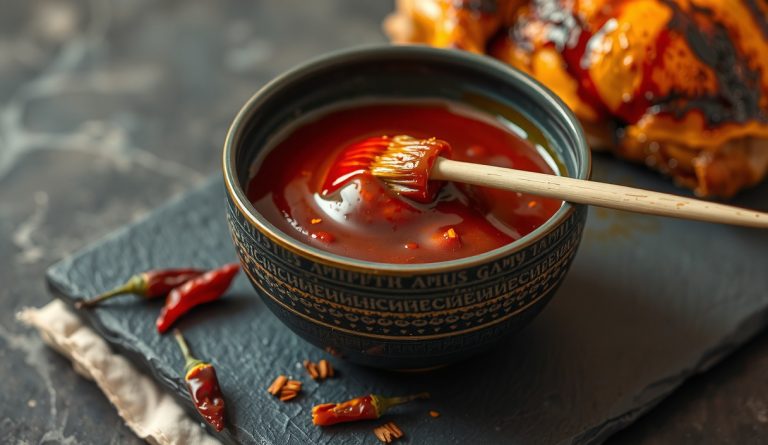
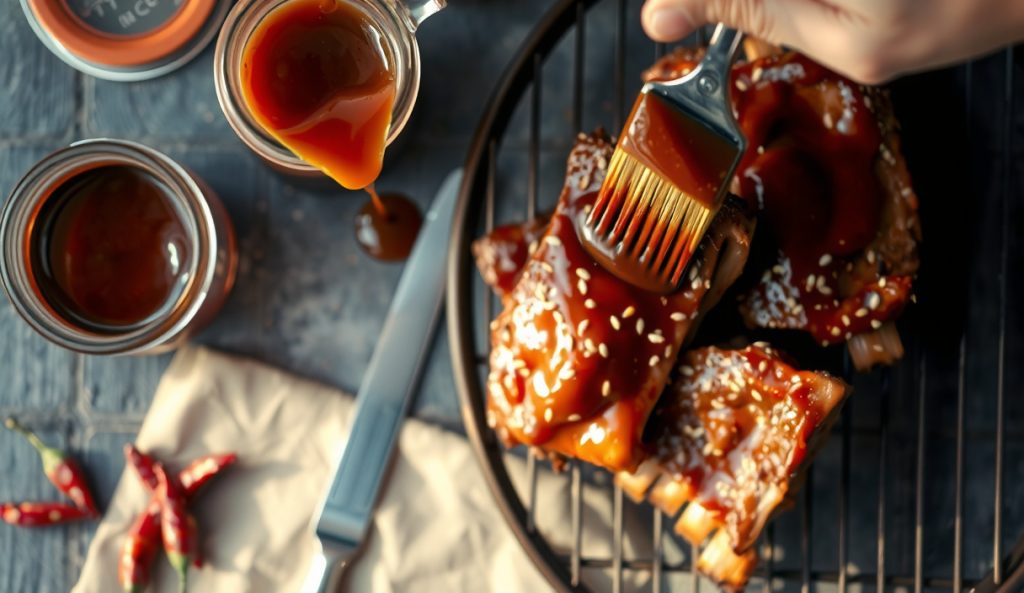
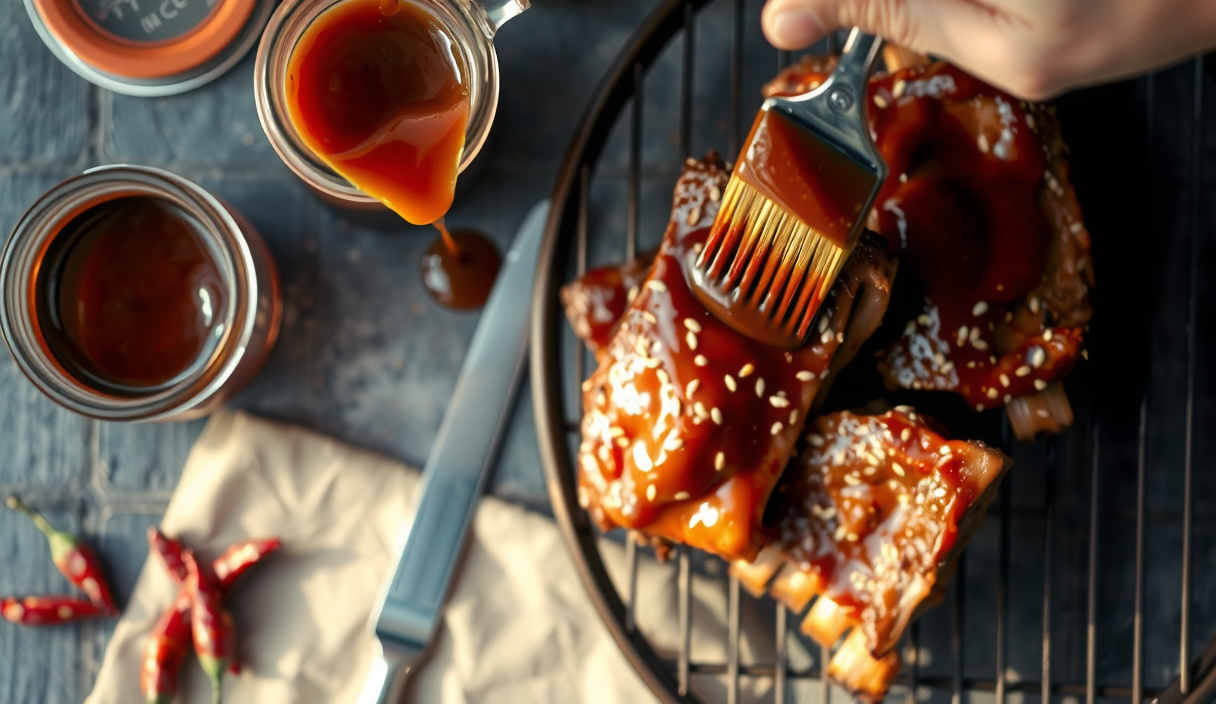
- For grilling application, brush in the final 20–30 minutes only. Brushing this sauce on meat too early burns the sugars to bitter carbon before the Maillard intermediates (furfurals, diacetyl, acetylpyrazine) can form properly. On a smoker running 225°F (107°C), wait until internal meat temp is within 15°F of your target before glazing. On a direct-heat grill, work over indirect zones at 325–375°F (163–190°C).
- Watch the color shift as a doneness signal. The sauce transitions from a matte brick-red to a lacquered mahogany-brown as the reducing sugars and free amino acids complete their condensation cycle. That color shift — not a timer — is your cue that the glaze layer has fully developed.
- Salt at the end, not the beginning. Soy sauce provides baseline sodium, but reducing the sauce concentrates salt. Taste and adjust with soy or a pinch of fine sea salt only after the sauce has reached its final consistency.
- For storage stability: The sauce holds refrigerated at or below 38°F (3°C) for up to 3 weeks. The aw of the finished sauce is low enough to resist most pathogen growth, but the sesame oil’s polyunsaturated fraction will oxidize over time — store in an airtight glass jar to limit oxygen exposure and extend aromatic fidelity.
What variations can I make to this sauce?
Spicier version: Add 1–2 teaspoons of gochugaru (Korean red pepper flakes) alongside the gochujang. Gochugaru contributes additional capsaicin-driven TRPV1 heat and a fruitier, less fermented chili note that pushes the sauce from a slow burn toward an upfront heat profile. This is particularly effective on chicken thighs or duck, where the fat renders slowly enough to buffer the added capsaicin intensity.
Citrus-forward variation: Replace the rice vinegar with 2 tablespoons of fresh yuzu juice or a combination of Meyer lemon juice and a few drops of orange oil. The citrus terpenes (limonene, linalool) partition into the sesame oil phase and extend the aromatic finish while the citric acid provides a brighter pH counterpoint (pH ~2.2–2.5) than rice vinegar. This variant pairs exceptionally well with fatty fish like salmon or arctic char on a cedar plank.
Deeper umami variation: Whisk in 1 tablespoon of white miso paste or 1 teaspoon of doenjang (Korean fermented soybean paste) after removing from heat. Both contribute additional free glutamate, branched-chain peptides, and nucleotide fractions that push the sauce’s umami ceiling substantially higher. The miso version is milder and more accessible; the doenjang version is funky, pungent, and aggressive — use it on bold proteins like beef brisket or pork ribs.
Scaling for production: This recipe scales linearly through 8x without any formulation adjustment. At volumes above 8x, the reduction time increases non-linearly because a larger liquid mass has a higher thermal mass and slower evaporation rate per surface area. At 16x scale, expect reduction time to increase by 40–60%. Do not increase heat to compensate — maintain the 90–95°C ceiling and simply allow more time. Sesame oil still goes in off-heat regardless of batch size.
Frequently asked questions
Can I substitute sriracha or sambal for the gochujang? You can, but the Korean Gochujang BBQ Sauce will be fundamentally different. Gochujang carries 400–900 mg/100g of free glutamate from its fermentation process — sriracha and sambal oelek are unfermented and carry essentially none. You will get heat and some sweetness but none of the umami depth that makes this sauce interact so powerfully with grilled meat. If gochujang is unavailable, the closest functional substitute is a 2:1 blend of miso paste and sambal oelek, which approximates the glutamate load.
Why does my sauce look thin right off the heat but thicken in the refrigerator? Two mechanisms are at work. First, as the sauce cools, the viscosity of the aqueous continuous phase increases non-linearly — the sugars and dissolved solids form a denser, more viscous matrix at low temperatures. Second, the sesame oil, which is fully liquid at cooking temperatures, partially organizes into a higher-viscosity phase near refrigeration temperatures (though it does not solidify). The sauce will thin again when warmed to room temperature or applied to warm food. This is by design — the thin hot-brush application coats more evenly than a thick cold application would.
Is the sauce safe to use as both a marinade and a finishing glaze on the same cook? If the sauce contacts raw meat during marination, it must be treated as contaminated with raw meat pathogens. Either discard the marinade or bring it to a full boil (100°C) for at least 2 minutes before using as a finishing glaze — this achieves a sufficient log reduction of vegetative pathogens. The simplest approach: make a double batch, use half for the marinade, and reserve the other half untouched for glazing.