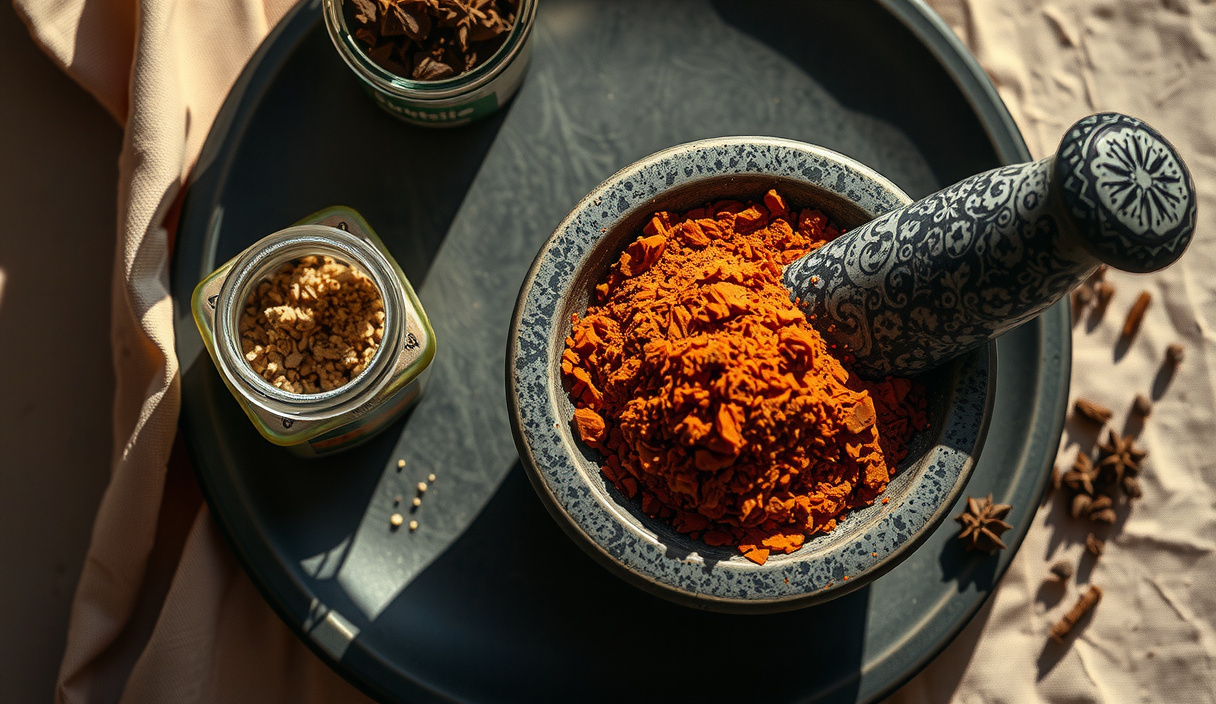
Low-Sodium BBQ Rub — Smoked Paprika-Forward

A precisely engineered low-sodium BBQ rub delivering full-spectrum bark and savory depth with under 90 mg sodium per serving. Potassium chloride at 30% of total chloride equivalents, amplified by mushroom glutamate and smoked paprika melanoidins, closes the saltiness gap through cross-modal sensory masking rather than simple salt reduction. Works on brisket, pork shoulder, ribs, and chicken.
Equipment
- 1 Spice grinder or clean coffee grinder For grinding dried mushrooms to a fine, flour-like powder — 150–200 micron target particle size
- 1 Fine mesh strainer Optional — screens out coarse mushroom flecks that can scorch at high heat
- 1 Digital kitchen scale Strongly recommended for precision on the KCl-to-NaCl ratio; small measurement errors shift the formula into the metallic-bitter zone
- 1 Airtight glass jar or sealed spice shaker 8 oz / 250 mL capacity; light and oxygen degrade volatile aromatics — keep sealed and dark
- 1 Mixing bowl Medium size, for combining all components
Ingredients
Salt System
- 1.5 tsp fine sea salt (sodium chloride, NaCl) Approximately 2,340 mg sodium total in the full batch — spreads to about 87 mg per 2-tsp serving; use fine-grain for even dispersion
- 0.75 tsp potassium chloride (KCl salt substitute) Nu-Salt, Morton Salt Substitute, or NoSalt brand; this sets KCl at approximately 30% of total chloride equivalents — do not exceed 1 tsp or bitterness crosses detection threshold
Umami Masking Layer
- 2 tsp dried porcini or shiitake mushroom powder Grind whole dried mushrooms in a spice grinder until flour-fine; porcini delivers higher free glutamate density; pass through a fine mesh strainer to remove coarse fragments
Aromatic Spice Base
- 4 tbsp smoked paprika Spanish pimentón de la Vera bittersweet (agridulce) grade strongly preferred — cold-smoked over oak, delivering dense Maillard melanoidins; do not substitute Hungarian paprika
- 1.5 tbsp ground cumin Freshly ground from whole seeds is ideal; contributes pyrazines for nutty, earthy depth
- 1.5 tbsp freshly ground black pepper Medium-coarse grind (approx. 1.0–1.5 mm); provides piperine for trigeminal TRPV1 activation, extending perceived flavor intensity; grind fresh for maximum volatile retention
- 1 tbsp garlic powder Not garlic salt — pure dried garlic; adds allium sulfur compounds and Amadori-product precursors for Maillard reactivity on the meat surface
- 1 tbsp onion powder Pure dried onion; reinforces allium aromatic base; synergizes with garlic's sulfur volatiles
- 1 tsp ground coriander Adds citrus-floral linalool top notes that brighten the dense spice base
- 1 tsp dry mustard powder Provides mild isothiocyanate-driven pungency and acts as a natural emulsifier on the meat surface pellicle, helping the rub adhere
- 0.5 tsp cayenne pepper Optional but recommended; low-dose capsaicin adds background heat that further activates TRPV1 receptors, amplifying overall flavor intensity without perceivable spiciness at this level
Bark Development
- 1 tbsp dark brown sugar Provides reducing sugars for Maillard cascade onset and caramelization above 230°F; moisture from molasses content helps the rub bind to the pellicle — reduce to 1.5 tsp for hot-and-fast cooks above 325°F to prevent over-charring

Instructions
Prepare Mushroom Powder
- Place dried porcini or shiitake mushrooms in a clean spice grinder. Grind in 10-second pulses until the mushrooms reach a fine, flour-like consistency. Pass through a fine mesh strainer into your mixing bowl, discarding any coarse fragments. Target particle size is 150–200 microns — visible flecks will scorch on the grill before contributing flavor.2 tsp dried porcini or shiitake mushroom powder
Combine the Salt System
- Add the fine sea salt and potassium chloride to the mushroom powder in the mixing bowl. Whisk together thoroughly. This NaCl-to-KCl ratio (approximately 70:30 by chloride equivalents) is the critical control point of this formula. Too much KCl yields metallic bitterness; too little undermines the sodium reduction. Mix these three components first so the KCl is fully dispersed before the spices go in.0.75 tsp potassium chloride (KCl salt substitute), 2 tsp dried porcini or shiitake mushroom powder
Add Aromatic Spices
- Add the smoked paprika, ground cumin, freshly ground black pepper, garlic powder, onion powder, ground coriander, dry mustard powder, and cayenne (if using) to the bowl. Grind black pepper fresh immediately before adding — pre-ground loses up to 60% of its volatile aromatics within two weeks of opening.4 tbsp smoked paprika, 1.5 tbsp ground cumin, 1.5 tbsp freshly ground black pepper, 1 tbsp garlic powder, 1 tbsp onion powder, 1 tsp ground coriander, 1 tsp dry mustard powder, 0.5 tsp cayenne pepper
Add Brown Sugar and Finish
- Add the dark brown sugar. Using a fork or small whisk, work through any clumps from the brown sugar — it tends to compact. Mix all components together for 60–90 seconds until the color is uniform and no unmixed pockets of white salt or dark sugar remain. The finished rub should appear deep brick-red throughout.1 tbsp dark brown sugar
Store and Apply
- Transfer the rub to an airtight glass jar or sealed shaker. Store in a cool, dark pantry — maximum shelf life is approximately 90 days before volatile aromatic degradation (primarily paprika and cumin) begins to noticeably flatten the profile. Label with the date.
- To apply: Pat the protein completely dry with paper towels. Apply 2 teaspoons per pound of meat and press firmly so the rub adheres. Rest uncovered on a rack in the refrigerator for 30–60 minutes before cooking to allow the pellicle to form and the rub to bond to the surface. Do not taste the rub dry off the spoon to assess saltiness — dry spice concentrations always taste flat until heat and moisture activate the full flavor cascade.
Notes
Why KCl does not simply taste like salt: Potassium and sodium both activate ENaC (epithelial sodium channels) on taste receptor cells, but K+ carries a secondary bitter signal via TASK-2 potassium channels. At or above 35% of total chloride equivalents, this bitterness becomes detectable to most palates. This formula holds KCl at approximately 30%, keeping the bitter note sub-threshold while still delivering a meaningful reduction in sodium load.
The glutamate masking mechanism: Dried porcini mushroom powder contains 1,500–3,000 mg free L-glutamic acid per 100 g — comparable to aged Parmesan. At the 2-teaspoon dose used here (approximately 0.5–0.8% w/w of a full batch applied to meat), this glutamate binds T1R1/T1R3 umami receptors, which cross-modally heightens the perceived intensity of adjacent salt signals. The effect is not additive — it is multiplicative: less sodium registers as more salty because the glutamate has primed the sensory system. Additional NMDA-receptor activation in the pharyngeal epithelium extends the temporal persistence of savoriness, producing the kokumi mouthfeel (depth, continuity) normally delivered only by fat and salt.
Maillard onset and bark formation: Smoked paprika already carries Maillard melanoidins from its curing process. When this rub hits a 250°F smoker grate, the brown sugar's reducing sugars (glucose and fructose from molasses) begin reacting with free amino groups from garlic and onion powder above 230°F. The bark fully sets between 160–180°F internal temperature on brisket — the moment collagen hydrolysis begins accelerating. At grill temperatures above 325°F (hot-and-fast cooks), the paprika's trace sugars caramelize rapidly toward the pyrolysis threshold; reduce paprika by 20% or tent with foil once bark is set.
Sodium math per serving: Total NaCl in the full batch (1.5 tsp fine sea salt) = approximately 3,480 mg sodium. Divided across approximately 12 tablespoons of finished rub at a 2-tsp-per-serving application rate, each serving delivers roughly 87 mg sodium — compared to 400–450 mg in a conventional rub using 1 tablespoon NaCl in a similar volume batch. That is a 78–80% sodium reduction per serving.
Nutrition
Calories: 12kcalCarbohydrates: 2.5gProtein: 0.4gFat: 0.3gSodium: 87mgFiber: 0.6gSugar: 1.1g
Tried this recipe?Let us know how it was!