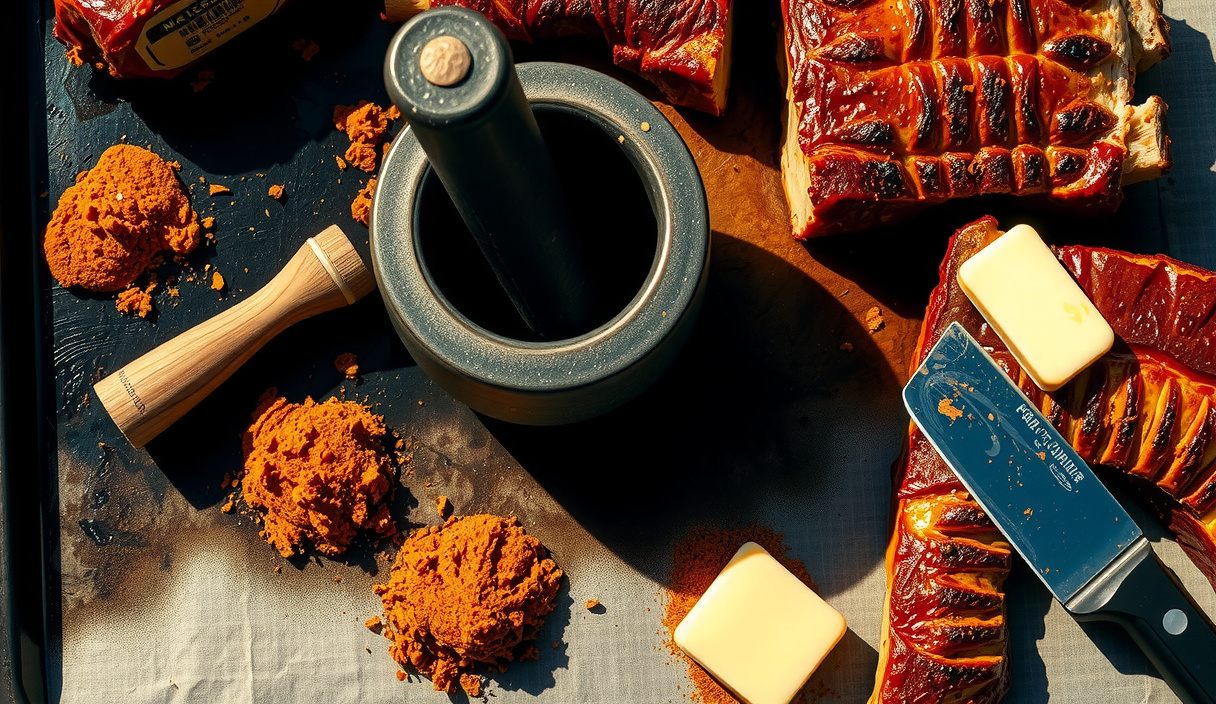
Memphis Pork Rub — Paprika-Brown-Sugar Base

A pitmaster-calibrated dry rub built on a 30% smoked paprika and 20% brown sugar base, engineered to produce consistent Maillard browning and bark formation at 285–300°F surface temperatures. This 100-gram formula scales precisely by percentage — the standard for competition and backyard cooks who want repeatable results on ribs, shoulder, and whole-muscle pork.
Equipment
- 1 Kitchen scale Digital, 0.1g resolution preferred — essential for accurate ratio formulation
- 1 Mixing bowl Medium, stainless or glass
- 1 Fine mesh sieve or sifter For breaking up brown sugar clumps before measuring and combining
- 1 Airtight glass jar For storage — keeps the rub up to 6 months away from direct light and humidity
- 1 Whisk or fork For blending the dry ingredients evenly
Ingredients
- 30 g smoked paprika Spanish pimentón de la Vera, hot or bittersweet — not sweet Hungarian paprika
- 20 g light brown sugar Sifted to break up clumps; dark brown sugar adds deeper molasses note and slightly faster browning
- 15 g kosher salt Diamond Crystal preferred; if using Morton, reduce to 12g — Morton is denser by volume
- 10 g coarse-ground black pepper 16-mesh cracked for ribs; fine-ground for tenderloin or smaller cuts
- 8 g ancho or New Mexico chili powder Single-ingredient, not a commercial blend — commercial blends contain salt and cumin that disrupt the ratio
- 7 g onion powder Not onion salt — onion powder only
- 5 g garlic powder Not garlic salt
- 3 g ground cumin Freshly ground whole cumin seeds preferred for higher volatile aromatic concentration
- 2 g dry mustard powder Coleman's or similar pure ground mustard — provides Strecker degradation precursors for roasted depth

Instructions
- Sift the light brown sugar through a fine mesh sieve into your mixing bowl to break up any clumps. Brown sugar's hygroscopic nature causes it to harden rapidly — sifting ensures even distribution throughout the rub.20 g light brown sugar
- Weigh all remaining ingredients individually on a digital kitchen scale and add them to the bowl with the sifted brown sugar: smoked paprika, kosher salt, black pepper, chili powder, onion powder, garlic powder, cumin, and mustard powder.30 g smoked paprika, 15 g kosher salt, 10 g coarse-ground black pepper, 8 g ancho or New Mexico chili powder, 7 g onion powder, 5 g garlic powder, 3 g ground cumin, 2 g dry mustard powder
- Whisk thoroughly for 60–90 seconds until the mixture is completely uniform in color. No streaks of salt or sugar should be visible. The final blend should be a deep red-brown with visible black pepper flecks. Taste a pinch on your fingertip — it should hit paprika and smoke first, then black pepper heat, with a clean salt finish.
- To use: Pat your pork ribs or shoulder completely dry with paper towels. Apply the rub in two passes — a moderate base coat patted lightly to adhere, rest two minutes, then a second layer. Allow at least 45 minutes at room temperature, or rest uncovered overnight in the refrigerator for optimal osmotic penetration and surface drying before the cook.
- To store: Transfer to an airtight glass jar. Store at room temperature away from direct heat and light for up to 6 months. Add a food-safe desiccant packet to the jar to prevent brown sugar clumping in humid climates. Before each subsequent use, break up any clumps with a fork and pass through a sieve.
Notes
Why the Maillard window is 285–300°F surface: Sucrose begins caramelizing around 320°F and is a slow Maillard participant at lower temperatures because it is a non-reducing disaccharide — it must first hydrolyze to glucose and fructose before reacting with amino groups. The molasses fraction in brown sugar provides free-form glucose and fructose that bypass this hydrolysis step, enabling Maillard condensation to initiate meaningfully above 280°F. This is why this rub produces consistent dark bark on a 275°F pit when a pure-sucrose rub would remain pale for hours.
Salt osmosis timing: At 20–40 minutes post-application, osmotic pressure has pulled surface moisture out of the meat but reabsorption has not yet completed. This creates a wet, diluted surface layer — the worst state for bark formation. Either cook immediately from cold (rub applied, straight to the fire) or allow the full 45-minute minimum rest for reabsorption. Overnight refrigeration is the gold standard: low-humidity cold air dries the surface aggressively while the osmotic cycle completes, resulting in a tacky, semi-dry surface that adheres smoke phenols and develops bark faster on the pit.
Paprika VOC partitioning: Smoked paprika's flavor-active carotenoid ketones and pyrazine volatiles are lipophilic — they partition strongly into the surface fat layer on the pork. This means they are released gradually as the fat renders during the cook, providing sustained aromatic complexity rather than a single upfront flash. At 30% inclusion, paprika also contributes capsanthin and capsorubin pigments, which deepen bark color through a non-Maillard oxidative pathway. Do not use bark color alone as a doneness indicator — probe temperature and bark firmness are your reliable signals.
Scaling math: This is a 100-gram base formula. To scale: multiply each percentage by your target batch weight in grams. For 500g of rub: smoked paprika = 150g, brown sugar = 100g, salt = 75g, and so on across all nine ingredients.
Nutrition
Calories: 18kcalCarbohydrates: 4.2gProtein: 0.4gFat: 0.3gSodium: 860mgFiber: 0.8gSugar: 3.1g
Tried this recipe?Let us know how it was!