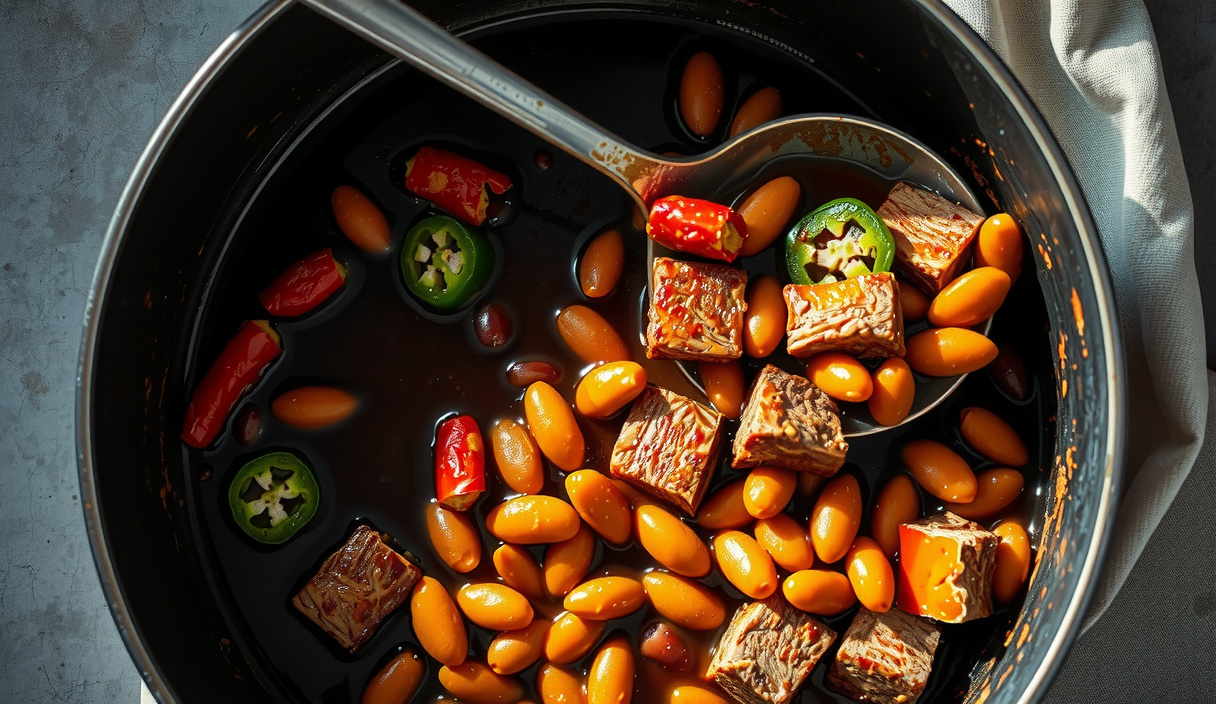
Pit Beans — Texas-Style Smoked Pinto Beans with Brisket Trimmings
Texas pit beans cooked in two phases under live post oak smoke: uncovered for maximum phenolic absorption during the first two hours, then covered to finish the braise. Brisket trimmings contribute hydrolyzing collagen for a thick, glossy braising liquid; jalapeño and apple cider vinegar provide heat and structural control of bean-pectin softening. Serve alongside sliced brisket or smoked ribs.
Equipment
- 1 5-to-6-quart cast iron Dutch oven or heavy enameled pot Must fit under your smoker rack with the lid off
- 1 Offset smoker, kettle, or kamado cooker Running at 250 to 275°F with post oak, hickory, or a blend
- 1 Instant-read thermometer For verifying liquid temperature above 200°F during the covered braise
- 1 Large mixing bowl For overnight soaking the beans
Ingredients
Beans and Liquid
- 1 lb dried pinto beans Soaked overnight in cold water, drained and rinsed
- 4 cups unsalted beef stock Plus up to 1 additional cup hot stock or water to maintain liquid level
- 2 cups water
- 3 tbsp apple cider vinegar Unfiltered, with the mother preferred
Protein and Fat
- 12 oz brisket trimmings Fatty point-end offcuts with connective tissue intact, cut into 1.5-inch chunks
- 4 strips thick-cut bacon Cut into 1-inch lardons
Aromatics and Seasoning
- 1 medium yellow onion Diced
- 4 cloves garlic Minced
- 2 medium jalapeños Sliced into thin rounds, seeds included for full heat
- 3 tbsp dark brown sugar Packed
- 2 tbsp yellow mustard
- 1 tbsp Worcestershire sauce
- 1 tsp smoked paprika
- 1 tsp black pepper Freshly cracked
- 1 tsp kosher salt Added only in the final 30 minutes of the cook
- 0.5 tsp cayenne pepper Optional, for additional heat

Instructions
Prep
- The night before, place the dried pinto beans in a large bowl and cover with cold water by at least 3 inches. Let soak 8 to 12 hours. Drain and rinse well before using. Do not add salt to the soak water.
- Fire up your smoker and bring it to a stable 250 to 275°F using post oak, hickory, or a clean hardwood blend. You want a steady, thin blue smoke — not thick white billowing smoke, which will deposit harsh, acrid compounds onto the beans.
Build the Pot
- In the Dutch oven over a side burner or stovetop on medium heat, render the bacon lardons until the fat is released and the edges are just beginning to crisp, 4 to 5 minutes. Do not drain the fat — it stays in the pot.4 strips thick-cut bacon
- Add the brisket trimming chunks to the rendered bacon fat and sear on the highest-surface-contact sides for 2 to 3 minutes per side to develop a Maillard crust. They do not need to be cooked through. Remove and set aside briefly.12 oz brisket trimmings
- In the same pot, add the diced onion and sliced jalapeños. Cook over medium heat until the onion is translucent and beginning to soften, 4 to 5 minutes. Add the minced garlic and cook 1 minute more until fragrant.4 cloves garlic, 3 tbsp dark brown sugar, 2 medium jalapeños
- Return the brisket trimmings and bacon to the pot. Add the drained pinto beans, beef stock, water, apple cider vinegar, dark brown sugar, yellow mustard, Worcestershire sauce, smoked paprika, black pepper, and cayenne if using. Stir to combine. Do not add salt yet.4 cups unsalted beef stock, 2 cups water, 3 tbsp apple cider vinegar, 2 tbsp yellow mustard, 1 tbsp Worcestershire sauce, 1 tsp smoked paprika, 1 tsp black pepper, 1 tsp kosher salt
- Bring the pot to a strong simmer on the stovetop over medium-high heat. This gets the liquid temperature up before it goes into the smoker so you do not waste smoke absorption time waiting for the liquid to heat.
Phase 1 — Open Smoke (2 hours)
- Transfer the pot, uncovered and lid off, to the smoker rack. Position it directly under any protein you may be cooking simultaneously if possible — drippings from above contribute rendered fat and juice to the bean liquid. Maintain smoker temperature at 250 to 275°F.
- At the 60-minute mark, check the liquid level. The beans must remain submerged by at least 1 inch of liquid. If the level has dropped below that, add hot beef stock or hot water — never cold — in 0.5-cup increments to maintain coverage. Stir once gently, then leave the surface undisturbed.4 cups unsalted beef stock
- Continue the uncovered smoke phase for a full 2 hours total from the moment the pot entered the smoker. Resist stirring during this window to allow maximum phenolic compound deposition on the liquid surface.
Phase 2 — Covered Braise (2 hours)
- After 2 hours of open smoke, check liquid level once more and adjust if needed. Place the lid on the Dutch oven. Continue cooking with the lid on at the same 250 to 275°F smoker temperature for 2 additional hours. The covered environment traps steam, raises the internal liquid temperature above 200°F, and accelerates pectin degradation in the bean cell walls.
- At the 3-hour total mark (1 hour into the covered phase), stir the beans gently from the bottom to prevent any sugar-rich liquid from scorching on the bottom of the pot. Check bean texture by pressing one bean between two fingers — it should yield with some resistance but have no chalky center.
- In the final 30 minutes of the cook, add the kosher salt. Stir to incorporate. Taste and adjust: if you want more brightness, add a teaspoon of additional ACV; for more sweetness, a small pinch of brown sugar; for more heat, a pinch of cayenne.0.5 tsp cayenne pepper, 3 tbsp apple cider vinegar, 2 tbsp yellow mustard
Finish and Serve
- After 4 total hours on the smoker, the beans are done when: they crush easily between your fingers with no chalky interior, the braising liquid coats the back of a spoon with a glossy, lightly viscous sheen from dissolved gelatin, and the edges of the pot show a dark caramelized ring of reduced sugar and fat. If you want a drier, crustier top, remove the lid for the final 15 minutes.
- Remove the pot from the smoker. Let rest, uncovered, for 10 minutes before serving. The liquid will thicken slightly as it cools and the gelatin concentration rises. Serve directly from the Dutch oven alongside sliced brisket, ribs, or sausage.
Notes
Why uncovered first, then covered? Smoke-volatile absorption onto a wet food surface follows a saturation curve — the rate is highest in the first 90 to 120 minutes when the concentration gradient between the smoke aerosol and the bean-liquid surface is steepest. After that, absorption yields diminish sharply. Keeping the pot open captures that entire early-window loading. Covering after 2 hours shifts the thermal environment into an efficient pressure-approximating braise where steam recirculates, liquid temperature climbs above 200°F, and bean pectin degradation accelerates without further evaporative loss.
Bean pectin and the 200°F threshold: The middle lamella of bean cotyledon cells is held together by calcium-cross-linked polygalacturonic acid (pectin). Thermal beta-elimination — the primary degradation mechanism — proceeds at a meaningful rate above approximately 183°F and accelerates substantially past 200°F. The apple cider vinegar establishes a cooking-liquid pH of roughly 4.5 to 5.5, which slows beta-elimination just enough to preserve bean structure while still allowing full tenderness. Too alkaline and the beans collapse; the vinegar is doing textural architecture, not just flavor.
Collagen hydrolysis kinetics: Type I collagen in the brisket connective tissue begins converting to soluble gelatin above 160°F. The rate is governed by first-order kinetics and accelerates sharply past 180°F. During the covered braise with liquid temperatures above 200°F, this conversion is essentially complete over the 2-hour window. The dissolved gelatin raises the viscosity of the braising liquid and contributes the body and mouthfeel that distinguishes pit beans from simple boiled beans.
Salt timing: Sodium ions compete with calcium at pectin cross-links in the bean cell wall. Early salting can cause premature, uneven softening — beans go mushy on the exterior before the interior cotyledon is cooked. Adding salt only in the final 30 minutes allows the pectin structure to set first, then seasons the finished texture.
Wood selection: Post oak produces predominantly guaiacol-class phenolics (smoky, vanilla-adjacent) that integrate cleanly with beef. Mesquite produces more aggressive cresol-heavy smoke with a higher concentration of phenanthrene-class compounds — use it sparingly or blended. Avoid green or resinous wood entirely; terpene compounds from pine or cedar will overwhelm the beans with turpentine-adjacent off-notes that do not cook out.
Nutrition
Calories: 310kcalCarbohydrates: 32gProtein: 18gFat: 12gSaturated Fat: 4gCholesterol: 38mgSodium: 480mgFiber: 8gSugar: 7g
Tried this recipe?Let us know how it was!