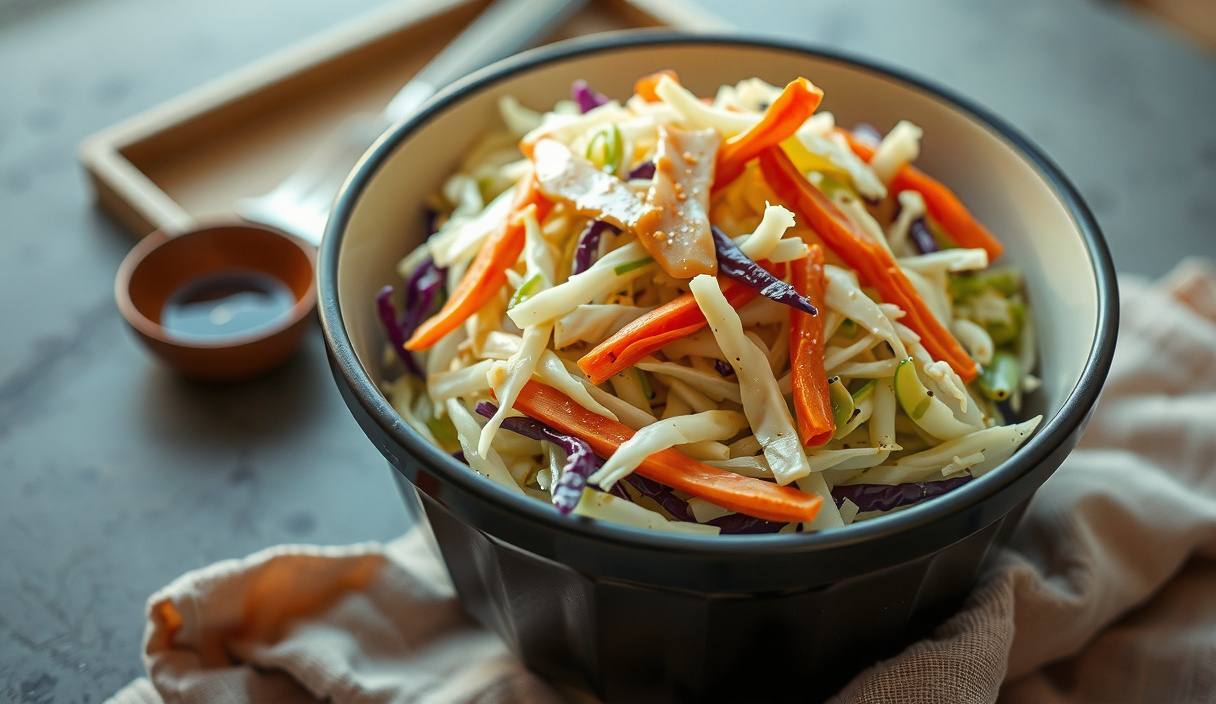
Pit-Master Coleslaw — Vinegar-Forward

A vinegar-forward BBQ slaw built on osmotic dehydration science. Cabbage is salted for 30 minutes to expel excess water before dressing, keeping the slaw crisp and the apple cider vinegar-Dijon dressing punchy and concentrated — not diluted by vegetable water. A one-hour rest before serving integrates the dressing and tightens the texture. This is the slaw that belongs next to brisket, pulled pork, and smoked ribs.
Equipment
- 1 Large mixing bowl At least 5-quart capacity for tossing 1.5 lbs of cabbage comfortably
- 1 Colander For draining the osmotically expelled water after the salt draw
- 1 Salad spinner or clean kitchen towels For removing surface moisture after rinsing — critical step for preventing a watery slaw
- 1 Mandoline slicer or sharp chef's knife Mandoline at 2mm setting gives the most consistent shred; a sharp knife works fine
- 1 Whisk For emulsifying the dressing before it contacts the cabbage
- 1 Kitchen scale Strongly recommended — salt concentration relative to cabbage mass drives the osmotic step
Ingredients
Cabbage
- 1.25 lbs green cabbage about 1/2 medium head, cored and very thinly shredded (approximately 570g); firm, dense head preferred
- 0.25 lb red (purple) cabbage about 1/8 small head, cored and thinly shredded (approximately 115g); adds color and mild sulfur complexity
- 2 medium carrots peeled and coarsely grated on the large holes of a box grater (approximately 110g)
- 10 g kosher salt for the osmotic draw step — approximately 1.5 teaspoons Diamond Crystal or 1 teaspoon Morton kosher; weigh if possible
Vinegar-Dijon Dressing
- 3 tablespoons apple cider vinegar raw unfiltered preferred (5% acidity); adds fermentation-ester depth beyond plain acetic acid
- 1.5 tablespoons smooth Dijon mustard acts as the primary emulsifier via amphiphilic mucilage proteins; whole-grain Dijon is a fine swap for texture variation
- 1.5 tablespoons mayonnaise full-fat; small amount rounds the acidity and extends dressing stability via egg yolk lecithin
- 1 tablespoon neutral oil avocado, grapeseed, or refined sunflower — not EVOO (too assertive)
- 1 teaspoon granulated sugar balances acidity; do not increase — this is a savory-acid profile, not a sweet slaw
- 0.25 teaspoon celery seed non-negotiable for the BBQ pitmaster profile; provides volatile terpene complexity (limonene, selinene)
- 0.25 teaspoon freshly ground black pepper
- 0.5 teaspoon kosher salt for the dressing — adjust after tasting post-rest; the rinsed cabbage will carry some residual salt
Finish
- 3 tablespoons fresh flat-leaf parsley finely chopped; added just before serving for fresh volatile top-notes
- 2 whole scallions thinly sliced, green parts only; adds mild allium brightness without FODMAP fructan load of raw onion

Instructions
Salt Draw — Osmotic Dehydration (30 minutes)
- Combine the shredded green cabbage, red cabbage, and grated carrots in a large bowl. Weigh or measure the kosher salt for the draw step and scatter it evenly over the cabbage. Toss aggressively for 60 seconds with clean hands, squeezing and massaging the salt into the shredded tissue to ensure full surface contact.0.25 lb red (purple) cabbage, 2 medium carrots, 10 g kosher salt
- Set the bowl aside at room temperature for exactly 30 minutes. You will see water begin pooling in the bottom of the bowl within 5 to 8 minutes as osmotic pressure drives intracellular water out through the cabbage cell membranes. Do not rush this step — the full 30 minutes is required to expel a meaningful water fraction and achieve the slightly softened, leathery texture that characterizes properly prepared slaw base.
- Transfer the wilted cabbage to a colander set over the sink. Rinse thoroughly under cold running water, tossing with your hands, for about 30 seconds. Rinse a second time. Taste a shred — it should taste barely, pleasantly salty. If it tastes aggressively salty, rinse a third time. Transfer to a salad spinner and spin until very dry, or spread on clean kitchen towels and squeeze firmly. The cabbage must be as dry as possible before dressing — surface moisture dilutes the emulsion on contact.
Build the Dressing
- In the now-empty large bowl (dried), combine the apple cider vinegar, Dijon mustard, sugar, celery seed, black pepper, and the 0.5 teaspoon of kosher salt for the dressing. Whisk vigorously until the sugar and salt fully dissolve, about 30 seconds. The Dijon mustard will begin to emulsify and thicken the liquid slightly as the whisk incorporates air.3 tablespoons apple cider vinegar, 1.5 tablespoons smooth Dijon mustard, 0.25 teaspoon celery seed, 1 teaspoon granulated sugar, 0.25 teaspoon freshly ground black pepper, 0.5 teaspoon kosher salt
- Drizzle in the neutral oil in a slow, steady stream while whisking constantly to create a temporary oil-in-water emulsion. The dressing should look slightly opaque and unified rather than visibly separated. Whisk in the mayonnaise last until fully smooth and incorporated. The dressing should coat the back of a spoon. Taste it — it should be aggressively vinegary and mustardy at this stage. That sharpness will mellow once it contacts the cabbage.1 tablespoon neutral oil, 1.5 tablespoons mayonnaise
Dress and Rest (1 hour)
- Add the dried salted cabbage and carrots to the bowl with the dressing. Toss thoroughly with tongs or two large spoons for a full 2 minutes, ensuring every shred is evenly coated. The dressing should cling without pooling in the bottom of the bowl. If dressing pools heavily, the cabbage was not dried sufficiently — use the tongs to lift and toss from the bottom, distributing the dressing back upward.0.25 lb red (purple) cabbage, 2 medium carrots
- Cover the bowl tightly with plastic wrap and refrigerate for at least 1 hour before serving. This rest is the flavor-integration step: the apple cider vinegar acids continue mild osmotic conditioning of the cabbage, the celery seed volatile compounds bloom into the fat phase of the dressing, and the dressing loses its raw assembled quality and becomes cohesive. Do not skip this step.
- After the hour rest, remove from the refrigerator and stir from the bottom to redistribute any dressing that has settled. Taste and adjust: if it needs more acid brightness, add a small splash of apple cider vinegar (start with 1 teaspoon). If it tastes flat, it likely needs a tiny pinch more salt. Fold in the fresh chopped parsley and sliced scallion greens now — adding them earlier would cause the parsley to lose its volatile aromatic compounds and the scallions to turn soft and sulfurous in the acid.3 tablespoons fresh flat-leaf parsley, 2 whole scallions
Serve
- Transfer the slaw to a chilled serving bowl. Serve immediately alongside smoked meats, BBQ sandwiches, or fried chicken. The slaw holds well refrigerated for up to 18 hours after dressing; beyond that, continued acid exposure softens the texture past the ideal firm-tender bite. Do not let it sit at room temperature for longer than 2 hours once plated.
Notes
The osmotic dehydration mechanism: Cabbage is approximately 92% water by mass, held under positive turgor pressure inside intact plant cells. Kosher salt at 1.5% to 2.0% concentration by weight of the cabbage creates a steep osmotic gradient across the semi-permeable cell membranes. The thermodynamic response is water migration outward through the membranes — expelling 10 to 20% of total water mass in 30 minutes at room temperature. This expelled water is discarded before dressing, so the vinaigrette never gets diluted and the slaw never puddles. The same physics drive traditional kimchi preparation and German sauerkraut conditioning.
Why Dijon works as an emulsifier: Dijon mustard contains amphiphilic proteins and polysaccharide mucilage compounds derived from the mustard seed that adsorb to the oil-water interface and reduce interfacial tension. This provides short-term kinetic emulsion stability without egg lecithin. The small addition of mayonnaise (a stable O/W emulsion built on egg yolk lipoproteins) extends that stability and rounds the sharp vinegar edge with fat-phase buffering of volatile aroma compounds.
The one-hour rest is not optional: Apple cider vinegar's brightness comes from acetic acid (pH ~3.0 to 3.5) layered with fermentation esters — ethyl acetate, 3-methylbutyl acetate — that read as fruit-forward complexity. In a freshly dressed slaw these components are perceptible as separate elements. After one hour refrigerated, the esters partition partially into the oil and mayo fat phase, the celery seed terpenes bloom into the continuous dressing, and the cabbage absorbs enough dressing to stop tasting like dressed shredded vegetable and start tasting like cohesive slaw.
Celery seed biology: Celery seed contains limonene (citrus-adjacent terpene), selinene (woody-herbal sesquiterpene), and phthalide compounds responsible for the characteristic savory depth. These volatiles are lipophilic — they partition strongly into the fat phase of the mayo-oil emulsion during the rest period, becoming more integrated and less raw-spice-forward over time. This is why celery seed tastes harsh sprinkled on at the end but smooth and resonant after a proper rest in an emulsified dressing.
Nutrition
Calories: 78kcalCarbohydrates: 7.2gProtein: 1.4gFat: 5.1gSaturated Fat: 0.7gCholesterol: 2mgSodium: 290mgFiber: 2.1gSugar: 4g
Tried this recipe?Let us know how it was!