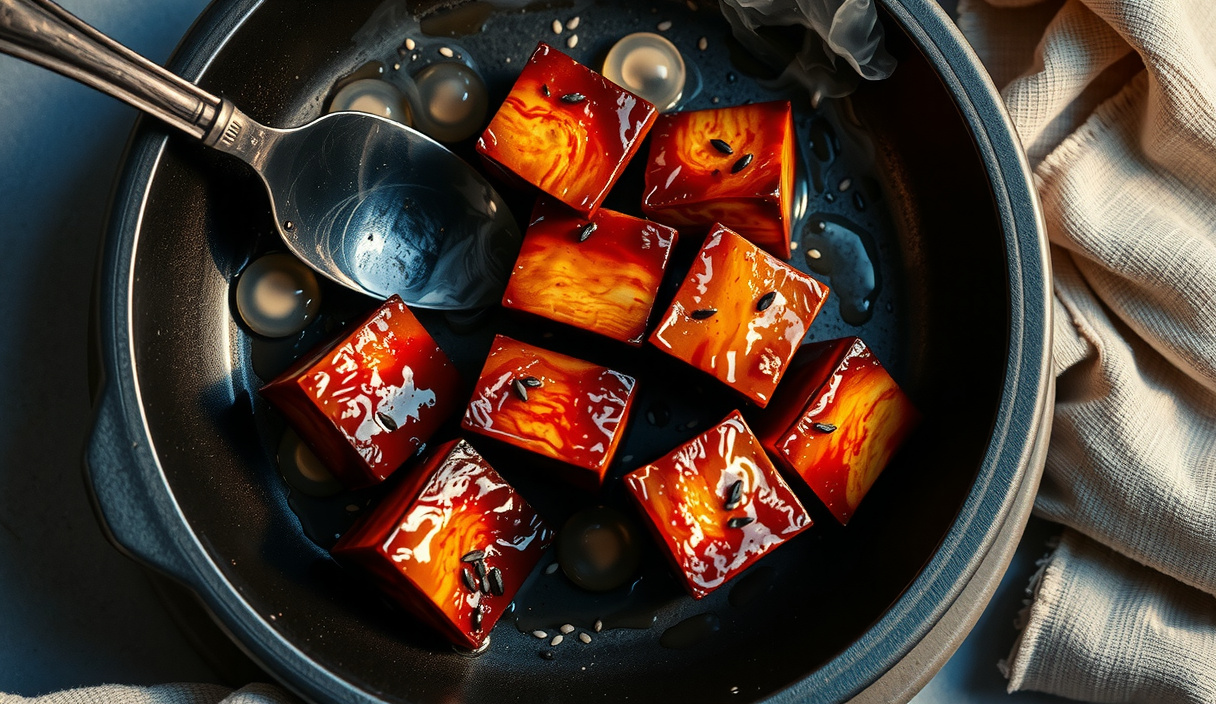
Plant-Based Smoked Mushroom Burnt Ends

King trumpet mushroom stems scored crosshatch, rubbed with a savory spice blend, cold-smoked at 250°F for 90 minutes, then lacquered twice in a hoisin-maple glaze and returned to the smoker until the surface is dark, sticky bark. The result has the structural contrast of a proper burnt end: firm, caramelized exterior and a yielding, umami-dense interior — no meat required.
Equipment
- 1 Offset smoker or kettle grill with indirect setup Maintain stable 250°F at grate level. Use a separate grate thermometer — dome thermometers read 15–25°F cooler.
- 2 Cherry or apple wood chunks Fist-sized chunks, not chips. Chips combust too fast and produce acrid smoke spikes.
- 1 Wire cooling rack over half-sheet pan For pre-smoke refrigerator dry and for resting post-cook.
- 1 Sharp boning or chef's knife For clean crosshatch scoring without tearing the mycelial tissue.
- 1 Pastry brush Silicone preferred — natural bristle scorches on second glaze pass.
- 1 Instant-read thermometer Used for grate temp monitoring, not internal mushroom temp.
Ingredients
Mushrooms
- 2 lbs king trumpet mushroom stems Stems only, minimum 1.5-inch diameter. Caps reserved for another use. Patted dry, then uncovered on a rack in the refrigerator for 1–2 hours before cooking.
Dry Rub
- 1 tbsp smoked paprika Spanish pimentón de la vera preferred for its phenol-rich smoke character.
- 1 tbsp dark brown sugar Provides Maillard-active reducing sugars and caramel precursors at the surface.
- 1.5 tsp kosher salt Diamond Crystal. If using Morton, reduce to 1 tsp.
- 1 tsp garlic powder
- 1 tsp onion powder
- 0.75 tsp freshly ground black pepper Coarsely ground. Fine-ground over-penetrates and turns acrid under prolonged smoke.
- 0.5 tsp ground cumin
- 0.25 tsp cayenne pepper Adjust to heat preference. TRPV1 activation from capsaicin enhances perceived savory depth.
Hoisin-Maple Glaze
- 0.25 cup hoisin sauce Check label for fish sauce — some brands include it. Lee Kum Kee vegetarian hoisin is plant-based certified.
- 2 tbsp pure maple syrup Grade B (dark) preferred — higher concentration of reducing sugars accelerates Maillard onset at lower temperatures.
- 2 tbsp soy sauce Low-sodium preferred. Provides free glutamate and sodium synergistically for umami depth.
- 1 tbsp rice vinegar Corrects glaze pH toward 4.5–5.0, preventing cloying sweetness and brightening the finish.
- 1 tsp grated fresh ginger Provides gingerol-driven mild heat and volatile aromatics that survive only the last glaze pass.
- 1 tsp toasted sesame oil Added to glaze off-heat only. Delicate methyl pyrazines and furanones in sesame oil volatilize above 250°F.
For Serving
- 2 stalks scallions, green tops only, thinly sliced Green tops are low-FODMAP; white bulbs are high-fructan. Green parts provide fresh sulfur-volatile contrast to the deep roasted notes.
- 1 tsp toasted sesame seeds

Instructions
Prep the Mushrooms
- Trim the base of each king trumpet stem to expose a clean, flat face. Slice stems crosswise into 1.5-inch rounds or, if stems are long, leave whole. Using a sharp knife, score each flat face in a crosshatch pattern — cuts approximately 1/2 inch apart, 3/4 inch deep, at 45-degree angles to each other. Work both flat faces of each piece.
- Pat all surfaces thoroughly dry with paper towels. Place mushrooms cut-side up on a wire rack over a sheet pan. Transfer to the refrigerator, uncovered, for at least 1 hour and up to 2 hours. This step drives down surface water activity — without it, the smoker will steam the mushrooms for the first 30–40 minutes rather than building bark. Do not skip.
Make the Dry Rub
- Combine smoked paprika, dark brown sugar, kosher salt, garlic powder, onion powder, black pepper, cumin, and cayenne in a small bowl. Whisk until homogeneous — the brown sugar tends to clump; break up any lumps before applying.1 tbsp dark brown sugar, 1.5 tsp kosher salt, 1 tsp garlic powder, 1 tsp onion powder, 0.75 tsp freshly ground black pepper, 0.5 tsp ground cumin, 0.25 tsp cayenne pepper
- Remove mushrooms from the refrigerator. Apply rub generously to all surfaces, using your fingers to press and work the spice mix deep into the crosshatch scores. The scores are your seasoning delivery system — the interior tissue should visibly receive rub. Season all flat faces, sides, and any exposed top surfaces. Let the rubbed mushrooms sit at room temperature for 15 minutes while the smoker comes to temperature.1 tbsp dark brown sugar, 1.5 tsp kosher salt, 1 tsp garlic powder, 1 tsp onion powder, 0.75 tsp freshly ground black pepper, 0.5 tsp ground cumin, 0.25 tsp cayenne pepper
Fire the Smoker and First Smoke Phase
- Set up your smoker for indirect heat at a stable 250°F measured at grate level. Add 1–2 fist-sized chunks of cherry or apple wood to the coals or firebox — not chips. Allow the smoke to turn thin and blue before loading the mushrooms. White billowing smoke deposits acrid creosote; thin blue smoke deposits desired phenolic compounds and organic acids.
- Place mushrooms cut-face up on the grate with at least 1 inch of clearance between pieces. Close the lid. Smoke at 250°F for 90 minutes, rotating the pieces to a cooler or hotter zone as needed at the 45-minute mark to ensure even exposure. Do not lift the lid more than once during this phase — each lid lift drops grate temperature by 25–40°F and extends actual cook time.
- At 90 minutes, check the mushrooms: the cut faces should look matte, visibly shrunken at the edges, and show color development from golden-brown to deep amber. The surface should feel dry and firm to a light press. If any faces still look wet or pale, close the lid and continue for 15–20 additional minutes. Do not glaze a wet surface.
Make the Glaze
- While mushrooms are in their first smoke phase, combine hoisin sauce, maple syrup, soy sauce, and rice vinegar in a small saucepan over medium-low heat. Stir until homogeneous and just barely simmering — about 2 minutes. Remove from heat. Stir in grated ginger and toasted sesame oil. The sesame oil goes in off-heat only; its volatile aromatics flash off rapidly above 250°F. Allow glaze to cool to room temperature. It should coat a spoon thickly and fall in a slow ribbon. If it is too thin, return to low heat and reduce by 15–20% before cooling.0.25 cup hoisin sauce, 2 tbsp pure maple syrup, 2 tbsp soy sauce, 1 tbsp rice vinegar, 1 tsp grated fresh ginger, 1 tsp toasted sesame oil
Glaze and Second Smoke Phase
- Remove mushrooms from the smoker. Working quickly, apply a thin, even coat of glaze to all scored faces using a pastry brush. Thin coat means you can still see the surface texture through the glaze — not pooling in the scores. Return glazed mushrooms to the smoker cut-face up. Close the lid. Smoke for 15 minutes at 250°F.0.25 cup hoisin sauce, 2 tbsp pure maple syrup, 2 tbsp soy sauce, 1 tbsp rice vinegar, 1 tsp grated fresh ginger, 1 tsp toasted sesame oil
- Open the smoker, apply a second thin coat of glaze to all faces. The first coat should now be tacky and show darkening — this is the second Maillard event building on the first crust. Return to the smoker for a final 15 minutes. Total second-phase time: 30 minutes. Watch carefully: if the glaze appears to be blackening rather than darkening to mahogany, your grate temperature has exceeded 280°F — move mushrooms to a cooler zone immediately.0.25 cup hoisin sauce, 2 tbsp pure maple syrup, 2 tbsp soy sauce, 1 tbsp rice vinegar, 1 tsp grated fresh ginger, 1 tsp toasted sesame oil
Rest and Serve
- Transfer mushrooms to a wire rack or warm cast-iron skillet. Rest for 10 minutes uncovered — do not cover or the steam will soften the bark you just built. During this rest, the glaze firms from a running liquid to the tacky, sticky consistency characteristic of proper burnt end bark, and volatile aromatics partially re-adsorb onto the cooled surface.
- Arrange on a serving platter or keep in the cast-iron. Scatter sliced scallion greens and toasted sesame seeds over the top. Serve immediately — these lose heat quickly. If serving buffet-style, keep in a warm cast-iron skillet or chafing dish at 140°F to hold glaze consistency.2 stalks scallions, green tops only, thinly sliced, 1 tsp toasted sesame seeds
Notes
Why the crosshatch score matters — surface area physics: Scoring creates new surface area at a 45-degree angle to the mushroom's natural cellular orientation. The mycelial fibers run longitudinally in king trumpet stems; crosshatch cutting severs these fibers transversely, exposing the intracellular protein and beta-glucan matrix directly to hot airflow. This dramatically accelerates local evaporation at the cut faces — driving water activity below 0.70 within 40–50 minutes at 250°F rather than the 70–80 minutes needed for an unscored surface. Below water activity 0.70, Maillard kinetics accelerate sharply because reactant mobility is high but evaporative cooling no longer suppresses surface temperature.
Why 250°F, not higher: At 250°F indirect, the heat flux is high enough to drive surface desiccation within 90 minutes but low enough to allow the interior beta-glucan network to slowly soften via beta-elimination of the polysaccharide backbone without complete cellular collapse. Higher temperatures (300°F+) desiccate the exterior faster than the interior can equilibrate, producing a hard, papery exterior and a raw-feeling center. This is the same physical logic that governs low-and-slow brisket cooking — slow heat allows moisture redistribution throughout the matrix.
The stall does not apply here: Brisket experiences a dramatic temperature plateau at 160–170°F internal as evaporative cooling matches heat input. Mushrooms, being porous and low in connective tissue, do not stall in the same way. Surface moisture evaporation is faster and the mass is smaller — trust visual and tactile cues over timing.
Glaze Maillard chemistry: Hoisin provides free amino acids from fermented soybeans — particularly glutamic acid, lysine, and alanine — that pair with the reducing sugars in maple syrup (glucose and fructose) to run rapid Maillard condensation at the desiccated mushroom surface. The pH of the glaze (approximately 4.8 after rice vinegar addition) keeps the reaction kinetics in a moderate range — highly alkaline environments (pH 8+) accelerate browning but also generate bitter melanoidin side products. The slightly acidic glaze produces controlled, sweet-savory browning without bitterness.
Wood smoke chemistry: Cherry and apple wood combust at temperatures that favor the generation of guaiacol, 4-methylguaiacol, and syringol — phenolic compounds responsible for the sweet, fruity smoke character associated with American BBQ. These compounds physically absorb into the surface moisture layer of the mushroom during the first smoke phase, then bind to the protein matrix as it denatures, creating a genuine smoke ring analog in the first 3–5mm of tissue depth. The smoke ring in meat is a myoglobin reaction; the ring here is phenol-protein binding — visually similar, mechanistically different.
Nutrition
Calories: 185kcalCarbohydrates: 28gProtein: 7gFat: 5gSaturated Fat: 0.7gSodium: 820mgFiber: 4gSugar: 16g
Tried this recipe?Let us know how it was!