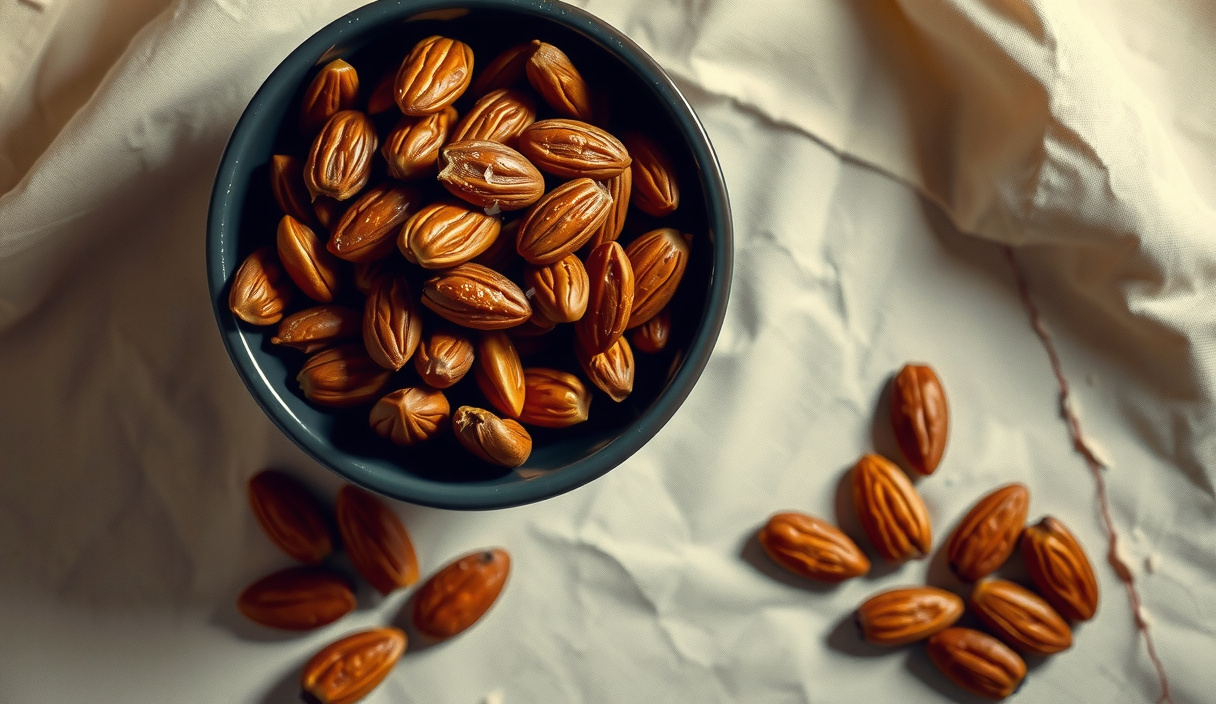
Maple-Cayenne Smoked Almonds

Raw almonds tossed in dark maple syrup, cayenne, and sea salt, then slow-smoked at 225°F for 90 minutes over apple or cherry wood. The maple coating caramelizes into a lacquered sugar glass that traps smoke phenols on contact, delivering deep campfire-caramel flavor with a clean, lingering heat. Stir every 30 minutes, pull while tacky, and let them firm on the rack — they are gone faster than you expect.
Equipment
- 1 Smoker or kettle grill with indirect heat setup Must hold a stable 225°F. Pellet grills, offset smokers, or kettle grills with two-zone setup all work.
- 1 Wire cooling rack Set over a half-sheet pan. Elevating the almonds allows smoke to contact all surfaces and prevents pooling of the coating.
- 1 Large mixing bowl
- 2 to 3 small chunks Wood chunks or chips (apple, cherry, or mild hickory) Soak chips in water 20 minutes if using a charcoal setup. Pellets need no soaking.
- 1 Instant-read or grill probe thermometer Optional but recommended for confirming smoker temperature at rack level.
Ingredients
- 1 lb raw whole almonds Do not use pre-roasted; surface is too dry for coating adhesion and smoke uptake.
- 3 tbsp pure maple syrup, Grade A Dark Color or Robust Taste Darker grades contain more Maillard precursors from extended sap evaporation.
- 1 tsp cayenne pepper Adjust to taste. Provides approximately 0.3% w/w capsaicin load in the finished coating.
- ¾ tsp fine sea salt Applied before smoking to accelerate surface moisture draw and suppress bitter receptor signaling.
- ½ tsp flaky sea salt For finishing immediately off the smoker while the coating is still tacky.
- 1 tsp neutral oil (such as avocado or light olive oil) Optional but helps the maple coating adhere evenly and slows initial moisture loss slightly.

Instructions
Prepare the smoker
- Fire up your smoker or set your grill for indirect heat. Target a stable 225°F at rack level — use an independent probe thermometer clipped near where the almonds will sit, not just the lid thermometer, which often reads 15 to 25°F off. Add 2 to 3 small chunks of apple or cherry wood (or a single cup of chips in a foil pouch for gas grills). Allow the smoker to reach temperature and produce thin blue smoke before the almonds go on — thick white smoke means the wood is smoldering inefficiently and will deposit acrid compounds on the coating.
Coat the almonds
- In a large bowl, combine the raw almonds, maple syrup, cayenne, fine sea salt, and oil if using. Toss thoroughly for about 60 seconds until every almond is evenly coated. The mixture should look glossy and slightly thick — no dry almonds and no pooling liquid.1 lb raw whole almonds, 3 tbsp pure maple syrup, Grade A Dark Color or Robust Taste, 1 tsp cayenne pepper, 3/4 tsp fine sea salt, 1 tsp neutral oil (such as avocado or light olive oil)
- Spread the coated almonds in a single layer on a wire rack set over a sheet pan. Every almond should have clearance from its neighbors — crowding traps steam and prevents the coating from setting evenly.1 lb raw whole almonds
Smoke
- Place the rack in the smoker. Close the lid and smoke at 225°F for the first 30 minutes without opening. Resist the urge to check — the coating needs uninterrupted heat to begin drying down from its initial high water activity state.
- At the 30-minute mark, open the smoker and stir the almonds with a spatula or tongs, turning them to expose the underside surfaces to smoke and prevent the coating from fusing to the rack. The almonds will still look tacky and pale — this is correct. Close the lid and continue.
- At the 60-minute mark, stir again. By now you should see the beginnings of amber Maillard color on the coating — the water activity has dropped sufficiently for the browning cascade to accelerate. If the coating looks dark brown or smells burnt at this stage, your smoker is running hotter than indicated; reduce heat immediately and pull at 75 to 80 minutes total.
- At 90 minutes total, the almonds should have a rich amber-to-caramel-brown coating that looks slightly tacky but no longer wet. They will feel semi-firm when pushed with a spatula but will not yet be crunchy — this is the correct pull point. The sugar glass completes its set during cooling, not on the smoker. Remove the rack.
Cool and finish
- Immediately scatter the flaky sea salt over the almonds while the coating is still tacky — this is the only window where finishing salt will adhere to the surface rather than falling off. Spread the almonds in a single layer and do not touch them for at least 15 to 20 minutes. As they cool, you will hear the coating harden from a sticky soft gel into a crisp, lacquered shell.1/2 tsp flaky sea salt
- Once fully cooled and crunchy, taste and adjust. If you want more heat, dust lightly with additional cayenne while the surface still has a trace of tack. Transfer to an airtight container and store at room temperature for up to 10 days. Do not refrigerate — ambient humidity will slowly dissolve the sugar glass and make the almonds sticky.1 tsp cayenne pepper
Notes
Why the coating looks pale for the first 25 minutes: The maple syrup coating starts with a high water activity (aw near 0.85). At this moisture level, evaporative cooling at the nut surface is intense enough to suppress the surface temperature below the Maillard activation threshold even inside a 225°F smoker. You are essentially running a miniature drying phase before browning can begin. Once aw drops below approximately 0.70, the surface temperature rises freely past the Maillard onset range and color development accelerates — this is why the second 30-minute interval looks so dramatically different from the first.
Smoke phenol adsorption mechanism: Guaiacol, syringol, and their alkyl derivatives condense onto the sticky maple surface via physical adsorption in the early phase when aw is high. As the coating vitrifies into a sugar glass (the transition from a rubbery, pliable state into a rigid amorphous solid), phenol molecules are partially encapsulated within the glass matrix. This is why these almonds retain smoke character for days rather than hours — the phenols are physically trapped, not just adsorbed on a dry surface where they evaporate freely.
Capsaicin partitioning into almond lipids: Capsaicin is highly lipophilic (log P approximately 3.0). Over 90 minutes at 225°F, it partitions from the surface coating into the almond's native lipid fraction (almonds are roughly 50% fat by weight). This fat-phase depot releases capsaicin progressively during mastication, creating a heat perception that builds and lingers rather than hitting immediately and fading — a fundamentally different sensory profile compared to surface-only spice application.
Pulling slightly underdone: The sugar glass transition is exothermic — stored thermal energy in the hot coating continues to drive browning reactions for several minutes after the almonds leave the smoker. Pulling at the apparent "slightly underdone" visual stage accounts for this carry-over Maillard development and delivers the intended final color without crossing into pyrolysis bitterness territory.
Nutrition
Calories: 215kcalCarbohydrates: 10gProtein: 8gFat: 17gSaturated Fat: 1.3gSodium: 220mgFiber: 3.5gSugar: 6g
Tried this recipe?Let us know how it was!