Smoked Bologna — Oklahoma Steakhouse Style
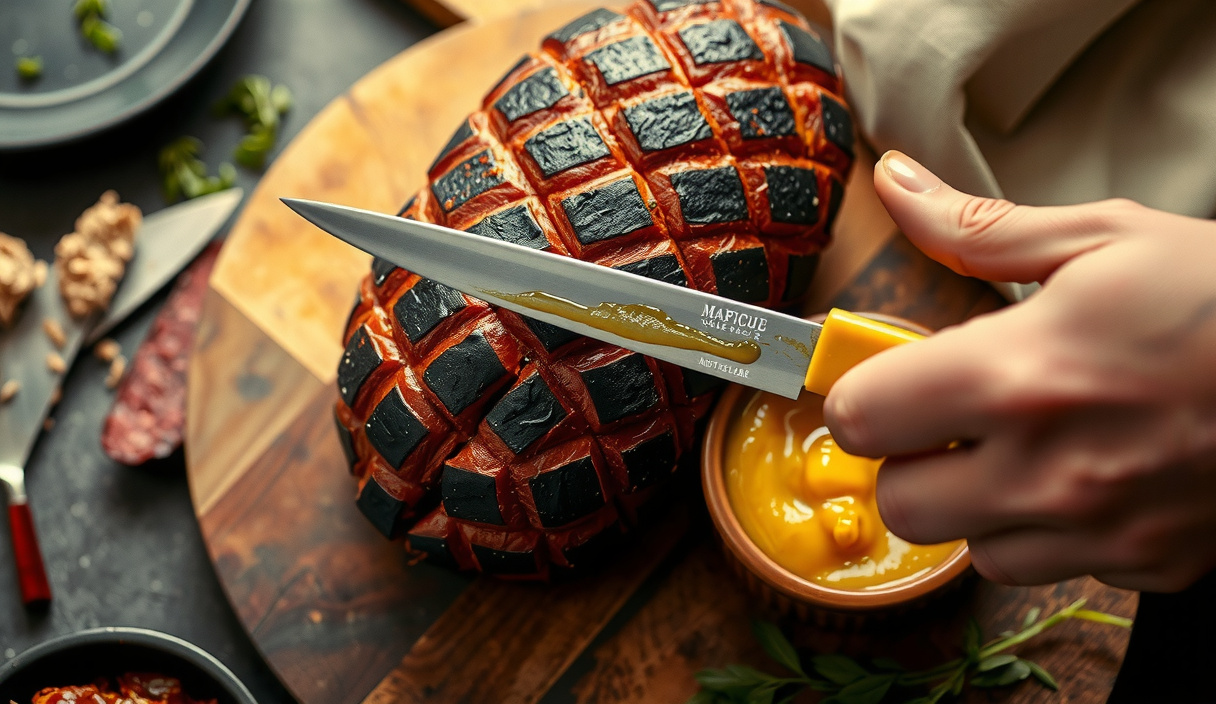
A whole 5-lb bologna chub, scored in a deep diamond crosshatch, slathered in yellow mustard, coated in a sweet-heat BBQ rub, and smoked low and slow over hickory for 4 hours at 225°F until the surface develops a deep mahogany bark with a visible smoke ring. Sliced half-inch thick and served on white bread — this is Oklahoma roadside BBQ at its most honest and most satisfying.
Equipment
- 1 Smoker or kettle grill Offset, pellet, charcoal kettle, or gas grill with 2-zone setup — all work. Target 225°F with indirect heat.
- 4 to 6 chunks Hickory wood chunks or chips Chunks for offsets and kettles; chips in a foil packet or smoker box for gas grills. Replenish chips at 90 minutes.
- 1 Sharp boning or chef's knife Must be sharp — the emulsified bologna gel resists a dull blade and will tear rather than score cleanly.
- 1 Instant-read thermometer Used to monitor smoker temperature, not a required endpoint temp for the bologna itself.
- 1 Wire rack Set inside a sheet pan for resting and transport. Keeps the bark from softening against a flat surface.
Ingredients
The Bologna
- 1 whole bologna chub or ring bologna 5 lb / approximately 2.3 kg. Ring or club style both work. If casing is plastic, peel before scoring. If fibrous or natural, score through the casing.
Mustard Binder
- 3 tablespoons yellow mustard Standard American yellow mustard (French's or Heinz). Dijon works but changes the surface character slightly.
BBQ Rub
- 2 tablespoons brown sugar Light or dark both work. Dark brown sugar gives deeper molasses notes in the bark.
- 1 tablespoon smoked paprika
- 1 tablespoon kosher salt
- 1 teaspoon coarse black pepper Freshly ground if possible — pre-ground works but delivers less volatile aromatic punch.
- 1 teaspoon garlic powder
- 1 teaspoon onion powder
- ½ teaspoon cayenne pepper Reduce to 1/4 teaspoon for a milder rub, increase to 1 teaspoon for a hot version.
- ½ teaspoon dry mustard powder Amplifies the mustard binder note and adds low-level TRPV1 trigeminal warmth to the bark.
For Serving
- 20 slices white sandwich bread Soft white bread — Wonder Bread or equivalent. 2 slices per sandwich.
- yellow mustard, for serving Optional but traditional.
- BBQ sauce, for serving Optional. A tangy, vinegar-forward Kansas City or Oklahoma-style sauce works best.

Instructions
Prep the Chub
- If the bologna has a plastic casing, peel it off completely and discard. If it has a fibrous or natural casing, leave it on — it will score and smoke beautifully. Pat the surface dry with paper towels if it is wet from refrigeration.
- Using a sharp boning knife, score the entire surface of the bologna in a crosshatch pattern: make diagonal cuts approximately 1 inch apart at a 45-degree angle, then rotate the knife 90 degrees and repeat to create a diamond grid. Cut at least 1/4 inch deep — you want to visibly open the surface. Work all the way around the circumference, the top, the bottom, and both flat ends. Missing any section will result in patchy bark.
- Apply the yellow mustard all over the scored surface, using your hands or a brush to work it into the cuts. You want a thin, even slick — not a thick paste. The mustard will be invisible in the final product but holds the rub and structurally improves bark adhesion.
- Combine all rub ingredients in a small bowl and mix thoroughly. Apply the rub generously over the entire mustard-coated surface, pressing it firmly into the scored cuts. The mustard binder should hold the rub in place without sliding. Let the rub-coated bologna rest at room temperature for 20 to 30 minutes while you prep the smoker — this gives the salt time to begin drawing surface moisture and helps the rub adhere further.1 tablespoon smoked paprika, 1 tablespoon kosher salt, 1 teaspoon coarse black pepper, 1 teaspoon garlic powder, 1 teaspoon onion powder, 1/2 teaspoon cayenne pepper, 1/2 teaspoon dry mustard powder
Fire Up the Smoker
- Preheat your smoker, kettle, or grill to a stable 225°F using indirect heat. Add 4 to 6 hickory wood chunks (or a foil packet of hickory chips for gas grills) to the fire. Wait until the smoke runs thin and blue-gray before loading the meat. White or gray billowing smoke indicates incomplete combustion and will produce a bitter, acrid bark — let the fire stabilize first.
Smoke
- Place the bologna directly on the grate over indirect heat. Close the lid. Smoke at 225°F for 4 hours, maintaining a steady temperature and thin blue smoke throughout. Resist the urge to open the lid more than once per hour — every lid lift drops the chamber temperature and extends your cook.
- At the 90-minute mark, check the smoke source. If using chips in a foil packet on a gas grill, replenish the chips now. If using wood chunks in an offset or kettle, add one additional chunk if needed. The bark will be visibly forming — the surface should be starting to turn from reddish-brown to a deeper mahogany.
- At 4 hours, the bologna should have a deep mahogany to dark brown bark all over, the score lines will have opened and caramelized, and the surface will be slightly tacky to the touch. The internal temperature will read approximately 155 to 165°F — this is incidental confirmation of the cook, not the target endpoint. Pull based on bark color and texture.
Rest and Slice
- Remove the bologna from the smoker and let it rest on a wire rack for 5 to 10 minutes. This allows the outer bark to set slightly and makes for cleaner slices. Do not rest longer than 15 minutes uncovered or internal steam will soften the crust.
- Slice the bologna 1/2 inch thick — no thinner. Thin slices lose the textural contrast between the bark exterior and the soft, steamed interior that defines this dish. Use a sharp slicing or chef's knife and work in long, deliberate strokes rather than sawing.
Serve
- Serve immediately on white sandwich bread — 2 slices of bread, 1 to 2 thick slabs of smoked bologna. Add yellow mustard and BBQ sauce to taste. Wrap in butcher paper for the full roadside experience.20 slices white sandwich bread, yellow mustard, for serving, BBQ sauce, for serving
Notes
Why the scoring drives everything: The outer casing of a bologna chub is a low-permeability membrane. Left intact, it traps surface moisture, creating a steam environment that suppresses the localized surface desiccation required for Maillard browning. The quarter-inch crosshatch physically breaches this membrane across the entire surface, exposing the emulsified meat gel directly to the convective heat and smoke of the chamber. As the exposed surface dehydrates, the boundary layer temperature climbs through the Maillard activation zone — roughly 280 to 330°F surface temperature even in a 225°F chamber — and the amino-carbonyl cascade begins generating the pyrazines and melanoidins that constitute the bark. Deeper scores do not dramatically improve bark but do provide better fat render channels; shallower scores close up during the cook and defeat the purpose.
Why mustard works as a binder: Prepared yellow mustard is a stable oil-in-water emulsion containing mucilage polysaccharides from the mustard seed at an effective hydrocolloid concentration of roughly 0.5 to 1.0% w/w. Applied to the bologna surface, the aqueous continuous phase dissolves the hygroscopic components of the rub (sugars, salt) and anchors them to the meat surface before the bark locks them in place during the early phase of the cook. The allyl isothiocyanate responsible for mustard's pungency volatilizes within the first 20 to 30 minutes of the cook — what remains is a slightly acidic, savory base note that is indistinguishable from the meat itself in the finished product. The mustard is a structural tool, not a flavor statement.
Smoke ring mechanics: The pink smoke ring on the cross-section of the sliced bologna is carbon monoxide and nitric oxide from wood combustion binding to myoglobin to form stable carboxymyoglobin and nitrosomyoglobin. These reactions occur only in the presence of moisture on the meat surface — once the surface desiccates and the bark forms, further smoke ring development stops. Because bologna is a fine-grind emulsion with uniformly distributed myoglobin rather than intact muscle fiber, the ring will be tight (2 to 4 mm) rather than the deep ring seen on a whole brisket. It is still diagnostically visible and proves your fire chemistry is correct.
Hickory specificity: Hickory lignin pyrolysis produces a dense output of syringol and guaiacol derivatives — the phenolic compounds that give hickory its assertive, slightly medicinal smoke signature. These phenolics deposit efficiently on the high-water-activity surface of the bologna during the first two hours of the cook. After the surface desiccates and bark begins forming, deposition rate drops sharply regardless of how much wood you add. The practical implication: your first two hours of wood management matter far more than the final two. Get the fire stabilized and the smoke running clean before you load the meat, and you have done most of the critical work.
Nutrition
Calories: 520kcalCarbohydrates: 28gProtein: 18gFat: 36gSaturated Fat: 13gCholesterol: 75mgSodium: 1480mgFiber: 1gSugar: 8g
Tried this recipe?Let us know how it was!