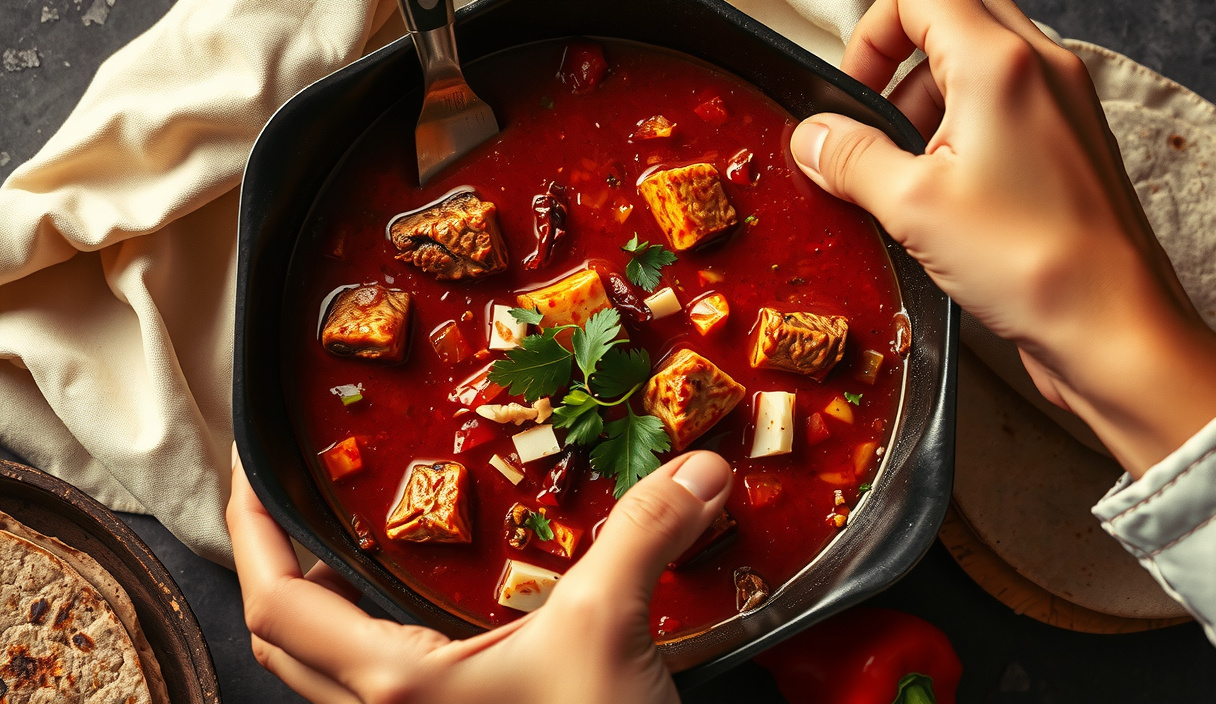
Smoked Brisket Chili
Leftover smoked brisket point is cubed, hard-seared on fresh-cut faces to rebuild the Maillard crust, then braised in a hand-toasted ancho-guajillo paste, fire-roasted tomatoes, and dark lager. Masa harina gelatinizes into a thick, corn-tortilla-scented broth that ties smoke, dried chile, and beef into something greater than any of its parts.
Equipment
- 1 6-quart enameled cast iron Dutch oven High thermal mass prevents scorching of the thick chili paste; essential for an even low simmer.
- 1 12-inch cast iron or carbon steel skillet For searing brisket cubes and dry-toasting chiles. Must hold sustained high heat.
- 1 High-speed blender Emulsifies the soaked chiles into a smooth paste. An immersion blender will work but produces a coarser texture.
- 1 Instant-read thermometer Confirms the braise holds 200–205°F. Prevents hard boiling that shreds the meat.
- 1 Fine-mesh strainer Optional: strain the chile paste for a silkier broth. Skip for rustic texture.
Ingredients
Smoked Brisket
- 2 lbs smoked brisket point (or point-heavy slices) Cold from the refrigerator; cut into 1-inch cubes. Bark-on is correct and preferred.
- 2 tbsp neutral oil (beef tallow or lard preferred) High smoke-point fat for searing. Tallow amplifies the beef character.
- 1 tsp kosher salt For seasoning before sear.
Ancho-Guajillo Chile Paste
- 4 dried ancho chiles (stems removed, seeded) Approximately 1.5 oz. Remove seeds for medium heat; leave one chile’s seeds for hotter result.
- 3 dried guajillo chiles (stems removed, seeded) Approximately 0.75 oz. Adds brightness and clean red color.
- 2 cups boiling water For soaking the toasted chiles. Reserve the soaking liquid.
- 4 cloves garlic Added raw to the blender with the soaked chiles.
- 1 tsp ground cumin Toasted and freshly ground if possible.
- 1 tsp dried Mexican oregano Not Mediterranean oregano—Mexican oregano has citrus and anise notes that work with dried chiles.
- 1 tsp kosher salt
Braise Base
- 1 medium yellow onion, diced Approximately 1.5 cups diced.
- 1 tbsp neutral oil For sweating the onion.
- 12 oz dark lager or amber ale Negra Modelo, Dos Equis Ámbar, or equivalent. One 12-oz bottle.
- 1 can (28 oz) fire-roasted crushed tomatoes Muir Glen or equivalent. Fire-roasting adds smokiness that reinforces the brisket.
- 1 cup low-sodium beef stock Adjust at the end if the chili thickens too much.
- 1 tbsp tomato paste Concentrated umami and color depth. Brown it in the pot for 60 seconds before adding liquid.
- 1 tbsp brown sugar Balances the acidity of the tomatoes and dried chiles. Adjust to taste.
- 1 tsp smoked paprika Amplifies the brisket smoke signature in the broth.
- 1 tsp kosher salt Starting point; taste and adjust at the end.
- 0.5 tsp black pepper, freshly ground
Masa Thickener
- 3 tbsp masa harina Maseca or Bob’s Red Mill. Must be masa harina (nixtamalized), not raw cornmeal or polenta.
- 0.25 cup cold beef stock or water For whisking with the masa harina to form a lump-free slurry before adding to the pot.
Finishing
- 1 tbsp apple cider vinegar or fresh lime juice Added off-heat. Re-volatilizes aromatics and balances richness. Do not add during active simmer.
- 2 tbsp pickled jalapeño slices Optional garnish. The brine adds acidity; the jalapeños add bright heat.
- 0.25 cup crumbled cotija or shredded sharp cheddar Optional garnish.
- 2 scallions, thinly sliced Optional garnish.
- 1 lime, cut into wedges For serving.

Instructions
Make the Chile Paste
- Heat a 12-inch cast iron skillet over medium heat until a drop of water evaporates instantly. Working in batches, place the dried ancho and guajillo chiles flat in the dry skillet. Press firmly with a spatula for 20–30 seconds per side until the skin blisters slightly, the color deepens, and the kitchen smells of warm chocolate and dried fruit—not char. Transfer immediately to a bowl.4 dried ancho chiles (stems removed, seeded), 3 dried guajillo chiles (stems removed, seeded)
- Pour boiling water over the toasted chiles. Place a small plate on top to keep them submerged. Soak for 20 minutes until completely softened. Do not discard the soaking liquid—it is part of the paste.2 cups boiling water
- Transfer the soaked chiles and 1 cup of their soaking liquid to a high-speed blender. Add the raw garlic cloves, ground cumin, dried Mexican oregano, and 1 teaspoon kosher salt. Blend on high for 60–90 seconds until completely smooth. The paste should be thick, deeply red, and glossy. Taste—it should be bold, slightly bitter, and intensely savory. Set aside.4 cloves garlic, 1 tsp ground cumin, 1 tsp dried Mexican oregano, 1 tsp kosher salt
Sear the Brisket
- Pat the brisket cubes completely dry with paper towels. Season lightly with 1 teaspoon kosher salt. Surface dryness is critical: any moisture will cause steam that delays the Maillard browning threshold.1 tsp kosher salt
- Heat the Dutch oven over high heat. Add 2 tablespoons of tallow or neutral oil and heat until shimmering and just beginning to smoke. Working in two batches, add the brisket cubes in a single layer with at least 1 inch of clearance between pieces. Sear undisturbed for 2–3 minutes per side until deeply browned on at least two faces. Transfer to a plate. Repeat with the second batch. Pour off excess rendered fat if more than 2 tablespoons remain in the pot, but leave the fond (browned bits) intact.2 tbsp neutral oil (beef tallow or lard preferred)
Build the Braise
- Reduce heat to medium. Add 1 tablespoon oil to the Dutch oven if the pot looks dry. Add the diced yellow onion and cook, stirring occasionally and scraping up the fond, for 6–8 minutes until softened and lightly golden.1 tbsp neutral oil, 1 medium yellow onion, diced
- Add the tomato paste directly to the onions. Spread it into a thin layer and cook undisturbed for 60–90 seconds until it darkens from bright red to a deeper brick color. This Maillard step concentrates the tomato’s glutamic acid load and eliminates raw, tinny notes.1 tsp smoked paprika
- Pour in the dark lager. Scrape the bottom of the pot vigorously to deglaze all fond into the liquid. Let it simmer for 2 minutes to cook off most of the alcohol.12 oz dark lager or amber ale
- Add the fire-roasted crushed tomatoes, beef stock, chile paste (all of it), brown sugar, smoked paprika, 1 teaspoon kosher salt, and black pepper. Stir to combine. Return the seared brisket cubes and any accumulated juices to the pot.1 can (28 oz) fire-roasted crushed tomatoes, 1 cup low-sodium beef stock, 1 tsp ground cumin, 1 tsp kosher salt, 0.5 tsp black pepper, freshly ground, 3 tbsp masa harina, 0.25 cup cold beef stock or water
- Bring the pot to a gentle simmer over medium heat. Reduce to medium-low to hold the braise at 200–205°F—a lazy, occasional bubble at the surface. Set the lid slightly ajar (leave a 1-inch gap). Simmer for 45 minutes, stirring every 10–15 minutes to prevent the chile paste from settling and scorching on the bottom.
Thicken with Masa Harina
- In a small bowl, whisk the masa harina into the cold beef stock or water until completely lump-free. The slurry should be the consistency of heavy cream. This pre-dispersion step is non-negotiable: adding dry masa harina directly to hot liquid creates ungelatinized pockets that never fully cook out.1 tbsp apple cider vinegar or fresh lime juice, 2 tbsp pickled jalapeño slices
- Pour the masa slurry slowly into the simmering chili while stirring constantly. Increase heat slightly to bring the pot back to 200–205°F and hold it there for 10–15 minutes, stirring frequently, until the broth visibly thickens and the raw corn aroma cooks off entirely. The finished broth should coat the back of a spoon with a light, glossy layer.1 tbsp apple cider vinegar or fresh lime juice
Finish and Serve
- Pull the pot off heat. Stir in the apple cider vinegar or lime juice. Taste and adjust salt, acid, and heat. The vinegar brightens the aromatic profile by re-volatilizing bound flavor compounds that flatten during the long braise. Do not skip this step.0.25 cup crumbled cotija or shredded sharp cheddar
- Ladle into bowls. Garnish with pickled jalapeño slices, crumbled cotija or shredded cheddar, sliced scallions, and a lime wedge. Serve immediately. For next-level service, ladle over a half-cup of cooked white rice or alongside charred flour tortillas.2 scallions, thinly sliced, 1 lime, cut into wedges
Notes
Why does the chili stall at medium thickness and then suddenly get much thicker? This is the starch gelatinization threshold in action. Masa harina’s nixtamalized starch granules begin absorbing water and swelling around 150°F, but the primary viscosity surge—when amylose chains leach out of disrupted granules and entangle in the continuous phase—occurs above 180°F. Keep the pot at or above that threshold for the full 10–15 minutes after adding the slurry. If you simmer too low, the starch will not fully gelatinize and the broth will remain thin. If you pull it off heat too early, expect the chili to tighten dramatically in the bowl as residual heat completes the process—not a bad thing, but plan accordingly.
The Maillard double-stack: The brisket has already undergone extensive Maillard browning during the original smoke (bark formation at the exterior surface where temperatures reach 250–275°F ambient). Searing the cubed leftovers exposes previously interior surfaces to direct high heat, running the browning reaction on protein-rich faces that were never exposed to the smoker’s atmosphere. The two Maillard events produce different volatile profiles—the smoke-driven crust contains guaiacol (wood-smoke character) and syringol (sweet smoke), while the sear-driven crust adds alkylpyrazines (roasted, nutty) and furans (caramel). Together they produce a flavor complexity that raw braised beef cannot match.
Capsaicin fat partitioning: Over the 60–75 minute braise, capsaicin—the primary heat-delivering compound in the chile paste—migrates from the aqueous phase into the fat droplets suspended in the broth. Because fat dramatically suppresses the vapor pressure of lipophilic molecules, the perceived heat intensity of the chili softens slightly compared to tasting the raw paste. This is the mechanism behind why adding more fat (sour cream, cheese, avocado) at service further reduces perceived spice. Adding acid (lime) does not reduce capsaicin concentration but does increase saliva production, which dilutes and clears the compound from TRPV1 receptors faster.
Gelatin and cooling behavior: The dissolved collagen-gelatin from the brisket point, combined with the masa starch network, will cause the chili to set almost solid when fully refrigerated. This is correct and indicates a high-quality broth. Reheat gently over medium-low, adding a splash of beef stock or water, and stir continuously until the gel melts back into a pourable broth. Flavor on day two is measurably better as volatile compounds redistribute through the fat phase and acid-base equilibrium shifts overnight.
Nutrition
Calories: 480kcalCarbohydrates: 22gProtein: 41gFat: 24gSaturated Fat: 9gCholesterol: 115mgSodium: 890mgFiber: 5gSugar: 9g
Tried this recipe?Let us know how it was!