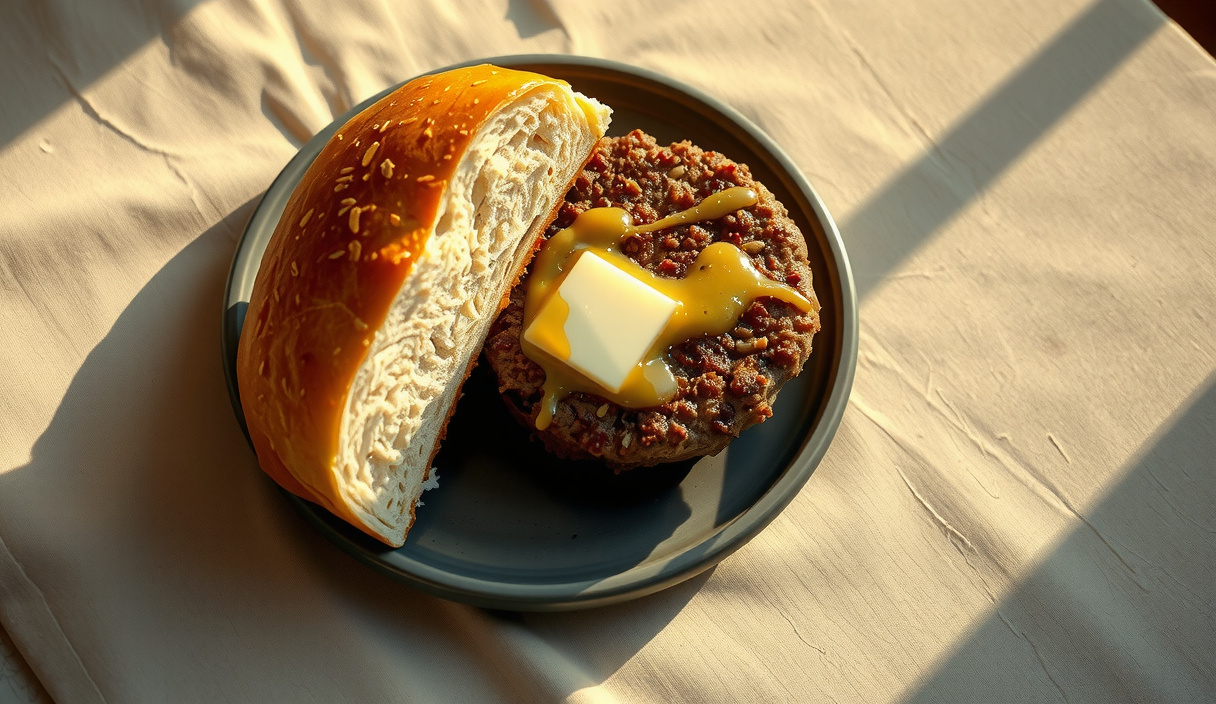
Smoked Burger with Compound-Butter Center

An 80/20 ground chuck patty formed around a frozen herb-compound-butter disc, smoked at 225°F to an internal temperature of 110°F for bark development and smoke penetration, then blasted on a 500°F cast-iron surface for 60–90 seconds per side. The frozen butter stays structurally intact through the smoke phase and releases inside the patty during the high-heat sear, internally basting the lean meat with herb-infused fat at the precise moment the crust forms.
Equipment
- 1 Offset smoker or kettle grill with two-zone setup Maintain 225°F cooking-grate temperature throughout the smoke phase. Calibrate with a separate grate-level thermometer.
- 1 Leave-in instant-read or probe thermometer Required to pull the patty precisely at 110°F internal. Lid thermometers on smokers typically read 30–50°F high.
- 1 12-inch cast-iron skillet Preheat over maximum burner heat for 8–10 minutes before searing. Target surface temperature of 500°F–520°F.
- 1 Parchment-lined sheet pan For freezing compound butter discs solid before forming patties.
- 1 Burger press or 3-inch ring mold
Ingredients
Compound Butter (make ahead)
- 4 tablespoons unsalted butter room temperature, then re-frozen after mixing
- 1 tablespoon fresh flat-leaf parsley finely minced
- 1 teaspoon fresh thyme leaves stripped from stems
- 1 clove garlic minced to a paste with the flat of a knife
- 1 tablespoon finely grated Parmesan adds glutamate depth
- 0.5 teaspoon kosher salt
- 0.25 teaspoon freshly cracked black pepper
Patty
- 1 pound ground chuck, 80/20 fat ratio freshly ground preferred; cold from refrigerator
- 1 teaspoon kosher salt for exterior seasoning; apply 30 minutes before smoking
- 0.5 teaspoon freshly cracked black pepper
- 0.5 teaspoon garlic powder
Wood and Finishing
- 2 chunks cherry or apple wood for the smoker; produces mild, slightly sweet smoke
- 1 tablespoon neutral high-smoke-point oil avocado or refined grapeseed; for the cast iron before searing
For Serving
- 2 brioche or potato buns toasted in residual pan fat
- 2 slices sharp cheddar or American cheese optional; apply in the final 30 seconds of sear under a basting dome
- lettuce, tomato, pickles, and condiments to preference

Instructions
Make the Compound Butter Discs
- In a small bowl, combine the room-temperature butter, parsley, thyme, garlic paste, Parmesan, salt, and pepper. Mix thoroughly with a fork until all aromatics are evenly distributed through the butter fat phase.1 tablespoon fresh flat-leaf parsley, 1 teaspoon fresh thyme leaves, 1 clove garlic, 1 tablespoon finely grated Parmesan, 0.5 teaspoon kosher salt, 0.25 teaspoon freshly cracked black pepper
- Divide the butter mixture in half. Shape each portion into a flat disc approximately 2 inches in diameter and 1/2 inch thick. Place the discs on a parchment-lined sheet pan and freeze for a minimum of 2 hours, or overnight. The discs must be completely solid — no give when pressed — before you form the patties.
Form the Patties
- Divide the cold ground chuck into 4 equal portions (approximately 4 oz each). Working quickly to keep the meat cold, flatten two of the portions into thin base rounds slightly larger than the butter disc. Place one frozen butter disc in the center of each base round, leaving at least 1/2 inch of meat border around the disc.1 pound ground chuck, 80/20 fat ratio
- Flatten the remaining two meat portions into top rounds of the same diameter. Press each top round over a butter disc, then pinch and seal the perimeter firmly all the way around. You should have two sealed patties each approximately 4 inches in diameter and 1 inch thick with a completely encased butter disc. Handle gently — do not overwork the seam. If any butter is visible at the seam, press it closed and refrigerate the patty for 20 minutes to re-solidify.1 pound ground chuck, 80/20 fat ratio
- Season the exterior of both formed patties generously on all sides with kosher salt, black pepper, and garlic powder. Place the patties uncovered on a wire rack over a sheet pan and refrigerate for 30 minutes. This resting period allows the salt to draw surface moisture back into solution, beginning the drying cycle that will accelerate bark development during the smoke phase.1 pound ground chuck, 80/20 fat ratio, 1 teaspoon kosher salt, 0.5 teaspoon freshly cracked black pepper, 0.5 teaspoon garlic powder
Smoke the Patties
- Set up your smoker or two-zone grill to maintain a steady 225°F at the cooking grate. Add cherry or apple wood chunks to your heat source. Allow the smoker to come to temperature and the smoke to run thin and blue before loading the patties — white billowing smoke deposits acrid compounds on the meat surface.2 brioche or potato buns
- Place the seasoned patties on the smoker grate with at least 2 inches of clearance between them. Insert a leave-in probe thermometer horizontally into the center of one patty, targeting the geometric center where the butter disc sits. Close the lid and smoke at 225°F, monitoring internal temperature closely.
- Pull the patties off the smoker when the internal temperature reads exactly 110°F. This typically takes 30–45 minutes at 225°F depending on patty thickness and smoker airflow. At 110°F, the surface will have developed a light bark and absorbed significant smoke aromatics while the interior butter disc remains structurally solid. Do not let the internal temperature exceed 115°F before the sear — each degree of overshoot compromises the butter pocket's integrity.
- Remove the patties from the smoker and let them rest uncovered at room temperature for 5 minutes while you preheat the cast iron. This rest slightly firms the exterior and stabilizes the surface for the sear.
Sear and Finish
- Place your 12-inch cast-iron skillet over your highest burner setting and preheat for 8–10 minutes. The surface should be smoking hot — a drop of water should evaporate instantly on contact. Add the neutral oil and swirl to coat; it will smoke immediately, which is correct.2 slices sharp cheddar or American cheese
- Place both patties in the skillet. Do not press them down. Sear for 60–90 seconds on the first side — you are targeting deep, dark Maillard crust, not gray steaming. Flip once using a wide spatula. Sear the second side for another 60–90 seconds. If using cheese, place a slice on each patty immediately after the flip and cover the pan with a basting dome or aluminum foil tent for the final 30 seconds to melt under the retained steam.
- Remove the patties from the skillet. The internal temperature should now read 130°F–135°F for a medium-rare to medium interior with the butter pocket fully released. Rest the patties on a wire rack for 3 minutes before building the burger — this allows the internal pressure in the butter pocket to equalize and the melted butter to migrate back into the surrounding meat fibers rather than flooding the plate.
- While the patties rest, toast the brioche or potato buns cut-side down in the residual fat in the cast iron for 30–45 seconds until golden. Build the burgers with your preferred toppings and serve immediately.lettuce, tomato, pickles, and condiments
Notes
Why the two-stage temperature structure works: The smoke phase at 225°F keeps the patty surface below the Maillard onset temperature (which requires surface temps well above 212°F and surface water activity below ~0.7). Instead of browning, the surface slowly desiccates and absorbs volatile smoke compounds — primarily guaiacol, syringol, and eugenol — that partition strongly into the surface fat phase. The 500°F sear then triggers rapid Maillard cascade on an already partially desiccated surface, generating crust compounds with exceptional efficiency in under 90 seconds.
The compound butter pocket physics: Frozen butter exists as a crystalline fat lattice in stable β and β' polymorphic crystal forms. The butter disc begins melting only as it approaches 59°F–95°F depending on milkfat triacylglycerol composition. At 110°F internal pull temperature, the disc center has barely softened. The 500°F sear causes the surrounding protein matrix to denature and cross-link rapidly, mechanically containing the butter as it crosses its full melt range — creating a pressurized internal pocket of herb-infused liquid fat that bastes the lean meat from inside out.
Why 80/20 fat ratio is structural, not optional: The 20% dispersed fat phase serves two simultaneous mechanical roles. It provides the intramuscular lipid buffer that maintains juiciness through a two-stage cook that pushes the interior above 130°F, and it lubricates the protein matrix around the butter disc so the disc remains a discrete pocket rather than fragmenting through the lean tissue during searing. Below 80/20, the pocket tends to rupture rather than release gradually.
Surface drying and Maillard kinetics: Salting the exterior 30 minutes pre-smoke is not about flavor penetration alone. Salt draws surface moisture outward via osmosis, which initially pools at the surface and then re-absorbs into the meat along with dissolved seasoning. The net effect is a partially dried exterior surface before the patty even enters the smoker — meaning the bark formation begins faster and smoke compound adsorption onto the surface fat is more efficient.
Wood choice and smoke compound partitioning: Cherry and apple wood produce lighter smoke character because their combustion generates lower concentrations of guaiacol and syringol relative to hardwoods like hickory or oak. Since these phenolic smoke compounds partition strongly into the surface fat phase of the patty, lighter smoke woods prevent the aromatic overload that would compete with the herb butter's volatile organic compounds (primarily linalool from thyme, alpha-pinene from parsley) released at the sear stage.
Nutrition
Calories: 820kcalCarbohydrates: 28gProtein: 48gFat: 58gSaturated Fat: 26gCholesterol: 210mgSodium: 1240mgFiber: 1gSugar: 5g
Tried this recipe?Let us know how it was!