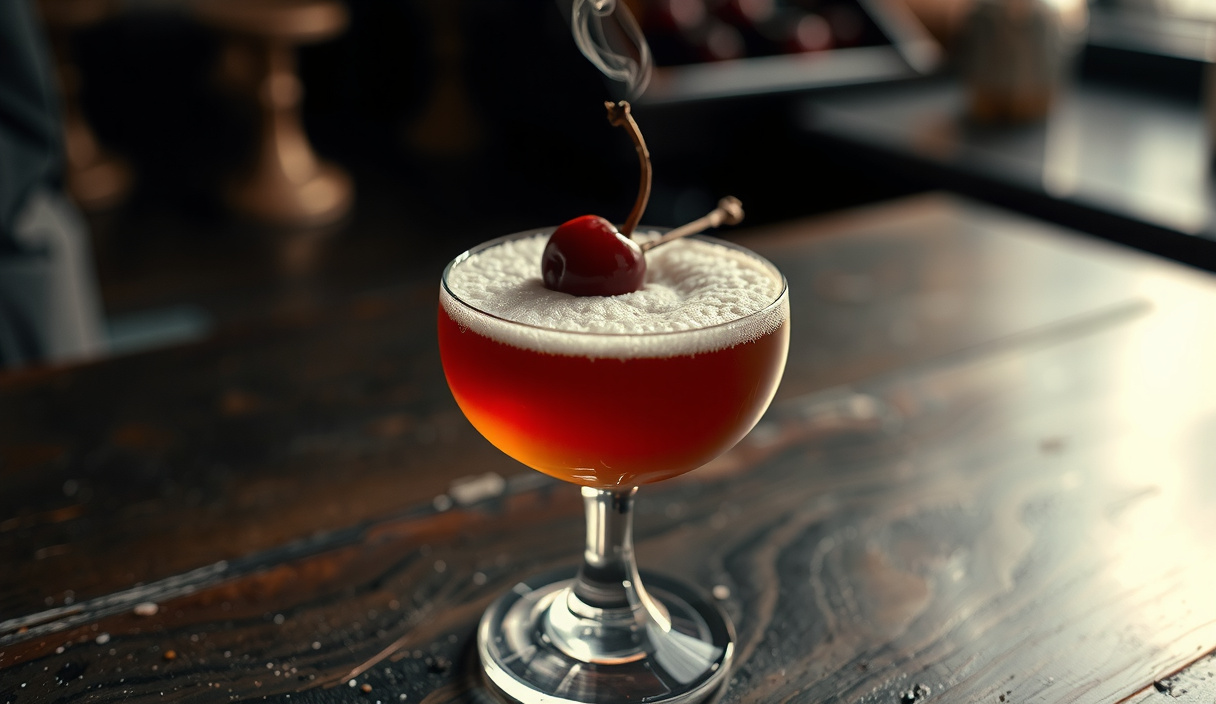
Smoked Cherry Bourbon Sour
A bourbon sour built on cold-smoked cherry shrub, maple syrup, fresh lemon juice, and a thick ovalbumin foam that acts as an aromatic membrane, holding the smoke-cherry volatiles at the rim of the glass. The shrub takes two weeks to develop its full fermented depth; the cocktail itself takes two shakes to build. Both waits are worth it.
Equipment
- 1 Boston shaker (weighted, two-piece) Weighted tins produce better shear for ovalbumin foam than cobbler shakers
- 1 Hawthorne strainer
- 1 Fine-mesh strainer Double-straining removes ice chips and cherry particulate that puncture foam bubbles
- 1 Coupe glass Chill in the freezer for at least 10 minutes before service
- 1 Jigger or measuring tool
- 1 Cold smoker or smoking gun Load with cherry or applewood chips; avoid hickory
- 1 1-quart mason jar with lid For the shrub
- 1 Fine-mesh strainer or cheesecloth For straining the finished shrub
Ingredients
Smoked Cherry Shrub (makes approximately 300 mL; prepare 14 days ahead)
- 225 g fresh Bing or dark sweet cherries Pitted; sour cherries work but require reducing lemon juice in the cocktail by 5 mL
- 120 mL raw unfiltered apple cider vinegar Must be unfiltered; the residual cultures drive passive fermentation
- 100 g cane sugar
- 1 tbsp cherry or applewood smoking chips For the cold-smoke step
Cocktail (per serving)
- 60 mL bourbon whiskey 90 to 100 proof, wheated or balanced rye expression preferred
- 22 mL fresh lemon juice Strained; approximately 1 medium lemon
- 15 mL pure maple syrup Grade A, amber or dark for more guaiacol and lactone character
- 30 g egg white 1 large egg white; pasteurized liquid egg white is a safe substitute
- 15 mL smoked cherry shrub From above; taste before adding and adjust lemon accordingly
- 5 mL smoked cherry shrub Additional float, drizzled on finished foam for aroma and visual marble

Instructions
Make the Smoked Cherry Shrub (14 days before serving)
- Pit the cherries and place them in a single layer in a heatproof vessel or on a rack. Using a smoking gun or cold smoker loaded with cherry or applewood chips, cold-smoke the cherries for 15 to 20 minutes. The cherries should carry a visible smoke coat and smell deeply aromatic but should not be warmed through — this is a cold application only. Avoid hickory; its phenol profile reads too aggressively against sweet cherry.1 tbsp cherry or applewood smoking chips
- Transfer the smoked cherries to a clean 1-quart mason jar. Add the cane sugar directly over the fruit, toss to coat, and allow to macerate at room temperature for 30 minutes until the sugar begins drawing out the fruit's juice.100 g cane sugar
- Pour the raw unfiltered apple cider vinegar over the sugared cherries. The pH of the combined mixture should be approximately 3.2 to 3.5 — sharp but not chemically harsh. Stir once to begin dissolving the sugar. Seal the jar tightly.120 mL raw unfiltered apple cider vinegar
- Refrigerate the sealed jar for 14 days minimum. During the first week the shrub will taste aggressively acidic — this is expected. The passive fermentation driven by the unfiltered ACV cultures, combined with slow phenol migration from the smoke into the acidified brine, requires the full two-week window to develop depth. Shake the jar gently every 2 to 3 days to redistribute the fruit and brine. At day 14, strain the shrub through a fine-mesh strainer or cheesecloth, pressing the fruit gently to extract all liquid. Discard the spent fruit. The strained shrub stores refrigerated for up to 3 months.120 mL raw unfiltered apple cider vinegar, 100 g cane sugar, 1 tbsp cherry or applewood smoking chips
Build the Cocktail
- Place a coupe glass in the freezer for at least 10 minutes before service. This slows the rate of warming and extends the structural life of the foam once poured.
- Add the bourbon, fresh lemon juice, maple syrup, and egg white to the larger tin of a Boston shaker. Do not add ice yet. Close the shaker tightly.60 mL bourbon whiskey, 22 mL fresh lemon juice, 15 mL pure maple syrup, 30 g egg white
- Dry shake for 45 seconds, hard. The mechanical shear unfolds ovalbumin chains and drives them to newly created air-water interfaces, building the foam structure. The shaker will feel lighter and the contents will sound muffled when the foam is properly established. Cheating this step produces a thin, draining head. If your foam comes out loose, fat contamination or insufficient shake duration are the primary suspects.30 g egg white
- Open the shaker and add a generous scoop of ice — approximately 150 g. Close and shake again for 15 seconds, vigorously. This second shake chills the foam rapidly, arresting bubble coalescence and stabilizing the ovalbumin film. The speed matters here — you want the thermal drop to happen fast.
- Double-strain through a Hawthorne strainer and fine-mesh strainer simultaneously into the chilled coupe glass. This removes ice chips and any cherry particulate from the 15 mL of shrub already in the cocktail. Pour with purpose — the foam should rise to just above the rim of the glass.15 mL smoked cherry shrub
- Float the additional 5 mL of smoked cherry shrub by gently drizzling it across the surface of the foam using a bar spoon or by letting it fall from a small measure held 2 cm above the glass. The shrub's higher sugar-acid density causes it to sit briefly on the foam surface, creating a visual marble and keeping the smoke-cherry aromatics at nose level. Do not shake or stir the shrub in.5 mL smoked cherry shrub
- Serve immediately. The ovalbumin foam is a kinetically trapped dispersion — visually intact for 10 to 15 minutes, after which drainage becomes apparent. This is not a build-ahead cocktail.
Notes
Why the shrub needs two full weeks: In the first 3 to 5 days, acetic acid from the apple cider vinegar dominates at a sharp, undifferentiated pitch. During days 5 through 14, the residual bacterial cultures in unfiltered ACV initiate a passive lactic co-fermentation that generates diacetyl precursors and additional organic acids, collectively rounding the acid profile. Simultaneously, the lipophilic phenolic smoke compounds — guaiacol, syringol, 4-methylguaiacol — slowly migrate from the fruit flesh into the acidified brine. A 7-day shrub delivers 40 to 60% of this aromatic complexity. The second week earns the other half.
Ovalbumin foam physics: Ovalbumin (approximately 54% of egg white protein by mass) begins to denature at roughly 84°F (29°C) under heat, but under the mechanical shear stress of a hard shake it unfolds at room temperature, exposing hydrophobic interior segments that migrate to air-water interfaces and stabilize bubbles. Ovomucin, a glycoprotein in egg white, increases the continuous-phase viscosity from approximately 1.7 mPa·s toward 8 to 12 mPa·s depending on concentration, slowing bubble drainage by increasing resistance to gravity-driven liquid flow through the lamellae. The cold second shake arrests bubble coalescence by pushing the protein film toward its glass transition. Any trace of lipid — egg yolk, oily shaker tin, or fat in a flavored spirit — will disrupt this film at the interface and produce a loose, fast-draining foam. Identify fat contamination by timing the foam collapse: a properly built foam holds structural integrity for 10 to 15 minutes; fat-contaminated foam collapses to a thin ring within 3 to 5 minutes.
Maple syrup vs. simple syrup: Maple syrup's approximately 65:35 sucrose-to-invert-sugar ratio means its sucrose backbone hydrolyzes slowly in the acidic cocktail environment (target pH 3.5 to 3.8), providing a trailing sweetness that simple syrup's pre-inverted glucose-fructose cannot. Additionally, maple's trace guaiacol and phenolic lactone content — present at levels detectable by smell above approximately 2 ppb — harmonizes directly with the bourbon's oak-derived vanillin and the shrub's smoke phenols, creating a three-way aromatic convergence rather than a background sweetener note.
Bourbon proof and aroma partitioning: The vapor-condensed phase partition coefficient of vanillin and oak lactones in bourbon is highly sensitive to ABV. At 90 to 100 proof (45 to 50% ABV), these lipophilic congeners remain in solution at cocktail dilution (approximately 15 to 18% ABV in the finished glass) and release progressively as the drink warms. A lower-proof bourbon will under-extract these compounds into solution; a higher-proof will shift the ethanol-to-water ratio past the point where the aromatic compounds partition efficiently against the acidic cherry matrix.
Nutrition
Calories: 195kcalCarbohydrates: 18gProtein: 3.5gFat: 0.1gSodium: 55mgSugar: 16g
Tried this recipe?Let us know how it was!