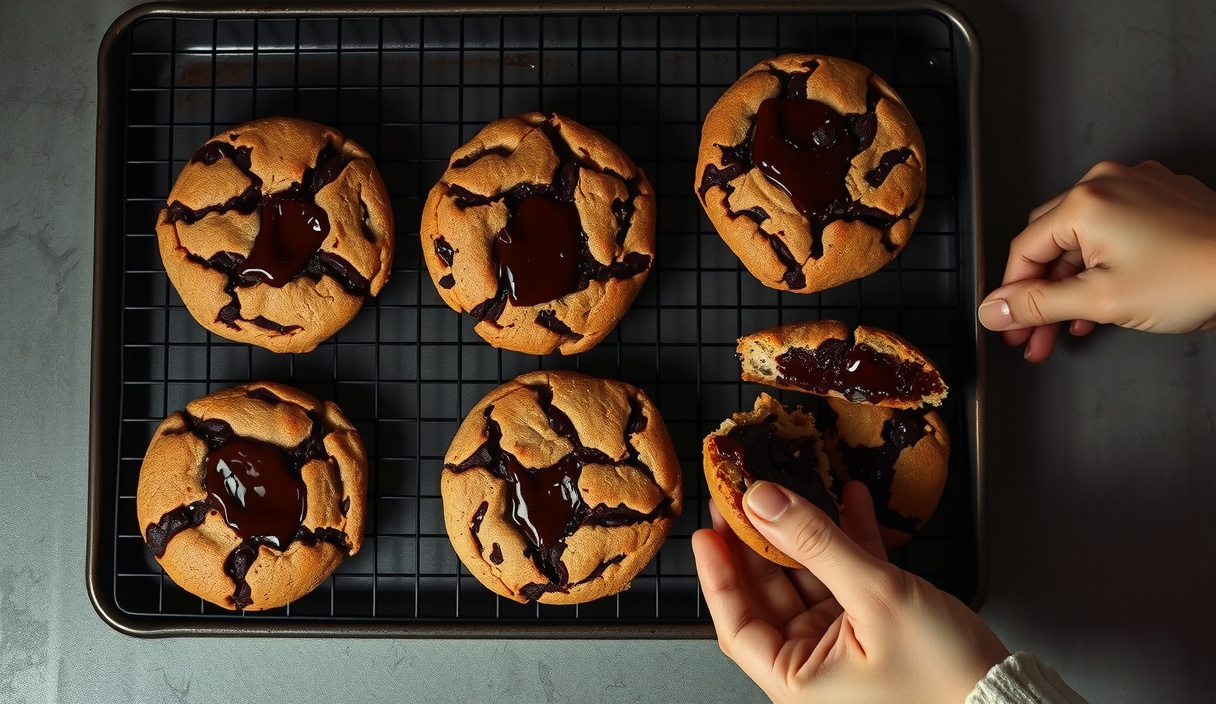
Smoked Chocolate-Chip Cookies — Pellet-Grill Baked

Standard chocolate-chip cookie dough baked at 375°F on a pellet grill picks up a whisper of hardwood smoke phenols that dissolve into the browned-butter fat phase and emerge during the bake as a low, resonant aromatic layer you simply cannot replicate in a kitchen oven. The result is the same crisp edge and fudgy center you expect — and a flavor that tastes like every familiar element of a great cookie got quietly turned up.
Equipment
- 1 Pellet grill With cherry or apple pellets loaded; preheat 20 minutes to 375°F before loading cookies
- 1 Light-colored rimmed baking sheet Half-sheet (18x13 in); do not use dark non-stick pans — they bottom-burn on the grill
- 1 sheet Parchment paper
- 1 Light-colored saucepan For browning butter; light interior lets you monitor milk-solid color
- 1 Stand mixer or hand mixer
- 1 Cookie scoop, 1.5 oz (3 tablespoons)
- 1 Instant-read thermometer Verify grill temperature independently — pellet grills often read 15–25°F low
Ingredients
Browned Butter Base
- 226 g unsalted butter 2 sticks; browned to amber, then cooled to room temperature — about 195 g usable browned butter after moisture loss
Sugar System
- 200 g light brown sugar packed; 2:1 ratio to white sugar increases hygroscopicity and accelerates early Maillard reactions
- 100 g granulated white sugar
Wet Ingredients
- 2 large eggs at room temperature
- 2 tsp pure vanilla extract
Dry Ingredients
- 270 g all-purpose flour spooned and leveled or weighed; approximately 2 1/4 cups
- 1 tbsp Dutch-process cocoa powder deepens chocolate backbone and provides additional Maillard-reactive amino acids
- 1 tsp baking soda
- 1 tsp fine sea salt
Chocolate
- 280 g dark chocolate (60–70% cacao), roughly chopped chopped bars produce irregular pools of melted chocolate with both crispy edges and molten centers; do not substitute stabilizer-containing chips if you can avoid it
Finish
- 1 tsp flaky sea salt such as Maldon; applied immediately after pulling from grill

Instructions
Brown the Butter
- Place the unsalted butter in a light-colored saucepan over medium heat. Swirl constantly as it melts, foams, and then subsides. Continue swirling until the milk solids at the bottom turn deep amber and the butter smells like hazelnuts — this takes 6–8 minutes and the butter will read approximately 300°F on an instant-read. Immediately pour through a fine-mesh strainer into a large bowl (discard the dark solids or save for another use). Cool to room temperature until the fat is semi-solid, about 45–60 minutes at room temperature or 20 minutes in the refrigerator. Do not proceed until the butter is cool enough to cream.
Mix the Dough
- Beat the cooled browned butter with light brown sugar and granulated white sugar on medium-high speed for 3 minutes until lightened and fluffy. The mixture will smell deeply of caramel.100 g granulated white sugar
- Add the eggs one at a time, beating 30 seconds after each. Scrape the bowl. Add vanilla extract and beat 10 seconds to incorporate.2 large eggs, 2 tsp pure vanilla extract
- Whisk together all-purpose flour, Dutch-process cocoa powder, baking soda, and fine sea salt in a separate bowl. Add the dry ingredients to the wet in one addition and mix on low speed until just combined — do not overmix. Streaks of flour should disappear but the dough should not be worked beyond that point.270 g all-purpose flour, 1 tbsp Dutch-process cocoa powder, 1 tsp baking soda, 1 tsp fine sea salt
- Fold in the chopped dark chocolate by hand with a flexible spatula until evenly distributed. The dough will be thick and slightly tacky.280 g dark chocolate (60–70% cacao), roughly chopped
- Cover the bowl with plastic wrap and rest the dough at room temperature for 30 minutes minimum (or refrigerate up to 24 hours). This rest hydrates the flour proteins fully, reduces surface stickiness, and deepens flavor as enzymatic activity converts starches to reducing sugars.
Prep the Grill
- Load the pellet grill with cherry or apple pellets. Ignite and preheat with the lid closed to 375°F — verify with an independent probe thermometer placed at grate level. Allow the grill to run at temperature for at least 20 minutes until it is producing clean, thin blue smoke rather than the thick white smoke of a cold start. Line a light-colored half-sheet baking pan with parchment.
Scoop and Bake
- Using a 1.5-oz (3-tablespoon) cookie scoop, portion the dough into balls and space them 2 inches apart on the parchment-lined pan — 9 cookies per pan is comfortable. If the dough was refrigerated, scoop it cold; cold dough spreads more slowly and bakes thicker.
- Slide the pan onto the grill grates. Close the lid. Bake for 11–13 minutes at 375°F. At the 8-minute mark, give the pan one firm bang against the grill grates to deflate any puffy domes and create the characteristic ripple texture.
- Pull the pan when the edges are set and golden but the centers still look glossy and slightly underdone — they will finish from carryover heat. Do not wait for the centers to look fully baked or the final cookie will be dry.
- Immediately and generously apply flaky sea salt across the tops of the cookies while they are still soft. Allow to rest on the pan for 10 minutes — this is mandatory, not optional, as the centers finish setting during this window. Transfer to a wire rack to cool completely, or eat one warm.1 tsp flaky sea salt
Notes
Why browned butter matters at the molecular level: Browning butter to ~300°F drives the Maillard reaction between milk-solid proteins and lactose, producing hundreds of volatile flavor compounds — primarily diacetyl (buttery), furfural (caramel), and 2-acetylpyrroline (nutty/popcorn). These pre-formed melanoidins dissolve into the fat and carry through every stage of mixing and baking, providing a flavor foundation no amount of extra vanilla can replicate. The moisture lost during browning (~15% of starting weight) also concentrates the fat, which slightly reduces cookie spread — a useful structural side effect.
Why smoke phenols partition into the fat phase: Guaiacol, syringol, and 4-methylguaiacol — the primary phenolic compounds in hardwood smoke — are lipophilic molecules with log P values between 1.0 and 2.5. When they contact the butter-rich surface of raw cookie dough, they partition preferentially into the fat phase at ratios of 10:1 or greater relative to the aqueous phase. This means the smoke is effectively captured and concentrated in the most flavor-active part of the dough, then released slowly and progressively as the fat renders during the bake — a controlled time-delayed aromatic delivery that an oven simply cannot produce.
The 2:1 brown-to-white sugar ratio: Brown sugar's molasses fraction (approximately 10% by weight) lowers the mixture's water activity and raises its hygroscopicity. This keeps the interior moisture higher for longer during the bake, which means the Maillard reactions at the surface can proceed without the interior drying out. The higher molasses content also increases the reducing-sugar concentration, which directly raises the rate of Strecker degradation — the pathway that produces aldehydes that react most readily with the incoming smoke phenols.
Temperature precision is the single biggest variable: The difference between 350°F and 375°F on a pellet grill changes cookie spread, interior texture, and the rate of smoke deposition. At 350°F, cookies spread flatter and spend more time in the smoke environment — which sounds desirable but results in phenolic over-accumulation that reads as bitter. At 375°F the bake is fast enough to keep smoke at a background note rather than a foreground flavor. Always verify grill temperature with an independent probe; factory displays on most pellet grills are unreliable by ±20°F.
Nutrition
Calories: 285kcalCarbohydrates: 34gProtein: 3gFat: 15gSaturated Fat: 9gCholesterol: 45mgSodium: 165mgFiber: 1.5gSugar: 22g
Tried this recipe?Let us know how it was!