Smoked Chuck Roast — Poor-Man's Brisket
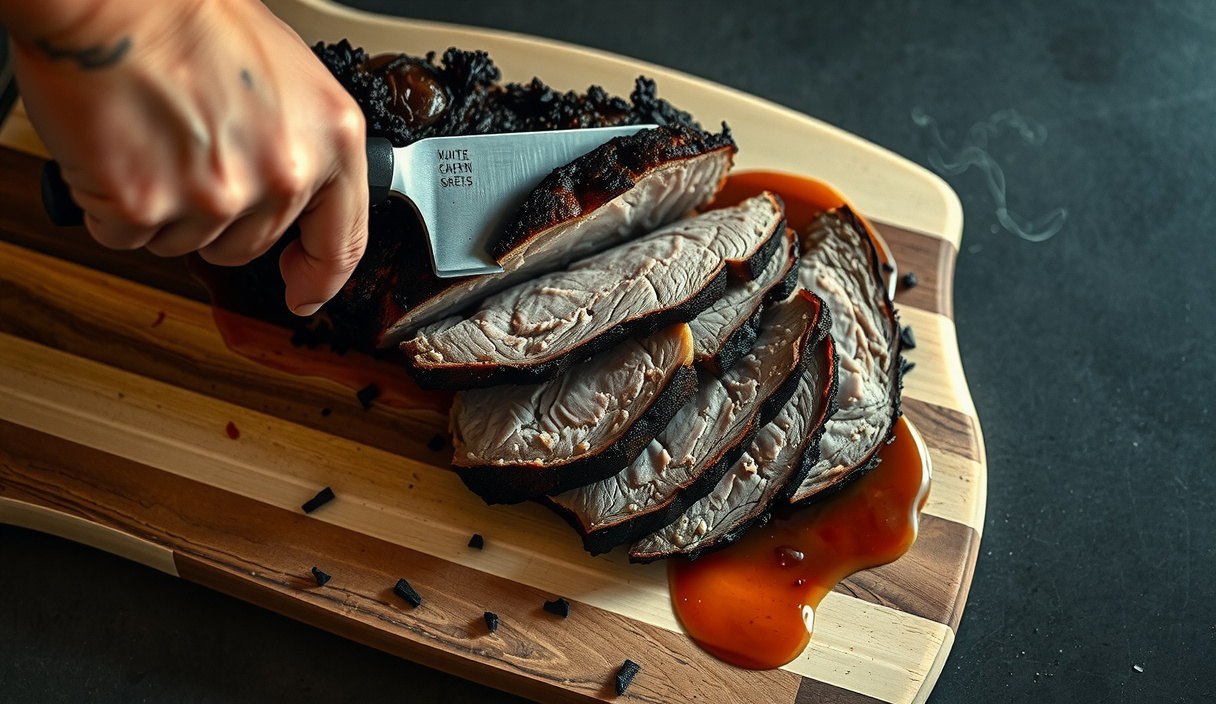
A 3-pound chuck roast smoked low and slow at 225°F — wrapped at 165°F to power through the stall, pulled at 203°F when collagen has fully converted to gelatin. The result is brisket-style bark, a deep smoke ring, and fork-tender, glistening meat at a fraction of the price and cook time of a full packer.
Equipment
- 1 Smoker or grill set up for indirect heat Offset, kettle, pellet, or ceramic kamado — all work at 225°F
- 1 Leave-in probe thermometer Non-negotiable — you are cooking to internal temperature
- 1 Instant-read thermometer For confirming pull temp and probe feel at 203°F
- 2 large sheets Unwaxed butcher paper Preferred over foil — vapor-permeable to preserve bark texture
- 1 Wire cooling rack For resting the roast elevated off the cutting board
Ingredients
The Roast
- 3 lb bone-in or boneless chuck roast Choose one with visible marbling and at least 1/4-inch fat cap; bone-in preferred for added collagen
Brisket-Style Dry Rub
- 2 tbsp coarse kosher salt Diamond Crystal or Morton coarse — do not use fine table salt
- 1 tbsp coarse-ground black pepper 16-mesh cracked pepper preferred for bark texture
- 1 tbsp dark brown sugar Packed; provides reducing sugars for Maillard browning and bark development
- 1 tsp garlic powder
- 1 tsp onion powder
- 1 tsp smoked paprika
- ½ tsp cayenne pepper Optional — omit for a milder profile
For the Smoke
- 3 fist-sized chunks of post oak, hickory, or cherry wood Post oak is the Texas standard; hickory adds aggression; cherry deepens bark color

Instructions
Dry Brine (12–24 Hours Before)
- Combine all dry rub ingredients in a small bowl and mix thoroughly. Pat the chuck roast completely dry with paper towels — surface moisture is the enemy of bark formation.1 tbsp coarse-ground black pepper, 1 tbsp dark brown sugar, 1 tsp garlic powder, 1 tsp onion powder, 1 tsp smoked paprika, 1/2 tsp cayenne pepper
- Apply the rub generously on all surfaces of the roast, pressing firmly to adhere. Do not be shy — this is a thick piece of beef and the rub forms the bark. Place uncovered on a wire rack set over a sheet pan and refrigerate for 12 to 24 hours. The salt will initially draw moisture out and then reabsorb into the meat, leaving a tacky, concentrated pellicle on the surface — exactly what you want for Maillard browning.1 tbsp coarse-ground black pepper, 1 tbsp dark brown sugar, 1 tsp garlic powder, 1 tsp onion powder, 1 tsp smoked paprika, 1/2 tsp cayenne pepper
Fire Setup and First Smoke Phase
- Remove the roast from the refrigerator 30 to 45 minutes before smoking to take the chill off the exterior. This is not about bringing it to room temperature — that is a myth for a piece of meat this size — it is about reducing the thermal gradient between the surface and core so bark sets before the center overcooks.
- Set up your smoker for indirect cooking at a steady 225°F. Add 2 to 3 chunks of your chosen wood to establish clean, thin blue smoke. Avoid thick white billowing smoke — that is incomplete combustion and it deposits bitter, acrid compounds on the surface. You want the smoke you can barely see, not the smoke you can smell from the street.3 fist-sized chunks of post oak, hickory, or cherry wood
- Place the chuck roast fat-cap-up directly on the smoker grates over indirect heat. Insert your leave-in probe thermometer into the thickest part of the meat, away from any bone. Close the lid and do not open it for the first 2 hours. You lose approximately 10 minutes of stable temperature every time you open a smoker lid.
- Smoke at 225°F, maintaining steady temperature. Add wood chunks as needed to keep a thin smoke presence — typically one chunk every 60 to 90 minutes depending on your setup. The roast will pass through the myosin denaturation zone (130–140°F) quietly and start showing its smoke ring forming. Monitor temperature but resist intervening.3 fist-sized chunks of post oak, hickory, or cherry wood
The Stall and the Wrap (at 165°F)
- Somewhere between 155°F and 170°F internal, your temperature climb will slow dramatically or stop entirely for 45 minutes to 2 hours. This is the stall — evaporative cooling at the surface is absorbing heat as fast as your smoker delivers it. Do not panic, do not raise the temperature. Watch your probe and wait for 165°F internal.
- At 165°F internal, remove the roast from the smoker. Lay two large sheets of unwaxed butcher paper overlapping on a flat surface. Place the roast fat-cap-up in the center and wrap tightly, tucking the sides in like a burrito. The wrap should be snug enough that no steam can easily escape. Return the wrapped roast to the smoker with the probe re-inserted through the paper. This collapses the evaporative cooling mechanism and pushes the roast into the final collagen hydrolysis phase.
Final Push to 203°F
- Continue smoking at 225°F. The temperature will now climb steadily without another significant stall — the wrapped environment creates a humid, high-heat braising atmosphere that accelerates heat transfer into the core. Collagen is hydrolyzing into gelatin throughout this phase.
- Pull the roast at 203°F internal. Before pulling, perform the probe feel test: insert your thermometer probe or a skewer into the thickest section. At 203°F with full collagen conversion, it should slide in with near-zero resistance — like pushing into softened butter. If you feel any springback, give it another 15 minutes and test again. Temperature is a proxy; probe feel is the real signal.
Rest and Slice
- Transfer the wrapped roast to a cutting board or sheet pan and let it rest, still wrapped, for a minimum of 45 minutes — 60 to 90 minutes is better. Carry-over cooking adds another 3°F to 5°F. More importantly, the rest period allows the fully hydrolyzed gelatin to redistribute and slightly re-gel throughout the muscle fibers rather than immediately running off the board when you slice. Do not skip this step.
- Unwrap the roast over the cutting board to capture the accumulated juices in the paper — those drippings are pure gelatin-rich jus, and you want them. Identify the grain direction in each muscle section before cutting. Chuck runs in two or three different directions across the roast. Slice against the grain at about 1/4-inch thickness for maximum tenderness. Serve immediately, drizzled with the collected jus.
Notes
Why 203°F is the target — not 190°F or 210°F: At 190°F, collagen hydrolysis is still incomplete in the denser connective tissue sheaths between muscle groups — you will taste the difference as slightly chewy seams through the roast. At 210°F, the actin network has over-contracted and the water-holding capacity has collapsed beyond what the gelatin phase can compensate for, producing a drier, stringier result. The 200°F to 205°F window is the kinetic sweet spot where gelatin yield is maximized and moisture loss is still within acceptable bounds. The probe feel test at 203°F is more reliable than temperature alone because collagen conversion rate varies with the specific collagen density of the individual animal.
Why the stall happens and why wrapping fixes it: At 160–170°F internal, surface evaporation absorbs energy as fast as the smoker delivers it — this is evaporative phase change, the same physics that makes sweating cool your body. The meat is not stuck; it is using all available heat to vaporize surface water rather than raise internal temperature. Wrapping in butcher paper seals off the vapor escape route. The trapped moisture creates a high-humidity, slightly pressurized environment that transfers heat via steam conduction directly into the roast core, bypassing the evaporative thermal anchor entirely. Temperature climb resumes within 20 to 30 minutes of wrapping.
Collagen concentration in chuck vs. brisket: Chuck roast contains approximately 15–20% collagen as a percentage of total protein content, compared to roughly 12–15% in brisket flat. This higher collagen density means more gelatin available per unit of cooked meat, which is why properly executed chuck can actually feel richer and more lip-coating than brisket flat — though the point cut of a packer brisket remains in a class of its own for intramuscular fat content.
Wood smoke temperature note: At 225°F ambient, the smoke ring development in chuck roast is particularly pronounced because nitrogen dioxide from wood combustion reacts with myoglobin in the meat to form a stable nitrosomyoglobin complex, locking in the pink color. This reaction is most active below 140°F internal — meaning the long, slow climb to 165°F before the wrap gives maximum exposure time for smoke ring development. Wrapping does not hurt the smoke ring because it has already set.
Nutrition
Calories: 420kcalCarbohydrates: 4gProtein: 48gFat: 23gSaturated Fat: 9gCholesterol: 155mgSodium: 780mgSugar: 3g
Tried this recipe?Let us know how it was!