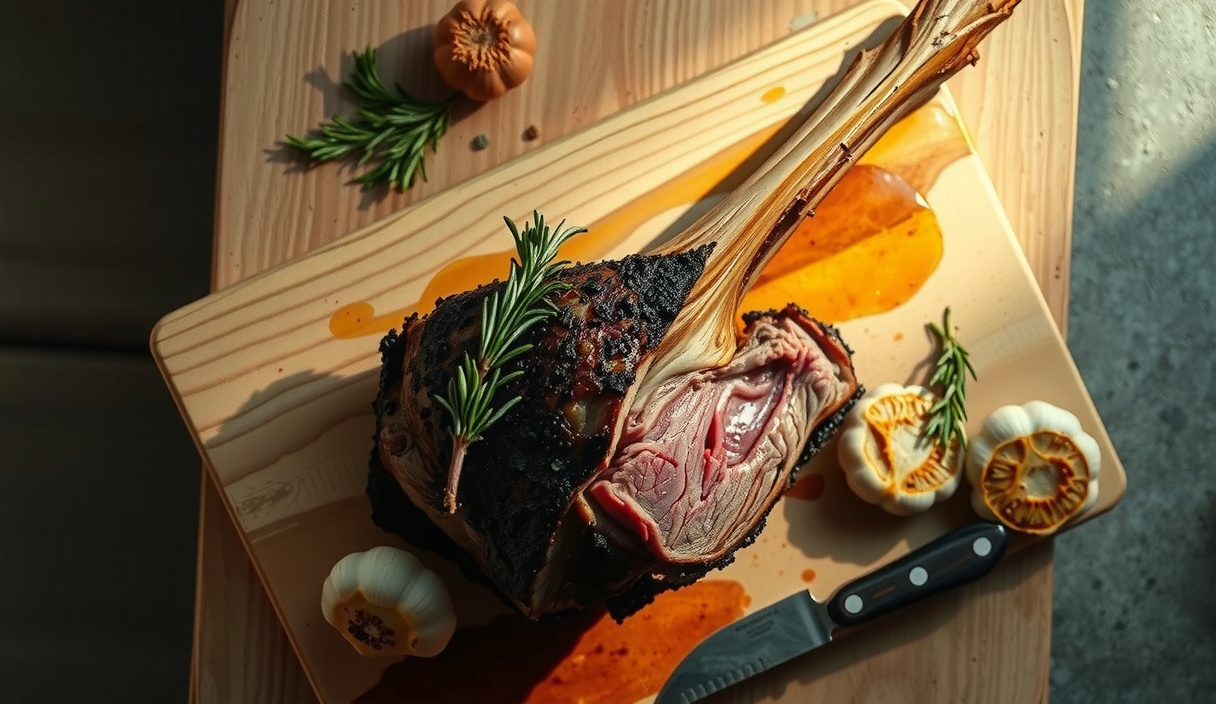
Smoked Leg of Lamb — Garlic-Rosemary Crust

A bone-in leg of lamb rubbed with a garlic, rosemary, and Dijon mustard paste, then smoked low and slow at 275°F over oak and cherry until the sirloin end reaches 135°F internal. The result is a rose-pink center, a deeply savory bark, and a perfume driven by the molecular synergy between rosemary terpenes and lamb's branched-chain fatty acids.
Equipment
- 1 Offset, pellet, or kettle smoker Must hold a steady 275°F at grate level. Calibrate with a separate thermometer — built-in dome gauges read 30–50°F high.
- 1 Dual-probe leave-in thermometer One probe for grate-level ambient temp, one for the deepest point of the sirloin end of the leg.
- 1 Wire rack set inside a half-sheet pan For resting the roast off the pan surface so steam does not soften the bark.
- 1 Carving knife A slicing knife 10–12 inches long; sharp edge is essential for clean cross-grain cuts through the multiple muscle groups.
- 4 to 6 chunks Oak and cherry wood chunks or pellets Approx. 3 oz each. Add at the start and replenish once at the 90-minute mark if using an offset or kettle.
Ingredients
The Lamb
- 1 bone-in leg of lamb, aitch bone removed if possible 4.5 to 6 pounds. Ask the butcher to remove the pelvic aitch bone for easier carving.
- 1 tbsp kosher salt Approximately 1 tsp per pound; scale proportionally to the exact weight of your leg.
- 1 tsp freshly cracked black pepper
Garlic-Rosemary-Mustard Paste
- 8 cloves fresh garlic Pressed or very finely minced into a paste.
- 2 tbsp fresh rosemary needles, finely chopped Stripped from 3 large sprigs; fresh only — dried rosemary loses its critical terpene volatiles.
- 2 tbsp Dijon mustard Smooth or whole-grain. Acts as an emulsion binder and adds mild allyl isothiocyanate pungency to the bark.
- 3 tbsp extra-virgin olive oil
- 1 tsp lemon zest From half a lemon. Volatile citrus terpenes add brightness without dropping the pH of the bark-forming layer.
- 0.5 tsp red pepper flakes Optional. Capsaicin activates TRPV1 receptors, heightening the perception of the warm terpene notes in the rosemary.

Instructions
Day Before (Optional but Recommended)
- Season the leg aggressively with kosher salt and cracked pepper on all surfaces. Place on a wire rack set over a sheet pan and refrigerate uncovered for 8 to 24 hours. The dry-brine draws surface moisture out by osmosis, which is then reabsorbed into the meat, seasoning it internally. The dried exterior surface will produce a firmer, more adherent bark on the smoker.1 tbsp kosher salt, 1 tsp freshly cracked black pepper
Make the Paste and Prep the Leg
- Combine pressed garlic, chopped rosemary, Dijon mustard, olive oil, lemon zest, and red pepper flakes in a small bowl. Stir vigorously until the oil and mustard emulsify into a cohesive paste. The mustard's natural lecithin-like emulsifiers bind the oil and aqueous phases together, ensuring the paste stays on the meat surface rather than running off.8 cloves fresh garlic, 2 tbsp fresh rosemary needles, finely chopped, 2 tbsp Dijon mustard, 3 tbsp extra-virgin olive oil, 1 tsp lemon zest, 0.5 tsp red pepper flakes
- Using a sharp paring knife, score the fat cap of the leg in a crosshatch pattern, cuts approximately 0.5 inches deep and 1 inch apart. These cuts serve two purposes: they allow the paste to penetrate below the fat membrane into the underlying muscle, and they give rendered fat an escape route so it drips rather than pooling and steaming the bark.
- Work the paste into every surface of the leg — fat cap, lean faces, and especially down into the score cuts. Use your hands to press the paste firmly into the meat. Allow the pasted leg to sit at room temperature for 45 minutes while the smoker comes up to temperature. A cold center dramatically extends cook time and produces an uneven temperature gradient across the roast.8 cloves fresh garlic, 2 tbsp fresh rosemary needles, finely chopped, 2 tbsp Dijon mustard, 3 tbsp extra-virgin olive oil, 1 tsp lemon zest, 0.5 tsp red pepper flakes
Fire and Smoke
- Fire your smoker and stabilize it at a steady 275°F at grate level. Add 3 to 4 chunks of oak and 2 chunks of cherry wood. You are targeting thin blue smoke — barely visible, not white and billowing. White smoke indicates incomplete combustion and excessive phenolic deposition, which produces a bitter, acrid bark. Allow the fire to establish a clean, thin smoke stream before placing the meat.
- Place the leg of lamb bone-side down on the grate, positioned over the indirect heat zone. Insert the meat probe into the deepest point of the sirloin (thick, round) end of the leg, ensuring the probe tip is at least 2 inches from the femur. Bone proximity reads 8 to 12°F higher than the true geometric center and will cause you to pull the roast under-done.
- Smoke at 275°F, maintaining thin blue smoke, until the internal temperature reaches 135°F. Expect approximately 3 to 3.5 hours for a 5-pound leg, though thermal mass variability means your specific time may differ. If you observe the internal temperature plateauing between 115°F and 125°F for 20 to 30 minutes, this is the evaporative stall — surface moisture is absorbing heat as fast as the smoker delivers it. Do not raise the temperature. The stall is extending Maillard time on the bark and will resolve on its own.
Rest and Carve
- When the sirloin-end probe reads 135°F, remove the leg from the smoker immediately. Transfer to a wire rack set over a cutting board or sheet pan. Tent loosely with a single sheet of aluminum foil — not tightly wrapped. A tight seal traps steam and collapses the bark. Rest for 25 minutes undisturbed. During rest, thermal equilibration carries the center to approximately 140°F to 142°F as heat flows inward from the hotter outer layers, and the contracted myofibrillar network partially relaxes, reabsorbing expelled moisture.
- Carve by working in sections. The leg has multiple muscle groups — sirloin end, top round, bottom round, shank — each with a different grain direction. Identify the grain in each section and slice perpendicular to it in 0.25- to 0.375-inch slices. Slicing against the grain mechanically shortens the muscle fibers and dramatically improves perceived tenderness. Serve immediately.
Notes
Why 135°F and not higher? Lamb leg is composed primarily of myofibrillar proteins — myosin and actin. Myosin denatures and begins cross-linking between 130°F and 140°F, producing a pleasantly firm yet yielding texture. Actin, the protein responsible for catastrophic water expulsion and the dry, stringy texture of overcooked meat, does not denature until 154°F and above. Pulling at 135°F keeps you safely in the moisture-retention window. Carryover during the 25-minute rest delivers the center to 140–142°F — a textbook medium.
The terpene-fatty acid synergy: Lamb fat contains branched-chain fatty acids — specifically 4-methyloctanoic acid and 4-methylnonanoic acid — at concentrations far higher than beef or pork. These acids are the source of lamb's characteristic flavor. Rosemary's dominant volatile terpenes (1,8-cineole, camphor, alpha-pinene) are structurally complementary to these fatty acids and occupy overlapping receptor pathways on the palate, producing a synergistic effect that simultaneously softens the perceived gamey note and amplifies savory depth. Applying the paste before the cook allows the lipid-soluble terpenes to partition into and remain anchored in the surface fat layer throughout the smoke.
Wood selection matters: Oak produces a clean, firm smoke flavor with no sweetness. Cherry adds color — specifically the hydroxyl compounds from cherry wood drive the deep mahogany bark hue — and a very mild fruitiness. Avoid mesquite for a cook exceeding 2 hours; its high guaiacol and syringol content becomes aggressively bitter with extended exposure. Apple is an acceptable substitute for cherry and produces a slightly lighter bark color.
Doneness guide: 130°F = medium-rare (bright red center, very juicy). 135°F = medium (rosy pink throughout, optimal for most guests). 145°F = medium-well (pale pink, firmer). Above 154°F = well-done (actin fully denatured, dry and firm — not recommended for this preparation).
Nutrition
Calories: 420kcalCarbohydrates: 2gProtein: 46gFat: 24gSaturated Fat: 9gCholesterol: 148mgSodium: 610mg
Tried this recipe?Let us know how it was!