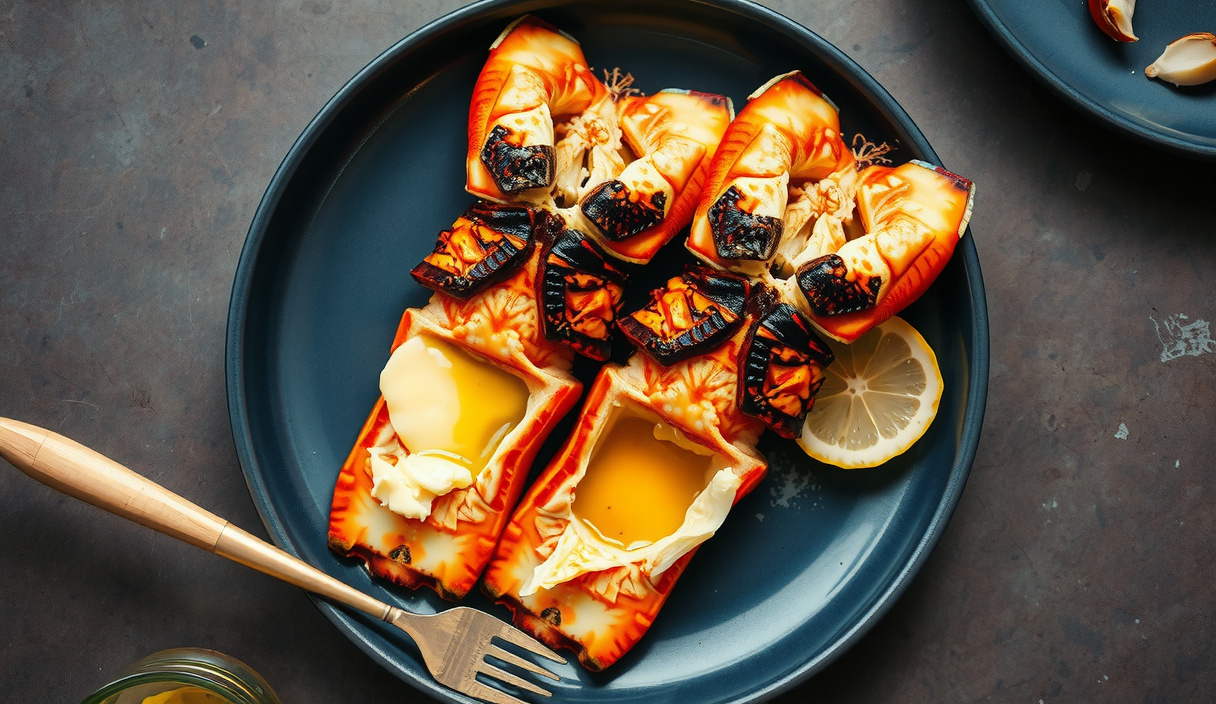
Smoked Lobster Tails with Butter-Paprika Baste

Split lobster tails smoked low and slow at 225°F over alder wood, then basted every seven minutes with a noisette butter spiked with smoked paprika and fresh garlic. Pulled at 135°F internal so residual carryover heat finishes the tropomyosin denaturation precisely at the tender threshold — never beyond it.
Equipment
- 1 Offset smoker, pellet grill, or kettle grill set up for indirect heat Must hold 225°F ± 15°F stably
- 2 Alder or apple wood chunks Chunks, not chips — chips burn too fast for a 20-minute cook
- 1 Instant-read thermometer ±1°F accuracy; insert horizontally into the thickest part of the flesh
- 1 pair Heavy kitchen shears
- 1 Small saucepan For browning the butter baste
- 1 Silicone basting brush
- 1 sheet Aluminum foil For tenting during the rest
Ingredients
Lobster
- 2 cold-water lobster tails, 6 to 8 oz each, fully thawed Maine or Canadian; thaw overnight in the refrigerator
Butter-Paprika Baste
- 4 tablespoons unsalted butter European-style 84% fat butter preferred
- 3 cloves garlic, finely minced or pressed
- 1 teaspoon smoked paprika Spanish pimentón de la Vera, sweet or bittersweet
- 0.5 teaspoon kosher salt
- 0.25 teaspoon freshly ground black pepper
- 1 pinch cayenne pepper Optional; omit for a milder profile
To Finish
- 1 lemon, cut into wedges For serving
- 2 tablespoons fresh flat-leaf parsley, roughly chopped For garnish

Instructions
Fire & Baste Setup
- Set up your smoker for indirect heat and preheat to 225°F. Add two chunks of alder or apple wood to the fire and let the smoke establish to a thin blue wisp — not white billowing smoke. Allow the chamber to hold at 225°F for at least 10 minutes before loading the tails.
- While the smoker stabilizes, make the baste. Place unsalted butter in a small saucepan over medium heat. Let it melt and continue cooking, swirling occasionally, until the foam subsides and the milk solids on the bottom turn deep amber — the color of a copper penny — and the butter smells of toasted hazelnuts. This is the noisette stage, approximately 3 to 4 minutes.
- Pull the pan off heat immediately and stir in the minced garlic, smoked paprika, kosher salt, black pepper, and cayenne (if using). The residual heat will bloom the aromatics without burning them. Keep the baste warm at the side of the smoker or over the lowest possible burner flame.3 cloves garlic, finely minced or pressed, 1 teaspoon smoked paprika, 0.5 teaspoon kosher salt, 0.25 teaspoon freshly ground black pepper, 1 pinch cayenne pepper
Butterfly the Tails
- Using heavy kitchen shears, cut straight down the center of the top shell of each lobster tail, from the open end toward the tail fan, stopping just before the fan. Do not cut the underside membrane.
- Run your thumbs under the meat on both sides of the cut and gently press outward and upward, lifting the meat free of the shell while keeping it attached at the tail fan. Rest the meat on top of the shell — it should sit proud above the shell halves, fully exposed. Pat the flesh dry with a paper towel.
Smoke & Baste
- Place the butterflied tails meat-side up on the smoker grate over indirect heat. Close the lid. Apply the first coat of baste immediately using the silicone brush, covering the exposed flesh completely.3 cloves garlic, finely minced or pressed, 1 teaspoon smoked paprika, 0.5 teaspoon kosher salt, 0.25 teaspoon freshly ground black pepper, 1 pinch cayenne pepper
- After 7 minutes, open the lid, baste again, and close. Repeat after another 7 minutes for the third and final baste coat. Insert the instant-read thermometer horizontally into the thickest part of the flesh at this point — you are looking for an internal temperature between 130°F and 135°F.
- Continue checking every 2 to 3 minutes. Pull the tails from the smoker when the thickest part reads 135°F. Total cook time will be approximately 20 to 25 minutes depending on tail size and smoker stability. Do not cook beyond 135°F on the smoker — carryover heat will finish the job.
Rest & Serve
- Transfer the tails to a warm plate and tent loosely with foil. Rest for 5 minutes — internal temperature will rise to approximately 138°F to 140°F during this window, which is precisely the target denaturation zone for tropomyosin.
- Drizzle any remaining baste over the flesh, garnish with chopped flat-leaf parsley, and serve immediately alongside lemon wedges. The flesh should be opaque, ivory-white with a faint translucence at the very center, and part cleanly under a fork without any resistance.1 lemon, cut into wedges, 2 tablespoons fresh flat-leaf parsley, roughly chopped
Notes
Why 135°F and not 140°F? Lobster muscle fiber is held together primarily by tropomyosin and paramyosin. Tropomyosin begins to denature measurably at 131°F and completes structural collapse around 140°F. At that point, protein aggregation is irreversible and water held within the muscle fiber matrix is expelled — producing the chalky, rubbery texture that marks overcooked crustacean. Pulling at 135°F and resting under foil allows the thermal gradient still present in the flesh to equalize, carrying the center to 138°F–140°F gently and uniformly without the cell-level contraction that happens when you hit that temperature on the heat source itself.
Why brown butter (noisette)? Butter is approximately 80–84% milkfat, 16% water, and 3–4% milk solids (proteins and lactose). When heated past 250°F, the water boils off and the milk solids undergo their own Maillard reaction — the same amino-carbonyl condensation cascade that browns steak. This produces hundreds of heterocyclic volatile compounds, including 2-acetyl-1-pyrroline (the nutty-roasty note in basmati rice and popcorn) and diacetyl. These compounds are lipid-soluble and bind directly to the lobster flesh surface, creating a flavor layer that raw melted butter simply cannot provide.
Wood smoke phenol chemistry: Alder produces a phenol profile dominated by guaiacol and 4-methylguaiacol — compounds with a sweet, woody, slightly vanilla character. These integrate with the sweet marine brine of lobster rather than fighting it. Hickory and mesquite produce significantly higher concentrations of syringol and creosote-class phenols, which register as acrid and medicinal against delicate seafood. Alder's low resin content also means less particulate deposition, preserving the natural luster of the shell.
Nutrition
Calories: 390kcalCarbohydrates: 2gProtein: 38gFat: 25gSaturated Fat: 14gCholesterol: 245mgSodium: 820mg
Tried this recipe?Let us know how it was!