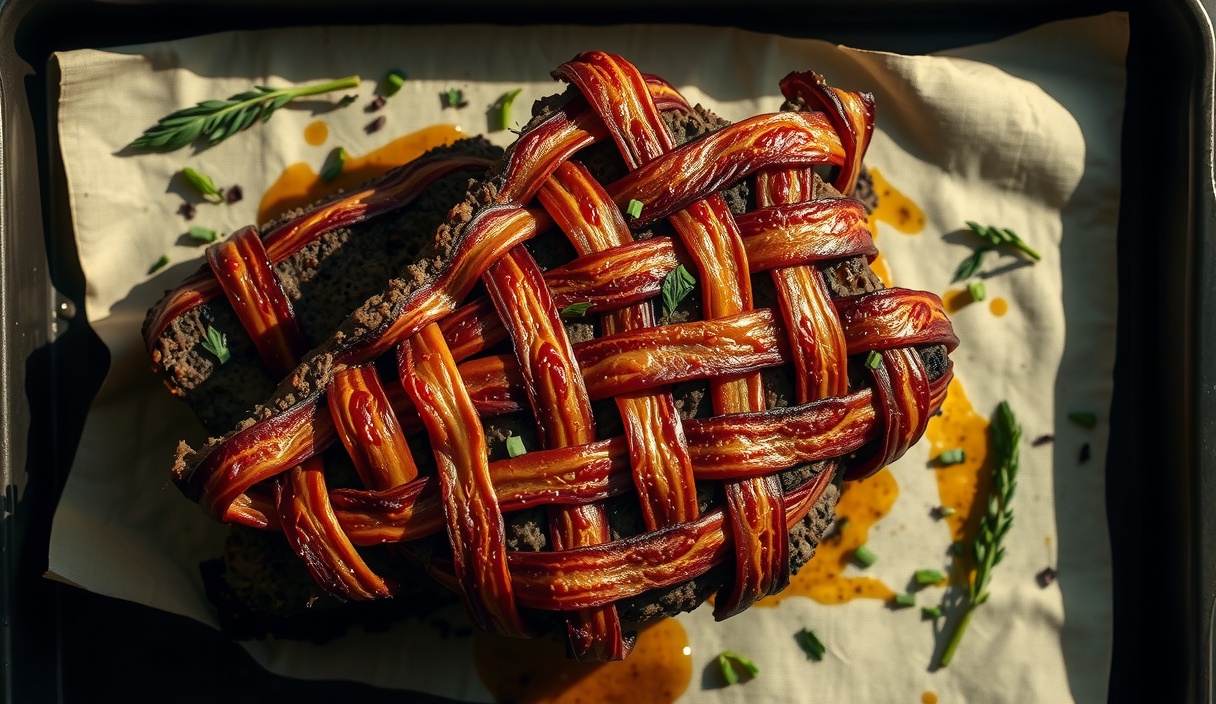
Smoked Meatloaf — Bacon-Weave Wrapped
A two-pound beef-pork meatloaf built on a panade-stabilized protein matrix, wrapped in a tight bacon weave, and smoked low-and-slow at 250°F to a precise 160°F internal temperature. The result is a loaf with genuine bark, a clean smoke ring, and the kind of moist, tender slice that stays together on the plate.
Equipment
- 1 Smoker (offset, pellet, kettle, or kamado) Set up for indirect cooking at a stable 250°F
- 1 Wire rack Elevated rack allows smoke contact on all sides
- 1 Sheet pan (half-size) Lined with foil to catch bacon drippings
- 1 Instant-read thermometer Probe from the side into the geometric center of the loaf
- 1 Large mixing bowl
- 1 sheet Plastic wrap Used to build and roll the bacon weave cleanly
Ingredients
Panade
- 2 slices white sandwich bread crusts removed, torn into rough pieces
- ⅓ cup whole milk warmed slightly to accelerate starch absorption
Meat Mixture
- 1 lb 80/20 ground beef chuck kept cold until mixing
- 1 lb ground pork shoulder not ground loin — you need the fat and collagen
- 2 large eggs beaten
- ½ cup yellow onion finely grated or food-processed to a paste — no large pieces that create steam pockets
- 3 cloves garlic finely minced or pressed
- 2 tbsp Worcestershire sauce
- 2 tbsp ketchup
- 1 tsp kosher salt
- 1 tsp black pepper freshly ground
- 1 tsp smoked paprika
- ½ tsp dried thyme
- ½ tsp dry mustard powder
Bacon Weave
- 12 strips standard-cut bacon not thick-cut — standard-cut renders fully within the cook window
Optional BBQ Glaze
- ¼ cup BBQ sauce your house sauce; applied in the last 20 minutes only

Instructions
Make the Panade
- Combine the torn bread pieces and warm whole milk in a small bowl. Press the bread down into the milk and let it soak for 5 minutes, until the bread is completely saturated and collapses when squeezed. Mash into a rough paste with a fork. The goal is a homogeneous, wet slurry — no dry crumb remaining. This is the structural spacer that prevents protein over-cross-linking during the long smoke.1/3 cup whole milk
Build the Meat Mixture
- In a large mixing bowl, combine the ground beef, ground pork, beaten eggs, grated onion, minced garlic, Worcestershire sauce, ketchup, kosher salt, black pepper, smoked paprika, dried thyme, dry mustard powder, and the panade paste. Using your hands, mix until the ingredients just disappear into a uniform mass — stop the moment it is homogeneous. Overworking develops myosin cross-links before cooking and produces a rubbery, dense loaf. Work fast; warm hands smear the fat phase.1 lb 80/20 ground beef chuck, 1 lb ground pork shoulder, 2 large eggs, 1/2 cup yellow onion, 3 cloves garlic, 2 tbsp Worcestershire sauce, 2 tbsp ketchup, 1 tsp kosher salt, 1 tsp black pepper, 1 tsp smoked paprika, 1/2 tsp dried thyme, 1/2 tsp dry mustard powder, 1/3 cup whole milk
- Refrigerate the meat mixture for 20 minutes. This firms the fat phase and makes the loaf easier to form a clean freehand shape without sticking to your hands.
Build the Bacon Weave
- Lay a sheet of plastic wrap (about 16 inches long) flat on your work surface. Arrange 6 strips of bacon vertically, side by side, slightly overlapping. Fold every other strip back halfway. Lay one horizontal strip of bacon across the unfolded strips at the fold point. Unfold the folded strips back over the horizontal strip. Now fold the alternate strips back and lay a second horizontal strip. Continue weaving until you have a tight 6x6 weave. You should have a woven mat roughly 10 x 10 inches.12 strips standard-cut bacon
Form and Wrap the Loaf
- Remove the meat mixture from the refrigerator. On a separate piece of plastic wrap, shape the mixture into a tight log approximately 9 inches long and 4 inches wide, using wet hands and gentle pressure — do not pack it hard. A light touch keeps the structure open enough to trap the fat as it renders.
- Center the formed loaf near the edge of the bacon weave. Using the plastic wrap beneath the weave as a sling, roll the bacon weave tightly around the loaf, overlapping the edges on the underside. Press the seam side down. Tuck any overhanging bacon ends underneath. Peel away all plastic wrap. Place the wrapped loaf seam-side down on the wire rack set over the foil-lined sheet pan. Pat the surface dry with paper towels to remove any surface moisture — a dry surface means bacon fat renders into browning reactions rather than steaming.12 strips standard-cut bacon
Fire Up the Smoker
- Preheat your smoker to a stable 250°F using indirect heat. Add cherry or apple wood — two to three fist-size chunks for an offset or kettle, or set a pellet grill to cherry/apple blend. Allow the smoker to settle and produce clean, thin blue smoke before loading the loaf. Thick white smoke at the start deposits acrid creosote compounds on the surface.
Smoke the Meatloaf
- Place the wire rack with the loaf into the smoker, seam-side of the bacon down. Close the lid and maintain 250°F throughout the cook — adjust your vents or feed rate as needed. Do not open the smoker in the first 60 minutes; every lid-lift dumps heat and smoke and extends the cook time by 10 to 15 minutes.
- Begin probing from the side at the 2-hour mark. The loaf will likely be in the 130–145°F range. Around 150°F you may notice a plateau — a temperature stall lasting 20 to 30 minutes — caused by evaporative cooling and collagen hydrolysis drawing energy away from the heat-up curve. Hold your smoker at 250°F and wait it out. This stall window is where the gelatin-rich texture is being built.
- Optional BBQ glaze: Once the loaf hits 145°F internal, brush the bacon surface with a thin layer of BBQ sauce. Apply a second coat 10 minutes later. The sugar in the sauce caramelizes against the rendered bacon fat, producing a lacquered shell. Skip this step if you prefer clean smoke bark.1/4 cup BBQ sauce
- Pull the loaf from the smoker when the center reads 160°F on your instant-read thermometer. This achieves full USDA safety compliance for ground meat while staying below the 165°F threshold where actin networks fully collapse and water-holding capacity craters irreversibly. Total cook time is typically 3 to 3.5 hours at a true 250°F.
Rest and Serve
- Transfer the loaf (still on the rack) to a cutting board and tent loosely with foil. Rest for a minimum of 10 minutes — during this time the carryover heat will push the center to 163–165°F, and the protein network will reabsorb the internal moisture gradient. Slicing before the rest releases that moisture onto the board rather than keeping it in the loaf. Slice crosswise into 3/4-inch rounds and serve immediately.
Notes
Why the panade works: When bread absorbs warm whole milk, the starch granules partially gelatinize and the milk proteins denature and bind with the gluten network, creating a plasticized hydrogel matrix. Dispersed throughout the raw meat, this matrix physically spaces the myosin and actin filaments, capping the density of cross-links that form during cooking. The result is a loaf that sets firm but yields tender — not the springy, livery brick that comes from straight, unmixed ground meat. The panade also functions as a water reservoir: as the meat matrix contracts during cooking and expels water, the saturated starch sponge holds that moisture in the protein network rather than letting it drip away.
The stall at 150–155°F: At this internal temperature range, two simultaneous endothermic processes absorb energy as fast as the smoker delivers it — surface evaporation (latent heat of vaporization) and collagen hydrolysis into soluble gelatin (first-order kinetics that require sustained heat input). The temperature plateaus for 20 to 30 minutes. Increasing smoker temperature to escape the stall typically causes the bacon surface to scorch before the interior catches up. Hold 250°F and the stall resolves naturally.
Target internal temperature logic: USDA requires ground beef to reach 160°F for full pathogen safety (a 6.5-log reduction in vegetative pathogens). At 160°F, myosin has fully denatured (threshold: 39–58°F), sarcoplasmic proteins are set (51–67°F), collagen has hydrolyzed (begins above 55°F and accelerates above 70°F), but the actin network — which collapses catastrophically above 74°C / 165°F, destroying water-holding capacity — is still substantially intact. Pulling at 160°F and resting to 163°F via carryover is the precise window where safety and texture intersect.
Bacon weave fat-phase interaction: Standard-cut bacon (approximately 1/16-inch thick) contains a fat-to-lean ratio that renders completely between 140°F and 160°F surface temperature. As the fat phase liquefies, it pools at the meat-to-bacon interface and conducts localized heat in excess of the ambient smoker temperature — inducing Maillard amino-carbonyl reactions that require surface temperatures above 285°F to proceed. These reactions generate melanoidin pigments (the dark bark color) and pyrazine-family aromatics (the nutty, roasted note) that penetrate the outer 5–8mm of the loaf and are perceptible in every slice.
Nutrition
Calories: 480kcalCarbohydrates: 8gProtein: 32gFat: 34gSaturated Fat: 13gCholesterol: 155mgSodium: 720mgSugar: 3g
Tried this recipe?Let us know how it was!