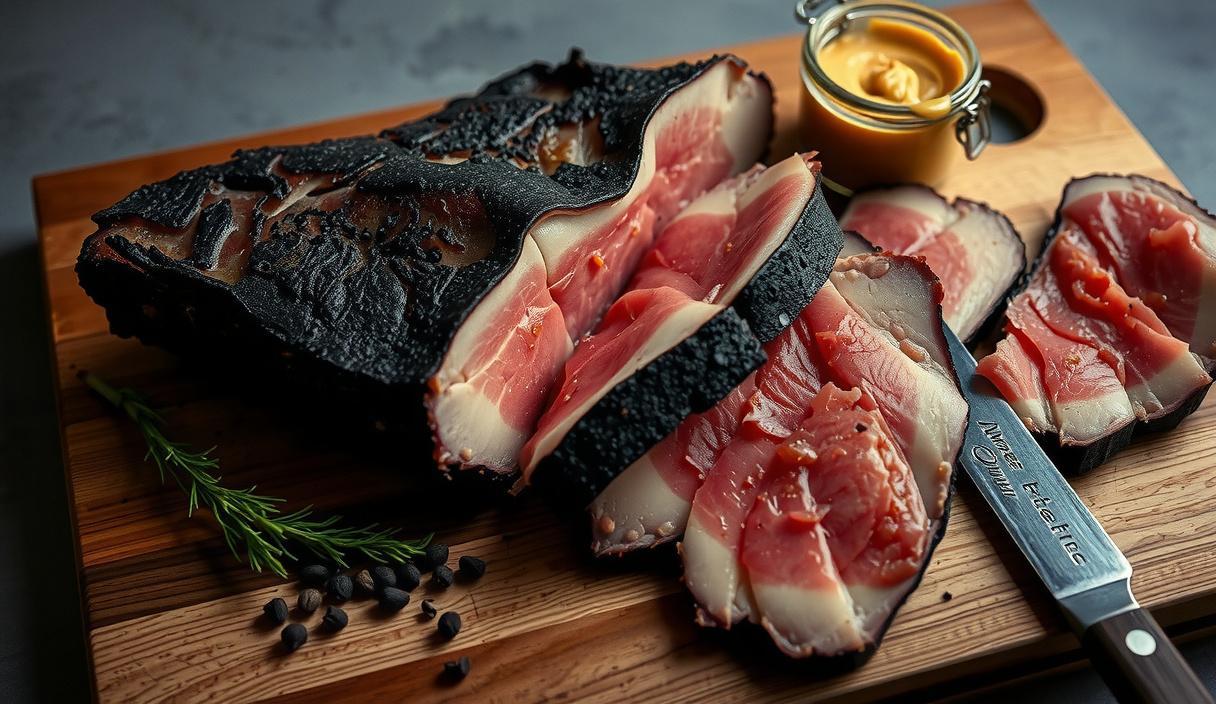
Smoked Pastrami from Scratch

A full brisket flat cured for 7 days in a sodium-nitrite brine, air-dried to form a pellicle, crusted in cracked black pepper and coriander, smoked low and slow to 165°F internal over rye wood, then steamed to 203°F for the collagen-to-gelatin conversion that delivers classic deli-grade pastrami with a deep mahogany bark and vivid pink interior.
Equipment
- 1 Offset smoker, kettle, or pellet grill Must hold a steady 225°F for 6–9 hours
- 1 3.5-gallon food-safe container or brining bag Must fully submerge a 4–5 lb brisket flat
- 1 Digital gram scale Required for precise curing salt measurement
- 1 Instant-read or leave-in probe thermometer Track internal temp through the stall
- 1 Half hotel pan or roasting pan with rack For the steam finish phase; must seal tightly with foil
- 1 Spice grinder or mortar and pestle For cracking coriander and black pepper to medium-coarse texture
Ingredients
Brisket
- 4.5 lb brisket flat Untrimmed, with at least 1/4-inch fat cap; avoid pre-enhanced (injected) cuts
Pink-Cure Brine
- 1 gallon cold water Filtered preferred; divided if needed to dissolve salts
- 150 g kosher salt Diamond Crystal; use 120 g if Morton's (denser grain)
- 15 g Prague Powder No. 1 (pink curing salt) 6.25% sodium nitrite; weigh precisely on a gram scale — do not estimate by volume
- 75 g dark brown sugar Provides Maillard precursors and balances salinity
- 2 tbsp black peppercorns Whole, lightly cracked
- 1 tbsp coriander seeds Whole
- 4 cloves garlic Smashed
- 2 bay leaves
- 1 tsp mustard seeds Yellow or brown
- 1 tsp red pepper flakes Optional; adds mild heat to the cured interior
Pastrami Rub
- 3 tbsp whole black peppercorns Cracked coarse in a spice grinder or under a heavy skillet — not powdered
- 2 tbsp coriander seeds Cracked coarse; the dominant rub flavor
- 1 tsp garlic powder
- 1 tsp smoked paprika Optional; deepens color and adds a secondary smoky phenolic note
- 1 tsp mustard powder Acts as a binder adhesion agent for the bark
Smoke
- 4 oz rye wood chunks or oak chunks Rye is traditional and lighter; oak is heavier and more widely available
Steam
- 2 cups water Placed in the bottom of the roasting pan to generate steam

Instructions
Make the Brine
- Bring 1 quart of the cold water to a simmer in a large saucepan. Add the kosher salt, Prague Powder No. 1, and brown sugar. Stir until fully dissolved — do not let the brine boil vigorously, as that degrades nitrite. Add the peppercorns, coriander seeds, garlic, bay leaves, mustard seeds, and red pepper flakes. Remove from heat and add the remaining cold water to bring the brine down to below 40°F before use. Do not add the brisket to warm brine.150 g kosher salt, 15 g Prague Powder No. 1 (pink curing salt), 75 g dark brown sugar, 2 tbsp black peppercorns, 1 tbsp coriander seeds, 4 cloves garlic, 2 bay leaves, 1 tsp mustard seeds
Cure the Brisket
- Place the brisket flat in a 3.5-gallon food-safe container or a 2-gallon zip-lock bag. Pour the cold brine over the brisket, ensuring it is fully submerged. Use a plate or zip-lock bag filled with water as a weight if necessary — any exposed surface will cure unevenly and remain grey.
- Refrigerate for 7 days. Flip the brisket once at the halfway mark (day 3 or 4) to promote even brine distribution. The cure is complete when the meat is firm and uniformly pink-grey throughout when you inspect a corner cut — there should be no raw dark-red center remaining.
Rinse and Form the Pellicle
- Remove the brisket from the brine and rinse thoroughly under cold running water for 2 to 3 minutes, scrubbing off any spice debris. Pat completely dry with paper towels. Place fat-cap-up on a wire rack set over a sheet pan. Refrigerate uncovered for 4 to 8 hours, or overnight, until the surface is dry and tacky to the touch. This pellicle is the protein matrix that smoke particulates and the Maillard cascade will anchor to — a wet surface produces steam, not bark.
Apply the Rub and Prep the Smoker
- Crack the black peppercorns and coriander seeds to a coarse texture — you want irregular shards, not powder. Mix with the garlic powder, smoked paprika, and mustard powder. Apply the rub liberally to all surfaces of the brisket, pressing firmly so the crust adheres. Do this 30 minutes before the brisket enters the smoker, not hours before — the volatile aromatic compounds in the crust dissipate rapidly at room temperature.3 tbsp whole black peppercorns, 2 tbsp coriander seeds, 1 tsp garlic powder, 1 tsp smoked paprika, 1 tsp mustard powder
- Set up your smoker for indirect heat and bring it to a stable 225°F (107°C). Add your wood chunks to the fire or smoke chamber. Allow the smoker to produce clean, thin blue smoke before adding the brisket — thick white smoke carries excess creosote and will produce a bitter, astringent bark.4 oz rye wood chunks or oak chunks
Smoke
- Place the brisket fat-cap-up on the smoker grate. Insert a probe thermometer into the thickest part of the flat, avoiding fat seams. Smoke at 225°F until the internal temperature reaches 165°F (74°C). This will take approximately 6 to 9 hours depending on the size of the flat and the efficiency of your smoker.
- The stall is real and it is long. Expect the internal temperature to plateau between 150°F and 165°F for 2 to 5 hours as evaporative cooling at the surface matches the heat input from the smoker. Do not raise the smoker temperature. Do not wrap the brisket. The surface must remain exposed to smoke and dry heat for bark formation to complete. The stall breaks on its own as the surface crust fully sets and evaporative cooling slows.
Steam
- Once the brisket reaches 165°F internal, remove it from the smoker and transfer it to a rack set inside a roasting pan or hotel pan. Pour the 2 cups of water into the bottom of the pan — ensure the water does not touch the brisket. Seal the pan tightly with two layers of heavy-duty aluminum foil, crimping firmly around all edges to trap steam.
- Place the sealed pan in a 275°F (135°C) oven. Steam until the internal temperature of the brisket reaches 203°F (95°C), approximately 2 to 3 hours. Hold at 203°F for an additional 30 minutes — this hold window completes the collagen hydrolysis into gelatin. If you check and the foil has ballooned tightly, steam is doing its work; do not unseal early.
- Remove the pan from the oven, unseal one corner of the foil carefully to release the steam burst away from your hands, and allow the brisket to rest uncovered for 20 minutes. This redistributes the gelatin phase and equalizes the internal temperature gradient before slicing.
Slice and Serve
- Identify the grain direction of the brisket flat — the long muscle fibers run in one consistent direction. Slice against the grain, at approximately 3 to 4 millimeters thickness, using a sharp slicing knife with long, smooth strokes rather than a sawing motion. Serve immediately on rye bread with spicy brown mustard, or allow to cool completely before vacuum-sealing for refrigerator storage up to 5 days or freezer storage up to 3 months.
Notes
Why 7 days and not less? Nitrite and salt diffuse through beef muscle at roughly 0.6 to 0.8 inches per day under refrigeration, governed by Fick's second law of diffusion. A 3-inch flat requires a minimum of 4 days for full center penetration; 7 days adds a safety margin and allows the brine flavors to equilibrate uniformly. A short-cured flat will have a grey, under-cured center regardless of smoke time.
Why does the stall happen? Between approximately 150°F and 165°F internal, the evaporation rate from the surface of the brisket absorbs latent heat energy as fast as the smoker delivers it, anchoring surface temperature near 212°F while the internal temperature stops climbing. This is identical to the physics of a wet-bulb thermometer. The stall breaks when enough surface area has desiccated (crust formation) that the evaporative surface is sufficiently reduced — typically after 2 to 5 hours. Raising temperature to bust the stall pushes surface bark into pyrolysis and causes premature actin over-denaturation in the outer layers.
Nitrite safety math: Prague Powder No. 1 at 15 g per gallon (3,785 mL) of brine yields approximately 15 × 0.0625 × 1,000 / 3,785 = 24.8 mg/L nitrite in the brine before equilibration into the meat. USDA regulations cap finished cured meat at 156 ppm nitrite. At typical cure equilibration ratios (approximately 30–40% brine uptake relative to meat weight), this protocol lands within safe regulatory parameters. Do not double the dose to accelerate curing — that does not work and creates an unsafe and metallic-tasting product.
The steam converts collagen: Collagen hydrolysis into soluble gelatin is governed by first-order kinetics that accelerate sharply above 185°F (85°C). At 203°F, the conversion rate is high enough that a 30-minute hold produces measurable gelatin phase throughout the muscle. This gelatin coats the denatured muscle fibers with a lubricating matrix that produces the characteristic silky, pull-apart texture of great pastrami. Without the steam phase, collagen remains as partially hydrolyzed, chewy, insoluble material.
Nutrition
Calories: 310kcalCarbohydrates: 3gProtein: 38gFat: 15gSaturated Fat: 5gCholesterol: 115mgSodium: 980mgSugar: 2g
Tried this recipe?Let us know how it was!