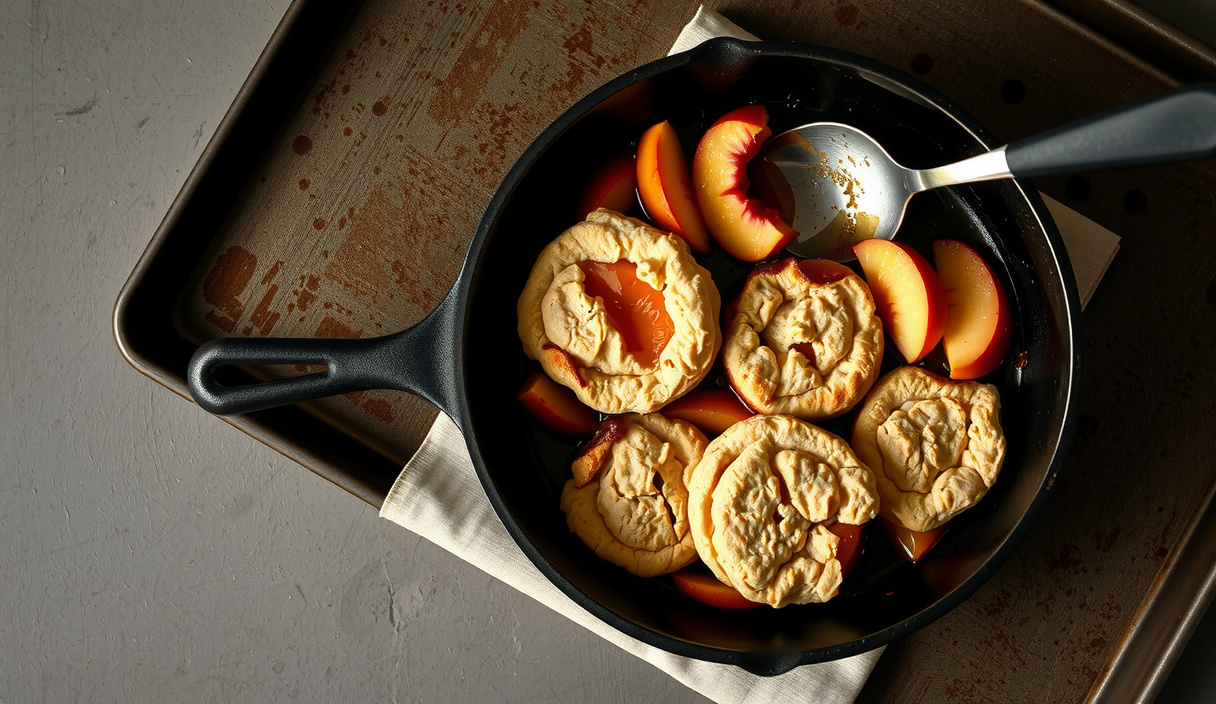
Smoked Peach Cobbler in a Cast Iron Skillet

A classic Southern-style peach cobbler cooked entirely on the smoker in a 12-inch cast iron skillet. Ripe peaches, brown sugar, and cinnamon caramelize into a glossy, jammy filling beneath a buttery drop-biscuit crust, while hardwood smoke deposits a layer of phenolic aroma compounds into the butter fat of the topping — creating a campfire-peach-caramel flavor profile you cannot replicate in an indoor oven. Serve warm with vanilla ice cream.
Equipment
- 1 12-inch cast iron skillet Pre-seasoned. Thermal mass is essential for even bottom heat and preventing a scorched filling.
- 1 Smoker or charcoal grill with a lid Must hold a stable 350°F. Apple, cherry, or peach wood chunks recommended.
- 1 Instant-read thermometer Required to confirm biscuit doneness — target 200–205°F at the center of the thickest biscuit piece.
- 2 Large mixing bowl One for the filling, one for the biscuit dough.
- 1 Pastry cutter or fork For cutting cold butter into the flour mixture.
Ingredients
Peach Filling
- 3 lbs fresh ripe freestone peaches Peeled, pitted, and sliced 1/2-inch thick. About 6 to 7 medium peaches. Frozen (thawed and drained) works off-season.
- ½ cup dark brown sugar Packed. Dark brown preferred for deeper molasses-Maillard flavor; light brown works.
- 2 tablespoons granulated sugar
- 2 tablespoons cornstarch Primary thickening agent for the filling gel.
- 1 teaspoon ground cinnamon
- ¼ teaspoon ground nutmeg Freshly grated preferred.
- 1 tablespoon fresh lemon juice Brightens the filling and prevents enzymatic browning of cut peaches.
- 1 teaspoon pure vanilla extract
Biscuit Topping
- 1 ½ cups all-purpose flour
- ¼ cup granulated sugar
- 1 ½ teaspoons baking powder
- ¼ teaspoon baking soda
- ½ teaspoon kosher salt
- 6 tablespoons unsalted butter Cold, cut into 1/2-inch cubes. Keep refrigerated until the moment of use.
- ¾ cup cold whole buttermilk The acidity reacts with baking soda for additional lift and contributes lactic acid tang.
Finish
- 2 tablespoons unsalted butter Melted, for brushing the skillet and optionally brushing the biscuit top before the last 5 minutes.
- 2 tablespoons turbinado sugar For sprinkling over the biscuit top. Creates a crackling, caramelized crust.

Instructions
Prep and Fire Setup
- Fire up your smoker and bring it to a stable 350°F. Add 2 to 3 chunks of apple, cherry, or peach wood (each about the size of a fist) to the firebox or coals. Allow the smoker to run for 20 to 25 minutes until the temperature is locked in and you are producing a thin, blue-white smoke rather than thick white billowing smoke. Thick white smoke carries harsh, acrolein-heavy combustion products that will make the cobbler taste bitter.
- While the smoker stabilizes, peel, pit, and slice the peaches into 1/2-inch thick wedges. Place them in a large bowl. Add the dark brown sugar, granulated sugar, cornstarch, cinnamon, nutmeg, lemon juice, and vanilla extract. Toss thoroughly until every peach slice is coated and the cornstarch is fully dissolved into the released juice. Let the mixture sit for 5 minutes — the peaches will macerate and release additional liquid that will become the base of the filling gel.1/2 cup dark brown sugar, 2 tablespoons granulated sugar, 2 tablespoons cornstarch, 1 teaspoon ground cinnamon, 1/4 teaspoon ground nutmeg, 1 tablespoon fresh lemon juice, 1 teaspoon pure vanilla extract
Make the Biscuit Topping
- In a separate large bowl, whisk together the all-purpose flour, granulated sugar, baking powder, baking soda, and kosher salt until evenly combined.1 1/2 cups all-purpose flour, 1/4 cup granulated sugar, 1 1/2 teaspoons baking powder, 1/4 teaspoon baking soda, 1/2 teaspoon kosher salt
- Add the cold butter cubes to the flour mixture. Using a pastry cutter or your fingertips (work quickly to avoid warming the fat), cut the butter into the flour until the mixture resembles coarse, irregular crumbs with some pea-sized butter pieces remaining. Those larger chunks are exactly what you want — they will create steam pockets and laminate layers in the finished biscuit top.6 tablespoons unsalted butter
- Pour the cold buttermilk into the flour-butter mixture. Stir with a fork until the dough just comes together — it will look shaggy and sticky. Do not overwork it. Overworking develops gluten and produces a tough, bready topping rather than a tender, flaky biscuit crust. Stop stirring the moment there are no large streaks of dry flour remaining.3/4 cup cold whole buttermilk
Assemble and Smoke
- Brush the inside of the 12-inch cast iron skillet generously with the melted butter, coating the bottom and sides completely. Pour the peach filling into the skillet and spread it into an even layer.2 tablespoons unsalted butter
- Drop the biscuit dough over the peach filling in rough, irregular spoonfuls — aim for pieces about 2 to 3 inches across and roughly 1 inch tall. Do not smooth the dough into a single flat sheet. Leave gaps between the pieces; the filling will bubble up through the gaps as it cooks, which is correct and beautiful. Sprinkle the turbinado sugar evenly over the biscuit pieces.2 tablespoons turbinado sugar
- Place the cast iron skillet directly on the smoker grate. Close the lid. Cook at 350°F for 40 to 45 minutes, resisting the urge to open the lid more than once during cooking. Check at the 40-minute mark: the biscuit top should be deep golden-brown, the filling should be visibly bubbling at the edges, and an instant-read thermometer inserted into the center of the thickest biscuit piece should read 200°F to 205°F. If the top is darkening too quickly before the interior is done, tent loosely with foil for the final 10 minutes.
- Optional: In the last 5 minutes of cooking, brush the biscuit tops lightly with any remaining melted butter and close the lid. This adds a final layer of fat for the smoke phenolics to bind to and deepens the crust color.2 tablespoons unsalted butter
Rest and Serve
- Remove the skillet from the smoker and place it on a heat-safe surface. Rest for at least 15 minutes before serving. The cornstarch gel continues to firm as the filling temperature drops below 160°F. Serving too hot produces a runny, sauce-like filling. After 15 minutes, the filling will be thick, glossy, and scoopable. Serve directly from the skillet with vanilla ice cream or lightly sweetened whipped cream.
Notes
Why the biscuit top browns faster on a smoker than in an oven: Wood smoke deposits guaiacol, syringol, and related phenolic compounds on the surface of the dough. These molecules are chromophores — they absorb and convert radiant energy more efficiently than plain flour-butter dough. The result is that color develops 10 to 15 minutes earlier than in a conventional oven at the same temperature. This is why internal temperature (200–205°F) is a more reliable doneness indicator than visual color in a smoked environment.
How the cornstarch gel works: Raw cornstarch granules are intact semi-crystalline structures that do not thicken in cold liquid. Once the filling exceeds 185°F, the granules absorb water, swell, and burst — releasing amylose chains that cross-link with each other and with the peach pectin to form the clear, glossy gel you want. The ratio here (2 tablespoons per 3 lbs of peaches) is calibrated for fresh ripe peaches, which release a moderate amount of juice. If your peaches are very ripe and very juicy, add an extra teaspoon of cornstarch to the filling mixture.
The campfire peach aroma mechanism: Guaiacol and syringol (the primary phenolic products of hardwood lignin combustion) are highly lipophilic — their log P values of approximately 1.3 and 1.4 respectively mean they partition strongly into fat phases. The butter in the biscuit topping acts as an aroma reservoir during cooking, absorbing and retaining these smoke volatiles at far higher concentrations than a lean water-based gel could hold. This is why the smoked biscuit top carries more perceived smoke character than the peach filling directly below it, even though both are exposed to the same smoke environment.
Cold butter science: The flakiness of the biscuit topping is entirely dependent on maintaining discrete butter lenses within the flour matrix through the dough-making stage. If the butter softens before it hits the smoker, the fat fuses into the surrounding starch-protein network instead of remaining separate. When the fused fat heats in the smoker, it simply lubricates the crumb rather than generating steam pockets, and you get a dense, scone-like dome instead of a layered, flaky crust. Keep butter refrigerator-cold until the moment it is cut into the flour.
Nutrition
Calories: 410kcalCarbohydrates: 62gProtein: 5gFat: 16gSaturated Fat: 10gCholesterol: 42mgSodium: 290mgFiber: 3gSugar: 38g
Tried this recipe?Let us know how it was!