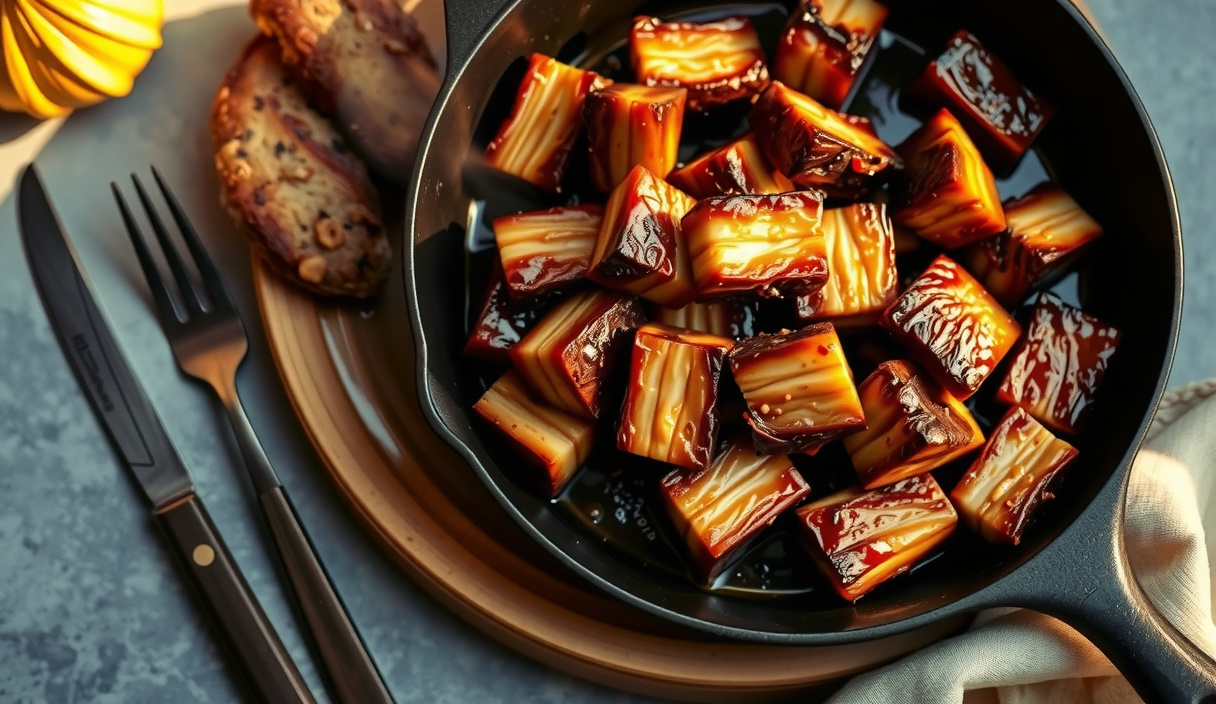
Smoked Pork Belly Burnt Ends (Meat Candy)

Skin-off pork belly cubed to 1.5 inches, rubbed with a savory-sweet bark rub, and smoked low and slow at 250°F until the internal temperature reaches 190°F — the precise window where collagen fully hydrolyzes into sticky gelatin and intramuscular fat renders completely. A final 60-minute glaze phase in butter, brown sugar, and Kansas City-style BBQ sauce creates the lacquered mahogany crust that earns these their "meat candy" reputation. Where Flavor Meets the Flame.
Equipment
- 1 Offset smoker or kettle grill Capable of holding a stable 250°F for 5–6 hours. A ceramic kamado or pellet grill works equally well.
- 1 Dual-probe wireless thermometer One probe for smoker ambient temperature, one for pork belly internal temperature. Do not rely on time alone.
- 1 Disposable full-size aluminum pan Used during the glaze phase to braise the cubes in rendered fat and glaze. A 9x13 inch disposable pan also works for smaller batches.
- 4 to 6 Cherry wood chunks or chips Chunks preferred for offset smokers; chips in a foil pouch for kettle grills. Apple or pecan are solid alternatives.
- 1 Sharp chef's knife For cubing the belly into precise 1.5-inch pieces. A dull knife compresses rather than cuts, disrupting the cube geometry.
- 1 Large mixing bowl For tossing cubes in rub and later in glaze.
Ingredients
Pork Belly
- 5 lb skin-off pork belly Ask your butcher to remove the skin. The slab should be at least 1.5 inches thick to yield proper cube depth after trimming.
Bark Rub
- 2 tbsp kosher salt
- 2 tbsp coarse black pepper 16-mesh preferred for visible pepper bark.
- 2 tbsp brown sugar Packed. Provides reducing sugars for the initial Maillard crust.
- 1 tbsp smoked paprika
- 1 tbsp garlic powder
- 1 tsp onion powder
- 1 tsp cayenne pepper Reduce to 1/2 tsp for mild heat.
- 1 tsp dry mustard powder
Glaze
- 4 tbsp unsalted butter Cut into pats. Provides the lipid carrier for the glaze and promotes even coating across the cube surface.
- ¼ cup brown sugar Packed. Reduces and caramelizes against the warm cube surface during the final smoke phase.
- ½ cup Kansas City-style BBQ sauce Choose a tomato-based sauce with moderate sweetness and low vinegar. High-acid sauces suppress re-browning.
- 2 tbsp honey Optional. Adds hygroscopic humectancy and free monosaccharides that accelerate the final Maillard glaze.

Instructions
Prep the Pork Belly
- Remove the pork belly from refrigeration 30 minutes before cooking to take the chill off the exterior. Pat the entire surface completely dry with paper towels — thorough surface dehydration is essential for bark formation. Any surface moisture delays Maillard onset and extends your cook time unnecessarily.
- Place the belly fat-side down on a cutting board. Using a sharp chef's knife, cube the belly into uniform 1.5-inch pieces. Precision here matters: undersized cubes dry out before collagen hydrolyzes; oversized cubes overcook on the exterior before the center reaches 190°F. Trim any loose, thin flaps that would burn before the main cubes are done.
- Combine all rub ingredients — kosher salt, black pepper, brown sugar, smoked paprika, garlic powder, onion powder, cayenne, and dry mustard — in a small bowl and whisk until evenly blended. Transfer the cubes to a large mixing bowl, add the rub, and toss thoroughly until every surface of every cube is coated. Do not be timid — full surface coverage is the difference between a thick bark and bare spots.2 tbsp coarse black pepper, 2 tbsp brown sugar, 1 tbsp smoked paprika, 1 tbsp garlic powder, 1 tsp onion powder, 1 tsp cayenne pepper, 1 tsp dry mustard powder
Fire Up the Smoker
- Bring your smoker to a stable 250°F before adding any meat. Verify the temperature at grate level with your thermometer probe — lid thermometers are notoriously inaccurate, reading 20–30°F higher than actual grate temperature. Add 2–3 cherry wood chunks (or a foil pouch of soaked chips for a kettle) once the smoker is at temperature. You want thin blue smoke, not billowing white smoke — white smoke carries bitter creosote that will muddy the flavor of your bark.
First Smoke — Low and Slow to 190°F
- Arrange the seasoned pork belly cubes fat-side up directly on the smoker grate, leaving at least 1/2 inch of space between each cube for airflow and smoke penetration. Fat-side up allows the rendering fat to self-baste the muscle fibers below as it melts and migrates downward through the protein matrix.
- Insert the second thermometer probe into the thickest cube. Close the smoker and resist the urge to open it for at least the first 2 hours. The bark sets during this window. Every lid-lift vents heat and resets your momentum.
- Smoke at 250°F until the internal temperature of the cubes reaches 190°F. Total time is typically 4.5 to 5.5 hours, but cook to temperature, not to time. You will encounter the stall — a plateau between approximately 165°F and 175°F internal that can last 45–90 minutes. This is caused by surface evaporative cooling absorbing energy as fast as the smoker delivers it. Do not panic. Do not wrap. Do not increase temperature. Maintain 250°F and let the physics resolve. The stall ends when surface moisture is depleted and conductive heating resumes.
Glaze and Final Smoke
- When the cubes reach 190°F internal, remove them from the smoker to a large mixing bowl. Allow them to rest 5 minutes — this lets the surface cool slightly so the glaze can adhere rather than sliding off hot rendered fat.
- Add the butter pats, brown sugar, BBQ sauce, and honey (if using) directly to the bowl with the cubes. Toss everything together until every cube is thoroughly coated on all surfaces. The residual heat from the cubes will begin melting the butter and dissolving the brown sugar as you toss.4 tbsp unsalted butter, 1/4 cup brown sugar, 1/2 cup Kansas City-style BBQ sauce, 2 tbsp honey
- Transfer the glazed cubes and all the glaze and rendered fat from the bowl into a disposable aluminum pan. Spread the cubes into a single layer — do not stack them. Return the pan, uncovered, to the smoker at 250°F for 60 minutes. During this phase the glaze reduces, the sugars re-enter the Maillard cascade against the warm bark surface, and the cubes braise gently in the pool of rendered fat and caramelizing glaze at the bottom of the pan. This is the step that creates the signature lacquered crust.4 tbsp unsalted butter, 1/4 cup brown sugar, 1/2 cup Kansas City-style BBQ sauce, 2 tbsp honey
Rest and Serve
- After 60 minutes, the glaze should be thick, sticky, and deeply mahogany. Remove the pan from the smoker. Allow the burnt ends to rest in the pan for 10–15 minutes before serving. The internal gelatin will re-set slightly during the rest, giving each cube structural integrity without losing the trembling, pull-apart texture. Serve directly from the pan — no further cutting required.
Notes
Why 190°F and not 203°F (brisket territory)? Pork belly's fat architecture is substantially different from brisket point. The extremely high intramuscular fat content (often 40–50% by cross-section) means the muscle fibers are already physically separated and lubricated by rendered fat well before 190°F. Pushing to 203°F causes the remaining actomyosin cross-links to contract violently, squeezing the gelatin phase you worked hours to produce back out of the matrix. The result is a greasy, crumbling cube rather than a cohesive, sticky one. Pull at 185–192°F internal for the optimal texture window.
The stall explained: Between approximately 160°F and 175°F internal, surface evaporation absorbs energy as fast as the smoker delivers it — the latent heat of vaporization of water (approximately 2,257 J/g) effectively anchors the surface temperature near 212°F while the conductive wave into the interior stalls. This is identical physics to the brisket stall. The stall ends when free surface moisture is depleted and conductive heating resumes. Do not wrap: wrapping creates a steam environment that softens the bark and prevents the second Maillard layer from forming during the glaze phase.
Collagen hydrolysis kinetics: Collagen hydrolysis into soluble gelatin follows first-order kinetics — the rate increases exponentially with temperature above 160°F. At 190°F internal maintained for 15–20 minutes, virtually all accessible collagen cross-links in the pork belly matrix have hydrolyzed. The resulting gelatin concentration in a properly cooked belly cube is sufficient to produce a self-saucing, sticky texture without any added thickeners. This is the same biochemical pathway as a 12-hour braise, achieved via dry heat in the smoker.
Glaze re-browning mechanism: During the final 60 minutes, the brown sugar and honey in the glaze provide free glucose, fructose, and molasses melanoidins that re-enter the Maillard cascade at the warm cube surface (well above the 140°F onset threshold). The butter provides a continuous lipid film that lowers the water activity at the glaze surface, concentrating the amino-carbonyl reactants and accelerating browning without scorching. Choose a low-acid BBQ sauce: pH below 4.5 suppresses the Maillard reaction by protonating the nucleophilic amino groups required for Schiff base formation.
Nutrition
Calories: 620kcalCarbohydrates: 18gProtein: 22gFat: 52gSaturated Fat: 19gCholesterol: 115mgSodium: 780mgSugar: 16g
Tried this recipe?Let us know how it was!