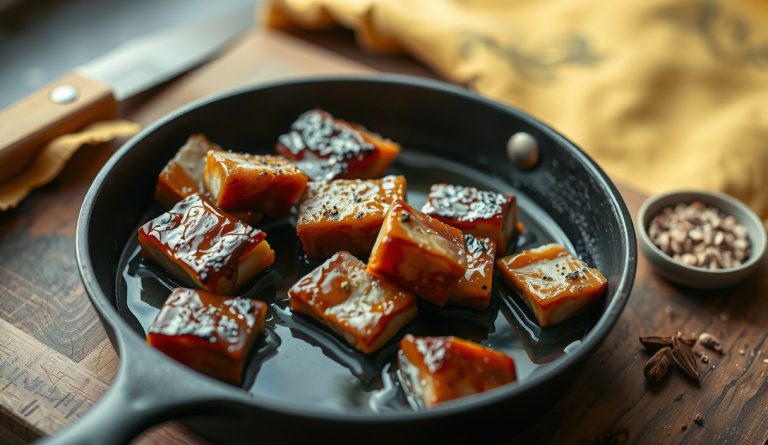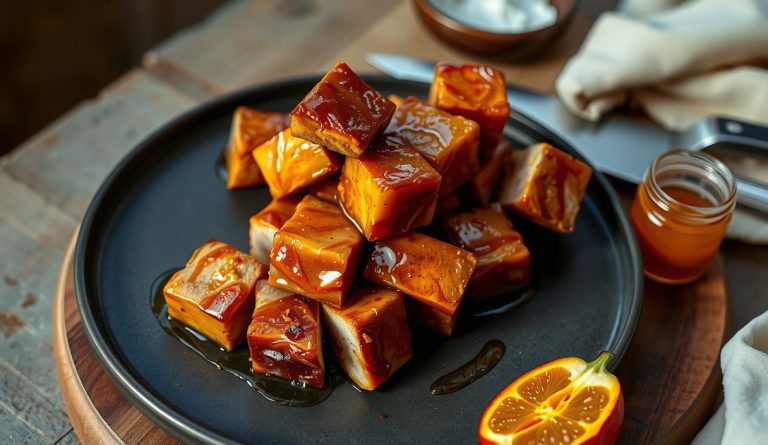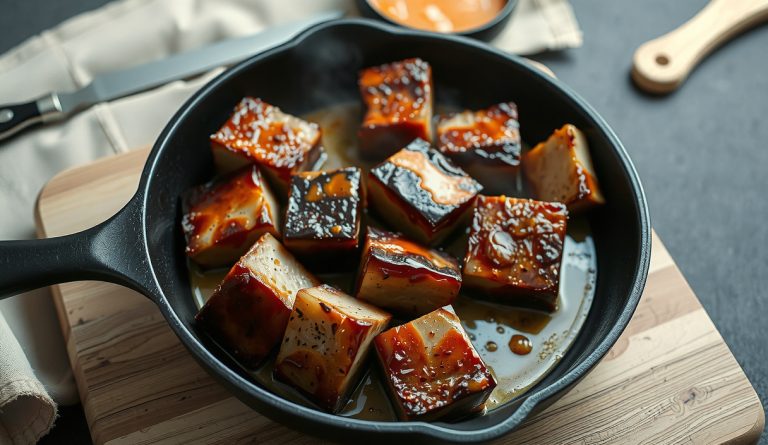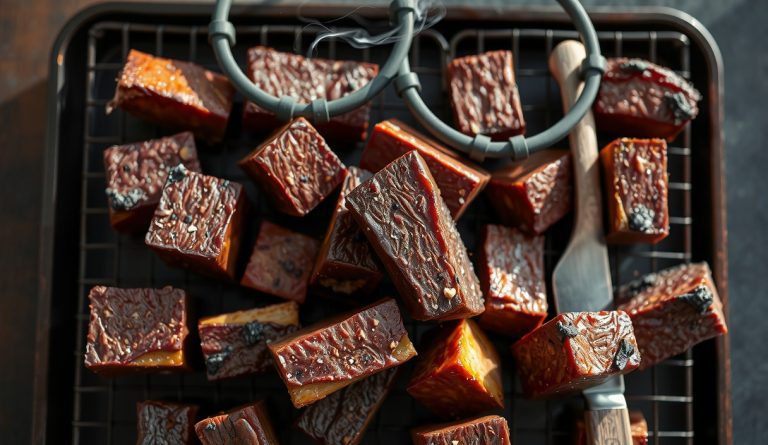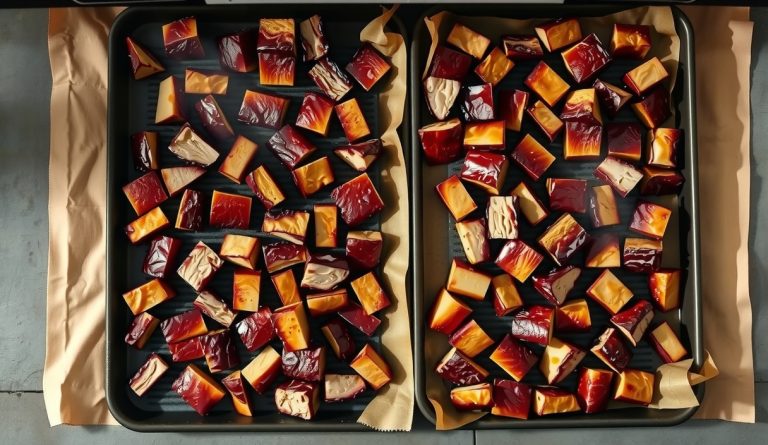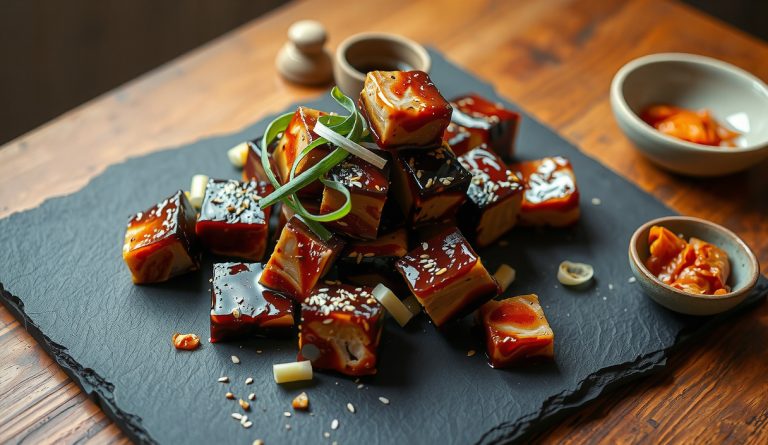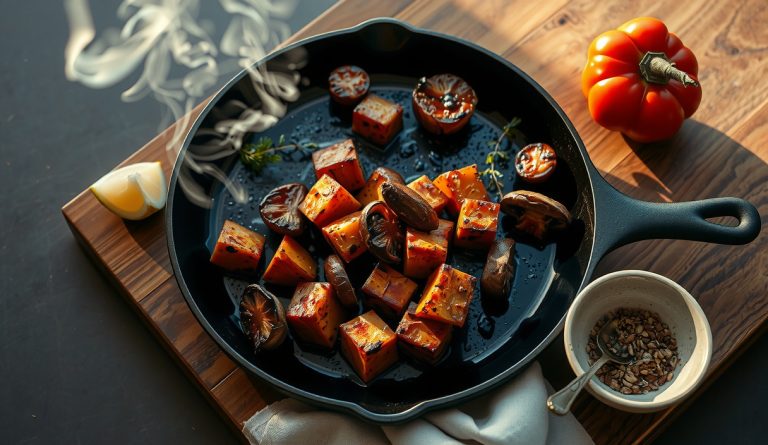
Smoked Pork Belly Burnt Ends (Meat Candy)

Equipment
- 1 Offset smoker or kettle grill Capable of holding a stable 250°F for 5–6 hours. A ceramic kamado or pellet grill works equally well.
- 1 Dual-probe wireless thermometer One probe for smoker ambient temperature, one for pork belly internal temperature. Do not rely on time alone.
- 1 Disposable full-size aluminum pan Used during the glaze phase to braise the cubes in rendered fat and glaze. A 9×13 inch disposable pan also works for smaller batches.
- 4 to 6 Cherry wood chunks or chips Chunks preferred for offset smokers; chips in a foil pouch for kettle grills. Apple or pecan are solid alternatives.
- 1 Sharp chef’s knife For cubing the belly into precise 1.5-inch pieces. A dull knife compresses rather than cuts, disrupting the cube geometry.
- 1 Large mixing bowl For tossing cubes in rub and later in glaze.
Ingredients
Pork Belly
- 5 lb skin-off pork belly Ask your butcher to remove the skin. The slab should be at least 1.5 inches thick to yield proper cube depth after trimming.
Bark Rub
- 2 tbsp kosher salt
- 2 tbsp coarse black pepper 16-mesh preferred for visible pepper bark.
- 2 tbsp brown sugar Packed. Provides reducing sugars for the initial Maillard crust.
- 1 tbsp smoked paprika
- 1 tbsp garlic powder
- 1 tsp onion powder
- 1 tsp cayenne pepper Reduce to 1/2 tsp for mild heat.
- 1 tsp dry mustard powder
Glaze
- 4 tbsp unsalted butter Cut into pats. Provides the lipid carrier for the glaze and promotes even coating across the cube surface.
- ¼ cup brown sugar Packed. Reduces and caramelizes against the warm cube surface during the final smoke phase.
- ½ cup Kansas City-style BBQ sauce Choose a tomato-based sauce with moderate sweetness and low vinegar. High-acid sauces suppress re-browning.
- 2 tbsp honey Optional. Adds hygroscopic humectancy and free monosaccharides that accelerate the final Maillard glaze.

Instructions
Prep the Pork Belly
- Remove the pork belly from refrigeration 30 minutes before cooking to take the chill off the exterior. Pat the entire surface completely dry with paper towels — thorough surface dehydration is essential for bark formation. Any surface moisture delays Maillard onset and extends your cook time unnecessarily.
- Place the belly fat-side down on a cutting board. Using a sharp chef’s knife, cube the belly into uniform 1.5-inch pieces. Precision here matters: undersized cubes dry out before collagen hydrolyzes; oversized cubes overcook on the exterior before the center reaches 190°F. Trim any loose, thin flaps that would burn before the main cubes are done.
- Combine all rub ingredients — kosher salt, black pepper, brown sugar, smoked paprika, garlic powder, onion powder, cayenne, and dry mustard — in a small bowl and whisk until evenly blended. Transfer the cubes to a large mixing bowl, add the rub, and toss thoroughly until every surface of every cube is coated. Do not be timid — full surface coverage is the difference between a thick bark and bare spots.2 tbsp coarse black pepper, 2 tbsp brown sugar, 1 tbsp smoked paprika, 1 tbsp garlic powder, 1 tsp onion powder, 1 tsp cayenne pepper, 1 tsp dry mustard powder
Fire Up the Smoker
- Bring your smoker to a stable 250°F before adding any meat. Verify the temperature at grate level with your thermometer probe — lid thermometers are notoriously inaccurate, reading 20–30°F higher than actual grate temperature. Add 2–3 cherry wood chunks (or a foil pouch of soaked chips for a kettle) once the smoker is at temperature. You want thin blue smoke, not billowing white smoke — white smoke carries bitter creosote that will muddy the flavor of your bark.
First Smoke — Low and Slow to 190°F
- Arrange the seasoned pork belly cubes fat-side up directly on the smoker grate, leaving at least 1/2 inch of space between each cube for airflow and smoke penetration. Fat-side up allows the rendering fat to self-baste the muscle fibers below as it melts and migrates downward through the protein matrix.
- Insert the second thermometer probe into the thickest cube. Close the smoker and resist the urge to open it for at least the first 2 hours. The bark sets during this window. Every lid-lift vents heat and resets your momentum.
- Smoke at 250°F until the internal temperature of the cubes reaches 190°F. Total time is typically 4.5 to 5.5 hours, but cook to temperature, not to time. You will encounter the stall — a plateau between approximately 165°F and 175°F internal that can last 45–90 minutes. This is caused by surface evaporative cooling absorbing energy as fast as the smoker delivers it. Do not panic. Do not wrap. Do not increase temperature. Maintain 250°F and let the physics resolve. The stall ends when surface moisture is depleted and conductive heating resumes.
Glaze and Final Smoke
- When the cubes reach 190°F internal, remove them from the smoker to a large mixing bowl. Allow them to rest 5 minutes — this lets the surface cool slightly so the glaze can adhere rather than sliding off hot rendered fat.
- Add the butter pats, brown sugar, BBQ sauce, and honey (if using) directly to the bowl with the cubes. Toss everything together until every cube is thoroughly coated on all surfaces. The residual heat from the cubes will begin melting the butter and dissolving the brown sugar as you toss.4 tbsp unsalted butter, 1/4 cup brown sugar, 1/2 cup Kansas City-style BBQ sauce, 2 tbsp honey
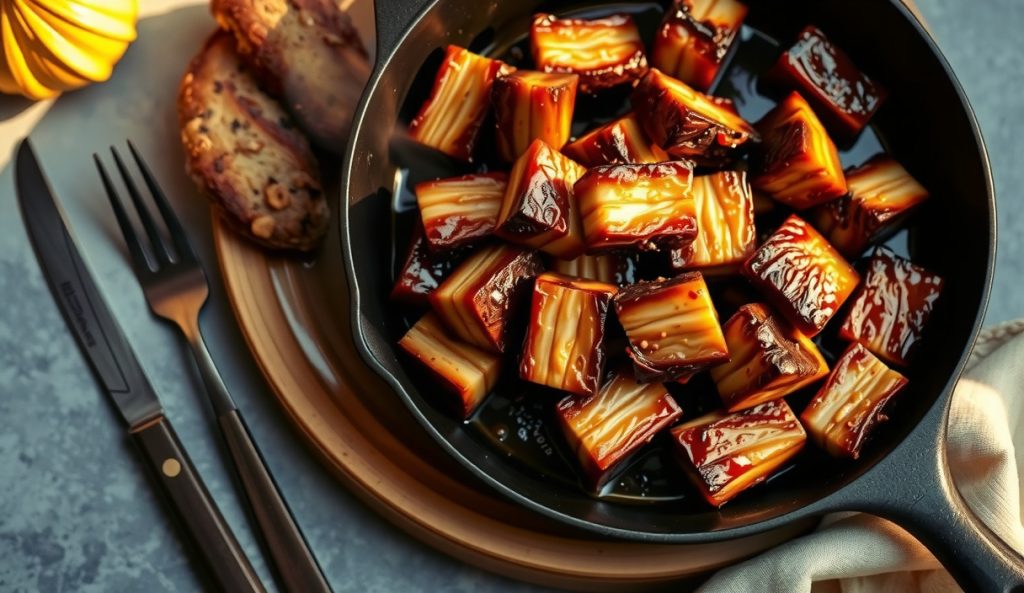
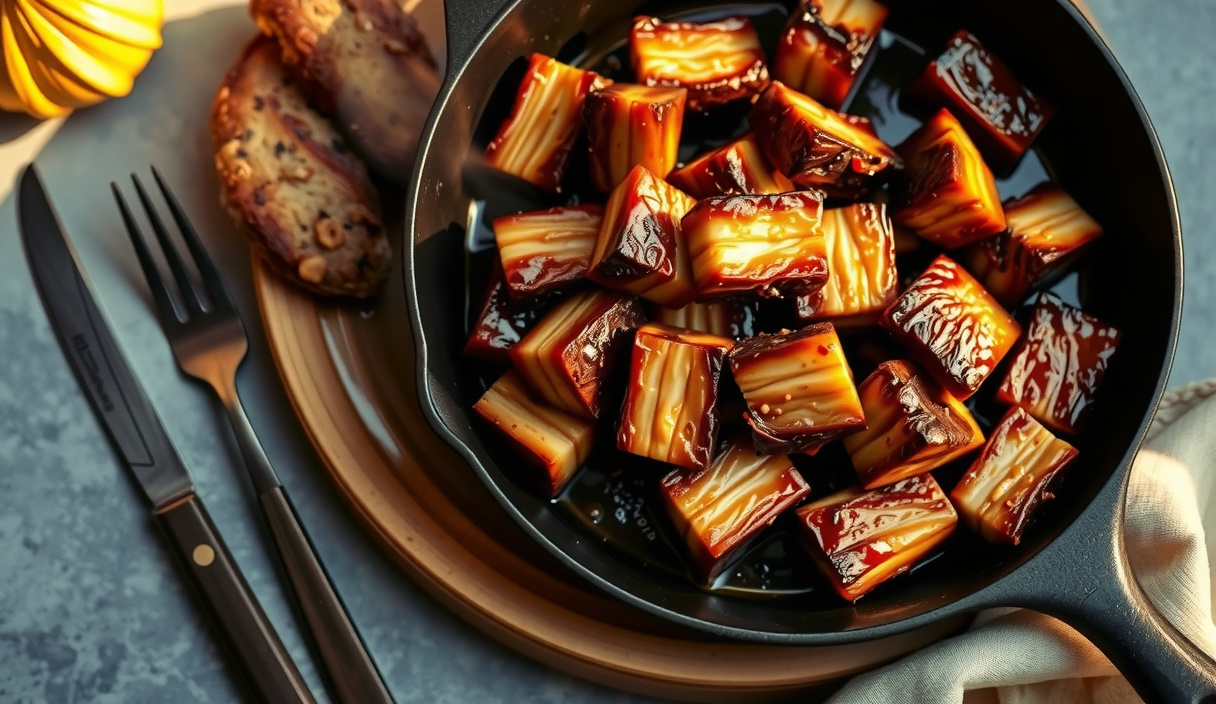
- Transfer the glazed cubes and all the glaze and rendered fat from the bowl into a disposable aluminum pan. Spread the cubes into a single layer — do not stack them. Return the pan, uncovered, to the smoker at 250°F for 60 minutes. During this phase the glaze reduces, the sugars re-enter the Maillard cascade against the warm bark surface, and the cubes braise gently in the pool of rendered fat and caramelizing glaze at the bottom of the pan. This is the step that creates the signature lacquered crust.4 tbsp unsalted butter, 1/4 cup brown sugar, 1/2 cup Kansas City-style BBQ sauce, 2 tbsp honey
Rest and Serve
- After 60 minutes, the glaze should be thick, sticky, and deeply mahogany. Remove the pan from the smoker. Allow the burnt ends to rest in the pan for 10–15 minutes before serving. The internal gelatin will re-set slightly during the rest, giving each cube structural integrity without losing the trembling, pull-apart texture. Serve directly from the pan — no further cutting required.
Notes
Nutrition
The first time I pulled a tray of pork belly burnt ends off the smoker, I understood immediately why pitmasters call them meat candy. The exterior is a deep lacquered mahogany, barely holding together under its own weight. Press one between your fingers and it collapses — releasing a rush of rendered fat, smoke, and sweet glaze. Pork belly burnt ends are the most forgiving and most rewarding thing you can cook on a smoker, and the physics behind why they work are genuinely beautiful.
Burnt ends traditionally came from brisket points, those trimmings too fatty and irregular to slice cleanly. Pork belly is the upgrade. The fat-to-muscle ratio is even higher, the collagen network is dense, and the individual cubes are self-contained flavor bombs. Get the process right — low heat, long time, a precise glaze window — and you will produce something that disappears off the tray faster than you can plate it.
Why do pork belly burnt ends work? The science explained
Pork belly burnt ends achieve their signature texture because the belly’s unusually high fat-to-muscle ratio and dense collagen network allow two separate transformations to occur simultaneously at 250°F smoker temperature. First, intramuscular fat — primarily triglycerides in a mixed polymorphic state — begins to render. As the triacylglycerol crystal lattice crosses its melting point and transitions from solid to liquid, the rendered fat migrates through the muscle fiber bundles, physically lubricating and basting the protein matrix from within. This is why pork belly burnt ends stay moist even at internal temperatures that would destroy a lean cut: the lipid phase acts as a thermal and moisture buffer, absorbing energy and delaying the violent moisture expulsion that occurs when actin contracts above 74°C (165°F).
The second transformation is collagen hydrolysis. The connective tissue in pork belly — primarily Type I collagen arranged in dense, covalently cross-linked fibers — undergoes a discrete phase transition beginning around 160°F internal. The triple-helix unwinds through thermal shrinkage, then, with sustained time above 160°F (ideally 185–190°F internal), first-order hydrolysis kinetics cleave the cross-links into soluble gelatin. This is the biological mechanism behind the meat candy texture: the collagen has been chemically converted into a viscous, gummy gel that coats every muscle fiber and holds each cube together in a trembling, self-saucing mass. Targeting 190°F internal temperature ensures you reach the upper end of the collagen hydrolysis window without catastrophic protein fracturing.
The stall — that maddening plateau between roughly 165°F and 175°F internal — is pure evaporative physics: surface water absorbs latent heat of vaporization and pins the surface temperature near 212°F, stalling the conductive heat wave into the interior. Wrapping or foiling the cubes would break the stall faster but costs bark. At American Meathead, we power through the stall unwrapped to preserve the Maillard crust that gives burnt ends their structural integrity and textural contrast.
The glaze phase is a separate thermodynamic event. Butter introduces saturated milkfat — primarily palmitic and stearic glycerides — that coats the bark in a thin continuous lipid film. Brown sugar provides reducing sugars (glucose and fructose from partial sucrose inversion, plus molasses melanoidins) that re-enter the Maillard cascade when the glazed cubes return to the 250°F smoker. As the glaze heats and sugar concentration rises, water activity at the surface drops, pushing the surface above the 140°F Maillard onset. The result is a second, distinct layer of caramelized crust over the existing smoke bark: the lacquered mahogany finish that makes pork belly burnt ends visually unmistakable. A pH-neutral BBQ sauce keeps the ionic environment favorable for continued Maillard condensation rather than shifting toward caramel degradation pathways — which is why high-acid vinegar sauces undermine the final glaze.
What equipment and ingredients do you need for pork belly burnt ends?
- Pork belly, skin-off: Ask your butcher for a skinless slab. Skin-on belly will not render correctly — the collagen-dense skin creates a moisture barrier that prevents even fat render and produces a rubbery exterior. The skin must be removed before cubing.
- Cube size matters: 1.5-inch cubes are the target. Too small (under 1 inch) and the cubes dry out before collagen fully hydrolyzes. Too large (over 2 inches) and the surface overcooks before the center reaches 190°F. Use a sharp chef’s knife and a ruler if needed.
- Smoker fuel: Cherry wood provides a mild, fruit-forward smoke that complements pork’s sweetness without the bitterness of mesquite. Apple or pecan work equally well. Hickory is acceptable but assertive — use it sparingly or blend it with a milder wood.
- Thermometer: A dual-probe wireless thermometer lets you monitor both the smoker ambient temperature and the internal temperature of a representative cube simultaneously. Do not rely on time alone — collagen hydrolysis is kinetics-driven, not clock-driven.
- Disposable aluminum pan: Essential for the glaze phase. The pan captures rendered fat and glaze, allowing the cubes to braise in their own liquid during the final 60 minutes. This is the mechanism that transforms good burnt ends into transcendent ones.
- BBQ sauce selection: Use a tomato-based Kansas City-style sauce with moderate sweetness and low vinegar. High-acid sauces (Carolina vinegar styles) will suppress Maillard re-browning during the glaze phase by lowering the surface pH below the optimal browning range.
Smoked Pork Belly Burnt Ends (Meat Candy)
Equipment
- 1 Offset smoker or kettle grill Capable of holding a stable 250°F for 5–6 hours. A ceramic kamado or pellet grill works equally well.
- 1 Dual-probe wireless thermometer One probe for smoker ambient temperature, one for pork belly internal temperature. Do not rely on time alone.
- 1 Disposable full-size aluminum pan Used during the glaze phase to braise the cubes in rendered fat and glaze. A 9×13 inch disposable pan also works for smaller batches.
- 4 to 6 Cherry wood chunks or chips Chunks preferred for offset smokers; chips in a foil pouch for kettle grills. Apple or pecan are solid alternatives.
- 1 Sharp chef’s knife For cubing the belly into precise 1.5-inch pieces. A dull knife compresses rather than cuts, disrupting the cube geometry.
- 1 Large mixing bowl For tossing cubes in rub and later in glaze.
Ingredients
Pork Belly
- 5 lb skin-off pork belly Ask your butcher to remove the skin. The slab should be at least 1.5 inches thick to yield proper cube depth after trimming.
Bark Rub
- 2 tbsp kosher salt
- 2 tbsp coarse black pepper 16-mesh preferred for visible pepper bark.
- 2 tbsp brown sugar Packed. Provides reducing sugars for the initial Maillard crust.
- 1 tbsp smoked paprika
- 1 tbsp garlic powder
- 1 tsp onion powder
- 1 tsp cayenne pepper Reduce to 1/2 tsp for mild heat.
- 1 tsp dry mustard powder
Glaze
- 4 tbsp unsalted butter Cut into pats. Provides the lipid carrier for the glaze and promotes even coating across the cube surface.
- ¼ cup brown sugar Packed. Reduces and caramelizes against the warm cube surface during the final smoke phase.
- ½ cup Kansas City-style BBQ sauce Choose a tomato-based sauce with moderate sweetness and low vinegar. High-acid sauces suppress re-browning.
- 2 tbsp honey Optional. Adds hygroscopic humectancy and free monosaccharides that accelerate the final Maillard glaze.
Instructions
Prep the Pork Belly
- Remove the pork belly from refrigeration 30 minutes before cooking to take the chill off the exterior. Pat the entire surface completely dry with paper towels — thorough surface dehydration is essential for bark formation. Any surface moisture delays Maillard onset and extends your cook time unnecessarily.
- Place the belly fat-side down on a cutting board. Using a sharp chef’s knife, cube the belly into uniform 1.5-inch pieces. Precision here matters: undersized cubes dry out before collagen hydrolyzes; oversized cubes overcook on the exterior before the center reaches 190°F. Trim any loose, thin flaps that would burn before the main cubes are done.
- Combine all rub ingredients — kosher salt, black pepper, brown sugar, smoked paprika, garlic powder, onion powder, cayenne, and dry mustard — in a small bowl and whisk until evenly blended. Transfer the cubes to a large mixing bowl, add the rub, and toss thoroughly until every surface of every cube is coated. Do not be timid — full surface coverage is the difference between a thick bark and bare spots.2 tbsp coarse black pepper, 2 tbsp brown sugar, 1 tbsp smoked paprika, 1 tbsp garlic powder, 1 tsp onion powder, 1 tsp cayenne pepper, 1 tsp dry mustard powder
Fire Up the Smoker
- Bring your smoker to a stable 250°F before adding any meat. Verify the temperature at grate level with your thermometer probe — lid thermometers are notoriously inaccurate, reading 20–30°F higher than actual grate temperature. Add 2–3 cherry wood chunks (or a foil pouch of soaked chips for a kettle) once the smoker is at temperature. You want thin blue smoke, not billowing white smoke — white smoke carries bitter creosote that will muddy the flavor of your bark.
First Smoke — Low and Slow to 190°F
- Arrange the seasoned pork belly cubes fat-side up directly on the smoker grate, leaving at least 1/2 inch of space between each cube for airflow and smoke penetration. Fat-side up allows the rendering fat to self-baste the muscle fibers below as it melts and migrates downward through the protein matrix.
- Insert the second thermometer probe into the thickest cube. Close the smoker and resist the urge to open it for at least the first 2 hours. The bark sets during this window. Every lid-lift vents heat and resets your momentum.
- Smoke at 250°F until the internal temperature of the cubes reaches 190°F. Total time is typically 4.5 to 5.5 hours, but cook to temperature, not to time. You will encounter the stall — a plateau between approximately 165°F and 175°F internal that can last 45–90 minutes. This is caused by surface evaporative cooling absorbing energy as fast as the smoker delivers it. Do not panic. Do not wrap. Do not increase temperature. Maintain 250°F and let the physics resolve. The stall ends when surface moisture is depleted and conductive heating resumes.
Glaze and Final Smoke
- When the cubes reach 190°F internal, remove them from the smoker to a large mixing bowl. Allow them to rest 5 minutes — this lets the surface cool slightly so the glaze can adhere rather than sliding off hot rendered fat.
- Add the butter pats, brown sugar, BBQ sauce, and honey (if using) directly to the bowl with the cubes. Toss everything together until every cube is thoroughly coated on all surfaces. The residual heat from the cubes will begin melting the butter and dissolving the brown sugar as you toss.4 tbsp unsalted butter, 1/4 cup brown sugar, 1/2 cup Kansas City-style BBQ sauce, 2 tbsp honey
- Transfer the glazed cubes and all the glaze and rendered fat from the bowl into a disposable aluminum pan. Spread the cubes into a single layer — do not stack them. Return the pan, uncovered, to the smoker at 250°F for 60 minutes. During this phase the glaze reduces, the sugars re-enter the Maillard cascade against the warm bark surface, and the cubes braise gently in the pool of rendered fat and caramelizing glaze at the bottom of the pan. This is the step that creates the signature lacquered crust.4 tbsp unsalted butter, 1/4 cup brown sugar, 1/2 cup Kansas City-style BBQ sauce, 2 tbsp honey
Rest and Serve
- After 60 minutes, the glaze should be thick, sticky, and deeply mahogany. Remove the pan from the smoker. Allow the burnt ends to rest in the pan for 10–15 minutes before serving. The internal gelatin will re-set slightly during the rest, giving each cube structural integrity without losing the trembling, pull-apart texture. Serve directly from the pan — no further cutting required.
Notes
Nutrition
How do I nail pork belly burnt ends every time?
- Dry the surface before applying rub. Pat each cube thoroughly dry with paper towels. Surface moisture dilutes the rub, delays bark formation, and extends the stall. Drier surfaces reach Maillard conditions faster.
- Do not rush the stall. The plateau between 165°F and 175°F internal temperature is real and can last 45–90 minutes depending on smoker humidity and cube size. Resist opening the smoker — every lid-lift dumps heat and resets momentum. Trust the physics.
- Pull at 190°F, not 200°F. Above 195°F internal, residual muscle fiber proteins (particularly the remaining actomyosin complex) begin to contract further, squeezing out the gelatin you worked hours to produce. The window between 185°F and 192°F is the target zone. Use a probe thermometer, not visual cues.
- Toss the cubes in glaze — do not pour it over. Coating every surface of every cube ensures uniform Maillard re-browning during the final 60 minutes. A pour-over leaves the top glazed and the sides bare.
- Rest the pan before serving. Five minutes off the smoker allows the internal gelatin to re-set slightly. Cutting into cubes immediately releases the liquid phase before it has thickened. The textural payoff is worth the wait.
- Failure mode — dry, crumbly cubes: Almost always caused by overshooting 195°F internal or starting with belly that is too lean (under 40% fat by cross-section). Source well-marbled belly and pull at 190°F.
What variations can I make on pork belly burnt ends?
Spicy Korean-inspired glaze: Replace the brown sugar and BBQ sauce glaze with a mixture of gochujang (2 tablespoons), honey (2 tablespoons), toasted sesame oil (1 tablespoon), soy sauce (1 tablespoon), and unsalted butter (2 tablespoons). The gochujang introduces capsaicin — a TRPV1 agonist that triggers chemesthetic heat — alongside fermented umami depth from Aspergillus oryzae-driven amino acid liberation. The sesame oil’s high smoke point prevents scorching during the final glaze phase. Finish the Korean-glazed burnt ends with toasted sesame seeds and sliced scallion greens.
Honey-habanero burnt ends: Swap brown sugar for raw honey, which contains native invertase that produces a higher ratio of free glucose and fructose than sucrose and accelerates Maillard onset, and add 1–2 minced habanero peppers to the glaze. The habanero’s capsaicin compounds are lipophilic — they partition heavily into the rendered pork fat, creating sustained heat release rather than a sharp spike. Wear gloves when handling the peppers and add them to the melted butter before the honey to bloom the capsaicinoids in fat.
Scaling up for a crowd: This recipe scales linearly. Two slabs of belly (10–12 lb total) fit comfortably on a full-size offset smoker or a 22-inch kettle with a two-zone setup. Use two separate aluminum pans for the glaze phase — overcrowding a single pan raises the steam environment inside and slows final bark formation. Budget an additional 30–45 minutes of total cook time for larger batches due to the increased thermal mass in the smoker.
Sauce-free bark variant: For those who prefer the pure smoke-fat-salt expression without glaze complexity, skip the butter-sugar-sauce phase entirely. After the burnt ends reach 190°F internal, return the cubes to the smoker grate (not a pan) for 20 minutes uncovered at 275°F. The brief temperature bump triggers rapid surface dehydration and a final Maillard burst from residual sugars in the rub. The result is a drier, crunchier cube with a more aggressive smoke presence — closer to traditional brisket burnt ends in texture.
Frequently asked questions about pork belly burnt ends
Can I use skin-on pork belly? You can, but remove the skin before cubing. The skin is almost pure collagen and elastin with negligible intramuscular fat. It will not render in the same time window as the belly meat, leaving a tough, chewy layer that prevents the exterior crust from forming correctly. A sharp boning knife removes the skin cleanly in under two minutes.
My burnt ends came out greasy rather than sticky — what happened? A greasy result is almost always a glaze-phase timing issue. If the cubes are returned to the smoker while still too hot from the initial smoke (above 180°F internal), the glaze cannot adhere — the rendered fat is still fully liquid and the sugar cannot reduce against the surface fast enough. Let the cubes rest for 5 minutes off heat before tossing in glaze, and ensure the aluminum pan is not so overcrowded that the cubes steam rather than roast during the final 60 minutes.
Do I need to wrap the pork belly during the stall? No — and American Meathead deliberately avoids it. Wrapping in foil (the Texas crutch) breaks the stall by eliminating evaporative surface cooling, but it also steams the bark off the cubes and prevents the second Maillard layer from forming. The bark is structural: it provides the textural contrast that makes burnt ends satisfying rather than merely tender. Power through the stall with patience and a steady 250°F smoker temperature.