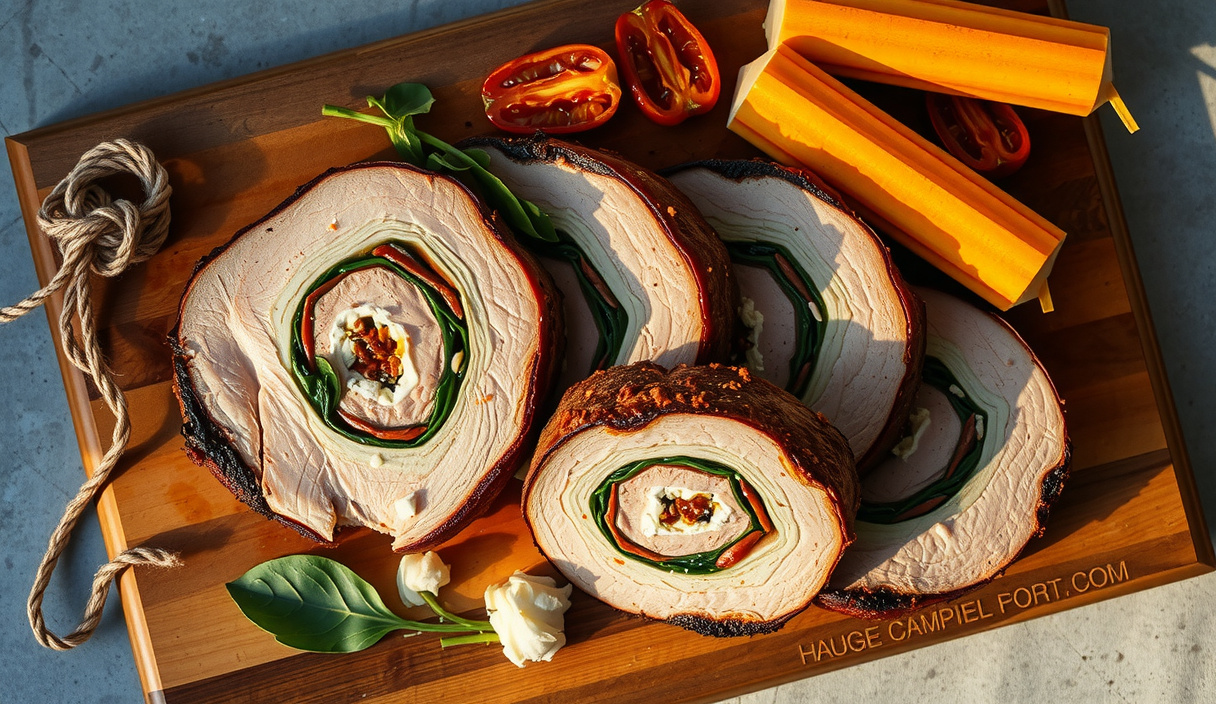
Smoked Stuffed Pork Loin with Spinach, Sun-Dried Tomato & Feta

A butterflied pork loin filled with wilted spinach, oil-packed sun-dried tomatoes, and crumbled feta — rolled tight, tied at 1.5-inch intervals, and smoked low and slow at 275°F until the center reads exactly 145°F. The result is a juicy, smoke-ringed roast with a spiraling cross-section and deeply savory interior contrast. Precise temperature control is everything here: myosin sets beautifully below 145°F while actin stays intact, keeping every slice genuinely moist.
Equipment
- 1 Smoker or charcoal kettle grill Set up for indirect heat at a stable 275°F; use apple or cherry wood chunks for smoke
- 1 Sharp boning knife Essential for an even butterfly — a dull knife creates ragged, uneven slabs
- 10 lengths Butcher's twine Pre-cut to 14 inches; cotton only, no synthetics
- 1 Instant-read thermometer Non-negotiable for this lean cut; probe horizontally from the end to reach the geometric center
- 1 Large skillet For wilting the spinach filling
- 1 large sheet Plastic wrap or parchment For rolling and chilling the stuffed loin before tying
Ingredients
Pork Loin
- 1 center-cut boneless pork loin roast, 3 to 3.5 pounds Not pork tenderloin — ask your butcher for the full center-cut loin
- 1.5 tsp kosher salt For dry-brining the butterflied surface
- 1 tsp freshly ground black pepper
- 1 tsp smoked paprika
- 0.5 tsp garlic powder
- 0.5 tsp dried thyme
- 1 tbsp olive oil Rubbed on the exterior after tying to promote bark adhesion
Spinach, Sun-Dried Tomato & Feta Filling
- 1 tbsp olive oil
- 3 cloves garlic, minced
- 10 oz fresh baby spinach About 10 loosely packed cups; will reduce dramatically after wilting
- 0.5 cup oil-packed sun-dried tomatoes, drained and roughly chopped Pat dry briefly on paper towels after draining
- 4 oz block feta cheese, crumbled Brine-packed block feta preferred over pre-crumbled
- 2 tbsp fresh basil, thinly sliced
- 0.25 tsp red pepper flakes Optional for mild heat
- 1 tbsp Dijon mustard Spread on butterflied surface as an adhesive layer before filling
Wood & Smoke
- 2 chunks apple or cherry wood chunks Fist-sized; soak in water 30 minutes if using charcoal

Instructions
Make the Filling
- Heat 1 tablespoon olive oil in a large skillet over medium heat. Add minced garlic and cook, stirring, for 45 seconds until fragrant but not browned.3 cloves garlic, minced, 10 oz fresh baby spinach
- Add spinach in three or four batches, folding each addition until just wilted before adding the next. Total wilting time is 3 to 4 minutes. Season with a pinch of salt and red pepper flakes if using.0.5 cup oil-packed sun-dried tomatoes, drained and roughly chopped, 1 tbsp Dijon mustard
- Transfer wilted spinach to a colander and press firmly with the back of a spoon, then squeeze again by hand in a clean kitchen towel until as much liquid as possible is removed. The spinach should be nearly dry. Roughly chop the squeezed spinach and transfer to a bowl.0.5 cup oil-packed sun-dried tomatoes, drained and roughly chopped
- Add the chopped sun-dried tomatoes, crumbled feta, and fresh basil to the spinach. Fold gently to combine. Taste and adjust seasoning — feta is salty, so additional salt is rarely needed. Set filling aside to cool to room temperature before using.4 oz block feta cheese, crumbled, 2 tbsp fresh basil, thinly sliced, 0.25 tsp red pepper flakes
Butterfly and Season the Loin
- Place the pork loin on a cutting board, fat cap side down. Using a sharp boning knife, make a horizontal cut starting 3/4 inch from the bottom along the long edge, cutting almost all the way through but leaving a 1/2-inch hinge. Open the loin like a book. If the slab is thicker than 3/4 inch in any area, make a second fold-cut on the thick half to create a consistent, even surface. Cover with plastic wrap and pound any thick spots gently with a meat mallet or rolling pin until the entire slab is roughly 3/4 inch thick throughout.
- Sprinkle 1 teaspoon kosher salt, black pepper, smoked paprika, garlic powder, and dried thyme evenly over the interior surface (the side that will hold the filling). Pat gently to adhere. Spread Dijon mustard in a thin, even layer over the same surface — this acts as both a flavor base and an adhesive for the filling.1.5 tsp kosher salt, 1 tsp freshly ground black pepper, 1 tsp smoked paprika, 0.5 tsp garlic powder, 0.5 tsp dried thyme, 2 chunks apple or cherry wood chunks
Fill, Roll, and Tie
- Spread the cooled filling evenly over the mustard-coated interior surface, leaving a 1-inch border along the far long edge to prevent filling blowout during rolling. Press the filling firmly and evenly to remove air pockets.4 oz block feta cheese, crumbled, 2 tbsp fresh basil, thinly sliced, 0.25 tsp red pepper flakes
- Starting from the near long edge, roll the loin tightly and evenly away from you, like a jelly roll. Keep consistent pressure throughout the roll — a tight roll holds the filling securely and creates an even cylinder. The fat cap, if present, should end up on the exterior top of the roll.
- Tie the roll with pre-cut butcher's twine at 1.5-inch intervals along the entire length, including two ties within half an inch of each end. Each tie should be snug enough that the roll holds its shape firmly but not so tight that it cuts into the meat. A well-tied loin will maintain its circular cross-section under pressure.
- Rub the exterior of the tied loin with 1 tablespoon olive oil, then season with the remaining 0.5 teaspoon kosher salt and a few turns of black pepper over the entire exterior. For maximum bark, place the tied loin uncovered on a rack over a sheet pan and refrigerate for at least 2 hours or up to overnight. This dries the surface and improves smoke adhesion significantly.1 tbsp olive oil, 1.5 tsp kosher salt
Smoke the Loin
- Prepare your smoker or kettle grill for indirect heat at a stable 275°F. Add apple or cherry wood chunks — two fist-sized pieces is sufficient. Wait until the smoke runs clean and thin (white, acrid smoke means the wood is not fully combusted; thin blue smoke is the target).
- Place the loin directly on the grate on the indirect-heat side, fat side up. Insert your probe thermometer horizontally from the end of the loin so the probe tip rests at the geometric center of the meat mass — not inside the filling pocket. Close the lid.
- Smoke, maintaining 275°F, until the internal temperature reads 145°F. This typically takes 1 hour 30 minutes to 1 hour 45 minutes for a 3 to 3.5 pound loin at this temperature, but cook by temperature, not time. Do not open the smoker more than once or twice to check progress — each lid lift drops the cooking environment by 25°F to 50°F and extends the cook.
- Optional high-heat finish for deeper bark: If the exterior color is paler than desired at 145°F, immediately transfer the loin to direct high heat — screaming-hot grill grates or a cast iron skillet — for 60 to 90 seconds per side. Watch closely: the surface is already dehydrated and will char quickly. The goal is deep mahogany, not black.
Rest and Slice
- Remove the loin from the smoker at 145°F. Tent loosely with foil — do not wrap tightly, which traps steam and softens the bark. Rest for 10 minutes. Internal temperature will carry over 3°F to 5°F during the rest.
- Remove the twine by cutting each loop and pulling it free before slicing. Using a sharp slicing knife, cut the loin into 3/4-inch to 1-inch rounds. Each slice should reveal a clear spiral of spinach, sun-dried tomato, and feta. Serve immediately.
Notes
Why 145°F and not 160°F? The old USDA recommendation of 160°F for pork was revised in 2011. At 160°F, actin — the thermally stable myofibrillar protein — undergoes significant denaturation and the actomyosin complex contracts violently, expelling bound water. The result is dry, chalky pork. At 145°F (with a 3-minute rest), myosin has fully coagulated and the loin is set and firm, but actin remains structurally intact and water-holding capacity is near maximum. This is the thermodynamic sweet spot for whole-muscle pork.
Why wilt the spinach? Raw baby spinach is approximately 92% water by mass. Sealed inside a rolled protein matrix under heat, that free water undergoes a phase change to steam. The resulting pressure — governed by the Clausius-Clapeyron relation — physically pushes the filling away from the surrounding pork proteins, creating a gap between the filling and the meat that expands during the cook. Wilted, squeezed spinach has shed the majority of its free water, eliminating the vapor pressure problem entirely and keeping the filling bonded to the interior protein surface.
Why 275°F for the smoker? This temperature represents a balance between three competing demands: (1) Maillard browning requires surface temperatures significantly above 212°F — 275°F ambient gets the exterior surface there progressively without requiring a subsequent sear; (2) smoke compound deposition is maximized on a warming, drying surface — too high an ambient temperature desiccates the exterior before smoke has time to adhere; (3) 275°F allows a gentle enough heat diffusion rate that the center temperature rises predictably without overshooting before a probe alarm can trigger a pull. At 225°F, cook time extends past 2.5 hours and the loin dries from the outside in. At 325°F, the exterior can approach overcooking before the center reaches temperature.
The filling temperature: The spinach-feta-tomato filling will track to approximately 135°F to 140°F by the time the surrounding pork hits 145°F. All filling components are either pre-cooked (wilted spinach), cured (feta), or low-moisture and low-risk (sun-dried tomatoes). The food safety critical control point is the pork protein itself at 145°F with a 3-minute hold, which is the USDA validated 6.5-log10 reduction in Salmonella for whole-muscle pork.
Nutrition
Calories: 340kcalCarbohydrates: 6gProtein: 42gFat: 16gSaturated Fat: 6gCholesterol: 115mgSodium: 720mgFiber: 1.5gSugar: 3g
Tried this recipe?Let us know how it was!