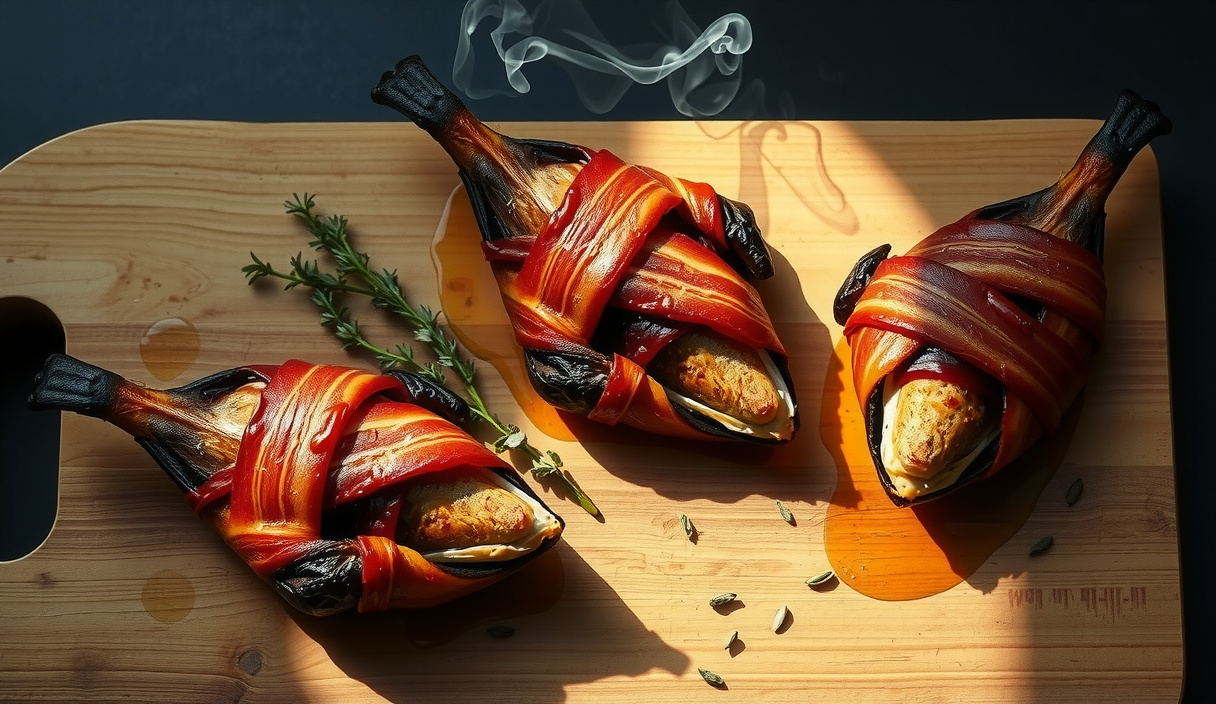
Smoked Bacon-Wrapped Quail
Whole semi-boneless quail wrapped in thin-cut bacon and smoked at 275°F over fruitwood until the bacon forms a shatteringly crisp Maillard crust and the bird inside hits a juicy 165°F internal. The bacon solves the lean-bird moisture problem by rendering fat directly onto the quail skin while building its own deep, caramelized layer of pork-smoke flavor. Plan on roughly 45 minutes active smoke time, then a critical five-minute rest.
Equipment
- 1 Smoker (offset, kamado, pellet, or kettle) Must hold a stable 275°F with convective airflow
- 1 Instant-read thermometer Non-negotiable for a bird this small — insert laterally into the thickest breast meat
- 1 Wire cooling rack set over a sheet pan For air-drying the quail before wrapping
- 8 toothpicks or 4 feet twine Toothpicks or butcher's twine To secure bacon overlap until rendering locks it in place
- 2 to 3 chunks or 1 cup chips Fruitwood chips or chunks (apple or cherry) Dry chunks preferred; soak chips only for charcoal setups prone to flare-ups
Ingredients
Quail
- 4 whole semi-boneless quail Fresh or fully thawed; about 4 to 5 oz each
- 8 slices thin-cut bacon Standard grocery thin-cut — not thick-cut, which will not render in time
Dry Rub
- 1 tsp kosher salt
- 1 tsp coarse black pepper
- 1 tsp smoked paprika
- 0.5 tsp garlic powder
- 0.25 tsp cayenne pepper Optional — omit for mild
- 0.5 tsp onion powder
Optional Compound Butter (for cavity)
- 2 tbsp unsalted butter Softened to room temperature
- 1 tsp fresh thyme leaves
- 0.5 tsp lemon zest

Instructions
Prep
- Pat each quail completely dry inside and out with paper towels. Set the birds breast-side up on a wire rack set over a sheet pan and refrigerate uncovered for 30 minutes. Removing surface moisture now is the single most important step for achieving crisp bacon — any residual water must evaporate before the bacon surface can exceed 212°F and begin the Maillard browning cascade.
- While the birds air-dry, combine the kosher salt, black pepper, smoked paprika, garlic powder, cayenne, and onion powder in a small bowl. Stir to combine evenly.1 tsp kosher salt, 1 tsp coarse black pepper, 1 tsp smoked paprika, 0.5 tsp garlic powder, 0.25 tsp cayenne pepper, 0.5 tsp onion powder
- Optional compound butter: Work the softened butter with the fresh thyme leaves and lemon zest until fully combined. Set aside at room temperature. If using, place a small teaspoon-sized knob inside each quail cavity before wrapping — it melts at cooking temperature and self-bastes the interior protein matrix throughout the cook.1 tsp fresh thyme leaves, 0.5 tsp lemon zest
- Remove the quail from the refrigerator. Apply the dry rub generously to the exterior skin of each bird — breast, back, legs, and wings. Because the bacon will seal the outside, this seasoning is trapped directly against the skin where it will bloom in the rendered fat. Do not season the bacon slices themselves.1 tsp kosher salt, 1 tsp coarse black pepper, 1 tsp smoked paprika, 0.5 tsp garlic powder, 0.25 tsp cayenne pepper, 0.5 tsp onion powder
- Lay two slices of thin-cut bacon flat on your work surface, overlapping them slightly in a cross or offset-stripe pattern. Place one seasoned quail breast-side down at the center. Pull the bacon slices up and around the bird, overlapping the ends on the breast side. Secure the overlap with two toothpicks or tie with a short length of butcher's twine. The bacon should be snug but not so tight that it compresses the breast — you want rendered fat to be able to circulate under the bacon layer during the cook. Repeat for all four birds.8 slices thin-cut bacon
Fire up the smoker
- Fire up your smoker and bring it to a stable 275°F. Allow at least 20 minutes for the temperature to fully stabilize with clean convective airflow before adding the birds. Add your fruitwood chunks or chips now — apple and cherry combust at temperatures that produce moderate phenolic concentrations (guaiacol and syringol), delivering a sweet, gentle smoke signature that complements rather than competes with quail's mild gamey iron notes. Ensure you are producing thin blue smoke, not thick white billowing smoke; the latter indicates incomplete combustion and will deposit acrid creosote on the food.
Smoke
- Place the bacon-wrapped quail breast-side up directly on the grate, spaced at least two inches apart on all sides for proper convective airflow. Do not crowd — stagnant steam trapped between birds delays bark development on the bacon and adds unpredictable time to the cook.8 slices thin-cut bacon
- Close the lid and smoke at 275°F without opening for the first 25 minutes. During this window the bacon surface is making contact with the grate on the underside and the chamber convective heat on the top, simultaneously developing a crust from both sides. Opening the lid during this phase releases accumulated smoke, drops the chamber temperature, and extends your cook time.
- At the 25-minute mark, insert your instant-read thermometer into the thickest part of the breast meat, angling the probe horizontally to avoid bone contact. A bone-contact reading will be artificially high — bone conducts heat faster than muscle. You are looking for 163°F as your pull temperature; carryover during the 5-minute rest will finish the work to 165°F. If the birds are below 155°F, close the lid and check every 5 minutes. Typical finish time is 40 to 50 minutes total at a true, stable 275°F.
- When the birds hit 163°F internal, remove them from the smoker immediately and transfer to a clean wire rack. The bacon should be deeply bronzed to mahogany — if it looks pale and flaccid at this temperature, see the failure-mode tip in the blog post above. Tent loosely with aluminum foil and rest for exactly 5 minutes. Do not skip the rest; carryover will bring the internal temperature to a safe 165°F while allowing the rendered liquid bacon fat to redistribute back into the quail skin rather than pooling on the cutting board when the bird is split.
Serve
- Remove toothpicks or twine. Serve each quail whole — they are finger food. The diner splits the bird by pressing down along the breastbone with both thumbs, opening it flat. The juices that run out at this point should be clear with a pink tinge from the smoke ring; this is normal and does not indicate undercooking. Pair with simple sides that do not compete: creamy grits, roasted root vegetables, or a sharp dressed arugula salad. A dry, bright red wine — Grenache or Zinfandel — or a cold lager works exceptionally well with the bacon-smoke-game flavor profile.
Notes
Why thin-cut bacon matters: Thin-cut bacon contains roughly 60–65% fat by weight in a β' crystal lattice that melts between 90°F and 110°F. At a 275°F chamber temperature, this fat transitions to liquid within the first 10 to 15 minutes and migrates toward the quail skin via capillary action. Thick-cut bacon requires a longer rendering window — often 60+ minutes at this temperature — which means the quail hits its safe internal temperature of 165°F before the bacon has released enough fat to crisp properly, leaving chewy, underrendered fat on a fully cooked bird.
Maillard onset and the bacon advantage: The Maillard reaction requires the surface temperature to exceed approximately 280°F (140°C) and a water activity (Aw) below 0.7 at the boundary layer. Bacon carries reducing sugars deposited during the curing process (predominantly glucose and fructose) and free amino acids from partial protein hydrolysis. These pre-loaded Maillard reactants mean browning initiates faster and at a lower total thermal energy input than unseasoned poultry skin. The pyrazines and heterocyclic volatiles generated contribute the characteristic deep, caramelized pork note that layers with the quail's iron-forward myoglobin character and the wood-derived phenolics from the smoke.
The actin collapse threshold: Quail breast muscle denatures sequentially: myosin heads unfold from 105–115°F, triggering the loss of raw translucency and a mild tightening of texture. Collagen in the connective tissue shrinks around 150–155°F. The danger zone is actin denaturation at 160–165°F, where the actomyosin complex undergoes violent longitudinal contraction and permanently destroys the protein matrix's water-holding capacity. This is why the pull temperature of 163°F with a 5-minute carryover rest is not optional — it threads the needle between the myosin-set texture and the actin-collapse desiccation zone above 170°F.
Wood phenolic chemistry: Apple and cherry wood contain high ratios of syringyl to guaiacyl lignin units. These combust at 275°F chamber temperatures to yield syringol-dominant smoke phenols, which have a softer, fruitier aromatic character compared to the harsher guaiacol spike of oak or hickory. The lighter phenolic signature allows the quail's inherent gamey compounds — primarily skatole, indole, and volatile fatty acids — to remain perceptible rather than being masked by aggressive smoke chemistry.
Nutrition
Calories: 420kcalCarbohydrates: 1.5gProtein: 38gFat: 29gSaturated Fat: 10gCholesterol: 155mgSodium: 820mgFiber: 0.2gSugar: 0.3g
Tried this recipe?Let us know how it was!