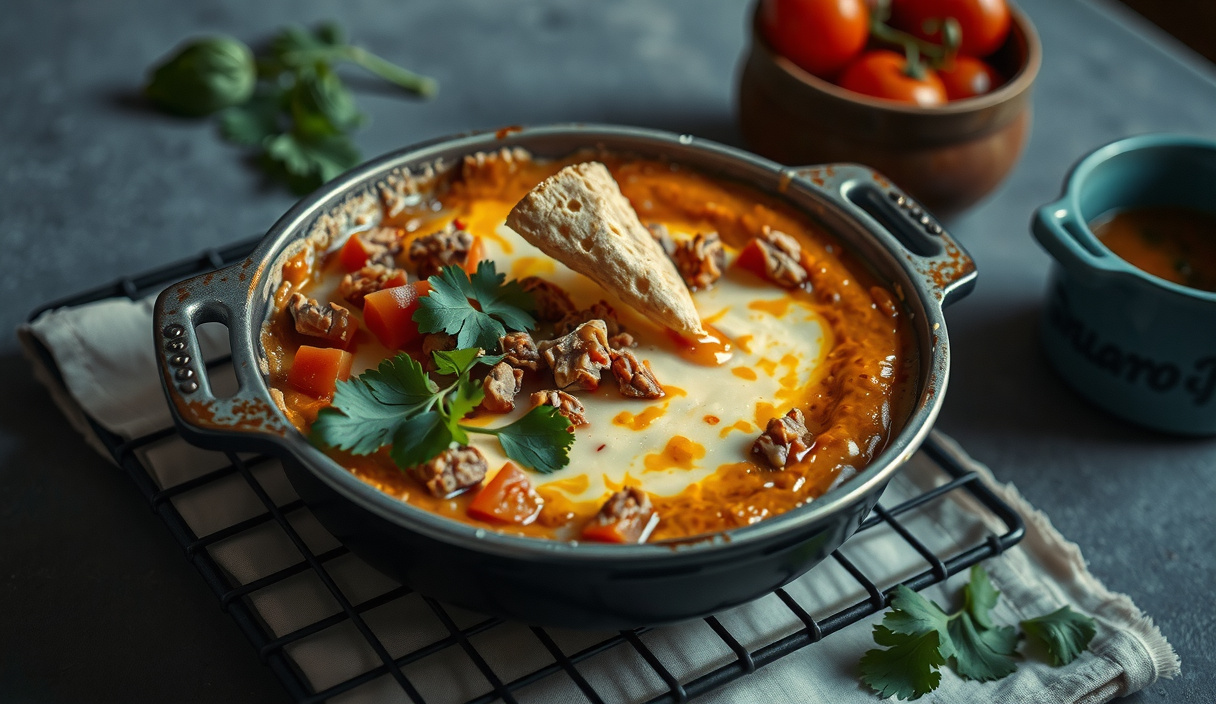
Smoked Queso Dip (Pellet Grill)
A deeply smoky, velvety queso dip built in a foil pan on a 250°F pellet grill. Velveeta's sodium-citrate chemistry keeps the emulsion stable for the full cook while hickory smoke slowly infuses the fat phase. Crumbled Mexican chorizo, Rotel tomatoes, and fresh cilantro finish the bowl.
Equipment
- 1 Pellet grill or offset smoker Set to 250°F indirect heat with hickory or pecan pellets
- 1 Half-size disposable aluminum foil pan 9x13-inch; thin gauge for even heat transfer
- 1 12-inch skillet For browning the chorizo before assembly
- 1 Instant-read thermometer Optional but useful for confirming grill stability at 250°F
- 1 Sturdy spoon or silicone spatula For the two mandatory stirs during the smoke
Ingredients
Queso base
- 1 lb Velveeta processed cheese Cut into 1-inch cubes; do not substitute natural cheese without adding sodium citrate
- 1 can (10 oz) Rotel Original Diced Tomatoes and Green Chiles Do not drain; the liquid is part of the emulsion
Chorizo layer
- 8 oz fresh Mexican chorizo Loose bulk or removed from casing; not Spanish cured chorizo
- 1 tbsp rendered chorizo fat Reserved from the skillet after browning; discard the rest
Aromatics and finish
- 1 small white onion Finely diced, about 1/3 cup
- 1 jalapeño fresh jalapeño Seeded and minced; leave seeds in for more heat
- 2 cloves garlic Minced
- 1 tsp ground cumin
- ½ tsp smoked paprika Optional; deepens the smoked note
- ¼ cup fresh cilantro leaves Roughly chopped; added after the pan comes off the grill
- 1 lime fresh lime Juiced; squeezed over the top off heat only
For serving
- 1 large bag tortilla chips

Instructions
Prepare the grill
- Fire up your pellet grill and set it to 250°F with hickory or pecan pellets loaded. Allow the grill to reach and stabilize at temperature for at least 10 minutes before you place the pan on the grates. You want thin blue smoke, not thick white smoke — thick white smoke indicates incomplete combustion and will deposit acrid compounds on your queso.
Brown the chorizo
- Heat a 12-inch skillet over medium-high heat. Add the fresh Mexican chorizo, breaking it up with a spoon as it cooks. Cook for 7 to 9 minutes until fully browned and crumbled. Drain into a strainer or blot with paper towels, reserving exactly 1 tablespoon of the rendered chorizo fat. Discard the rest. Fully cooking and draining the chorizo before assembly prevents an oily break in the queso during the long smoke.8 oz fresh Mexican chorizo, 1 tbsp rendered chorizo fat
Build the foil pan
- In the disposable foil pan, add the cubed Velveeta in an even layer. Pour the entire can of Rotel tomatoes and green chiles — liquid and all — directly over the cheese. Scatter the cooked chorizo crumbles and the reserved tablespoon of chorizo fat over the top.1 can (10 oz) Rotel Original Diced Tomatoes and Green Chiles, 8 oz fresh Mexican chorizo, 1 tbsp rendered chorizo fat
- Add the diced white onion, minced jalapeño, minced garlic, ground cumin, and smoked paprika (if using) across the surface. Do not stir at this point — you want the aromatics to bloom in the rising heat before being folded in.1 small white onion, 1 jalapeño fresh jalapeño, 2 cloves garlic, 1 tsp ground cumin, 1/2 tsp smoked paprika
Smoke the queso
- Place the loaded foil pan directly on the grill grates over indirect heat. Close the lid. Cook at 250°F for 30 minutes without disturbing the pan.
- At the 30-minute mark, open the grill and stir the queso thoroughly with a sturdy spoon, folding the melted edges into the center and scraping the bottom of the pan. The cheese should be mostly melted with a few soft lumps remaining. Close the lid and continue cooking.
- At the 50-minute mark, stir again. The queso should now be fully molten, smooth, and beginning to show a slight gloss on the surface from smoke deposition. If the mixture appears too thick, stir in 2 tablespoons of whole milk at this point to loosen it slightly. Close the lid for the final 10 minutes.
- At 60 minutes total, remove the pan from the grill. Do not continue smoking beyond this point — extended phenolic deposition on a dairy-fat surface becomes bitter past the 60-minute mark.
Finish and serve
- Immediately after removing the pan from the grill, squeeze the fresh lime juice over the surface and scatter the fresh cilantro on top. Both go on off heat only — volatile aromatics in fresh cilantro evaporate within 10 minutes at smoker temperatures, and lime juice reads brightest when its acidity hits the hot dip cold rather than cooking in.1/4 cup fresh cilantro leaves, 1 lime fresh lime
- Serve immediately with tortilla chips alongside. The queso will hold its emulsion and temperature for 20 to 25 minutes in the foil pan without any heat source. If guests are not ready, cover loosely with foil and keep in a 200°F oven for up to 30 minutes.1 large bag tortilla chips
Notes
Why Velveeta does not break: Natural cheeses break under sustained heat because calcium ions cross-link casein proteins into tight, greasy aggregates while the fat separates out. Velveeta contains approximately 2–3% sodium citrate (w/w), a chelating sequestrant that strips calcium from casein micelles before they can clump. The liberated casein acts as an amphiphilic emulsifier instead, holding fat and water in a stable oil-in-water dispersion. At 250°F for 60 minutes, the emulsion remains intact. If you ever want to replicate this stability with natural cheese, dissolve 14 grams of food-grade sodium citrate in 2 tablespoons of water per pound of cheese before melting.
How smoke integrates at this temperature: At 250°F, the surface of the queso is a high-fat, high-moisture target for smoke aerosol. The primary flavor-active phenolics in wood smoke — guaiacol and syringol — are lipophilic; they partition strongly into the cheese fat phase, which buffers their release during eating into a slow, layered finish rather than a sharp front-loaded smoked hit. Hickory produces more guaiacol (meaty, bacon-like) while pecan produces more syringol (subtly sweet, slightly floral). This is why the wood choice matters for this application even at low temperature exposure.
The Rotel pH effect: The diced tomatoes and green chiles in Rotel lower the pH of the queso system from roughly 5.8 to approximately 4.5–5.0 — nudging the casein closer to its isoelectric point. Counterintuitively this slightly tightens the emulsion texture and increases viscosity, making the finished dip clingy on a chip rather than runny. It is a useful physical consequence of an ingredient that is primarily there for flavor and heat.
Hold temperature for service: Queso held below 145°F will begin to thicken and eventually set as the fat phase partially crystallizes. If you are serving over an extended period, a slow cooker set to low (approximately 190°F) will hold the queso in a pourable state for up to 2 hours without breaking the emulsion, though further smoke will not develop. Stir every 20 minutes during the hold to maintain uniformity.
Nutrition
Calories: 185kcalCarbohydrates: 5gProtein: 10gFat: 14gSaturated Fat: 6gCholesterol: 38mgSodium: 620mgFiber: 0.5gSugar: 3g
Tried this recipe?Let us know how it was!