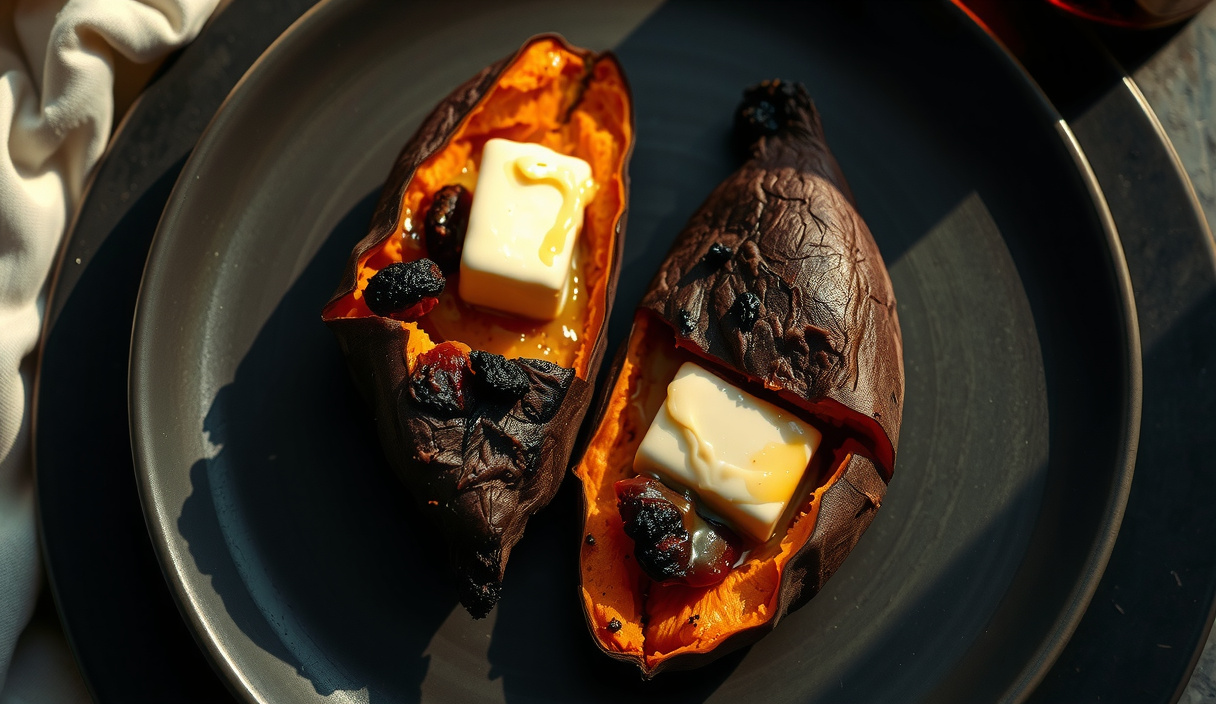
Smoked Sweet Potatoes with Brown Sugar Bourbon Butter

Whole sweet potatoes cooked low-and-slow at 250°F over cherry wood, where native β-amylase enzymes convert starch to maltose sugar for extreme natural sweetness. Split and finished with a compound butter of dark brown sugar, wheated bourbon, and salted butter that melts into the smoking-hot flesh — simple, technique-driven, and dramatically better than anything you have made in an oven.
Equipment
- 1 Smoker or covered kettle grill Set up for indirect heat, target 250°F chamber temperature
- 2-3 Cherry or apple wood chunks Soaking optional; chunks preferred over chips for longer burn
- 1 Leave-in probe thermometer Critical for monitoring internal temperature through the β-amylase window
- 1 Small mixing bowl For the compound butter
- 1 Fork or stand mixer For whipping the compound butter
Ingredients
Sweet Potatoes
- 4 medium sweet potatoes (Garnet or Jewel variety, 6–8 oz each) Uniform size is important — avoid large potatoes
- 1 tablespoon neutral oil (avocado or vegetable) For rubbing the skin
- 1 teaspoon kosher salt For the skin
Brown Sugar Bourbon Butter
- 6 tablespoons unsalted butter Room temperature — not melted
- 3 tablespoons dark brown sugar Packed; dark brown preferred for higher molasses content
- 2 tablespoons wheated bourbon Maker's Mark, Weller, or equivalent; high-rye bourbons compete with sweetness
- ½ teaspoon fine sea salt
- ¼ teaspoon ground cinnamon Optional but recommended
- ⅛ teaspoon cayenne pepper Optional — adds a TRPV1 chemesthetic counterpoint to the sweetness

Instructions
Prepare the Smoker
- Set up your smoker or kettle grill for indirect cooking. Target a stable 250°F chamber temperature. For a charcoal kettle, bank coals to one side and place 2 to 3 cherry or apple wood chunks directly on the coals. For a pellet grill, load with fruit-wood pellets and set to 250°F. Allow the smoker to fully stabilize at temperature before loading the potatoes — rushing this step causes temperature spikes that shorten the β-amylase enzymatic window.
Prep the Sweet Potatoes
- Scrub the sweet potatoes thoroughly under cold water and dry completely. Rub each potato all over with a thin film of neutral oil, then sprinkle with kosher salt on all surfaces. The oil helps the skin crisp and promotes the surface Maillard reaction during smoking. Do not pierce the potatoes — keeping the skin intact traps internal steam, which supports creamy interior texture.1 tablespoon neutral oil (avocado or vegetable), 1 teaspoon kosher salt
Make the Bourbon Butter
- In a small bowl, combine the room-temperature butter, dark brown sugar, bourbon, fine sea salt, cinnamon (if using), and cayenne (if using). Beat with a fork until fully integrated into a smooth, cohesive compound butter — this takes about 2 minutes. The mixture should look like a pale brown paste with no visible separation. If the butter is too cold and won't incorporate, let it sit at room temperature 10 more minutes and try again. Do not melt the butter — a melted butter mixture will pool and separate rather than forming a proper compound.6 tablespoons unsalted butter, 3 tablespoons dark brown sugar, 2 tablespoons wheated bourbon, 1/2 teaspoon fine sea salt, 1/4 teaspoon ground cinnamon, 1/8 teaspoon cayenne pepper
- Transfer the compound butter onto a sheet of plastic wrap or parchment, roll into a log, and refrigerate until ready to use. Remove from the refrigerator 15 minutes before the potatoes come off the smoker so it softens slightly.6 tablespoons unsalted butter, 3 tablespoons dark brown sugar, 2 tablespoons wheated bourbon, 1/2 teaspoon fine sea salt, 1/4 teaspoon ground cinnamon, 1/8 teaspoon cayenne pepper
Smoke the Sweet Potatoes
- Place the oiled, salted sweet potatoes directly on the grate in the indirect heat zone, with at least 1 inch of space between each potato for full smoke airflow. Insert a leave-in probe thermometer into the thickest part of the largest potato. Close the lid.1 tablespoon neutral oil (avocado or vegetable), 1 teaspoon kosher salt
- Smoke at 250°F for approximately 85 to 95 minutes, maintaining the temperature as steadily as possible. Watch the probe: between 135°F and 170°F internal, β-amylase is actively converting starch to maltose — this is the enzymatic sweet spot. Do not interrupt this phase by lifting the lid or spiking the temperature. The potato will spend roughly 45 to 60 minutes climbing through this window at 250°F.
- Continue smoking until the internal temperature reaches 205°F to 210°F. At this point, the starches are fully gelatinized and the flesh will be completely creamy and soft when probed. The skin should be wrinkled, slightly leathery, and deeply colored — this is correct. Remove the potatoes from the smoker.
Rest, Split, and Finish
- Rest the smoked sweet potatoes on a cutting board for 5 minutes before splitting. This allows internal vapor pressure to equilibrate, preventing volatile aromatics from blowing off the surface in a rush of steam at service.
- Using a sharp knife, split each potato lengthwise, cutting about three-quarters of the way through. Gently press the ends toward each other to open the split and fluff the interior flesh with a fork. The flesh should be visibly glistening, deeply amber-colored, and pull apart easily into creamy strands.
- While the potatoes are still blazing hot, place a generous tablespoon and a half of the bourbon brown sugar compound butter directly into the split of each potato. The residual heat of the flesh — 175°F to 190°F at the surface — will melt the butter, create a brief Maillard reaction from the brown sugar contacting the hot flesh, and volatilize the bourbon esters into the air. Serve immediately.6 tablespoons unsalted butter, 3 tablespoons dark brown sugar, 2 tablespoons wheated bourbon, 1/2 teaspoon fine sea salt, 1/4 teaspoon ground cinnamon, 1/8 teaspoon cayenne pepper
Notes
Why 250°F and not higher? β-amylase — the starch-splitting enzyme native to sweet potato flesh — operates optimally between 135°F and 170°F internal temperature and is irreversibly denatured above approximately 175°F. At 250°F chamber temperature, the potato interior spends roughly 45 to 60 minutes climbing through this enzymatic window. At 400°F, that time collapses to 20 to 25 minutes. Less time in the window = less maltose generated = measurably less sweetness. The 250°F target is not arbitrary; it is the rate-limiting step for enzymatic sugar production.
The β-amylase mechanism in detail: β-amylase is an exo-acting enzyme that hydrolyzes alternating α-1,4 glycosidic bonds from the non-reducing ends of amylopectin and amylose chains, releasing maltose disaccharides as its primary product. Each maltose unit is roughly twice as sweet-tasting as the glucose released by α-amylase. Extended time in the 135–170°F window means substantially more maltose accumulation in the interstitial fluid of the potato tissue, which is the biochemical explanation for why a properly smoked sweet potato tastes dramatically sweeter than a conventionally baked one despite containing the same starting carbohydrate load.
Smoke chemistry: Cherry and apple wood combustion produces lignin-pyrolysis volatiles dominated by syringol-group and guaiacol-group phenolics (4-methylguaiacol, isoeugenol, syringaldehyde). These compounds bind to the potato skin surface via hydrophobic adsorption and penetrate the outer 5 to 8mm of flesh. Their flavor character is fruity-smoky with low bitterness — a profile that amplifies rather than competes with the maltose-sweetness of the interior.
Bourbon butter science: The fat phase of the compound butter acts as a thermodynamic solvent for the lipophilic aroma compounds of both the bourbon (ethyl esters, higher alcohols) and the smoke (phenolic VOCs). Fat sequestration slows volatilization, extending aromatic persistence from a brief flash to a sustained release across the duration of eating. Dark brown sugar (higher molasses fraction) contains free reducing sugars (glucose, fructose) that react with the potato's surface amino acids in a short, high-temperature Maillard pulse when the butter contacts the 175–190°F flesh surface, generating additional pyrazine and furanic aromatics that deepen the overall flavor architecture.
Nutrition
Calories: 380kcalCarbohydrates: 52gProtein: 4gFat: 17gSaturated Fat: 10gCholesterol: 45mgSodium: 420mgFiber: 6gSugar: 22g
Tried this recipe?Let us know how it was!