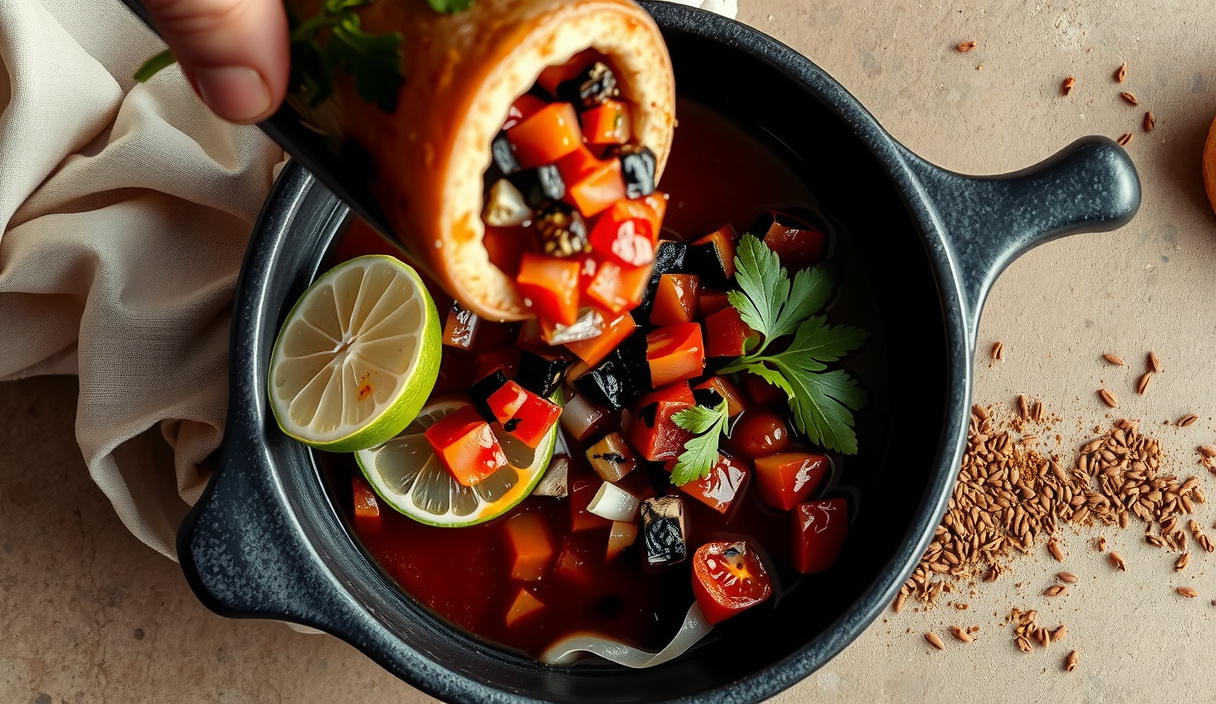
Smoked Tomato Salsa Asada — Charred Vegetable

Roma tomatoes, jalapeño, white onion, and garlic are cold-smoked at 350°F for 30 minutes to adsorb guaiacol and syringol phenolics from the wood, then direct-flame charred for 2 minutes to drive Maillard-derived pyrazine formation. Blended with fresh lime juice, cilantro, and toasted cumin, the result is a deeply layered salsa asada with irreplaceable char complexity. Where Flavor Meets the Flame.
Equipment
- 1 Smoker or covered charcoal grill Maintain 350°F. Use 1 oak or pecan wood chunk for moderate phenolic smoke.
- 1 Long tongs For rotating vegetables over direct flame safely.
- 1 Blender or food processor A standard countertop blender gives the best texture control. Immersion blenders work but provide less chunky control.
- 1 Dry skillet For toasting whole cumin seeds before grinding.
- 1 Spice grinder or mortar and pestle Grind toasted cumin immediately before using.
- 1 Rimmed baking sheet or cast-iron grate To hold vegetables in the smoker without losing them through grill grates.
Ingredients
Vegetables for smoking and charring
- 6 medium Roma tomatoes Firm and ripe, uncut, approximately 1.5 lb total
- 2 medium jalapeños Green or red; red jalapeños preferred for deeper Maillard flavor and higher sugar content
- 1 medium white onion Halved through the root, skin left on
- 6 cloves garlic Unpeeled — the skin protects moisture during the smoke and char phase
Seasoning and finish
- 3 tablespoons fresh lime juice From approximately 2 limes; add more to taste at the end
- 1 cup fresh cilantro leaves and tender stems Loosely packed; increase or omit to preference
- 1 teaspoon whole cumin seeds Toasted and ground fresh immediately before use
- 1 teaspoon Diamond Crystal kosher salt Added only after blending; adjust to taste

Instructions
Prepare the smoker
- Fire your smoker or set up your grill for indirect heat at 350°F. Add one fist-sized chunk of oak, pecan, or mesquite wood directly to the heat source. Allow the smoker to reach temperature and for the initial thick white smoke to transition to thin blue smoke — this takes 10–15 minutes. Thick white smoke contains excess moisture and incomplete combustion products that will make the salsa taste bitter and acrid.
Toast and grind the cumin
- Place a dry skillet over medium heat. Add the whole cumin seeds and toast, shaking the pan constantly, until they begin to pop and release a warm, earthy aroma — approximately 2 to 3 minutes. Immediately transfer to a spice grinder or mortar and pestle and grind to a fine powder. Set aside. Do not grind in advance; the volatile terpenes (cuminaldehyde, carvacrol) that define cumin's aroma oxidize within minutes of grinding.1 teaspoon whole cumin seeds
Smoke the vegetables
- Arrange the Roma tomatoes, jalapeños, white onion halves (cut-side down), and unpeeled garlic cloves on the smoker grate or a rimmed baking sheet placed in the indirect heat zone. Close the lid and smoke at 350°F for 30 minutes. Do not lift the lid during this phase — every lid-lift drops the temperature by 25–50°F and bleeds the smoke atmosphere. After 30 minutes, the tomato skins will have tightened and begun to crack, the onion will show grill marks on the cut face, and the jalapeños will have softened and changed color slightly.2 medium jalapeños, 1 medium white onion, 6 cloves garlic
Direct-flame char
- Transfer the smoked vegetables to a direct heat source — the hot zone of your grill, a gas burner set to high, or directly over the coals. Using long tongs, char each vegetable for a total of 2 minutes, rotating every 30 seconds. Target 40–60% blackened skin surface on the tomatoes and jalapeños. The onion cut-face should be deeply charred and caramelized. The garlic skin will char and smoke — that is correct. Pull everything off heat immediately once the target char level is reached. Do not char beyond 2 minutes total; this is the window where pyrazine formation peaks without crossing into acrolein accumulation.2 medium jalapeños, 1 medium white onion, 6 cloves garlic
Blend the salsa
- Allow the charred vegetables to rest for 5 minutes — they will be extremely hot and will cause pressure to build in a sealed blender. Do not remove the charred skin from the tomatoes or jalapeños. Squeeze the softened garlic cloves out of their charred skins directly into the blender jar and discard the skins. Add the charred tomatoes whole, the jalapeños (stem removed; keep the seeds for full heat), and the onion quarters. Add the lime juice and fresh cilantro.6 cloves garlic, 2 medium jalapeños, 1 medium white onion, 1 cup fresh cilantro leaves and tender stems, 3 tablespoons fresh lime juice
- Pulse the blender 8 to 10 times in 1-second bursts. Check the texture after each pulse. The target is a medium-chunky consistency where identifiable pieces of tomato and jalapeño are still visible but the salsa pours easily. Do not blend continuously — continuous blending fully homogenizes the cell structure and produces a thin, smooth, restaurant-style salsa rather than the more textured home-style version. If you prefer smooth, blend for 20–30 continuous seconds.
Season and rest
- Transfer the blended salsa to a bowl or storage jar. Add the ground toasted cumin and kosher salt. Stir to combine. Taste and adjust: more lime juice if the acid balance feels flat, more salt if the smoke character is muted (salt amplifies aroma perception via sodium-ion enhancement of taste receptor sensitivity), more cilantro if you want the green herbal contrast against the char.1 teaspoon whole cumin seeds, 1 teaspoon Diamond Crystal kosher salt
- Rest the salsa uncovered at room temperature for 20 minutes before serving. During this rest, the volatile partition equilibrium between the aqueous and minimal lipid phases stabilizes, and the Maillard-derived compounds continue to react slowly with the organic acids in the lime juice, building additional ester complexity. The salsa will taste noticeably more cohesive and rounded after the rest than it does immediately out of the blender. Serve with warm tortilla chips, as a taco topping, or alongside grilled meats.
Notes
Why two heat stages? The smoker phase (350°F, 30 min) adsorbs guaiacol and syringol phenolics from wood combustion into the moist tomato surface — these are the campfire-sweet smoke notes. Surface water activity stays above 0.8 during this phase, allowing phenolics to dissolve into the surface moisture film rather than just coating it. The direct-flame char phase (2 min, very high heat) pushes local surface temperatures above 400°F, which is where the Maillard cascade shifts from producing gentle caramel-like compounds to producing heterocyclic pyrazines (2-methylpyrazine, 2,3-dimethylpyrazine) — the roasted, nutty, earthy compounds that define salsa asada. These two volatile classes (phenolics + pyrazines) are chemically distinct and neither can produce the other; you need both heat stages to build both layers.
Why 40–60% char coverage? Below 30% surface blackening, pyrazine concentrations are too low to register distinctly against the tomato's fruit character. Above 70%, the carbonization reaction generates acrolein (a reactive aldehyde) and polycyclic aromatics that push the bitter threshold over the flavor contribution of the guaiacol-pyrazine balance. The 40–60% window is where the char compounds contribute complexity without dominance.
Why season after blending? Salt added to raw tomatoes before smoking initiates osmotic moisture loss via the Van't Hoff equation. The resulting surface dehydration tightens the tomato skin prematurely, physically blocking smoke compound adsorption into the surface moisture film. Delaying salt addition until after blending preserves the maximum uptake window for phenolic smoke compounds during the cooking phase.
Why keep jalapeño seeds? Capsaicin is concentrated in the placental tissue adjacent to the seeds, not the seeds themselves — but the seeds carry green leaf volatiles (Z-3-hexenal, hexanol) that contribute an important vegetal counterpoint to the char. Removing seeds drops the heat by roughly 20–30% and mutes the vegetal freshness that prevents the salsa from reading as purely smoky and one-dimensional. If heat sensitivity is a concern, remove seeds from one jalapeño and keep one intact.
Nutrition
Calories: 28kcalCarbohydrates: 6.2gProtein: 1.1gFat: 0.3gSodium: 198mgFiber: 1.4gSugar: 3.8g
Tried this recipe?Let us know how it was!