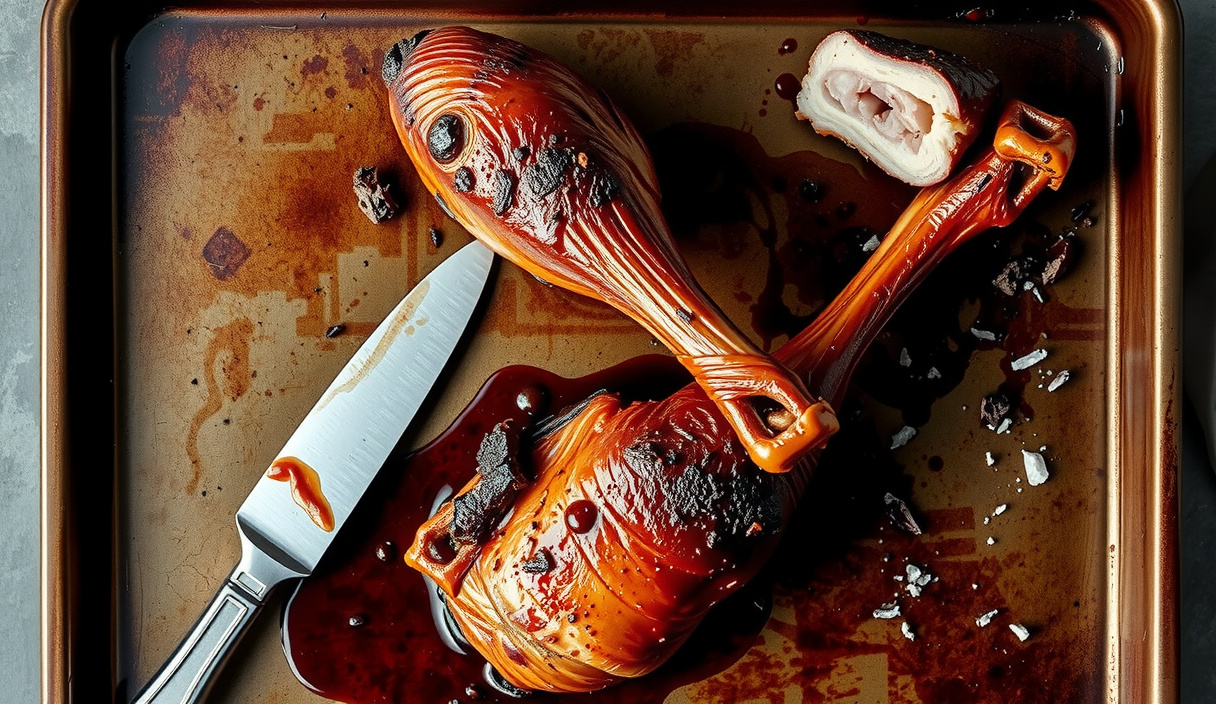
Smoked Turkey Legs — State-Fair Style
Massive, mahogany-barked turkey legs brined 24 hours in a pink-cure salt solution for authentic cured color and hammy depth, then smoked low and slow at 275°F until the collagen converts and the interior hits 175°F. Dense, smoky, gloriously sticky — exactly what you remember from the fair.
Equipment
- 1 Offset smoker, kettle grill, or pellet smoker Must hold a steady 275°F chamber temperature
- 1 Instant-read or leave-in probe thermometer Calibrated; pull target is 175°F
- 1 Large food-safe brining vessel or zip-lock bag Must fully submerge all four legs
- 1 Wire cooling rack set over a sheet pan For pellicle formation in the refrigerator
- 4 Cherry wood chunks Fist-sized chunks, not chips
- 2 Hickory wood chunks Fist-sized chunks; 2:1 cherry-to-hickory ratio
Ingredients
Brine
- 1 gallon cold water Divided: use 1 quart hot to dissolve salts, add 3 quarts ice cold
- ½ cup Diamond Crystal kosher salt About 120g by weight; reduce to 1/3 cup if using Morton kosher
- ¼ cup granulated white sugar
- 1 teaspoon Prague Powder #1 (Pink Curing Salt #1) 6.25% sodium nitrite; do not substitute or exceed this dose for 4 legs (~3.5 lbs total)
- 1 tablespoon black peppercorns Lightly cracked
- 4 cloves garlic Smashed
- 2 sprigs fresh thyme
- 2 bay leaves
Turkey
- 4 turkey legs 12–16 oz each; not pre-injected or pre-brined
Dry Rub
- 2 teaspoons coarse black pepper
- 1 teaspoon garlic powder
- 1 teaspoon onion powder
- 1 teaspoon smoked paprika
- ½ teaspoon cayenne pepper Optional; adds heat without obscuring the cured flavor

Instructions
Brine
- Combine 1 quart of hot water with the kosher salt, sugar, and Prague Powder #1 in a large pot. Stir until completely dissolved — undissolved nitrite creates uneven curing. Add the peppercorns, garlic, thyme, and bay leaves. Pour in the remaining 3 quarts of cold water. The brine must be fully cold before the meat goes in; warm brine starts surface cooking and raises food-safety risk.1/2 cup Diamond Crystal kosher salt, 1/4 cup granulated white sugar, 1 teaspoon Prague Powder #1 (Pink Curing Salt #1), 1 tablespoon black peppercorns, 4 cloves garlic, 2 sprigs fresh thyme, 2 bay leaves
- Submerge the turkey legs completely in the cold brine. Use a plate or zip-lock bag filled with water as a weight if needed. Refrigerate for 24 hours. Do not go shorter — nitrite diffusion into the thickest part of the drumstick needs the full time. Do not go longer than 36 hours or the legs will be noticeably salty.4 turkey legs
Pellicle Formation
- Remove the legs from the brine. Rinse briefly under cold water and pat completely dry with paper towels. Place on a wire rack set over a sheet pan — do not stack. Return to the refrigerator uncovered for 1 to 2 hours. The surface will transition from glistening to tacky and slightly matte. This is the pellicle: a dried protein-rich surface layer that smoke adheres to and on which the Maillard reaction fires properly. Skipping this step results in a steamed, pale exterior no matter how long you smoke.4 turkey legs
Rub and Fire Up
- Mix the black pepper, garlic powder, onion powder, smoked paprika, and cayenne in a small bowl. Apply the rub all over the legs immediately before they go into the smoker — the tacky pellicle surface holds it without needing oil. Preheat your smoker to a stable 275°F. Add 4 cherry chunks and 2 hickory chunks to the fire box or ash pan.2 teaspoons coarse black pepper, 1 teaspoon garlic powder, 1 teaspoon onion powder, 1 teaspoon smoked paprika, 1/2 teaspoon cayenne pepper
Smoke
- Place the legs directly on the grate with at least 1 inch of clearance between them. Insert a probe thermometer into the thickest part of the largest leg, not touching bone. Close the smoker and maintain 275°F chamber temperature throughout. Add wood chunks every 45–60 minutes as needed to maintain a thin blue smoke — thick white billowing smoke produces acrid, over-smoked bark.4 turkey legs
- Expect a stall between 155–160°F internal where the temperature plateaus for 20–35 minutes. This is evaporative cooling at the surface — surface moisture absorbs heat as fast as the smoker delivers it, locking the boundary layer at 212°F. Hold temperature, resist the urge to foil (foiling steams the bark soft), and wait it out. The stall breaks when the surface fully dries and evaporative cooling ceases.
- Pull the legs when the internal temperature reads 175°F at the thickest point. Total smoke time at 275°F is typically 2.5 to 3.5 hours depending on leg size and smoker airflow. The exterior should be deep mahogany, the bark set firm and dry. The interior will be distinctly pink — this is correct and expected from the nitrite cure.4 turkey legs
Rest and Serve
- Transfer the legs to a clean board or platter. Tent loosely with aluminum foil and rest for 15 minutes. During the rest, the gelatin generated by collagen hydrolysis redistributes through the muscle matrix, firming the texture and sealing in juiciness. Cutting immediately releases a significant portion of this moisture. Serve directly — no sauce required, though a thin apple cider vinegar mop on the side complements the smoke and cured salt without competing with them.4 turkey legs
Notes
Why the pink color is safe and intentional: Prague Powder #1 donates sodium nitrite (NaNO₂) ions that react with myoglobin in the muscle to form nitrosomyoglobin — a thermally stable pigment that remains pink through temperatures well above 175°F. This is identical chemistry to deli ham, hot dogs, and corned beef. The USDA validates pink-cure salt use at 1 oz per 25 lbs of meat (approximately 1 tsp per 5 lbs) as safe and effective. Do not interpret the pink interior as undercooked meat; verify doneness only with a calibrated probe thermometer reading 175°F.
Collagen hydrolysis window: Type I collagen in turkey drumsticks begins thermal shrinkage at 60–65°F, expelling fluid. The actual hydrolysis of collagen triple-helix cross-links into soluble gelatin is a first-order kinetic process that accelerates sharply above 160°F. Pulling at 175°F and resting for 15 minutes allows sufficient gelatin to redeposit within the muscle fiber bundles, creating the dense, slightly sticky interior texture characteristic of state-fair legs. Pulling at 165°F (the minimum USDA safe temperature for poultry) leaves collagen under-converted and the texture noticeably tougher.
Maillard onset and the pellicle: Maillard browning on the bark requires surface temperatures well above 212°F — impossible while surface moisture evaporates and holds the boundary layer at the boiling point of water. The pellicle step removes this evaporative barrier. Once the surface is dry, the first 30–45 minutes of 275°F smoke rapidly pushes the exterior past the Maillard activation threshold, building the mahogany bark that seals in juices and delivers the characteristic state-fair crust.
Wood smoke chemistry: Cherry wood combustion produces lower-molecular-weight phenolics (catechol, methylcatechol) with a mild, fruity aromatic character. Hickory produces heavier syringol and guaiacol derivatives — the dominant VOCs in the "classic" BBQ smoke fingerprint. At a 2:1 cherry-to-hickory ratio by wood volume, the lighter phenolics prevent the hickory from pushing into acrid territory while the hickory provides the assertive smoky backbone appropriate for fair-style legs.
Nutrition
Calories: 520kcalCarbohydrates: 3gProtein: 68gFat: 24gSaturated Fat: 7gCholesterol: 245mgSodium: 1280mgSugar: 2g
Tried this recipe?Let us know how it was!