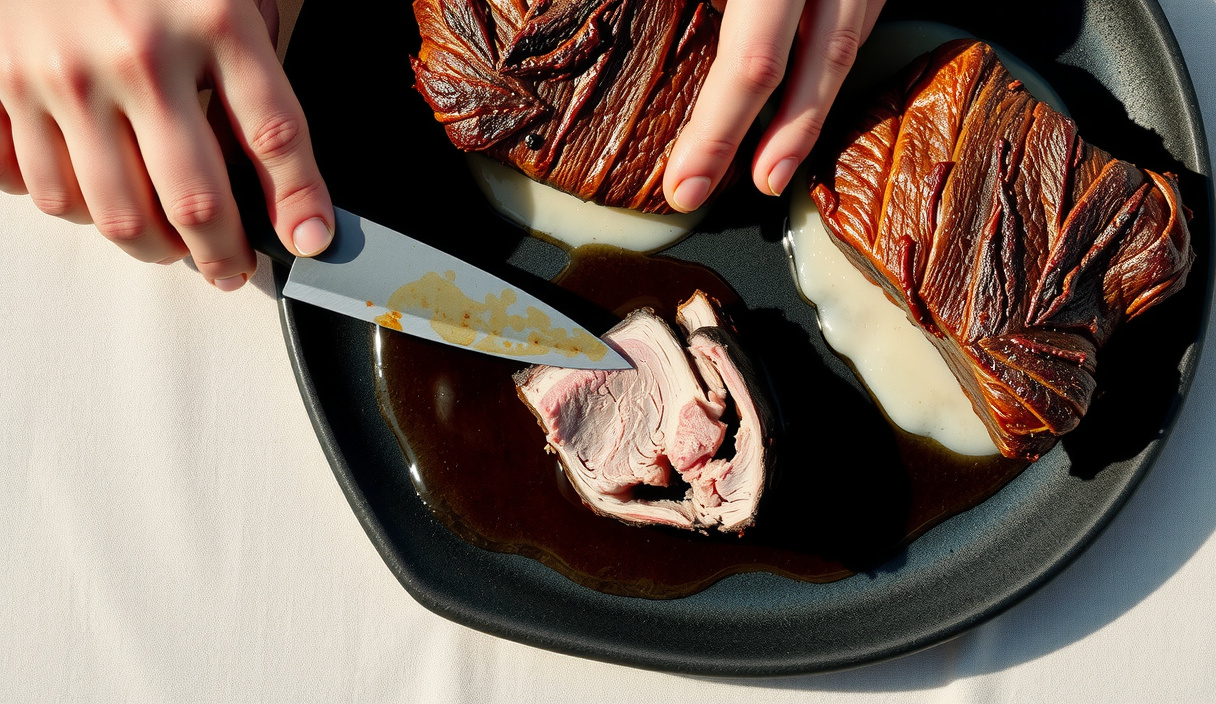
Sous Vide Smoked Beef Cheeks
Beef cheeks sous vide at 165°F for 36 hours converts their extraordinary collagen load into silky, lip-coating gelatin without crossing the actin-denaturation threshold that dries out muscle tissue. A 90-minute smoke finish at 250°F deposits oak phenolics on the dry surface and builds a genuine bark layer. The result is a cut that eats like the most tender brisket you have ever had, with a gelatin richness that no quick-cook method can replicate.
Equipment
- 1 Immersion circulator Must hold temperature within ±1°F. Verify with calibrated probe before loading.
- 1 Vacuum sealer and bags Channel-style minimum; chamber sealer preferred for a 36-hour cook. Avoid zipper-lock bags.
- 1 Large sous vide vessel or hotel pan Minimum 12-quart capacity. Cover with plastic wrap or a lid to minimize evaporation over 36 hours.
- 1 Offset smoker or kettle smoker Must hold a stable 250°F. A pellet grill set to 250°F with oak pellets is an acceptable substitute.
- 1 Calibrated probe thermometer For verifying bath temperature and smoker chamber temperature independently.
- 1 Boning knife For silver-skin removal. Must be sharp — dull knives tear fascia rather than cutting cleanly.
- 3 to 4 Oak wood chunks Post oak or white oak. Soak-free — dry chunks produce more consistent, less steamy smoke.
Ingredients
Beef Cheeks
- 2 whole beef cheeks (masseter muscle), 12–16 oz each trimmed weight Source from a butcher when possible. Look for the defined cheek muscle, not adjacent cheek meat.
- 1 tbsp Diamond Crystal kosher salt Use 2 tsp if substituting Morton kosher salt. Do not use iodized table salt.
- 1 tsp coarsely ground black pepper 16-mesh preferred. Coarse grind survives the long bath without going bitter.
- 1 tsp garlic powder Optional. Adds Maillard-reactive precursors to the bark layer.
- 1 tsp smoked paprika Optional. Adds pigment and a light phenolic backbone to the crust.
Bag Liquid Sauce (from reserved cook liquid)
- 1 cup reserved bag liquid from sous vide cook Strain through fine-mesh strainer. Will be deeply gelatinous when cold.
- 2 tbsp unsalted butter, cold and cubed For finishing. Add off-heat to prevent breaking the emulsion.
- 1 tsp red wine vinegar or fresh lemon juice Optional acid finish to balance the richness of the reduced gelatin sauce.

Instructions
Trim and Dry-Brine (12–24 hours before cook)
- Place each beef cheek on a cutting board. Locate all silver-skin — the pearlescent, opaque connective tissue fascia on the surface of the muscle. Using a sharp boning knife angled nearly flat against the meat, slide the blade under the membrane while pulling it taut with your off hand. Remove all silver-skin completely. This is not optional: fascia is a poor thermal conductor and its presence creates an uneven heat-transfer gradient through the cheek, compromising collagen conversion uniformity during the 36-hour bath.
- Combine the kosher salt, black pepper, garlic powder, and smoked paprika in a small bowl and mix to combine. Season each cheek liberally on all exposed surfaces. Place the seasoned cheeks on a wire rack set over a rimmed baking sheet and refrigerate, uncovered, for 12 to 24 hours. The dry-brine draws surface moisture out via osmosis, then allows it to be reabsorbed carrying dissolved salt deeper into the muscle fibers, increasing intracellular ionic strength and Water-Holding Capacity during the long bath.1 tbsp Diamond Crystal kosher salt, 1 tsp coarsely ground black pepper, 1 tsp garlic powder, 1 tsp smoked paprika
Sous Vide (36 hours at 165°F / 74°C)
- Set your immersion circulator to 165°F (74°C). Verify the temperature with a calibrated probe thermometer independently of the circulator's display — do not proceed until the bath is confirmed at 165°F. Cover the vessel with plastic wrap or a lid to minimize evaporation over the long cook.
- Vacuum-seal each beef cheek in a separate bag, or place both in one large bag ensuring they are not stacked directly on top of each other — water must be able to circulate between them. If using a chamber sealer, seal at full vacuum. If using a channel-style sealer, seal at the highest available vacuum setting. Submerge the sealed bags in the preheated bath and clip or weight them so they remain fully submerged. Cook at 165°F for exactly 36 hours. Do not open the vessel repeatedly. At this temperature, full pasteurization is achieved within 90 minutes of the cheek core reaching bath temperature; the remaining 34-plus hours are dedicated to collagen hydrolysis.
- When the 36-hour cook is complete, remove the bags from the bath. If not smoking immediately, transfer the still-sealed bags to an ice bath (50% ice, 50% water) and chill for 45 minutes to bring the core temperature below 40°F (4°C) quickly, then refrigerate for up to 5 days. When ready to smoke, reheat the sealed bags in a 140°F (60°C) bath for 45 minutes before proceeding to the smoke finish.
Smoke Finish (90 minutes at 250°F / 121°C)
- Prepare your smoker and bring it to a stable 250°F (121°C). Add 3 to 4 dry oak wood chunks to the firebox or over coals. You are looking for thin blue smoke — not billowing white smoke, which indicates incomplete combustion and will deposit bitter creosote on the surface.
- Open each bag carefully over a bowl, reserving every drop of the bag liquid. This gelatinous liquid is your sauce base. Remove the cheeks and pat every surface completely dry with paper towels — work quickly and thoroughly. Residual bag liquid on the surface will suppress the surface temperature, delay Maillard onset, and produce a gray, steamed exterior instead of bark. Do not rinse the cheeks.1 cup reserved bag liquid from sous vide cook
- Place the patted-dry cheeks directly on the smoker grate, leaving at least 2 inches between them for airflow. Smoke at 250°F for 90 minutes, resisting the urge to open the smoker more than once. The exterior will develop a deep mahogany to near-black bark as oak phenolics (primarily guaiacol and syringol) deposit and polymerize on the tacky, drying surface. Internal temperature is not the target here — bark formation is.
- Remove the cheeks from the smoker. Tent loosely with aluminum foil and rest for 15 minutes before slicing. This allows dissolved gelatin within the muscle to redistribute and partially re-set, giving you a sliceable rather than collapsing result. Slice against the grain for plated service, or shred for tacos.
Bag Liquid Sauce
- Pour the reserved bag liquid through a fine-mesh strainer into a small saucepan. Skim any visible fat from the surface. Bring to a simmer over medium heat and reduce by half — the liquid will visibly thicken as water evaporates and gelatin concentration increases. Taste for seasoning; it will likely need very little salt.1 cup reserved bag liquid from sous vide cook
- Remove the pan from heat. Add the cold, cubed butter one piece at a time, swirling the pan to emulsify each cube before adding the next. Do not return to a boil after butter has been added — this will break the emulsion. Finish with a few drops of red wine vinegar or lemon juice to balance the richness. Serve the sauce alongside or spooned over the sliced cheeks.1 cup reserved bag liquid from sous vide cook, 2 tbsp unsalted butter, cold and cubed, 1 tsp red wine vinegar or fresh lemon juice
Notes
Why 165°F and not 155°F or 170°F? Collagen hydrolysis into soluble gelatin follows first-order kinetics that accelerate with temperature. At 155°F (68°C) you need significantly longer than 36 hours to approach full conversion in a collagen-dense muscle like beef cheek. At 170°F (77°C) you cross the actin denaturation threshold of 74.4°C, causing violent contraction of the actomyosin complex that expels intracellular moisture and destroys Water-Holding Capacity — the cheek becomes dry and fibrous despite all the gelatin present. 165°F (74°C) is the engineered sweet spot: high enough for productive collagen hydrolysis kinetics over 36 hours, low enough to remain beneath the catastrophic actin-collapse window.
The stall does not apply here. Unlike open-smoker cooks, sous vide eliminates the evaporative-cooling stall entirely. Surface moisture cannot evaporate in a sealed bag, so there is no phase-change energy sink to overcome. All thermal energy goes directly into the protein-conversion reactions rather than being lost to evaporation. This is one of sous vide's most significant advantages for high-collagen cuts.
Silver-skin physics: Type I collagen in fascia is highly crosslinked and organized in a parallel-fiber architecture that makes it mechanically very strong and thermally resistant. Unlike the intramuscular collagen of the cheek itself, fascial silver-skin does not readily hydrolyze at 165°F over 36 hours — it simply becomes leathery and creates a textural barrier. More importantly, its low thermal conductivity (~0.4 W/m·K compared to ~0.5 W/m·K for lean muscle) means any intact fascia creates a measurable temperature gradient lag in the tissue beneath it. Remove it cold, before the bag.
Food safety confirmation: Sous vide at 165°F (74°C) achieves a 6.5-log reduction in vegetative pathogens (including Salmonella) in the time required for the cheek core to equilibrate to bath temperature — approximately 90 minutes for a 1-inch-thick muscle. The remaining 34+ hours of the cook operate at well above any relevant pathogen survival threshold. This protocol is consistent with USDA and FDA validated pasteurization guidelines for whole muscle beef in reduced-oxygen packaging.
Bag liquid gelatin concentration: The bag liquid after 36 hours at 165°F will gel firmly when refrigerated — evidence of successful collagen hydrolysis. A liquid that remains thin when cold indicates insufficient thermal exposure or a cheek with lower-than-expected collagen content. The gelatin concentration in the bag liquid typically runs 3–5% by mass, well within the range for a self-supporting culinary gel. Reduced by half, it approaches 6–10% — a concentrated demi-glace equivalent.
Nutrition
Calories: 520kcalCarbohydrates: 1gProtein: 52gFat: 34gSaturated Fat: 13gCholesterol: 165mgSodium: 680mg
Tried this recipe?Let us know how it was!