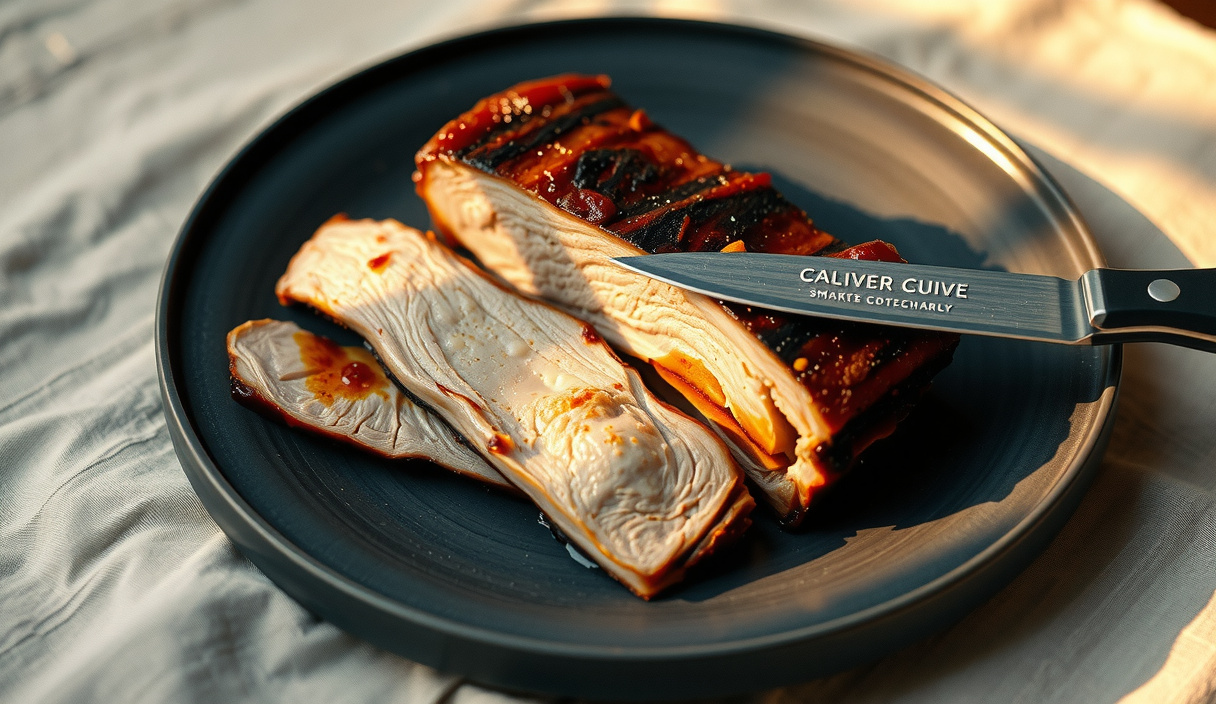
Sous Vide Smoked Pork Belly — 48-Hour

Pork belly processed at 158°F for 48 hours converts collagen fully to gelatin, then cold-smoked at 90°F for 4 hours to layer clean apple wood flavor without a degree of additional cooking, then seared hard to order. Three techniques, each running on its own thermal logic, producing a result that no single method can match.
Equipment
- 1 Immersion circulator Must hold ±0.2°F accuracy; 1000W or higher recommended
- 1 Sous vide container or large stock pot Minimum 12-quart capacity; cover with plastic wrap or lid to reduce evaporation over 48 hours
- 1 Vacuum sealer and bags Chamber sealer preferred for fatty cuts; clamp-style works if belly surface is frozen 30 min beforehand
- 1 Cold smoker or offset smoker with cold-smoking capability Target 85–95°F ambient in smoking chamber; Smoke Daddy generator on a covered grill works well
- 1 Apple wood chips or chunks Enough for 4 hours of sustained smolder; soak chips 30 min in water for slower burn
- 2 Probe thermometers One for smoke chamber ambient, one for belly internal temperature
- 1 Large cambro or stock pot for ice bath Must hold the bagged belly submerged in ice water
- 1 Cast iron skillet or carbon steel pan 12-inch minimum; must sustain very high heat without warping
- 1 Grill press or second heavy pan For maintaining fat-cap contact during the sear
- 1 Wire rack set over sheet pan For air-drying belly and resting after sear
Ingredients
Pork Belly
- 3 lbs skin-off pork belly Bone-free slab; fat cap between 0.75 and 1.25 inches thick; skin-on works if you want crackle — score skin in a crosshatch pattern before sealing
Dry Rub
- 1.5 tsp kosher salt Diamond Crystal; if using Morton's reduce to 1 tsp
- 1 tsp coarsely ground black pepper Fresh-cracked preferred; provides Maillard substrate during the sear
- 1 tsp dark brown sugar Provides reducing sugars for rapid surface browning during the sear without sweetening the meat noticeably
- 0.5 tsp smoked paprika Adds baseline redness and pre-smoke color; optional but improves visual bark development
- 0.25 tsp garlic powder
For Searing
- 1 tbsp neutral high-smoke-point oil Avocado oil or refined sunflower oil; smoke point above 450°F required
Optional Glaze (for service)
- 2 tbsp soy sauce
- 1 tbsp honey
- 1 tsp rice vinegar Adds acid balance to the glaze; optional

Instructions
Day 1: Rub and Seal
- Combine kosher salt, black pepper, dark brown sugar, smoked paprika, and garlic powder in a small bowl. Pat the pork belly completely dry with paper towels — moisture on the surface dilutes the rub and impedes Maillard development during the eventual sear. Apply the rub to all surfaces of the belly, pressing firmly so it adheres. Do not be timid; the rub needs to survive 48 hours in a water bath and still contribute flavor.1 tsp coarsely ground black pepper, 1 tsp dark brown sugar, 0.5 tsp smoked paprika, 0.25 tsp garlic powder
- Vacuum seal the rubbed belly in a single layer. If using a clamp-style sealer, ensure the belly is cold (freeze 30 minutes first) so surface fat does not migrate into the sealing channel. The bag should be sealed completely with zero air pockets — trapped air creates an insulating barrier that prevents accurate temperature transfer from the water to the meat.
- Set your immersion circulator to 158°F (70°C). Allow the bath to come to full temperature before submerging the sealed belly. Clip the bag to the side of the container to keep it fully submerged and away from the circulator intake. Cover the vessel tightly to prevent evaporation — significant water loss over 48 hours can expose the bag. Start the timer: 48 hours.
Day 3: Ice Bath and Pellicle Development
- After 48 hours, remove the bag from the bath. Transfer immediately to an ice-water bath — a large container filled with equal parts ice and cold water. The belly must drop from 158°F to below 40°F within 2 hours. This is not optional; it is the food safety step that prevents clostridium growth in the anaerobic bag. Stir the ice bath periodically and add more ice if needed. A 3-pound belly typically chills to below 40°F internal temperature in 45 to 60 minutes.
- Once chilled, remove the belly from the bag. Reserve any accumulated bag liquid — it is pure pork gelatin and collagen, intensely savory, and can be reduced and used as a sauce base. Pat the belly completely dry on all surfaces with paper towels. For optimal smoke adhesion, place the belly uncovered on a wire rack over a sheet pan and refrigerate uncovered for 1 to 2 hours. This air-drying step forms the pellicle — a dry, tacky, slightly tacky protein surface that accepts smoke cleanly without generating bitter creosote. Do not skip this if you have the time.
Cold Smoking (4 Hours at 85–95°F)
- Prepare your cold-smoking setup and stabilize the ambient temperature inside the smoking chamber between 85°F and 95°F (29–35°C). Place a probe thermometer in the chamber ambient and a second probe in the thickest part of the belly. Begin smoldering your apple wood chips — you want a slow, sustained smolder producing thin blue-white smoke, not thick white billowing smoke. Thick white smoke indicates incomplete combustion and will produce bitter, harsh deposits on the meat surface.
- Place the belly on the smoking grate with at least 2 inches of clearance on all sides. Cold-smoke for 4 hours, maintaining the chamber between 85°F and 95°F throughout. The belly's internal temperature should not rise more than 5°F above its starting temperature. If the chamber temperature spikes above 100°F, open vents, reduce fuel, or place a tray of ice in the chamber as a thermal buffer. After 4 hours, remove the belly. It will be deeply colored — mahogany to amber — and the surface will feel dry and tacky with smoke deposits.
- Refrigerate the smoked belly uncovered on a rack for at least 30 minutes before searing. This firms the exterior slightly and ensures the cold interior will not carry over from sear heat into an overcooked state. The belly can be held refrigerated at this stage for up to 24 hours before the final sear.
Sear and Serve
- Heat your cast iron skillet over high heat for a full 3 to 4 minutes until the pan is smoking. Add 1 tablespoon of neutral oil and swirl to coat. The oil should immediately begin to shimmer and just begin to smoke.1 tbsp neutral high-smoke-point oil
- Place the belly fat-cap side down into the hot pan. Press firmly with a grill press or a second heavy pan immediately — the fat cap will try to arch away from the hot surface in the first 30 seconds. Apply steady downward pressure for the first 60 to 90 seconds. You will hear violent sizzling and see smoke — this is correct. The fat cap needs to be in contact with the pan to render and blister. Sear fat-cap side for 2 to 3 minutes until deeply golden and beginning to crackle. The surface Maillard reaction is converting the brown sugar, amino acids from the rub, and smoke-deposited carbonyls into hundreds of aromatic compounds simultaneously.1 tbsp neutral high-smoke-point oil
- Flip and sear the meat side for 1 to 2 minutes, then the short sides for 30 seconds each. The total sear should not exceed 6 to 7 minutes — the interior is already cooked and gelatinized at 158°F; the sear is purely about surface transformation and temperature contrast. Remove from the pan and rest on a wire rack for 5 minutes uncovered.
- Optional glaze: While the belly rests, combine soy sauce, honey, and rice vinegar in the hot pan. Stir over medium heat for 60 seconds until the mixture thickens to a syrupy consistency. Brush over the rested belly just before slicing for a lacquered finish.2 tbsp soy sauce, 1 tbsp honey, 1 tsp rice vinegar
- Slice the belly against the grain into portions 0.5 to 0.75 inches thick using a long, sharp slicing knife. Each slice should reveal distinct alternating layers of translucent, trembling gelatin-set fat and deeply mahogany muscle. Serve immediately — pork belly at its peak is hot, with the fat still silky and the crust still cracking under the knife.
Notes
Why 158°F and not 145°F or 165°F? At 145°F, collagen hydrolysis into gelatin is thermodynamically possible but extremely slow — even 48 hours produces incomplete conversion and you end up with pork belly that is cooked and safe but still has tough, chewy connective tissue bands. At 165°F, actin denatures rapidly and the muscle fibers contract violently, expelling bound water and producing a mealy, dry texture despite the surrounding fat. 158°F is the calculated position in the rate curve where collagen hydrolysis runs at a practical speed while actin remains structurally intact. The result is a gel-like yielding texture that no other temperature achieves.
Why does the collagen conversion take 48 hours at this temperature? Collagen-to-gelatin hydrolysis follows first-order kinetics. At lower temperatures, the reaction half-life is extremely long. At 158°F, the reaction accelerates significantly, but the triple-helix structure of porcine type-I and type-III collagen is thermodynamically stable enough to require sustained thermal exposure over many hours to achieve near-complete hydrolysis. The 48-hour time integral is not arbitrary — it represents the minimum cumulative thermal load required for the collagen concentration present in pork belly connective tissue to convert meaningfully.
What is actually happening during cold smoking? Smoke from smoldering apple wood is a complex aerosol containing phenols (guaiacol, 4-methylguaiacol, syringol), carbonyls (acetaldehyde, diacetyl, furfural), and organic acids (acetic acid, formic acid). At 90°F, none of these compounds are causing any cooking — protein denaturation does not begin until above 104°F for the most labile fractions. What is happening is pure surface adsorption. The slightly tacky, low-water-activity surface of the chilled belly acts as a capture medium. The phenolic compounds are antimicrobial and antioxidant; the carbonyls contribute to the eventual Maillard browning during the sear; the organic acids shift the surface pH slightly, improving bark color development. This is why the cold-smoke step produces a cleaner, more precise smoke flavor than hot smoking — there is no competing protein denaturation or fat rendering occurring to muddy the aromatic signal.
The bag liquid after sous vide is a culinary asset: The liquid that accumulates in the bag during 48 hours at 158°F is a concentrated pork gelatin extract — essentially a ready-made glaze base. It contains solubilized collagen peptides, rendered fat, and water-soluble flavor compounds from the rub. Skim the fat layer, reduce the liquid in a small saucepan until it coats a spoon, adjust seasoning, and brush over the sliced belly at service. It will set to a glossy, intensely savory coating that no store-bought glaze can match.
Nutrition
Calories: 520kcalCarbohydrates: 3gProtein: 22gFat: 46gSaturated Fat: 17gCholesterol: 110mgSodium: 610mgSugar: 2g
Tried this recipe?Let us know how it was!