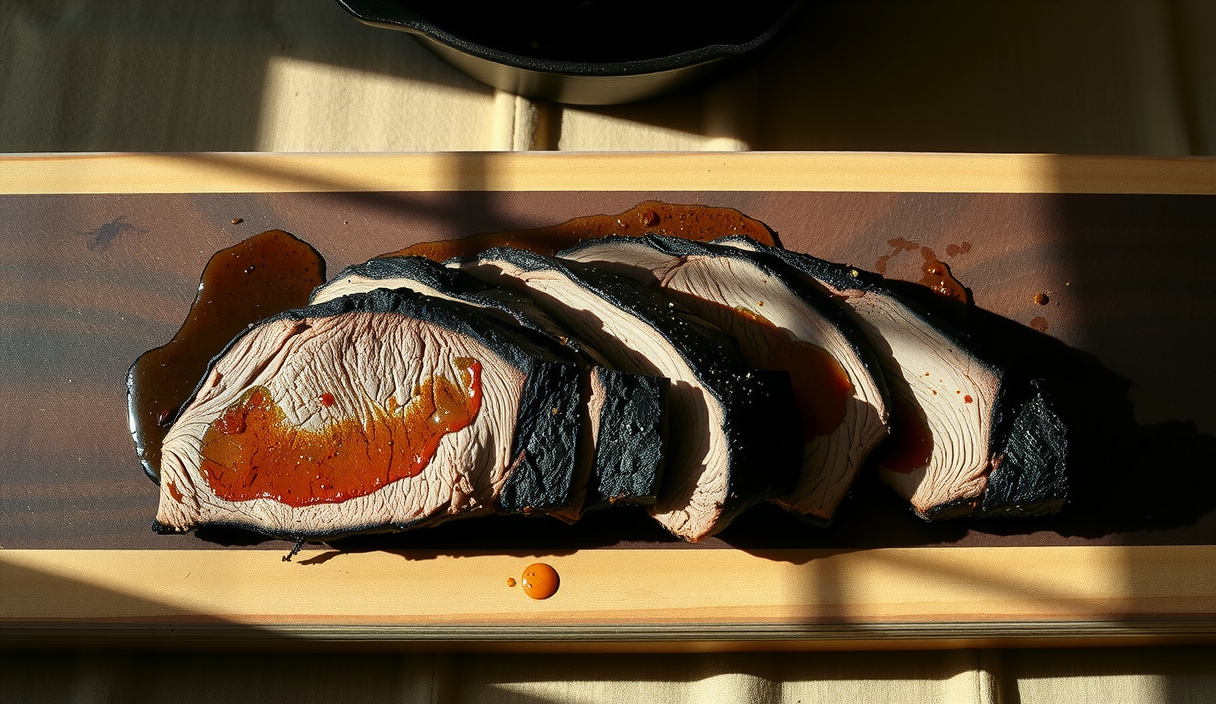
Sous Vide Then Seared Brisket Flat
A brisket flat cooked at exactly 155°F for 30 hours converts its dense collagen network into rich gelatin while staying below the actin-collapse threshold that dries out lean cuts. A screaming-hot cast-iron sear after the bath builds the dark, crackling bark that sous vide alone can never produce. This is the technique that makes the unforgiving flat as satisfying as the point.
Equipment
- 1 Immersion circulator Must hold ±0.2°F at 155°F; a PID-controlled unit is strongly preferred
- 1 Large sous vide container or stock pot Minimum 12-quart capacity to maintain stable water temperature over 30 hours
- 1 Vacuum sealer with heavy-duty bags Bags must be rated for extended high-temperature exposure; avoid zip-lock bags for 30-hour cooks
- 1 Cast-iron skillet or carbon-steel plancha Preheat in a 500°F oven for 30 minutes, then finish on a high-BTU burner; the goal is 600°F+ surface temperature
- 1 Instant-read thermometer To verify core temperature before searing and confirm the ice bath drops the bag below 41°F if cooking ahead
- 1 Wire rack set over a sheet pan For the pre-sear surface-drying step in a 170°F oven
Ingredients
Brisket
- 1 beef brisket flat 4 to 6 lb, USDA Choice or Prime, quarter-inch fat cap left intact on one side
Dry rub
- 2 tablespoons kosher salt Diamond Crystal; if using Morton reduce by 25% due to higher density
- 2 tablespoons coarse black pepper 16-mesh or freshly cracked — the larger grind holds its texture through the bath and contributes to bark structure
- 1 teaspoon granulated garlic Apply only immediately before the sear, not before the bath — decomposes poorly in a 30-hour hot anaerobic environment
- 1 teaspoon smoked paprika Apply only immediately before the sear, same reasoning as granulated garlic
For searing
- 1 tablespoon avocado oil or refined sunflower oil High smoke point (480°F+) essential; extra-virgin olive oil will smoke and burn before the surface reaches target browning temperature
Pan sauce (optional, from bag drippings)
- reserved bag liquid (all of it) Collagen-rich gelatin and rendered fat — reduce by 60% in a saucepan over medium-high heat; no additional thickener needed
- 1 teaspoon apple cider vinegar Optional — a small amount of acidity brightens the reduced gelatin pan sauce
- to taste kosher salt and black pepper Adjust the pan sauce seasoning after reduction since flavors concentrate significantly

Instructions
Dry brine (12–24 hours ahead, strongly recommended)
- Mix the kosher salt and coarse black pepper together in a small bowl. This is the bath rub — reserve the granulated garlic and smoked paprika for right before the sear. Coat all surfaces of the brisket flat generously, pressing the rub into the meat. Place the flat on a wire rack over a sheet pan, uncovered, in the refrigerator for a minimum of 12 hours and up to 24 hours. The salt draws surface moisture out via osmosis, then that brine is reabsorbed back into the muscle fibers, raising ionic strength and modestly increasing water-holding capacity before the cook begins.2 tablespoons coarse black pepper
Sous vide cook
- Set your immersion circulator to 155°F (68.3°C) and allow the water bath to reach temperature fully before proceeding. Do not rush this step — a bath that hasn't stabilized will read target temperature at the probe while the bulk of the water lags behind.
- Vacuum seal the dry-brined brisket flat in a heavy-duty bag. If using a chamber vacuum sealer, seal at maximum vacuum. If using a suction-style unit, seal until the bag is tightly conforming to the surface of the meat with no visible air pockets. The elimination of air ensures uniform heat transfer from the water to the meat surface.
- Submerge the sealed bag in the 155°F water bath. Use a rack, binder clips, or a sous vide weight to keep the bag fully submerged and not folded against the container walls, which can create insulated pockets that slow heat penetration. Cook for 30 hours. Check the water level every 8 to 10 hours and top off with hot water if evaporation has lowered it enough to expose any portion of the bag.
- If serving within 2 hours: Remove the bag from the bath and proceed directly to the surface-drying step. If cooking ahead: Transfer the bag immediately to an ice-water bath (50% ice, 50% cold water) large enough to fully submerge it. Stir the ice bath every 5 minutes. The bag must reach below 41°F within 2 hours — verify with a thermometer probe through the bag. Once chilled, refrigerate for up to 5 days. Reheat in a 140°F water bath for 45 minutes before proceeding to the sear.
Pre-sear surface drying
- Remove the brisket flat from the bag. Pour all bag liquid into a small saucepan and set aside — do not discard it. Pat the surface of the brisket aggressively dry with paper towels on all sides. Then place the flat on a wire rack set over a sheet pan and slide it into an oven set to 170°F (its lowest setting) for 15 minutes. This step drives off residual surface moisture, lowering the surface water activity below the evaporative-cooling lock point so the Maillard cascade can begin immediately when the flat hits the hot pan.reserved bag liquid (all of it)
- Remove the flat from the oven. Immediately dust all surfaces with the granulated garlic and smoked paprika. Apply evenly and press lightly so the spices adhere without clumping.1 teaspoon granulated garlic, 1 teaspoon smoked paprika
High-heat sear
- Place your cast-iron skillet or carbon-steel plancha in a 500°F oven for 30 minutes. Transfer it directly to your highest-BTU burner and preheat on high for an additional 3 to 5 minutes. The pan surface should be well above 500°F — a drop of water should vaporize in under one second with violent spattering. Good ventilation and a powerful exhaust fan are mandatory at this temperature.
- Add the avocado or refined sunflower oil to the ripping-hot pan — it should shimmer and smoke almost immediately. Place the brisket flat in the pan fat-cap side down first. Press it firmly into full contact with the surface using a heavy spatula or grill press. Sear without moving for 60 to 90 seconds until a deeply mahogany-brown bark has formed. Flip and repeat on all remaining surfaces: the two long sides, then each short end. Total sear time from first contact to last surface should be no more than 6 to 8 minutes. You are building bark, not cooking — the interior is already done.1 tablespoon avocado oil or refined sunflower oil
Rest, slice, and sauce
- Transfer the seared brisket to a clean cutting board and tent loosely with aluminum foil. Rest for 10 minutes. Do not skip this — even at 155°F a brief rest allows the gelatin phase to redistribute and the bark to set its texture fully.
- While the brisket rests, make the pan sauce. Pour the reserved bag liquid into the saucepan and bring to a vigorous simmer over medium-high heat. Reduce by 60% — approximately 10 to 12 minutes — until the sauce coats a spoon and has a glossy, slightly viscous consistency from the dissolved gelatin. Add the apple cider vinegar, taste, and adjust salt and pepper.reserved bag liquid (all of it), 1 teaspoon apple cider vinegar, to taste kosher salt and black pepper
- Identify the grain direction of the brisket flat — the muscle fibers run longitudinally along the length of the cut. Slice perpendicular to the grain (crosswise) in slices approximately 3/8 inch thick. This shorten the muscle fibers in every bite and is the single most impactful mechanical step you can take for tenderness perception. Serve immediately with the pan sauce spooned over the top or served alongside for dipping.
Notes
Why 155°F and not lower? At 145°F, collagen hydrolysis in a brisket flat's dense type I collagen matrix proceeds slowly enough that 30 hours may not achieve complete conversion — especially in the geometric center of a thick flat. At 155°F you sit in the collagen-shrinkage and hydrolysis zone (active above approximately 140°F) with kinetics fast enough to fully convert the flat's cross-linked network within the 30-hour window, while still holding 8°F of thermal buffer below the 163°F actin-denaturation onset. That 8°F gap is everything: actin collapse is irreversible and causes catastrophic water-holding capacity loss.
Why the gelatin phase matters: Collagen hydrolysis converts tough intramuscular collagen cross-links into soluble gelatin — a disordered network of denatured tropocollagen strands. In the finished brisket, this gelatin phase migrates into the interstitial spaces between muscle fibers, physically lubricating the denatured myosin and actin strands. The result is a tactile experience of tenderness and richness even in a lean cut that has virtually no intramuscular fat compared to the point. This is the same mechanism operating in traditional overnight-smoked brisket, but compacted and rendered reproducible by precise temperature control.
Surface moisture and Maillard kinetics: The Maillard reaction requires the amino-carbonyl browning cascade to begin, which demands surface temperatures above approximately 285°F. As long as free water is present on the surface, evaporative phase change absorbs all applied energy and anchors the boundary layer at 212°F. The oven-drying step after patting dry drops the surface water activity below the evaporative-cooling lock, allowing the surface temperature to spike past the Maillard activation threshold within the first seconds of contact with a 600°F pan.
Pasteurization note: The USDA 6.5-log reduction in Salmonella in whole-muscle beef is achieved at 155°F within approximately 50 minutes of reaching that temperature. After 30 hours at 155°F the brisket flat is thoroughly pasteurized. If held in reduced-oxygen packaging after the cook, strict chilling protocols (below 41°F within 2 hours) are mandatory to prevent Clostridium botulinum spore germination, which can occur between 38°F and 118°F under anaerobic conditions.
Nutrition
Calories: 420kcalCarbohydrates: 1gProtein: 48gFat: 24gSaturated Fat: 9gCholesterol: 145mgSodium: 680mg
Tried this recipe?Let us know how it was!