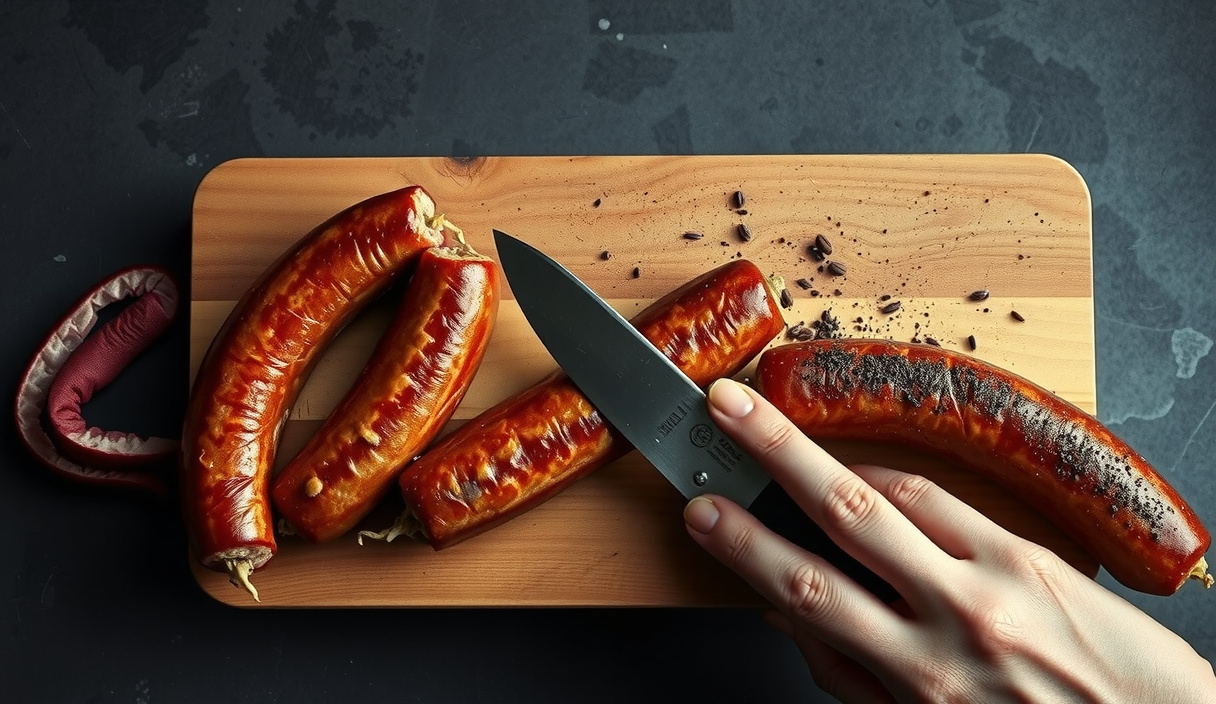
Texas-Style Hot Guts Sausage

Coarse-ground beef and pork cured with pink salt, seasoned with paprika and garlic, stuffed into hog casings, and smoked at 200°F over post oak until an internal temperature of 152°F. The result is the classic Central Texas sausage — mahogany bark, snapping casing, and fat-basted interior that has defined meat-market culture from Elgin to Lockhart.
Equipment
- 1 Meat grinder with 3/8-inch (9.5mm) grinding plate Chill all metal parts in the freezer 30 minutes before use
- 1 Sausage stuffer with 3/4-inch horn 5-lb vertical stuffer recommended; grinder attachment is a workable substitute
- 1 Offset smoker or ceramic kamado Must hold a stable 200–225°F; water pan helps stabilize temperature
- 4 to 6 Post oak or pecan wood chunks Fist-sized chunks; avoid mesquite for extended low-temp smokes
- 1 Instant-read thermometer Calibrated to within 2°F; verify with ice water bath before use
- 1 Large mixing bowl Set over ice bath during mixing to keep meat cold
- 1 Kitchen scale Gram-accurate scale required for precise cure calculation
- 1 Wire cooling rack For pellicle drying and post-smoke resting
Ingredients
Meat Mixture
- 2.5 lbs beef chuck, 80/20 lean-to-fat Cut into 1-inch cubes; chill to 34°F before grinding
- 1 lb pork shoulder (Boston butt) Cut into 1-inch cubes; chill to 34°F before grinding
- 0.5 lb pork back fat Cut into 1-inch cubes; freeze 20 minutes until firm but not rock-hard
Cure and Seasoning
- 10 grams Prague Powder #1 (pink curing salt, 6.25% sodium nitrite) Exactly 0.25% of total 4 lb meat weight by grams — do not estimate
- 28 grams kosher salt Approximately 1.75% of total meat weight; Diamond Crystal preferred
- 2 tablespoons smoked paprika Spanish pimentón de la Vera adds depth; sweet Hungarian is a milder substitute
- 1 tablespoon coarse-ground black pepper 16-mesh cracked; visible flecks in the finished link
- 1 tablespoon granulated garlic Not garlic powder; granulated hydrates more evenly through the coarse grind
- 1 teaspoon cayenne pepper Adjust to preference; this level delivers mild background heat, not frontal fire
- 1 teaspoon dry mustard powder Adds mild sulfurous depth and acts as a secondary emulsifying surfactant
- 0.25 cup ice water Keeps the mixture cold during binding; add 1 tablespoon at a time
Casings
- 4 feet natural hog casings, 32–35mm Salt-packed; soak in cold water 30 minutes, flush interior, keep in fresh cold water until use

Instructions
Grind and Mix
- Place your grinder head, grinding plate (3/8-inch), and die in the freezer for 30 minutes. Meanwhile, cut the beef chuck, pork shoulder, and pork back fat into 1-inch cubes. Spread on a sheet pan and refrigerate until the meat reaches 34–36°F and fat pieces are firm at the edges but not frozen through, about 20 minutes.1 lb pork shoulder (Boston butt), 0.5 lb pork back fat
- In a small bowl, combine the Prague Powder #1, kosher salt, smoked paprika, black pepper, granulated garlic, cayenne, and dry mustard. Whisk thoroughly so the cure is evenly distributed through the spice blend — uneven cure distribution creates pockets without nitrite protection.10 grams Prague Powder #1 (pink curing salt, 6.25% sodium nitrite), 28 grams kosher salt, 2 tablespoons smoked paprika, 1 tablespoon coarse-ground black pepper, 1 tablespoon granulated garlic, 1 teaspoon cayenne pepper, 1 teaspoon dry mustard powder
- Grind the cold meat and fat mixture once through the chilled 3/8-inch plate into a large bowl set over an ice bath. Work quickly. If the grinder starts struggling or the fat begins to smear rather than cut cleanly, the meat is warming — stop and re-chill everything for 15 minutes before continuing.1 lb pork shoulder (Boston butt), 0.5 lb pork back fat
- Sprinkle the combined cure and spice mixture evenly over the ground meat. Add the ice water one tablespoon at a time. Mix by hand or with the paddle attachment of a stand mixer on low speed for 90 seconds, until the mixture becomes slightly tacky and the proteins begin to bind — the mix will pull away from the bowl in a cohesive mass. Do not overmix past 2 minutes; fat smearing risks rise sharply with time and temperature.10 grams Prague Powder #1 (pink curing salt, 6.25% sodium nitrite), 28 grams kosher salt, 2 tablespoons smoked paprika, 1 tablespoon coarse-ground black pepper, 1 tablespoon granulated garlic, 1 teaspoon cayenne pepper, 1 teaspoon dry mustard powder, 0.25 cup ice water
- Fry off a small test patty in a dry skillet over medium heat until cooked through. Taste for salt and seasoning balance. Adjust the remaining uncooked mixture if needed, remembering that smoke will add additional salt-adjacent flavor during cooking. Re-chill the bulk mixture to 36°F before stuffing.
Stuff the Casings
- Drain the soaked hog casings and flush by running cold water through the interior of each length. Thread one end onto the 3/4-inch stuffing horn, gathering the casing onto the horn like a gathered sleeve, leaving 3 inches hanging free at the end. Tie a simple overhand knot in the hanging end.4 feet natural hog casings, 32–35mm
- Load the cold meat mixture into the stuffer cylinder and crank slowly to purge air until meat appears at the tip of the horn. Begin feeding the casing: hold the casing with light finger pressure against the horn, allowing it to fill steadily without stretching taut. Target 80% fill — the casing should feel firm but yield slightly when pressed with a finger. Overfilling is the single most common cause of casing blowout during smoking.4 feet natural hog casings, 32–35mm
- When the casing is filled, leave 3 inches of unfilled casing at the end and tie off with an overhand knot. To link: pinch the rope of sausage at 6-inch intervals and twist each link 3–4 full rotations in alternating directions (clockwise, then counterclockwise) to lock the links and prevent unraveling.
- Use a sterilized pin or sausage pricker to prick any visible air pockets — small bubbles visible under the casing. Prick at a shallow angle to release the air without tearing the casing wall. Air pockets expand during smoking and create burned, thin spots in the bark.
Pellicle Dry
- Hang the linked sausages on a wire rack or dowel rod and place them uncovered in the refrigerator for a minimum of 1 hour, or up to overnight. You are drying the casing surface to form a pellicle — a tacky, protein-rich skin that smoke compounds bond to efficiently. A wet casing repels smoke and produces a sour, creosote-tinged flavor. The links are ready when the casing surface feels dry and slightly tacky to a light touch.
Smoke
- Fire your smoker and stabilize at 200°F measured at grate level. Add 2 fist-sized chunks of post oak or pecan directly to the coals or firebox. A water pan placed between the fire and the cooking grate adds humidity that slows casing dehydration in the early stage of the cook and helps the smoke color develop evenly.
- Arrange the links on the grate with at least 1 inch of space between each one — touching links prevent airflow and create uneven bark. Insert a leave-in probe thermometer into the center of the thickest link. Close the smoker and maintain 200–210°F. Replenish wood as needed to maintain visible thin blue smoke; thick white smoke deposits bitter phenolics on the casing surface.
- Smoke the links until the internal temperature reads 152°F on your instant-read thermometer, approximately 3 to 3.5 hours at 200°F smoker temperature. Verify with a second spot-check of two or three links — the thinnest link will finish first. The casing should be mahogany to deep amber, firm and dry to the touch, and pull away slightly from the meat at the tie ends.
- Remove the links from the smoker and transfer to a clean wire rack. Rest uncovered at room temperature for 10–15 minutes. Do not cover or wrap — steam trapped under foil will soften the bark and prevent the casing from completing its retraction snap. The internal temperature will coast up 3–5°F during the rest; this is accounted for in the 152°F pull point.
Serve
- Serve links whole, cut on the bias into thick slices, or halved lengthwise. Central Texas tradition calls for butcher paper, saltine crackers, sliced onion, and pickled jalapeños alongside. The snap test: bend a link sharply — a proper hot guts link audibly snaps at the casing without splitting the meat. If it bends silently, the casing was under-dried or the smoker temperature spiked too early, preventing the full retraction mechanism from completing.
Notes
Why 0.25% Prague Powder #1 by weight? Sodium nitrite in Prague Powder #1 is diluted to 6.25% in a salt carrier, so 10 grams of Prague Powder #1 per 4 lbs (1814g) of meat delivers approximately 0.625 grams of actual sodium nitrite — within the USDA-regulated range of 156 ppm for cured sausage products. This concentration inhibits Clostridium botulinum spore germination in the anaerobic environment inside the casing and reacts with myoglobin to create the characteristic heat-stable pink interior. Do not exceed this ratio; excess nitrite does not improve safety and leaves a metallic off-note.
The fat smearing failure mode: When fat exceeds approximately 45°F during grinding or mixing, the adipose cell walls rupture and free oil coats the protein matrix. This cannot be reversed. The result is a greasy, dense sausage with poor smoke adhesion and a texture closer to a hot dog than a coarse-ground link. Keeping everything at or below 38°F is the single most important technique variable in sausage-making.
Protein denaturation sequence and the 152°F target: Myosin, the primary structural protein in muscle, denatures between 104°F and 120°F — this is what creates the initial gel structure that binds the sausage. Collagen in the casing begins hydrolysis toward gelatin above 130°F, which is what enables the retraction snap on cool-down. Actin, the secondary myofibrillar protein, denatures catastrophically at 163–167°F, destroying water-holding capacity and producing a chalky, dry interior. Pulling at 152°F keeps the sausage well above the USDA minimum safe temperature of 160°F (verified as safe via pathogen reduction time-temperature tables for cured products at 152°F with a 47-minute hold, though the cool-down handles this) while preserving succulence below the actin threshold.
Pellicle and smoke adhesion chemistry: Smoke contains phenols, carbonyls, and organic acids that deposit on the casing surface and undergo polymerization reactions to form the bark. These reactions require a dry, protein-rich surface — water at the surface repels the lipophilic smoke compounds and causes them to condense as acrid creosote instead of bonding as flavor-active melanoidins. The 1-hour minimum drying time in the refrigerator is not optional; it is the rate-limiting step for bark quality.
Nitrosomyoglobin and the permanent pink interior: At 152°F, the nitrosomyoglobin pigment formed during curing denatures to nitrosohemochrome, a thermally stable compound that does not re-oxidize to the gray metmyoglobin of an uncured cooked protein. This is why a properly cured sausage remains pink at temperatures that would turn uncured pork gray. If your sausage is gray at 152°F, the cure was not properly distributed — this is a mixing failure, not a food safety failure at verified temperature, but it indicates poor technique.
Nutrition
Calories: 320kcalCarbohydrates: 2gProtein: 22gFat: 25gSaturated Fat: 9gCholesterol: 80mgSodium: 720mg
Tried this recipe?Let us know how it was!